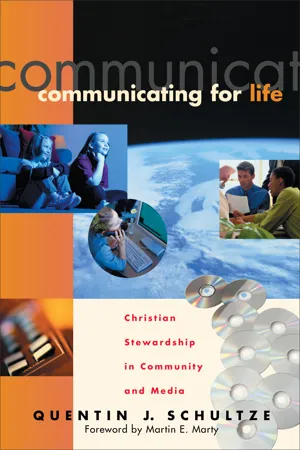
- 192 pages
- English
- ePUB (mobile friendly)
- Available on iOS & Android
eBook - ePub
Information
ONE
Symbolic Stewardship
The Meaning and Purpose
of Human Communication
of Human Communication
Wetlands ecologist Calvin DeWitt stopped his car one night along a busy section of interstate highway in northern Indiana in order to read aloud Psalm 19: “The heavens declare the glory of God” (v. 1). DeWitt recalls that he “looked up into the night sky and couldn’t see any stars because of all the lights and pollution. The noise of traffic was deafening. Semitrailers slammed by, literally sucking at my car. The psalm made no sense at all there. I thought, ‘Here is a community that has deprived itself of nature’s testimony.’”[1]
Determined not to let a similar thing happen in his own community, DeWitt ran for office and spoke passionately with residents about the importance of ecological planning. At town meetings he listened to the residents’ concerns and hopes. He encouraged the community to publish a study of its natural resources so residents would know their own habitat. DeWitt helped the town develop an ecological plan to protect and enhance the local environment. “Cal is so amazing,” said one resident, “how he could have a room full of hostile people, and he could calm the crowd. He would let them talk, would really try to understand them. Then he would start explaining his side. He would just calm things down. He always listens to people.”[2]
DeWitt’s effectiveness depended on his ability to communicate well. He first listened because he respected his neighbors’ opinions. He then communicated awe and wonder, built trust, sought the truth, and encouraged consensus. In the process, DeWitt cocreated community.[3] Using his God-given rhetorical gifts, DeWitt helped his neighbors to live harmoniously with the physical world and with each other. He became known as a caretaker of creation, a servant of his community, and an agent of grace.
DeWitt’s communication demonstrates that our talking and listening can be rooted in death or in life. He could have promoted ecological irresponsibility by pushing for projects that would have polluted the water and destroyed the natural beauty of the area. Instead he called for environmental stewardship. In every situation, our words help or hurt people, nurture or destroy community. “Are we cynical,” asks one Christian scholar, “measuring the talk of others according to the waste of limited resources, or are we charitable, looking with grace upon the efforts of others?”[4] Our communication is a two-edged sword.
In this chapter, I charge into the spiritual thicket of human communication. I ask why people communicate—and why they should communicate. These questions stretch back to our human origins, they complicate our lives today, and they reach forward to the ideal community that God intends for us to savor. Our language is more than a tool for communicating; it is the “home in which human beings live.”[5]
First, I examine how God’s gift of communication enables us to cocreate cultures, or ways of life. Our cultures include webs of relationships in everything from business to entertainment. For example, DeWitt communicated with neighbors to foster the ecological aspect of culture. He persuasively offered his town a vision of harmony between people and nature.
Second, I suggest that God created us all to be stewards of creation who use the gift of communication to care for the world. Every person on earth is meant to be a caretaker of God’s creation, but God holds us accountable for the kind of culture we cocreate. Our Creator expects us to cocreate culture that reflects our role as servants of God and of our neighbors. Every human being is made in the image of God and is our neighbor. DeWitt realized that his ability to persuade and educate his geographic neighbors was God’s gift to him to use for serving others. Like DeWitt, we need to recognize that we are symbol-using stewards of God’s world.
Third, I turn to how communication enables us to cocreate life-giving community. When we see little or no place for God, our communication will foster broken communities of fear, hatred, and oppression. But when God is the center of our communication, we are more likely to cocreate peaceful and justice-loving communities of shalom. When we are connected to God, our language is the “marrow” of community life.[6]
Finally, I suggest that our Creator wants us to become God-listening communicators. Ultimately, the quality of our community life and interpersonal relationships depends on how well we listen to God’s discourse. When DeWitt stopped his car along the highway to recite Psalm 19, he communicated obediently. Moreover, obedience may have been the most important aspect of his rhetorical skill for cocreating with neighbors the ecological future of their community. Our ability to communicate for shalom is a kind of sacred covenant with God. We have to listen to God in order to faithfully establish communities of shalom. Otherwise we tend to create a self-destructive culture of death.
Cocreating Culture
Chinese writer Zhang Jieying has become a thorn in the side of China’s traditionalists and a beacon of freedom for many young readers. In her book Absolute Privacy, Ms. Zhang interviews citizens about intimate topics such as broken marriages, premarital sex, and childlessness—all subjects that are taboo for public discussion in China. As her words slice through traditional social norms, Zhang has become both a hero and a rebel. Her journalistic colleagues shun and criticize her, while lovelorn readers celebrate her courage to address formerly unmentionable subjects.[7] For good or for bad, she has helped to usher new ways of life into China.
God gives us the gift of communication so that we can actively cocreate our culture, our whole way of life.[8] When we communicate, we expand God’s original creation by making and sharing our ways of life. Like craftspersons and traders at international ports, we exchange culture through communication of all kinds. Of course, we do not invent all of our culture ourselves. We inherit most of it from previous generations. Then we shape it and share it with others.
The word communication comes from the Latin communis, which means to share, to make common, or even to have “possession of a common faith.”[9] When we communicate, we create, maintain, and change shared ways of life. Communication enables us to cultivate education, engineering, business, the media, and every other aspect of human culture. Together we design and construct buildings, fall in love, establish households, and perform music. Perhaps this ability is part of what Scripture refers to as the imago Dei (image of God) in us (Gen. 1:26–27).
Every time we communicate, we creatively exercise God’s gifts by contributing good or bad pieces of culture to the world. We mimic the Creator, fashioning in our own image the kinds of culture that we desire. Our communication becomes “a faithful index of the state of our souls.”[10] Zhang’s columns invariably reflect her own vision of what Chinese culture should be like. That is why some readers celebrate her new cultural vision for China while traditionalists condemn or ignore her.
In the broadest sense, culture is everything that exists on earth because of human effort. God created the world but then turned it over to human beings to cultivate it. From this perspective, culture includes our values (what we believe), our practices (what we do), and our artifacts (the physical things that we make).
At the heart of all of this humanly created culture is a system of meaning—what people think and believe. Adolescents’ dating practices, for example, convey a particular meaning, namely, what it means to date someone. At one Midwestern Christian college the system of meaning defines dating as a prelude to marriage. If you date the same person more than once or twice, the rest of the campus considers you virtually engaged (values), and no one else expresses an interest in dating you. The meaning within the system of dating on that campus also shapes where people go on dates (practices) and what types of clothing they wear on dates (artifacts). Even who pays for the date (another practice) can reveal much about the meaning of gender roles and expectations (values).[11] Everything we do with other human beings—all of our social practices—is grounded in cultural ideals, attitudes, and assumptions.
But what people believe about the world around them may not reflect the way the world actually operates. In other words, a particular cultural system can be out of sync with social realities. Nevertheless, our systems of meaning are always grounded in society—the social structures and economics of everyday life. No matter what college students believe about dating, they will somehow have to pay for the dates, select from among available places to go, observe campus regulations about off-campus activities, and probably even follow some socially prescribed dating rituals. Similarly, a television network might profess to distribute family-oriented programs, but somehow it has to pay for the programs, generate a large enough audience to attract adequate advertising revenue, and even obey various governmental regulations for program content. Zhang depends on China’s laws, economy, technology, and transportation system in order to finance, print, and distribute her work. We cannot just create our own personal beliefs and values if we intend to get along with others in society.
In a narrower sense, then, culture is only a people’s system of meaning, whereas society comprises the rules, regulations, and social structures with which we live. Culture is especially what we carry around in our heads and hearts, the everyday meaning of our lives. Society, on the other hand, consists only of the external political and economic structures that set limits on what we can do. Clearly human beings create both culture (in this narrow sense) and society through the process of communication. Communication enables us to cocreate with others both our systems of meaning (culture) and systems for conveying meaning (society).[12]
For the sake of this book, I will use the term culture broadly to refer to both culture and society—to all human values, practices, and artifacts, and to the context within which these values, practices, and artifacts operate. Without the ability to communicate, human beings would be unable to cocreate any area of culture, from music to architecture to education.
We are marvelously made creatures who imitate God’s own creative ability to cultivate creation. Before we get too carried away about our own communication ability, however, we should contrast it with God’s ability. Scripture says that God “spoke” this world out of nothing (ex nihilo) (see Genesis 1). Unlike God, we do not create words or images out of nothing. Instead, we conceive new words by combining existing sounds or existing words. We can cocreate a language to talk spiritually about the environment—as DeWitt and many others have done,[13] but we cannot create a new language out of nothing. Zhang may have invented a few new words in her column, but she depended overwhelmingly on the existing language to communicate with her readers.
All of our communication seems fragile, limited, and utterly dependent on the shared goodwill of others. Author Richard Foster expresses wonderment that his “squiggles on paper” actually “work in the hearts and minds” of readers.[14] But as a communicator he has the benefit of his culture’s existing words and common meanings. We can communicate only because we already live in a shared culture. By making us cultural creatures, God empowers us to communicate through shared ways of life.
Every culture is cocreated through four types of relationships. First, God is our primary cocreator in communication. When we cocreate culture, we collaborate with God—or God cocreates through us! We commune with God through prayer, through listening to Scripture, through enjoying the created world, and through experiencing Christian community and tradition.[15] In other words, God can speak through all aspects of creation and culture.
Second, we cocreate culture by communicating with our neighbors. Biblically speaking, every person with whom we interact becomes our neighbor. We are a part of economic, political, and religious communities. Schools, for example, provide a means for us to educate our children as neighbors and citizens. Participating in a community means that we agree to cocreate culture with others.
Christian traditions typically offer a rich history of culture and communication that form a common life for a group of neighbors. The books, songs, liturgies, and creeds of a church provide a tradition of how and what to communicate. A tradition is a communal memory that keeps speaking to people as long as they listen together to its voice through books, recordings, holiday celebrations, and other media. We love God partly by loving each other in traditional communities of neighbors (see Matt. 22:37–39).
Third, we cocreate culture by having a dialogue with creation. God initiates some of this dialogue. Martin Luther said, “God writes the gospel not in the Bible alone, but on trees, flowers, clouds and stars.”[16] One novelist suggests that the “earth itself is His handiwork, and my treading on it is communicated through a network so complex that even our mightiest computers can’t begin to estimate its effect.”[17] When DeWitt parked his car along the highway and looked up to the heavens, he heard and saw that people had muffled the glory of God’s creation. The physical world spoke to him, and he responded creatively by awakening the ecological voice of his own community. Physical scientists dialogue with each other and with creation. Hoping to understand creation, they creatively apply the language of science to it, naming new elements and devising theories about how the physical world works.
Communication theory is partly a dialogue with God’s creation. Just as a chemist charts the elements, a communication scholar tries to categorize forms of human interaction and to explain or predict what happens when people communicate. Scholars cocreate theories of communication partly by observing how people use God’s gifts. All communication scholars interact with the creation as well as with each other.
Fourth, we cocreate culture by communicating with ourselves. This is a great mystery. Somehow we introspectively dialogue with our own thoughts, ideas, and feelings. In the process, we think about what others have said to us, or about what we believe God is saying to us, directly or through his creation. Strangely enough, our cultures are partly created when we dialogue with ourselves. For example, we might think to ourselves about what to say to someone before we say it. Also, we might listen thoughtfully to a politician before deciding whether to vote for that person. All of our “external” communication with others takes place in the context of our communication with ourselves.
All four kinds of relationships—with God, with our neighbors, with the created world, and with ourselves—influence culture. God’s gift of communication enables us to fashion incredibly complex combinations of all four types of interaction. Every day we cocreate ways of life shaped by these four relationships. In the process, we act wisely or foolishly as stewards of God’s creation.
Defining Reality under God
Pastor Bill Hybels of Willow Creek Community Church recalls the time that he met with a man who was devoted to shutting down producers of adult entertainment. “You’d be amazed at what people can justify,” the ...
Table of contents
- Cover
- Title Page
- Copyright Page
- Dedication
- Contents
- Foreword by Martin E. Marty
- Acknowledgments
- Introduction: The Case for the Legendary Jesus
- 1. Symbolic Stewardship: The Meaning and Purpose of Human Communication
- 2. Inexplicable Grace: The Mystery of Human Communication
- 3. Cockfights and Demographics: Two Views of Communication
- 4. Symbolic Ambiguity: Limitations of Human Communication
- 5. Slaves to Sin: The Effects of Sin on Communication
- 6. Incarnate Power: The Spiritual Component of Communication
- 7. Symbolic Power: Servant Communication
- 8. Blessing or Curse? The Role of Media
- 9. Prophet, Priest, or Demon? Mass-Media Mythology
- 10. Radical Discipleship: Responsible Communication
- 11. Christian Virtue: Authentic Communication
- 12. Gifted Disciples: Communicators for God
- Notes
- Index
Trusted by 375,005 students
Access to over 1.5 million titles for a fair monthly price.
Study more efficiently using our study tools.
Frequently asked questions
Yes, you can cancel anytime from the Subscription tab in your account settings on the Perlego website. Your subscription will stay active until the end of your current billing period. Learn how to cancel your subscription
No, books cannot be downloaded as external files, such as PDFs, for use outside of Perlego. However, you can download books within the Perlego app for offline reading on mobile or tablet. Learn how to download books offline
Perlego offers two plans: Essential and Complete
- Essential is ideal for learners and professionals who enjoy exploring a wide range of subjects. Access the Essential Library with 800,000+ trusted titles and best-sellers across business, personal growth, and the humanities. Includes unlimited reading time and Standard Read Aloud voice.
- Complete: Perfect for advanced learners and researchers needing full, unrestricted access. Unlock 1.5M+ books across hundreds of subjects, including academic and specialized titles. The Complete Plan also includes advanced features like Premium Read Aloud and Research Assistant.
We are an online textbook subscription service, where you can get access to an entire online library for less than the price of a single book per month. With over 1.5 million books across 990+ topics, we’ve got you covered! Learn about our mission
Look out for the read-aloud symbol on your next book to see if you can listen to it. The read-aloud tool reads text aloud for you, highlighting the text as it is being read. You can pause it, speed it up and slow it down. Learn more about Read Aloud
Yes! You can use the Perlego app on both iOS and Android devices to read anytime, anywhere — even offline. Perfect for commutes or when you’re on the go.
Please note we cannot support devices running on iOS 13 and Android 7 or earlier. Learn more about using the app
Please note we cannot support devices running on iOS 13 and Android 7 or earlier. Learn more about using the app
Yes, you can access Communicating for Life (RenewedMinds) by in PDF and/or ePUB format, as well as other popular books in Languages & Linguistics & Communication Studies. We have over 1.5 million books available in our catalogue for you to explore.