Named a 2014 Jesus Creed Book of the Year (Biography)
Best New Contribution to Bonhoeffer Studies & Best Youth Ministry Book for 2014, Hearts & Minds Books
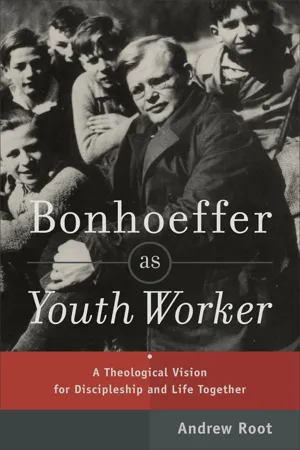
The youth ministry focus of Dietrich Bonhoeffer's life is often forgotten or overlooked, even though he did much work with young people and wrote a number of papers, sermons, and addresses about or for the youth of the church. However, youth ministry expert Andrew Root explains that this focus is central to Bonhoeffer's story and thought.
Root presents Bonhoeffer as the forefather and model of the growing theological turn in youth ministry. By linking contemporary youth workers with this epic theologian, the author shows the depth of youth ministry work and underscores its importance in the church. He also shows how Bonhoeffer's life and thought impact present-day youth ministry practice.
eBook - ePub
Bonhoeffer as Youth Worker
A Theological Vision for Discipleship and Life Together
- 224 pages
- English
- ePUB (mobile friendly)
- Available on iOS & Android
eBook - ePub
About this book
Information
Topic
Theology & ReligionSubtopic
Religious Biographies
Youth Ministry and Bonhoeffer
Finding a Forefather
The room was packed with youth workers, and I knew their presence had nothing to do with me. I was brand new in the youth-ministry-presenting world, and, for the most part, these youth workers had no idea who I was. I had already done an earlier breakout session at this big conference, on a topic directly related to youth ministry, like “Caring for Hurting Teenagers” or something similar. During that session, my room, ready to receive hundreds, saw only a trickle of twenty or so skeptical participants walk in, spreading themselves from one end to the next as if it were a competition to always keep a dozen chairs between them. The largest collective stayed near the door, comforted that if things went lame they could make it down the hall to another presentation before long.
I was expecting pretty much the same for this second breakout session, and my inner forecaster expected the drought of participants to not only continue but worsen. After all, the first presentation had been more directly on the practice of youth ministry, on the practical. And if there was anything that the youth workers at this conference wanted, it was the know-how of the practical.
As I readied my computer for this second presentation, shifting cords and moving keynote slides, a trickle of youth workers already began to enter the room. Soon the trickle became a steady stream that surged to become a flood. Now youth worker after youth worker sought seats before they disappeared into the humanity of one another, sliding by each other to grab a chair in the middle of rows. All these practical, thirsty-for-know-how-and-new-ideas youth workers were cramming themselves together, coming to hear something promising no practicality at all; they had no idea who I was or how this topic would help them. Nevertheless they came—and only because my title read, “Dietrich Bonhoeffer and Youth Ministry.”
As I concluded my fifty minutes of rambling, youth worker after youth worker lined up to talk to me. Yet almost none had a question; rather, they stood to give a confession, saying to me, “Hey, thanks; Bonhoeffer is my hero,” or “I came because I just find Bonhoeffer so interesting.” I stood for nearly an hour hearing one after another confess how this German man had impacted them. Many explained in shameful candor that they actually knew little about Bonhoeffer, but that the little they knew drew them in deeply and impacted them significantly.
Bonhoeffer and Youth Ministry
It was clear that day that youth workers were not unlike so many others who find intrigue and inspiration from Dietrich Bonhoeffer. Bonhoeffer ranks high on nearly every list of influential Christians; and across very distinct groups (whether liberal or conservative, mainline or evangelical, youth worker or senior pastor),[1] nearly all include Bonhoeffer in either their formal or informal pantheon of impactful leaders.
Yet it just may be that youth workers have a particular (and so often unexplored) connection with Bonhoeffer. Youth workers, as my experience highlights, have an admiration for Bonhoeffer, but hearing their confessions that day, none articulated (or seemed to know) how Bonhoeffer was connected to them through a shared calling to minister to young people. It seems, in fact, that most Bonhoeffer lovers (not to mention scholars) have forgotten or overlooked the amount and depth of youth ministry that encompassed his life and work. It may be even fair to say (as I’ll try to show below) that a central way to understand Bonhoeffer is as a pastor to youth and/or as a talented thinker who constructed some of the most creative theological perspectives of the early twentieth century with young people on his mind. Youth workers, like so many others, feel drawn to Bonhoeffer, but few have seen the links that connect them to Bonhoeffer, feeling he’s just a theologian they like rather than a forefather to their very calling. This forefather may stand at the beginning of a slowly evolving movement in youth ministry itself.
A Forefather to a Movement
It can be argued that youth ministry is a post–World War II North American phenomenon.[2] This, then, would make it quite strange to call its forefather a German man who was killed in 1945. Actually, as we’ll see in the chapters below, Dietrich Bonhoeffer more than likely would have been strongly against many of the forms American youth ministry has taken since its inception. Bonhoeffer, after all, was against overly exuberant ministerial endeavors like the Oxford Movement[3] and had certain disdain for the entrepreneurial spirit of American religion and its desire to always be doing without thinking (and confessing) the faith.[4] Dietrich Bonhoeffer, in intellectual pursuit and personal disposition, was far from the stereotypical image we have of the contemporary youth worker.
So it would not be right in any way to call Dietrich Bonhoeffer the forefather of North American–like youth ministry. But it would also be a great oversight not to see how central ministry to youth was for Bonhoeffer. Therefore, when I call Bonhoeffer a forefather to a movement, I mean to disconnect youth ministry from its post–World War II North American phenomenon and link Bonhoeffer with what Kenda Creasy Dean and I have called “the theological turn in youth ministry” (something we see as more global and reflective than post–World War II North American youth ministry).[5]
Dean and I have noticed, and sought to foster, a slowly evolving movement of youth workers that have taken what we’ve called a theological turn. These are youth workers who, in response to their previous ministry or the larger ethos of American youth ministry’s “industrial complex,” have sought to move into the theological. They have turned to the theological not for the sake of the academic or the intellectual but for the sake of the ministerial. They believe that turning theological can give them frameworks and direction in doing ministry with and for young people.
These are youth workers who have shifted from seeing youth ministry as a technical pursuit that seeks the functional ends of solving a problem, like getting young people religiously committed, entertained, or morally and spiritually safe. Instead, they see youth ministry as a concrete locale to reflect upon and participate in the action of God.[6] They have turned theological as a way of directing the very shape of their ministries.
Or we could say it this way: American youth ministry, since its inception in the mid-twentieth century, has been engendered with a technological mind-set; North American youth ministry has been a technology. It is no surprise that the age of the technological—the age in which American society was gripped by a consumptive drive for the new and better (that only a technological society could provide)—was the age of contemporary American youth ministry’s beginnings.
Technology is science used for functional ends, to achieve or solve some problem that will result in increased capital.[7] Youth ministry was created as a technology, needed to solve the problem of adolescent religious apathy, and thus it existed for functional growth, as all technologies do. Youth ministry was created to increase capital by solving the technical problem for which it was created. This functional problem was low religious commitment (kids didn’t like church) and immoral behavior (kids were doing drugs, having sex, and not reading their Bibles). As a technology created to functionally solve these problems, youth ministry could only be judged by its increased capital; if more kids were coming to church or youth group on Sunday and Wednesday, and if more kids were sober and sexually pure, youth ministry was successful—it was meeting the functional end it was created for. And as a technology, its good (its reason to exist at all) was only for accomplishing its functional end by expanding the desired capital.
This technological ethos has begun to feel like a noose around the neck of many youth workers. Tied up in this technological ethos, it feels as if their ministry is always in search of the next big program, model, or idea. In other words, it’s looking for the next big technological breakthrough that will finally help them exponentially increase their capital (yielding a big youth group filled with virgins). Some youth workers have begun to wonder if there is not more to ministry, or if ministry is even something different altogether than managing technologies to increase religious capital. They are wondering about God, and God’s action in youth ministry, or whether such deep thoughts and reflection are sucked dry by youth ministry’s technological addictions. It is those that have taken the brave step away from the technological and sought the action of God in their ministries with youth that have taken the theological turn.
I was shocked at the attendance of my Bonhoeffer presentation at the conference because the topic (and, as I hope to show, Bonhoeffer himself) stood opposed to the binding of (youth) ministry to the technological. In fact, it may be in part this very different starting point of Bonhoeffer’s that attracts so many to him. We hear something different in Bonhoeffer, something that moves us away from our addiction to ministry technology, something that turns us to place our ministries on the revelation of God.
Turning to the Forefather
Dean and I have noticed and sought to perpetuate a turn of youth ministry from the technological to the theological. We have tried to encourage youth workers to see youth ministry not for solving a functional problem that, when resolved, will increase capital (the technological), but instead to see youth ministry as a locale to encounter the revelation of God next to the humanity of young people themselves (the theological). Youth ministry, we believe, seeks to reflect deeply on the action of God in and through the lives of young people who are both within and outside the church.
But I need to be precise and say that the turn to the theological is not, and is different from, a turn to theology.[8] To turn to theology is to turn solely to doctrines and traditions, believing that if you can get such information into young people’s heads that you’ve met your goal. A turn to theology would risk a retreat away from the concrete and lived experience of young people.[9] Rather, we call this a theological turn because it seeks to explore the very concrete[10] and lived experience young people have as the location for encounter with God.[11]
A youth ministry that turns to theology seeks to move young people into forms of formal knowledge (to assimilate to the doctrinal). A youth ministry bound in the technological seeks to increase numbers and behavior. A youth ministry that turns to the theological seeks to share in the concrete and lived experience of young people as the very place to share in the act and being of God.[12]
For those of us seeking to live into the theological turn in youth ministry, I seek in the pages of this project to show Dietrich Bonhoeffer as our forefather. It would be impossible to make Bonhoeffer the forefather of technological North American youth ministry. Not only will his history and context not allow for it, but his very thought and commitments stand in opposition to it. In the same way, it would be hard to make Bonhoeffer a forefather to the turn to theology in youth ministry. Bonhoeffer was, without doubt, conversant with doctrine and confessions, even teaching them to his confirmation students. But in the end, the very shape of Bonhoeffer’s ministry to young people reveals that his desire was not for getting information into their heads but for sharing in their lives as a way of mutually experiencing the very revelation of God in Jesus Christ.
It is this theological attention, this focus on God’s act in our concrete lives, that I believe makes Bonhoeffer so intriguing to so many, and it is the fact that he himself lived and died seeking to follow Jesus Christ in the concrete and lived that draws roomfuls of people to come hear his story.[13]
Dietrich Bonhoeffer, I will argue then, is the forefather to those taking the theological turn in youth ministry. For those of us seeking to make such a turn, I hope to show how we stand on the shoulders of Bonhoeffer, and how we might claim him and learn from him as we turn theological in youth ministry. Dietrich Bonhoeffer is the forefather to the theological turn because he incomparably weaves together youth work, attention to concrete experience, and commitment to the revelatory nature of God’s continued action in the world through Jesus Christ. In these pages, then, Bonhoeffer will be our teacher. We will explore the richness of his theological projects, seeing from his life and writings what we might learn for our own contemporary theological turn.
Therefore, to start this journey, we must begin where all conversations about Bonhoeffer must: with his biography. Nearly every Bonhoeffer book published has been unable to resist a chapter or two on biography. This project hopes not simply to be pulled in by the intrigue of Bonhoeffer’s story (though it is quite intriguing) but to mine his narrative and tell a piece of Bonhoeffer’s story that has been so often overlooked or underplayed: Bonhoeffer’s very work as a minister to youth. Therefore, in part 1 I will seek to tell the story of Dietrich Bonhoeffer, the youth worker; in part 2 I’ll explore two of Bonhoeffer’s most important writings—Discipleship and Life Together—for their relevance to youth ministry today.

Dietrich Bonhoeffer, the Youth Worker
I made a bold statement at the end of chapter 1 that I now need to justify. I have asserted that Dietrich Bonhoeffer is the first theological youth worker. This statement is slightly hyperbolic, though I’m ready to stand behind it. It is hyperbolic because to say “first” is quite hard to prove. There clearly have been other pastors or theologians in the history of the church (and particularly outside Protestantism) that could be argued to predate Bonhoeffer as theologians of youth work or youth ministry, though I do think it could be very difficult to connect a figure earlier than the twentieth century with doing so. This would be difficult because our modern conceptions of childhood and, most particularly, adolescence were not nearly as present and defined as they were in Bonhoeffer’s own time and after.
Yet the point of this chapter is not t...
Table of contents
- Cover
- Title Page
- Copyright Page
- Dedication
- Contents
- Preface
- 1. Youth Ministry and Bonhoeffer: Finding a Forefather
- Part 1: The History of Dietrich Bonhoeffer, the Youth Worker
- Part 2: A Youth Worker’s Guide to Discipleship and Life Together
- Index
- Notes
- Back Cover
Trusted by 375,005 students
Access to over 1.5 million titles for a fair monthly price.
Study more efficiently using our study tools.
Frequently asked questions
Yes, you can cancel anytime from the Subscription tab in your account settings on the Perlego website. Your subscription will stay active until the end of your current billing period. Learn how to cancel your subscription
No, books cannot be downloaded as external files, such as PDFs, for use outside of Perlego. However, you can download books within the Perlego app for offline reading on mobile or tablet. Learn how to download books offline
Perlego offers two plans: Essential and Complete
- Essential is ideal for learners and professionals who enjoy exploring a wide range of subjects. Access the Essential Library with 800,000+ trusted titles and best-sellers across business, personal growth, and the humanities. Includes unlimited reading time and Standard Read Aloud voice.
- Complete: Perfect for advanced learners and researchers needing full, unrestricted access. Unlock 1.5M+ books across hundreds of subjects, including academic and specialized titles. The Complete Plan also includes advanced features like Premium Read Aloud and Research Assistant.
We are an online textbook subscription service, where you can get access to an entire online library for less than the price of a single book per month. With over 1.5 million books across 990+ topics, we’ve got you covered! Learn about our mission
Look out for the read-aloud symbol on your next book to see if you can listen to it. The read-aloud tool reads text aloud for you, highlighting the text as it is being read. You can pause it, speed it up and slow it down. Learn more about Read Aloud
Yes! You can use the Perlego app on both iOS and Android devices to read anytime, anywhere — even offline. Perfect for commutes or when you’re on the go.
Please note we cannot support devices running on iOS 13 and Android 7 or earlier. Learn more about using the app
Please note we cannot support devices running on iOS 13 and Android 7 or earlier. Learn more about using the app
Yes, you can access Bonhoeffer as Youth Worker by Andrew Root in PDF and/or ePUB format, as well as other popular books in Theology & Religion & Religious Biographies. We have over 1.5 million books available in our catalogue for you to explore.