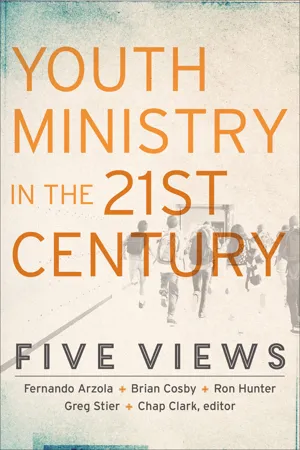
There are many philosophies and strategies that drive today's youth ministry. To most people, they are variations on a single goal: to make faithful disciples of young people. However, digging deeper into various programs, books, and concepts reveals substantive differences among approaches. Bestselling author Chap Clark is one of the leading voices in youth ministry today. In this multiview work, he brings together a diverse group of leaders to present major views on youth ministry. Chapters are written in essay/response fashion by Fernando Arzola, Greg Stier, Ron Hunter, Brian Cosby, and Chap Clark. As the contributors present their views and respond to each of the other views, they discuss their task and calling, giving readers the resources they need to develop their own approach to youth ministry. Offering a model of critical thinking and respectful dialogue, this volume provides a balanced, irenic approach to a topic with which every church wrestles.
- 224 pages
- English
- ePUB (mobile friendly)
- Available on iOS & Android
eBook - ePub
About this book
Information
Topic
Theology & ReligionSubtopic
Christian Ministry
The Adoption View of Youth Ministry
The success of youth ministry in this country is an illusion. Very little youth ministry has a lasting impact on students. I believe we’re no more effective today reaching young people with the gospel than we’ve ever been. . . . So let’s be honest. Youth ministry as an experiment has failed. If we want to see the church survive, we need to rethink youth ministry. What does that mean? I don’t have a clue. But my hunch is that if we want to see young people have a faith that lasts, then we have to completely change the way we do youth ministry in America. I wonder if any of us has the courage to try.
—Mike Yaconelli, “The Failure of Youth Ministry,” Youthworker Journal, May 2003
I have an apology to make. In my rush to make deadline my last column communicated the wrong message. What I thought I said and what many people read were two quite different things. I was hoping to throw some cold water on the high profile ministries out there that give the impression they’re attracting gazillions of young people to their ministries and changing the lives of gazillions more. I was trying to level the playing field by introducing a dose of reality. . . . What most of you read was, “Youth ministry is worthless, useless, and not worth doing.” I apologize. The last thing I want to do is discourage youth workers. What I intended (and didn’t accomplish) was to un-intimidate those youth workers who were discouraged because of all the “successful” ministries who were implying results different from the rest of us. . . . Maybe we don’t need a revolution in youth ministry; maybe what we need is what we’ve always needed—a few adults who are willing to follow God’s call to love young people into the kingdom of God no matter what the result.
—Mike Yaconelli, “An Apology,” Youthworker Journal, July 2003. Mike Yaconelli died in October 2003.
Around the time Mike was writing those articles, a local teacher started a small group. Three young men in their senior year of high school, fresh off camp where they together committed their lives to Christ, started meeting weekly with their middle-aged volunteer. They came to read their Bibles, share their struggles, and pray in support of one another. All three were good friends at school, active in youth group, played football together, and knew and liked their adult leader. For two of them, faith was a new thing, and they were excited to learn and grow. The third, raised in the church, had less overt enthusiasm but still was drawn in by his friends’ excitement. Each one became active in church attendance, served as a student leader, and even led younger students. When they were together, going deeply after their faith, sometimes the conversation was passionate, sometimes it felt stiff, and occasionally it just fell flat, but for most of the year the power seemed to be simply in the meeting. Each guy knew that they were cared for, and that when they met, something always good happened.
In spring, as they prepared to graduate and as life got busy, they stopped coming to the youth ministry programs but tried to keep the group together. That summer and through the next fall, they attempted to meet monthly, but it was rare when all four were able to come. The leader tried to stay in touch and connected, but because each one had gone a different way, it was not only less convenient to gather but seemed to be less desired. Soon the group stopped altogether, and soon the leader took on a new small group of incoming freshmen to “pour his life into.”
A few years later, the one who was raised in the church stopped coming to services as well—“I have to work . . .” was his reply when asked. Another started attending a Bible study at his new college. The third became a middle-school leader for a local parachurch organization while attending community college and working. Today, the one raised in the church attends now and then, but comes alone and sits in the back with his girlfriend, leaving immediately after the service is over. Neither of the others stayed involved in a church or ministry. They have simply drifted away. One, when asked via Facebook how he was doing in his faith, simply replied, “That was all great in high school, but I haven’t thought about God in quite a while.” End of conversation.
What became of these three? They were sincere about and invested in their faith. Each one prayed, served, and sought to make Christ Lord of every aspect of his life. One was an outspoken evangelist, and the other two were quieter but not afraid to talk to anyone who was interested. They were known at school for their faith, and people gave them space to live their Christian lives and yet remain socially connected. Their growth was visible and real. Yet around the time they began to look beyond the routine and expectations of high school life, and shortly thereafter, they seemed to see their faith journey as a part of a bygone era as opposed to a radical change of vocation. While Jesus still mattered, at least verbally, for a few years following graduation, the impact their faith had on their choices and lifestyles slowly began to dissipate. Within two to three years after graduation, active engagement in faith, and especially the faith community, had become a thing of the past.
For so many young people, this is their story—perhaps even the majority. There are various academic studies and market research groups that have tried to get at the scope of the issue, yet one thing is clear from all of them: even for those who were active in church or church-related discipleship ministries, by the time they move into their twenties, the faith they once saw as vital and experienced as vibrant became for most of them relegated to the narrative of a stage of life gone by. And there is no current evidence that they will come back when they “stabilize” (meaning, find a meaningful job, get married, and have children). The trends of past decades cannot possibly predict the future in such a wildly changing cultural milieu.
I contend that the primary reason we have lost so many of the hearts and investment of our young when they leave the confines of the high school routine is that we have failed to provide them with the most vital resource they possessed in Christ: the God-given faith community. The leader of that small group of seniors, who happened to be me, was intent on fulfilling the call as a committed and faithful leader. While we practiced our faith together the way we had been taught—we attended church programs, sometimes took notes and discussed the sermons, and participated in the level and kind of Christian community that went beyond most of their peers—even our small little community did not seem to be enough. By the time the three students moved beyond high school, they slowly began to drift from their faith. As much as I tried to help them be faithful, “committed,” and invested, what I had given them was not enough. They were products of traditional youth ministry, each a solid “student leader” and visible follower of Christ. Yet if I am honest, beyond me, they were not as deeply connected to the fullness of the body of Christ—even the one who grew up in the church—as they needed to be. Yes, there are no guarantees, and their story is not the story of all youth ministry products, but it is the story of most. When the youth ministry lights go dim and the faith journey is no longer programmatically handed to them, they are left on their own.
The Historical Backdrop: Why We Are Where We Are
The youth ministry that now commonly functions as the model of Christian adults initiating relationships with young people so that they may come to know Jesus Christ, described by Mike Yaconelli in 2003 as an “experiment,” has been more or less the same for the past fifty-plus years. While some argue that youth ministry started hundreds of years ago when people began to address the needs—both material and spiritual—of vulnerable young people, the way we have come to practice youth ministry around the world began in the twentieth century. The zeal and focus of parachurch movements during the late nineteenth and early twentieth centuries partnered with churches in reaching out to the young. Most of the young people involved were already identified with a congregation but benefited greatly from the generational focus of groups like Christian Endeavor. A greater recognition of the coming generational fissures was affecting not only advertising, education, and parenting but also religious communities. In the mid-twentieth century, missional parachurch groups like Young Life and later Youth for Christ generally focused more on all young people, not just those who were involved in a church. Throughout and following World War II, the drive to introduce the young to God through Jesus Christ by seeking them out where they lived and gathered, building welcoming relationships, and speaking the gospel to them in terms they could understand had become the basic methodology of the youth ministry “experiment.” In the 1960s and 1970s, churches began to put more energy, staff, and money into the young, and through the influence of emerging leaders, books, training opportunities, and materials like Youth Specialties, what we now know as youth ministry took shape: a group of adults who were willing to invest in the lives of young people and introduce them to a relationship with Jesus.
In 1987, Mark H. Senter III and Warren S. Benson wrote one of the earliest textbooks for youth ministry. Up to this point there had been a handful of books that had helped define and ground the fledgling field of youth ministry in biblical and theological thought, but to many of the pioneering teachers in college and seminary youth ministry classes, The Complete Book of Youth Ministry was the most comprehensive to date.[1] Benson and Senter, as Christian educators, were among the first to bring together in one volume a good number of the most prominent voices in what eventually came to be known as “academic” youth ministry.[2] In the first chapter—“A Theology of Youth Ministry”—as Benson makes the case for grounding the work of youth ministry within the rubric of theology, he lands on the work of Jim Rayburn, the founder of Young Life, and the theological impetus for seeing the incarnation as the “model for youth ministry.”[3] Benson, citing his coeditor, Mark H. Senter III, offered three statements that define youth ministry.
- “Youth Ministry begins when adults find a comfortable method of entering a student’s world.”
- “Youth ministry happens as long as adults are able to use their student contacts to draw students into a maturing relationship with God through Jesus Christ.”
- “Youth ministry ceases whenever the adult-student relationship is broken or the outcome of that relationship ceases to move the student toward spiritual maturity.”[4]
In many ways, The Complete Book of Youth Ministry broke new ground for the thinking and doing of youth ministry. In the late 1980s and early 1990s, as colleges and seminaries across North America and eventually around the world hired faculty and instituted classes and even some degree programs, the idea of youth ministry being on solid theological and pedagogical footing encouraged faculties and administrators, and vicariously churches and pastors, to embrace youth ministry as a worthy field of undergraduate and even graduate study (to say nothing of the potential for greatly increased enrollments).
Around this same time, Wayne Rice and Mike Yaconelli of Youth Specialties, and to a certain degree Thom and Joni Schultz at Group, provided a highly visible platform for writers and speakers to influence the shape, style, and structure of youth ministry. Through their seminars and conventions, and later in their publishing, the speakers and writers were also often the academic leaders of the youth ministry “experiment.” A synergy developed around the pre-web, viral Yaconelli mantra “Jesus and kids; that’s who we are, that’s what we do” that gave youth ministry its philosophical core. Regardless of tradition, denomination, or organization, men and women who were tasked with overseeing a youth ministry program in their church, or who served as Young Life or Youth for Christ leaders, read the same books and articles, went to the same training events and conferences, and perpetuated this universal calling—roughly the same that Benson and Senter advocated: youth ministry begins when an adult “enters a student’s world” and continues “as long as they are able to use their student contacts to draw students” into “maturing relationship with God” (italics mine).
For the past half-century, then, youth ministry has primarily focused on adults building relationships with teenagers for the purpose of helping “each and every young person grow personally and spiritually.”[5] The expression, delivery, and style of this basic premise have been debated, nuanced, contextualized, and dissected over the years. At certain points in the youth ministry landscape, a book or leader would come along and propose a corrective to a perceived movement or trajectory, whether it was pragmatic (as with Mark DeVries’s Family-Based Youth Ministry in 1994), strategic (Doug Fields’s million-plus seller Purpose Driven Youth Ministry in 1998), or programmatic (Duffy Robbins’s Ministry of Nurture in 1990).[6] In each of these and numerous other cases, and for the most part across traditions and denominations, the core has remained committed to individual young people being the recipients of a relational investment of a concerned adult, or group of concerned adults, for the purposes of the spiritual development of the adolescents’ individual journeys. Again, as Peter Benson notes, youth ministry is adults making “contact” with young people and using “their student contacts to draw students into a maturing relationship with God through Jesus Christ.”[7] Although he does not explicitly say this, it is clear that one could easily insert “draw students into a maturing individual relationship with God.”
The common denominator from the very beginning—despite corrective movements, such as including a greater recognition of the parents’ role in their kids’ spiritual growth, the development of a comprehensive ministry strategy, and the need to recognize how deeply growing up in a fragmented culture has affected all young people[8]—has been youth ministry’s focus on the individual. The seedbed of contemporary youth ministry, and where Young Life’s Jim Rayburn developed much of his missional theology, was the “tent meeting” evangelism of the early twentieth century.[9] This movement defined evangelism as the church’s job to share the “good news” with “outsiders” (Col. 4:5). To invite them to personally embrace the Christian faith became the garden youth ministry was planted and cultivated in. Much of the rhetoric summarizing the emphasis on an individual response to the gospel as the goal of contemporary discipleship has become the bumper sticker theology of youth ministry, regardless of tradition, from “Accept Jesus Christ as your personal Lord” (or sometimes “Savior”) to “Become a Christian.” By encouraging a personal decision to conversion,[10] followed by the amorphous “rededication,” the next step for those who had at some point previously “accepted” Christ (usually at camp), youth ministry has been focused on the task of helping “committed”[11] kids to “grow” in their faith. What this means is difficult to precisely pin down, but essentially it is to encourage young Christ-followers to live their lives in a way that is a reflection of how a “Christian” in a given context looks, talks, thinks, and behaves. In youth ministry seminars, articles, and books, “discipleship” is described in the “doing” of faith: consistent Bible reading, regular prayer, active church life, response to social issues in light of their faith, involvement in some sort of “ministry” where they serve others, and the like.[12] Obviously, none of these is wrong or even negative, but are they enough? Or, more important, do they represent the fullness of the call of God in the Scriptures? Perhaps this is what Dallas Willard was describing when he decried the “gospel of sin management.”[13]
For all of the good that youth ministry has done, for all of the lives that have been changed, we have moved into a “post-Christian” culture where the young have fewer relational resources than ever to navigate the complexities of entering interdependent adulthood, and the historic focus on faith as an individual responsibility has left countless young people with an inadequate understanding of the Christian faith. The danger of youth ministry exclusively dedicated to evangelizing and then personally “discipling” individuals during adolescence is that faith at its core can easily become so personal that both the daily walk and the lifelong journey as a Christian is all about and up to me. One may argue that this is not exclusively an issue in youth ministry but one found in the wider North American church, and contemporary youth ministry is no more or less culpable than the church at large. Certainly, the youth ministry models and practices focused on individual faith are a reflection of a greater indiv...
Table of contents
- Cover
- Series Page
- Title Page
- Copyright Page
- Endorsements
- Contents
- Acknowledgments
- Introduction: Why This Book?
- Introducing the Authors
- View One: Greg Stier
- View Two: Brian Cosby
- View Three: Chap Clark
- View Four: Fernando Arzola
- View Five: Ron Hunter
- Afterword: Where from Here?
- Notes
- Index
- Back Ads
- Back Cover
Trusted by 375,005 students
Access to over 1.5 million titles for a fair monthly price.
Study more efficiently using our study tools.
Frequently asked questions
Yes, you can cancel anytime from the Subscription tab in your account settings on the Perlego website. Your subscription will stay active until the end of your current billing period. Learn how to cancel your subscription
No, books cannot be downloaded as external files, such as PDFs, for use outside of Perlego. However, you can download books within the Perlego app for offline reading on mobile or tablet. Learn how to download books offline
Perlego offers two plans: Essential and Complete
- Essential is ideal for learners and professionals who enjoy exploring a wide range of subjects. Access the Essential Library with 800,000+ trusted titles and best-sellers across business, personal growth, and the humanities. Includes unlimited reading time and Standard Read Aloud voice.
- Complete: Perfect for advanced learners and researchers needing full, unrestricted access. Unlock 1.5M+ books across hundreds of subjects, including academic and specialized titles. The Complete Plan also includes advanced features like Premium Read Aloud and Research Assistant.
We are an online textbook subscription service, where you can get access to an entire online library for less than the price of a single book per month. With over 1.5 million books across 990+ topics, we’ve got you covered! Learn about our mission
Look out for the read-aloud symbol on your next book to see if you can listen to it. The read-aloud tool reads text aloud for you, highlighting the text as it is being read. You can pause it, speed it up and slow it down. Learn more about Read Aloud
Yes! You can use the Perlego app on both iOS and Android devices to read anytime, anywhere — even offline. Perfect for commutes or when you’re on the go.
Please note we cannot support devices running on iOS 13 and Android 7 or earlier. Learn more about using the app
Please note we cannot support devices running on iOS 13 and Android 7 or earlier. Learn more about using the app
Yes, you can access Youth Ministry in the 21st Century (Youth, Family, and Culture) by Clark, Chap in PDF and/or ePUB format, as well as other popular books in Theology & Religion & Christian Ministry. We have over 1.5 million books available in our catalogue for you to explore.