Dean Borgman, a nationally known youth ministry expert, offers a new edition of his influential classic. Reaching a broadly ecumenical audience, this book challenges readers to think about the theological nature of youth ministry. Questions for discussion and reflection are included. This thoroughly updated edition was previously published as When Kumbaya Is Not Enough.
Praise for the first edition
"Writing with the lens of a theologian, the heart of a pastor, and welcome doctrinal breadth, Borgman has provided a 'field book' of pastoral theologies that takes seriously the social systems shaping the lives of adolescents. This book is a significant step toward the long-awaited conversation about theology and youth ministry in postmodern culture."--Kenda Creasy Dean, Princeton Theological Seminary; author of Almost Christian
"In this excellent work Borgman brings theological integrity, depth, and years of wisdom like nothing else I have seen in our field."--Jim Burns, author of Teenology: The Art of Raising Great Teenagers
eBook - ePub
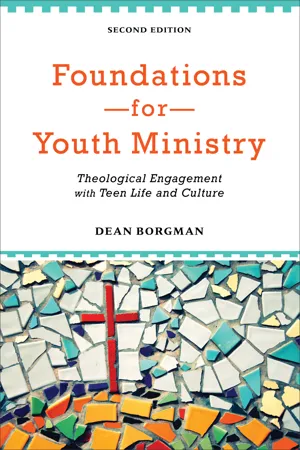
Foundations for Youth Ministry
Theological Engagement with Teen Life and Culture
- 320 pages
- English
- ePUB (mobile friendly)
- Available on iOS & Android
eBook - ePub
About this book
Information
Topic
Theology & ReligionSubtopic
Christian Ministry—1—
Introducing a Theology for Youth Ministry
Trust in the LORD with all your heart, and do not rely on your own insight. Do not be wise in your own eyes; fear the LORD, and turn away from evil. In all your ways acknowledge him, and he will make straight your [theological] paths.
PROVERBS 3:5, 7, 6 (AUTHOR’S PARAPHRASE)
Personal Starting Point
We all need reminders that practical ministry and practical theology flow from God and are intricately connected to each other. This is an awesome truth beyond proof to the skeptical or distracted mind. The Creator’s love and grace initiate the relationship and partnership God desires with humans. Our inclination to love a neighbor and to serve a younger generation is of God; effective ministry is letting God love and bless through us. It is God who has put the compassion and desire to care in our hearts.
Really caring about young people involves spending time with them and responding to their deepest needs and desires. Doing so in the name of Christ has always been the basic and essential characteristic of youth ministers. But this calls into question the motivations and manner of our relating. What is the nature of human relationships? Why are we doing youth ministry? How is our attention being perceived? What is the systemic context of our growing relationships? Who has sent us into young people’s external and internal spaces? And to what end? These questions, as well as the complicated contexts of adolescence, are what this book is about. So, we begin with God, then we look at ourselves and others in culture, and then we turn our attention to youth.
Changing Families, Youth, and Cultures
Youth, their families, and their peer groups are complicated because of their individualities, their localities, and their associations. Combinations of digital and face-to-face relationships add to the complexity. The impact of cultures and subcultures—of systems-within-systems—on the lives of young people is enormous. The digital age has produced a whole new environment. A failure to understand the larger, deeper picture can lead to frustration and burnout for youth ministers.
Back in the 1980s, David Elkind helped us understand how the weakening of families, communities, and schools in our society was forcing young people to turn to media and peers for life, relationships, and instruction. Surrounded by family and media, school and peers, sports and the streets, they began to learn by imitation rather than integration, becoming “patchwork selves.” The result was unintegrated compartments in their lives, producing added stress (according to Elkind and those of us who worked with teenagers back then).4 This pressure was often relieved by chemical stimulants, excessive risk-taking, and sex—which in turn further increased the stress in their lives.
The very titles of studies from the 1990s provide a quick review of what was happening to the young people youth ministry served. They include Peggy Orenstein’s SchoolGirls: Young Women, Self-Esteem, and the Confidence Gap5 and Mary Pipher’s Reviving Ophelia: Saving the Selves of Adolescent Girls.6 Experts warned of damage being done to girls by family breakups, the media, advertising, and the gender gap. Other authors found that boys were caught in their own traps. Michael Gurian’s The Wonder of Boys7 and William Pollack’s Real Boys8 are two of several books explaining the plight of boys in a changing society.
Provided a challenge as to how adult leaders could make contact and relate to seemingly disinterested youth, journalists headed into schools at the turn of the century. Their reports affirmed growing concern for the health of the nation’s young. Students at Largo High School in Florida at first avoided a middle-aged reporter who started hanging out in and around their school. But soon they opened up to this adult stranger who asked questions and listened attentively. Within a few months students were sharing their discontents, wildness, and anxieties with Thomas French, who described it all in South of Heaven: Welcome to High School at the End of the Twentieth Century.9
Writer and mother Patricia Hersch followed eight middle and high school students for three years in Reston, Virginia, and wrote a best-selling book whose title describes how we were distancing ourselves and failing our youth: A Tribe Apart: A Journey into the Heart of American Adolescence.10 Another journalist, Elinor Burkett, ventured into the halls and classrooms of Minneapolis’s Prior Lake High School and noted the effects of the post-Columbine era, with its zero tolerance of student misbehaviors, school lockdowns, and teaching to the test. The effect of imposing excessive demands, arbitrary school policies, and pedagogical changes on students, while encouraging them to grow up and act creatively and responsibly, is described in Beckett’s Another Planet: A Year in the Life of a Suburban High School.11 A few years later Jean Twenge described her own and other studies in the first decade of the twenty-first century: Generation Me: Why Today’s Young Americans Are More Confident, Assertive, Entitled—and More Miserable Than Ever Before.12 These titles beg pause for reflection.
Two heralded films further documented what real life was like among twentieth-century students—particularly the stress of school life. Waiting for Superman explores the tragedy of poor, especially urban schools and students’ stressful hopes of gaining entrance into a charter school, which may or may not provide a better education.13 Race to Nowhere, set in generally more privileged schools, portrays student and teacher/administrator burnout as a result of unrealistic expectations and arbitrary guidelines.14
A Growing Body of Youth Ministry Research and Theology
Youth ministry writers at the turn of the century were also researching and writing about society’s abandonment of youth and, at the same time, the consumption and excess that pushed young people toward autonomy and entitlement. The titles of these books suggest the challenge facing youth ministers, who believe the gospel to be good news for patchwork selves, for the bored or stressed, for overinflated or deflated senses of self.15
The most comprehensive study of American youth of the early twenty-first century is the National Study of Youth and Religion by sociologist Christian Smith. It shattered myths of adolescence, at least for the millennial generation—beliefs that adolescents tend to rebel against their parents’ beliefs and are spiritual but not religious. This survey of the religious life, values, beliefs, and practices of 3,290 English- and Spanish-speaking thirteen- to seventeen-year-olds (and their parents) yielded notable findings. These young people tended to reflect the opinions of their parents and held a widespread belief in a God who would help them through difficulties but was not particularly interested in the details of their lives. Smith identified a general religious creed (across “mainline Protestant and Catholic youth, but . . . also among black and conservative Protestants, Jewish teens . . . other religious types . . . and even many non-religious teenagers in the U.S.”):
- A God exists who created and orders the world and watches over human life.
- God wants people to be good, nice, and fair to one another, as taught in the Bible and by most world religions.
- The central goal of life is to be happy and to feel good about oneself.
- God does not need to be particularly involved in one’s life except when God is needed to resolve a problem.
- Good people go to heaven when they die.16
In short, the study found, across denominations and even religions, a rather shallow belief system that might be described as moral therapeutic deism. Such belief in a kindly, not-too-attentive grandfather figure “up there,” the researchers concluded, comes to youth primarily from their parents’ easygoing, culturally comfortable faith and lack of theological depth.
Youth minister and theologian Pete Ward has made an interesting observation about this and other studies: that youth (and all of us) have both an “espoused theology” and an “operant theology.”17 Such a distinction may question whether “moral therapeutic deism” describes the “operant theology” of teenagers more than their “espoused theology” as Catholics, evangelicals, or members of other faith traditions.
Youthful failures of faith, as expressed by “moral therapeutic deism,” point to the failures of parents and churches. An earlier book by Kenda Creasy Dean challenged the church for failing our youth with these words:
Every stage of the life cycle brings certain human characteristics to the fore; in adolescence, one of these qualities is passion . . . the adolescent brain is wired for passion.
The adolescent quest for passion reveals a theological aneurysm in mainline Protestantism [and I would add, in most of the church]: We are facing a crisis of passion, a crisis that guts Christian theology of its very core, not to mention its lifeblood for adolescents. . . . Not only does a church without passion deform Christian theology, it inevitably extinguishes the fire behind Christian practice as well.18
There is a rising consensus regarding weaknesses in many youth ministries these days. Many of our youth ministry alums are giving up their connection with churches and often their faith; youth programs are often producing superficial outcomes; and youth ministry sometimes further segregates students from family and intergenerational church. Many of us see these weaknesses as a reflection of a failure to hear young people ethnographically and understand theologically the full meaning of Christ’s incarnation, the nature of the church, and our mission to confront culture in the name of Jesus Christ. For the sake of the church today, including those who are young, we are called to further empirical research and rigorous theological engagement.
Our Present Challenge
Making sense of a complicated ministry in a complex world (and church) will require a bold and broad theology, true to its biblical foundation and teachings of the church, careful to include the best insights from the social sciences. We will not attempt to reason our way through culture to God as many do, but instead we seek wisdom from God as our starting point. It is God who has given humans reasoning ability within cultural milieus. We believe God’s revelation comes both through the written and Living Word of God and through nature and culture. Our challenge is to integrate these two sources of knowledge and wisdom.
Our relationships with (adolescent or adult) others and our relationship with the divine Trinity are twin mysteries. Without God’s forgiving and enlightening grace, there is little hope for understanding the origin and nature of culture and obvious dilemmas in culture, and to comprehend the hope of human redemption.
This book seeks God’s wisdom to explore the complex and subtle ways culture promotes and hinders youthful growth, as well as the ways in which churches and even youth ministries can hinder youthful maturation. Where growth has been hindered, we want to move from recognition of problems to positive assets, to helpful markers, to a clear sense of identity, to purpose and values—all needed for healthy functioning in the passage to adulthood. We will raise bold questions regarding who made culture and how popular culture has it right or has gone wrong. There will be encouragement for a greater collaboration among churches and organizations in supporting families and other social systems that are needed to provide youth with a just and peaceful environment.
An important underlying assumption of this book is that “youth ministry” is a remedial function. If all other systems—families, communities, schools, and churches—were functioning holistically, youth ministry as a profession and an academic discipline would not be needed. A secondary assumption is this: because dysfunctions in families, church, and society will not soon be eliminated, holistic youth ministry is desperately needed in fulfilling the Lord’s Prayer: “Thy will [justice or righteousness] be done on earth as it is in heaven.” Facing this challenge encourages continuing renewal in the whole discipline and practice of youth and family ministry.
Foundations for Youth Ministry is committed to encouraging and challenging youth ministers, as well as parents, teachers and coaches, social workers, military/prison chaplains, and other adults. What all of these share (or should share) in common are the basics of youth ministry: caring relationships with those passing from childhood to adulthood, relationships inviting youth into the adult world and community of faith. Our text encourages a deeper understanding of our work and its cultural and spiritual contexts.
This book needs your help if it is to work. It needs to interact with your experience, the passions of your heart, and your current ideas. Study questions at the end of each chapter will help, but we need to imagine a constant dialogue as we go along. More than most books, this one demands an interactive reading experience between you and the author, between you and others, even deeper within yourself, and between you and your Lord. Not enough attention has been given to you in most youth ministry books. Many of my students and youth leaders confess to deep wounds from the past hindering the way they respond to deep needs in young people. There is sometimes more tension within conflicting parts of ou...
Table of contents
- Cover
- Title Page
- Copyright Page
- Praise for the First Edition
- Contents
- Preface
- Part 1: Practical Theological Foundations
- Part 2: Theology of Persons
- Part 3: Practical Theology Engaging Culture
- Part 4: Practical Theology for Holistic Youth Ministry
- Notes
- Index
- Back Cover
Trusted by 375,005 students
Access to over 1.5 million titles for a fair monthly price.
Study more efficiently using our study tools.
Frequently asked questions
Yes, you can cancel anytime from the Subscription tab in your account settings on the Perlego website. Your subscription will stay active until the end of your current billing period. Learn how to cancel your subscription
No, books cannot be downloaded as external files, such as PDFs, for use outside of Perlego. However, you can download books within the Perlego app for offline reading on mobile or tablet. Learn how to download books offline
Perlego offers two plans: Essential and Complete
- Essential is ideal for learners and professionals who enjoy exploring a wide range of subjects. Access the Essential Library with 800,000+ trusted titles and best-sellers across business, personal growth, and the humanities. Includes unlimited reading time and Standard Read Aloud voice.
- Complete: Perfect for advanced learners and researchers needing full, unrestricted access. Unlock 1.5M+ books across hundreds of subjects, including academic and specialized titles. The Complete Plan also includes advanced features like Premium Read Aloud and Research Assistant.
We are an online textbook subscription service, where you can get access to an entire online library for less than the price of a single book per month. With over 1.5 million books across 990+ topics, we’ve got you covered! Learn about our mission
Look out for the read-aloud symbol on your next book to see if you can listen to it. The read-aloud tool reads text aloud for you, highlighting the text as it is being read. You can pause it, speed it up and slow it down. Learn more about Read Aloud
Yes! You can use the Perlego app on both iOS and Android devices to read anytime, anywhere — even offline. Perfect for commutes or when you’re on the go.
Please note we cannot support devices running on iOS 13 and Android 7 or earlier. Learn more about using the app
Please note we cannot support devices running on iOS 13 and Android 7 or earlier. Learn more about using the app
Yes, you can access Foundations for Youth Ministry by Dean Borgman in PDF and/or ePUB format, as well as other popular books in Theology & Religion & Christian Ministry. We have over 1.5 million books available in our catalogue for you to explore.