2011 Outreach Resource of the Year
2011 Book of the Year Award, Foreword Magazine
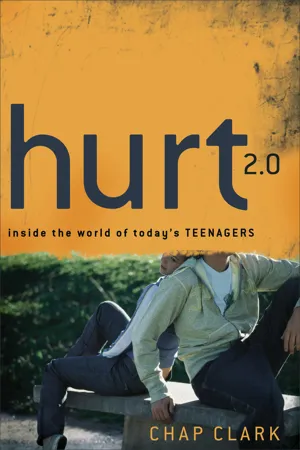
Hurt provided a vivid and insightful view into the world of today's teenagers. Now leading youth ministry expert Chap Clark substantially updates and revises his groundbreaking bestseller (over 55,000 copies sold). Hurt 2.0 features a new chapter on youth at society's margins and new material on social networking and gaming. Each chapter has been thoroughly revised with new research, statistics, quotations, and documentation.
Praise for the first edition
"Based on solid research and years of insightful observation, Hurt offers a deep and penetrating look into the contemporary adolescent experience that will serve us well as we work to have a prophetic, preventive, and redemptive influence on the world of today's youth culture."--Walt Mueller, Center for Parent/Youth Understanding
"A daring yet hopeful glance into the underworld of teen promiscuity, self-mutilation, and suicide. . . . A groundbreaking resource for parents, youth ministers, and counselors."--ForeWord
"Clark's classic book [is] highly recommended by youth workers and educators who write about teenage stress. It is foundational reading that provides valuable insight into the hurting hearts of young people."--YouthWorker Journal
"Clark has been stepping inside the world of teenagers for many years. This book is a unique invitation for us to join him in their world. When we finish this journey, we will care more about kids and understand who they are and the challenges they face."--Denny Rydberg, Young Life
"Drawing together research from many others along with his fresh exploration into the world beneath, Clark paints a compelling picture of adolescent life. . . . This book is a must-read for anyone who has any contact with adolescents."--Journal of Youth Ministry
- 272 pages
- English
- ePUB (mobile friendly)
- Available on iOS & Android
eBook - ePub
About this book
Information
Topic
Theology & ReligionSubtopic
Christian Ministrypart 1
the changing adolescent world
The smiles are genuine, and the flashes of joy are real. There is no doubt that much of life on the surface of the adolescent landscape is light, carefree, and straightforward. This is a time when life can feel like it is full of possibilities and when no barrier seems insurmountable. This is the place where students happily run at the lunch bell, where cheerleaders giggle in packs, and where athletes saunter without a care in the world. On the surface of their world, high school students seem no different from their parents or even their grandparents. The games bring excitement. There are dances and parties to attend, plays to put on, and homework to get done. In the majority of high schools, college is on the mind of many students, and the future seems basically bright and welcoming.
But there is another side to this idyllic picture. The surface of the adolescent landscape is where internal fears, loneliness, and insecurities must be held in check, where friendships are generally shallow, and where performance and image are the name of the game. Beneath the superficial and all-too-often cosmetic layer of high school life, there are dark, lonely corners where the neon light of sanitized conformity seldom penetrates. Just below the sheen of coerced normality are the stress and strain of personal survival in a hostile world.
There are two different perspectives on the nature of the adolescent landscape, depending on one’s viewpoint and on the angle from which one looks at the evidence. Adults believe either that contemporary adolescents are highly nurtured, motivated, and functioning or that they are in dire straits. In this discussion, there is rarely a middle ground.
How is it that we are so divided concerning the state of our young? Asking a vocal advocate of either perspective to answer this question can invite scorn to the point of ridicule.[14] Perhaps the solution lies not in trying to seek compromise between the perspectives but in attempting to reconcile the apparently contradictory data. While recognizing the complexities of the debate, affirming the evidence of well-done empirical research, and intuitively sensing that all is not well with contemporary midadolescents, I sought to find a way to hold these perspectives in tension. Somewhere in the middle of the study an explanation for the conflicting views began to dawn on me: both perspectives are valid and real, yet on different levels. In most settings, for example, adolescents appear genuinely happy, carefree, and seemingly healthy. What the vast majority of high school students confided, however, was a far different story. After months of reflection on and study of the perspectives concerning the adolescent landscape, I concluded that midadolescence is a new, understudied element of the adolescent process and journey. Unlike at any other stage of life, midadolescence is a world of multiple selves.[15] Midadolescents are not able to compartmentalize their lives while operating out of a personal sense of self. Society has let go of personal and individual commitment to the young. Therefore, during midadolescence, they find themselves forced to function out of multiple selves. To survive, a young person must learn how to be a child, a student, an athlete, and a friend, while also continuing the ever-lengthening process of determining who he or she is. In other words, we have allowed a new stage of life known as midadolescence to emerge, and this new stage carries with it new and at times very difficult challenges.
Adolescents have the ability to apply abstract thought and reflective action within a given realm, or “self,” of life. But once a midadolescent has moved on from a self—be it a relationship, a role, an expectation, or an activity—he or she creates a different, almost totally unique conceptualization process in the new self and then applies abstract thought and processing in that context as well. This has always been true of adolescents who have the ability to actualize abstract and nuanced thought processes. But what is new is the lack of ability to construct bridges between one self and another. The inability to see contradictions as contradictions and the ability to easily rationalize seemingly irreconcilable beliefs, attitudes, or values are but two of many markers that may be pointing to an emerging phase of adolescent development and may provide a key indicator of the essence of midadolescence.
In some ways, I am diving into waters that go beyond the scope of my academic training and expertise, yet I am also aware that few have allowed themselves to ask whether changes in culture may have an effect on the cognitive (and therefore moral and even spiritual) development of an adolescent. This is for others to discuss, debate, and research, but I am certain that something is going on, something that has changed the very nature of adolescence.
Part 1 lays the foundation for the premise of this book: adolescents have been cut off for far too long from the adults who have the power and experience to escort them into the greater society. Adolescents have been abandoned. They have, therefore, created their own world, a world that is designed to protect them from the destructive forces and wiles of the adult community. May this section open your eyes to the world beneath.
1
the changing face of adolescence
These kids are no different from when I was a kid. They are just more indulged today. And they have more options—from sports to money to the internet. Kids today are just a more spoiled breed of us when we were young.
high school teacher
This assessment was volunteered by a veteran teacher I had gotten to know over the course of my time on the high school campus. Occasionally, he would ask me how my research was going. On one occasion, he made this definitive declaration. Once he said it, and because of the way he said it, I knew it would not be easy to convince him that, indeed, things had changed—and changed a great deal.
Through numerous conversations since, and by immersing myself in literature related to the study of adolescence from a variety of disciplines, I have become aware that many adults have a similar view of adolescents. The tune of accepted folk wisdom goes something like this: “Kids (i.e., adolescents) have always been kids and have always been a part of the social landscape. Things may change on the surface, but teenagers have always been with us and have always pushed the extremes of adult society. They are basically the same now as they were thousands of years ago. Only the styles have changed.” This perception is regularly supported in articles, stories, media reports, and books about the young. Even the term kids can mean many things.[16] It can refer to any age group from pre-elementary school children to those in their mid to late twenties (such as when a new teacher confided in me, “I’m as much a kid as the guys in my class!”). When referring to the young, adults rarely attempt to distinguish between those who are just leaving the psychosocial and relational confines of childhood and entering that strange and wholly different experience known as early adolescence, and those who are in graduate school living off their parents and “trying to figure out what to do with my life.” It is all too easy in our culture not to ask the question, what is the difference between adolescents today and teenagers of the past? Instead, we fall back on the caricature that kids are kids, and they have always been kids. But is this true?
At times, adults attempt to reach back into antiquity to add credence to this characterization. Socrates, for example, is often erroneously credited with this comment on how the young of his day were viewed: “Our youth love luxury. They have bad manners, contempt for authority; they show disrespect for their elders, and love to chatter in places of exercise. Children are now tyrants, not the servants of their household. They no longer rise when their elders enter the room. They contradict their parents, chatter before company, gobble up their food, and tyrannize their teachers.”[17]
Augustine, bishop of Hippo in North Africa (fourth century AD), is known for his philandering and “adolescent” lifestyle prior to his conversion to Christianity. Augustine himself described his teenage years in his Confessions: “I had a period of leisure, living at home with my parents and not doing any work at all, the brambles of lust grew up right over my head.”[18]
These and a handful of other similar quotations have been cited to add credibility to the notion that young people throughout history have always been basically the same. The attempt is to show that adolescents of antiquity were essentially the same as adolescents of the 1940s and the early 2000s, and that the issues facing adolescents and their responses to them are universal. Indeed, Eddie Haskell, the prototypical deceiving and conniving adolescent of the late-1950s and early-1960s television show Leave It to Beaver, is but one example from the past of a teenager who would be no different today. Add to that James Dean (Rebel without a Cause) in the 1950s, Arthur Fonzarelli (The Fonz from Happy Days) in the 1970s, and even the rebellion showcased in the movie The Breakfast Club in the 1980s, and it is easy to see that in the minds of adults, adolescence has not changed much over the decades or even the centuries. It is for this reason that today’s teenagers—particularly with all the time they spend creating and maintaining profiles on social networking websites—are often deemed to be “all about me, me, me,” even though research has revealed that such activities certainly “need not imply narcissistic self-absorption” but are more likely an extension of peer-group relationships.[19]
This book contends that adolescence is a fundamentally different thing than it was even thirty years ago. There is, in fact, nearly universal support for the idea that adolescence as we know it was a cultural invention of Western society that was first noticed around 1900.[20] Numerous anecdotal narratives across time and cultures depict characteristics of what we call adolescence. The examples often cited (such as the ones above), however, represent extremely unusual exceptions to the record of civilization. Citing these and other examples from antiquity to assert that the adolescent experience in contemporary American culture is equivalent to the experience of teenagers in ancient Greece is participation in a reductionism that is dangerous at best. For example, Socrates’s argument, mentioned above, is not even true to the original text[21] and, moreover, was not concerned with the young but with the excesses of the entire society. In more recent decades, media depictions of rebellious and insolent youth have offered a clear distinction between the “good” kids and those who lived on the fringes of the youth culture rather than the mainstream, like Eddie Haskell in Leave It to Beaver and Happy Days’ The Fonz. Yet society’s view of teenagers has been subtly shifting over the last several decades to where many adults view teenagers in general as insolent, difficult, and arrogant. Even while this perception has gained momentum, there still is this fundamental perspective that kids have always been the way we now see them.
Throughout time and in every society, the dominant culture has seen the young as its most sacred treasure. Because of this, the human life span has historically been understood as having only two primary stages: childhood and adulthood. Children were viewed as a precious and nurtured resource and as such were guided into their place in the world by those responsible to care for them in their family and community. Once a child had completed the rituals, rites of passage, and training experiences necessary to be accepted into interdependent relationships within the adult community, he or she was fully assimilated as an adult member of that community. This process, called the rite of passage by Arnold van Gennep in 1908,[22] had three elements: separation from the old status; transition, usually with a specified ritual; and incorporation into the adult community. For over a century, formalized processes of incorporating the young into adulthood have been devalued, especially in the United States.[23]
First labeled and identified around the beginning of the twentieth century,[24] the span between childhood and adulthood, beginning with puberty and ending with the assuming of full adult responsibilities or even economic independence,[25] was approximately three years. The average age of menarche, the most common measurable marker for the beginning of adolescence in a society, was, prior to 1900, fourteen years, and a person began to assume an adult role in society as young as sixteen. Many accepted developmental theories, created primarily in the mid-twentieth century, tend to view the adolescent journey as a relatively stable, predictable, and orderly, though sometimes difficult, process.[26] For the past two or three decades, however, researchers and theorists attempting to understand human development more fully have challenged many of these orderly themes and stages of development. Postmodern culture has also tossed a proverbial wrench into the gears of developmental theory. In particular, variables such as shifts in cultural values and structure; changes in the family system; new research into peer relations, gender, and ethnic uniqueness; and new ways of thinking about morality, character, and ethics have become increasingly important in describing the nature of adolescence. Some researchers believe that culture has changed so quickly that the developmental, societal, and relational needs of children have been neglected in recent decades and that by the time children reach adolescence they have been left on their own to attempt to navigate the path toward adulthood.[27]
Adolescence—What Is It?
Many adults not only struggle with the notion of changing adolescence but also have a hard time describing what an adolescent is. I have experimented with defining an adolescent in a variety of settings with adults, and with few exceptions, when a group of adults are asked to vote on whether teenagers are big, more sophisticated children or inexperienced young adults, they will invariably be split fifty-fifty, generally with parents of older adolescents voting the former and parents of young children the latter. Society has not provided much help, for the inherent ambiguity and relative imprecision of the term adolescent causes us to fall back on more easily measured and therefore identifiable terms such as teenager and pre-teen or even blatantly generic terms such as youth.[28] Adolescence has been relegated to an amorphous transitionary phase of life. Most people see those in this general age range as being “sort of adults and sort of kids.”[29]
This foggy view of the period of adolescence has given rise to much adult ambivalence and even to systemic neglect. We simply have not agreed on who or what we are dealing with, and it is therefore easier to turn a blind eye to the unique needs of this population. In spite of the rhetoric and wishful thinking that adolescent life has not changed all that much, the vast majority of adults believe that there is something different going on in the world of today’s adolescents. In hundreds of casual and formal conversations I have had with adults, when it comes to nailing down what is truly happening with young people in our society, nearly everyone agreed that the rapid and in many ways severe changes in the last few decades have created new challenges, issues, and dilemmas for adolescents. But what those challenges and issues are and how they impact adolescents remain unclear. On top of this, many adults are not clear about the most fundamental question of all: Are adolescents big children (a view that brings with it a more or less clear set of assumptions) or little adults (a view that moves us into another set of assumptions and practices)? Or a...
Table of contents
- Cover
- Title Page
- Series Page
- Copyright Page
- Endorsements
- Contents
- Preface to Hurt 2.0
- Preface to the First Edition
- Acknowledgments
- Introduction to the Youth, Family, and Culture Series
- Part 1: The Changing Adolescent World
- Part 2: The Landscape of the World Beneath
- Part 3: Where Do We Go From Here?
- Appendix
- Bibliography
- Index
- Notes
Trusted by 375,005 students
Access to over 1.5 million titles for a fair monthly price.
Study more efficiently using our study tools.
Frequently asked questions
Yes, you can cancel anytime from the Subscription tab in your account settings on the Perlego website. Your subscription will stay active until the end of your current billing period. Learn how to cancel your subscription
No, books cannot be downloaded as external files, such as PDFs, for use outside of Perlego. However, you can download books within the Perlego app for offline reading on mobile or tablet. Learn how to download books offline
Perlego offers two plans: Essential and Complete
- Essential is ideal for learners and professionals who enjoy exploring a wide range of subjects. Access the Essential Library with 800,000+ trusted titles and best-sellers across business, personal growth, and the humanities. Includes unlimited reading time and Standard Read Aloud voice.
- Complete: Perfect for advanced learners and researchers needing full, unrestricted access. Unlock 1.5M+ books across hundreds of subjects, including academic and specialized titles. The Complete Plan also includes advanced features like Premium Read Aloud and Research Assistant.
We are an online textbook subscription service, where you can get access to an entire online library for less than the price of a single book per month. With over 1.5 million books across 990+ topics, we’ve got you covered! Learn about our mission
Look out for the read-aloud symbol on your next book to see if you can listen to it. The read-aloud tool reads text aloud for you, highlighting the text as it is being read. You can pause it, speed it up and slow it down. Learn more about Read Aloud
Yes! You can use the Perlego app on both iOS and Android devices to read anytime, anywhere — even offline. Perfect for commutes or when you’re on the go.
Please note we cannot support devices running on iOS 13 and Android 7 or earlier. Learn more about using the app
Please note we cannot support devices running on iOS 13 and Android 7 or earlier. Learn more about using the app
Yes, you can access Hurt 2.0 () by Chap Clark in PDF and/or ePUB format, as well as other popular books in Theology & Religion & Christian Ministry. We have over 1.5 million books available in our catalogue for you to explore.