eBook - ePub
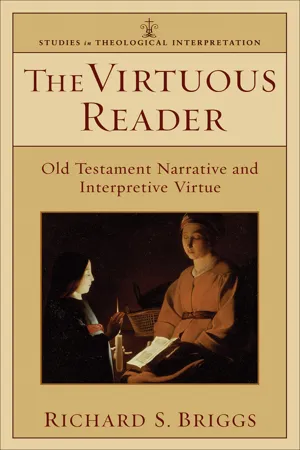
The Virtuous Reader (Studies in Theological Interpretation)
Old Testament Narrative and Interpretive Virtue
- 272 pages
- English
- ePUB (mobile friendly)
- Available on iOS & Android
eBook - ePub
The Virtuous Reader (Studies in Theological Interpretation)
Old Testament Narrative and Interpretive Virtue
About this book
Biblical interpretation expert Richard S. Briggs presents a rich and thought-provoking portrait, or series of portraits, of the kind of character most needed to be a good reader of the Old Testament. He highlights the moral character or virtues most appropriate to the varied tasks of reading the Old Testament, provides insight on theological interpretation, and examines five ways the Old Testament improves our ability to read Scripture well. Briggs also offers a defense of "interpretive virtue" and includes case studies of the Old Testament's shaping of the virtues of humility, wisdom, trust, love, and receptivity.
Information
1
IN PURSUIT OF THE VIRTUES OF THE IMPLIED READER OF THE OLD TESTAMENT
We need several interpretive virtues for wise and faithful reading of Scripture. Prominent among them are receptivity, humility, truthfulness, courage, charity, and imagination. (L. Gregory Jones 2002: 32)
This study is an exploration of the moral character or virtues most appropriate to the many and varied tasks of reading the Old Testament. Its main thesis may be simply stated: implicit in the Old Testament’s handling of a wide range of moral and ethical categories, we find a rich and thought-provoking portrait (or perhaps series of portraits) of the kind of character most eagerly to be sought after, and this in turn is the implied character of one who would read these texts, especially one in search of their own purposes and values. The main way of proceeding will be to build up a series of case studies of particular “interpretive virtues,” as Gregory Jones calls them, as they are handled, either explicitly or implicitly, in various texts of the Old Testament. Not until the conclusion will we give a direct account of the question of what one does with an implied reader once such a character has been described. There we shall be concerned with the broader hermeneutical and ethical considerations that lie in the transition from ideal reading to actual reading. In this first chapter, four tasks need to be accomplished in order to map out the hermeneutical space within which we shall operate.
- The idea of an “interpretive virtue” needs to be clarified, in dialogue with the concerns of virtue ethics and some issues in “theological interpretation” of biblical texts.
- The notion of an implied reader needs brief clarification.
- Some of the endless hermeneutical and theological questions surrounding the term “Old Testament” and its value as an independent topic of study need brief treatment, if only to avoid being waylaid by them in subsequent chapters.
- Finally, a brief plan of the remainder of the study will be offered.
The Interpretive Virtues
The phrase “interpretive virtue” does not have a clear history or prominent tradition behind it. I can find no discussion of it in the fields of philosophical hermeneutics or literary theory.[1] It has not acquired prominence in either philosophical or theological inquiry into the virtues in general.[2] My starting point will be a significant discussion of it in the context of Christian concerns about interpreting biblical texts that occurs in Kevin Vanhoozer’s discussion of hermeneutics, Is There a Meaning in This Text? (1998). As part of its subtitle, this study indicates that it is occupying itself with questions of “the morality of literary knowledge.” The book as a whole is a sustained plea for “hermeneutical realism,” and in his final chapter, Vanhoozer explicitly addresses the question of the nature of the reader of the text, defending the moral virtue of “respect for what is there in the text.” This leads him to develop an account of what he calls “the interpretive virtues”: “An interpretive virtue is a disposition of the mind and heart that arises from the motivation for understanding, for cognitive contact with the meaning of the text” (1998: 376, italics original). In addition to faith, hope, and love and their significance for hermeneutics, he suggests four further interpretive virtues in the first instance:
- Honesty: “acknowledging one’s prior commitments and preunderstandings.”
- Openness: being “willing to hear and consider the ideas of others . . . without prejudice.”
- Attention: the reader is “focused on the text,” with respect, patience, thoroughness, and care.
- Obedience: which means “not necessarily . . . doing what the text says, but . . . minimally, reading it in the way its author intended” (1998: 377).
As we shall see in a later chapter, the climax of his 500-page book is a call for a hermeneutic characterized by humility, though he does not explicitly list this as one of the interpretive virtues in view.
Taken together, we have here anything from four to eight specific virtues articulated as keys to right interpretation. One need not doubt that all of them are greatly to be sought after. Equally, to anticipate a point about the role of Scripture in our hermeneutical reflection, it seems that one need not have read the Bible in order to understand fully what Vanhoozer is talking about, although the status of “faith, hope, and love” as a foundational triad of virtues would perhaps be more evident to those who know 1 Corinthians 13:13 than to those who do not.[3]
Vanhoozer does not do a great deal with his list of virtues, which may be partly because his overall agenda concerns how the Bible ought to be read, as a trinitarian communicative act with a definite (though possibly multilayered, or even multiple) content and illocutionary force. In this scheme, the virtuous reader is one who operates within this conception of what constitutes the task of reading the Bible, even to the point where the key quality of humility is characterized primarily as “a prime interpretive virtue” that “constantly reminds interpreters that we can get it wrong” (1998: 463–64). In other words, humility represents the stance of standing “under” the definite meaning and force of the text rather than “over” it: understanding rather than overstanding, as Vanhoozer puts it.
The overall merits of Vanhoozer’s approach to hermeneutics are not our concern here. Instead, two points of specific evaluation may be ventured. First, it is not clear that this account of the virtues, which will serve as a springboard for our own inquiry, plays an especially significant role in the overall scheme of Vanhoozer’s hermeneutics.[4] Vanhoozer’s main concerns rest with meaning and force, tying together the classic speech-act triad of author, text, and reader in a productive and subtle proposal for considering questions of interpretation. His subsequent work broadens out these concerns in yet richer and more theologically nuanced ways but in fact does so without taking up the notion of interpretive virtue.[5] A similar point may be made about the brief discussion of “sapiential virtues” in his subsequent The Drama of Doctrine, where he notes the moral/intellectual and theological virtues that constitute the Aristotelian notion of phronēsis (2005a: 332–35). Elsewhere in this work he notes that “according to the canonical maps, . . . virtue requires a renewing not only of the mind but also of the whole being; it requires a work of transforming grace, a reorientation to truth” (2005a: 303). Again, one may recognize here a profoundly helpful characterization of the relevance of “virtue” thinking to the tasks of articulating theological understanding without going so far as to say that this insight is deeply woven into the fabric of the overall argument.
Second, especially given the way in which the notion of “interpretive virtue” does not particularly drive or even shape the argument, one may suggest that along the way to his own particular goal, Vanhoozer has coined a term that may usefully serve for purposes other than the (singular) one to which he puts it. In short, an “interpretive virtue” is a virtue relevant to the task(s) of interpretation, regardless of how one evaluates Vanhoozer’s particular view of what that task is—“cognitive contact with the meaning of the text,” in the definition quoted above (1998: 376). Thus one may extract the other part of his definition and work with it outside such a framework: an interpretive virtue is a disposition of the mind and heart that arises from the motivation for achieving good interpretation. In the quote from Gregory Jones with which we began, and which is without doubt operating with a different conception of the task of hermeneutics from Vanhoozer’s 1998 work, one might render this definition in terms of interpretive virtues being those dispositions that lead to “wise and faithful reading of Scripture” (2002: 32).
There is of course some sense of circularity, or perhaps begging the question, about such formulations: virtues help you to achieve good/wise/faithful ends, but how does this get you past defining virtue in terms of what achieves the good, and the good in terms of what results from the practice of virtue? This apparent risk of circularity is a familiar one to those aware of the broader discipline of virtue ethics, of which we must offer here the briefest of accounts.
Virtue Ethics
The major articulation of virtue ethics in recent times is the seminal work of Alasdair MacIntyre, After Virtue (1984). In this and subsequent works, MacIntyre has put forward the claim that much modern thought (which he characterizes as an “Enlightenment project”) has reduced moral language to “emotivism,” the expressing of individual preference. This rootless moral language of disembodied values, he suggests, has taken hold in the wake of the collapse of a longer and more robust tradition of speaking in terms of virtues and practices that nourish and sustain human communities. The various definitions of the key terms that MacIntyre uses reveal that they interlock: “The virtues are to be understood as those dispositions which will not only sustain practices and enable us to achieve the goods internal to practices, but which will also sustain us in the relevant kind of quest for the good . . . and which will furnish us with increasing self-knowledge and increasing knowledge of the good” (1984: 219). The main definition of practices is harder work but essentially suggests that practices are cooperative human activities with their own internal “goods” and standards of excellence (1984: 187). In other words, practices have their own inbuilt values, which bring with them appropriate practice-specific recognitions of levels of achievement. The virtues facilitate excellence in practices, and all contribute to the quest for human good.
To what then does this quest for the good lead? The clearest passage on this in MacIntyre’s book, to my mind, comes in the section where he is simply laying out Aristotle’s own account of the virtues from the Nicomachean Ethics. It is worth quoting at length:
What then does the good for man turn out to be? Aristotle has cogent arguments against identifying that good with money, with honor or with pleasure. He gives to it the name of eudaimonia—as so often there is a difficulty in translation: blessedness, happiness, prosperity. It is the state of being well and doing well in being well, of a man’s being well-favored himself and in relation to the divine. But when Aristotle first gives this name to the good for man, he leaves the question of the content of eudaimonia largely open.
The virtues are precisely those qualities the possession of which will enable an individual to achieve eudaimonia and the lack of which will frustrate his movement toward that telos. (1984: 148)
The virtues are precisely those qualities the possession of which will enable an individual to achieve eudaimonia and the lack of which will frustrate his movement toward that telos. (1984: 148)
Much of MacIntyre’s subsequent argument, in this and later works, is concerned with developing, correcting, and reappropriating this moral vision for today’s world. In particular, this teleological category of eudaimonia works well as long as it is the only telos in view, but how is one to judge between competing views of what “the end of man” is? It is Aquinas who co-opts Aristotle’s system into a Christian vision of how to live the moral life, and this raises an obvious question about After Virtue, which is how it can account (either in theory or in practice) for contested notions of telos. In particular, as MacIntyre notes in the second edition of the book, he has failed to discuss the competing claims of the Aristotelian and the biblical views of such a telos (1984: 278).
His subsequent work (in particular 1988; 1990) tackles the question of how to evaluate across competing systems of justice and rationality once more than one functioning set of virtues is in view (MacIntyre 1988), especially given that the kind of cross-tradition argument available to him is not that found in twentieth-century moral philosophy, where one may make judgments about whether a view is right or wrong on some metalevel independently of its place within its own tradition. (Such an approach, the encyclopedic view, is one of the “three rival versions of moral enquiry” that he finds wanting; MacIntyre 1990.)
Utilizing the Concerns of Virtue Ethics
For our purposes, it is not necessary to resolve all the questions raised by (and about) virtue ethics.[6] All we need to draw out of this discussion at this stage is the recognition of the tradition of virtue ethics that lies behind the notion of an “interpretive virtue,” which we have developed from Vanhoozer’s work. As for the plausibility of transplanting this kind of language into the concerns of hermeneutics, it is noteworthy that Vanhoozer himself develops the idea from the epistemological work of Linda Zagzebski, Virtues of the Mind (1996).[7] Zagzebski offers a penetrating account of how to reformulate many traditional epistemological questions (e.g., concerning knowledge, justification, and belief) in virtue terms. Along the way she makes several points helpful to a project of biblical interpretation, of which we may note three.
The basic point of her analysis is that knowledge is one form of the “good” (eudaimonia) noted in virtue-based approaches to human living, and that “if there are intimate connections between knowledge and happiness, it should not be surprising that the pursuit of one is not easily separable from the pursuit of the other” (1996: 338). This is not quite what philosophers mean when they talk of “virtue epistemology,” largely for contingent reasons relating to the questions that happen to have fallen under that label (cf. the edited collection of Fairweather and Zagzebski 2001), but the shorthand will suffice for our purposes. In short, and allowing for all the caveats and recognitions that virtuous people do not act invariably on their best apprehensions, her thesis is that, all other things being equal, one who is morally virtuous is more likely to make wise judgments. An account of how one judges (epistemologically) finds congruence with an account of how one lives morally in other spheres.
Second, to make her case, she challenges the standard (philosophical) distinction between moral and intellectual virtues, drawing in part on the point that other disciplines (e.g., cognitive psychology) no longer find it plausible to separate out a notion of the intellect from the wider embodied nature of the brain. Zagzebski mounts a strong argument for maintaining that “an intellectual virtue does not differ from certain moral virtues any more than one moral virtue differs from another” (1996: 139; cf. 137–65). Indeed, in certain cases, such as honesty, the moral virtue is inextricable from intellectual ones (such as truth-telling; 1996: 158–59).
Third, she offers a concise analysis of the standard difficulty of finding a list of virtues sufficient to the task of characterizing what sort of concerns occupy virtue ethics. This difficulty goes back to the earliest attempts to make sense of Aristotle’s own classification, or to compare it with that of Aquinas, or to search for some form of rationale for how many virtues there are or how they might be interrelated.[8] Zagzebski notes that there is a “pre-theoretic” notion of virtue, which serves as a constraint on any list put forward, and discusses how one may get past various culture and tradition-specific blocks that lie down the path of listing virtues (1996: 84–89).[9]
Zagzebski’s work is an example of utilizing the concerns of virtue ethics in an allied but distinct field of inquiry and thus lends itself most helpfully to any concern to develop an account of how virtue ethics sheds light on interpretive questions. Indeed, it is this insight that underlies Vanhoozer’s development of the notion of the “interpretive virtues.” One may therefore take up the three points just noted as follows.
First, how one interprets is not an entirely separable activity from how one lives the human life. Mindful of caveats, and noting the variability of how wise readers do or do not follow their own best practices, one finds this precise point made by Stephen Fowl in a short dictionary article on the relevance of the virtues to theological interpretation: “Given that Christians are called to interpret Scripture as part of their ongoing journey into ever-deeper communion with God, it is not surprising that those who have grown and advanced in virtue will tend to be masterful interpreters of Scripture” (2005: 838). As Fowl observes, this is not a mechanical operation whereby wise people offer wise readings and others do not, but the caveats and variables should not obscure the general point.
Second, interpretive virtues may not be entirely divorced from the moral virtues more generally. A hermeneutic of trust, to anticipate a later discussion, is related in some sense at least to the general virtue of trust (cf. also Zagzebski 1996: 160–61). Third, and briefly at this stage, it will not be possible to offer a definitive listing of interpretive virtues, although clearly one may still assess the ad hoc claims of one or another hermeneutical category to be a virtue, such as, indeed, a hermeneutic of suspicion or of trust.
MacIntyre’s work has been well received by Christian theologians and ethicists without it being assumed that one could simply transpose his Aristotelian argument into Christian tradition. Thus, in their robust theological analysis, Hauerwas and Pinches note that “if the language and logic of virtue tips in any direction, it is away from Christianity and toward the Greek context in which it originated. For Christians, it can be used with great reward, but it must be purified as used or else bear bad fruit” (1997: 57). Part of this purification, for them, is replacing the Greek notion of polis with a theology of participation in the bo...
Table of contents
- Cover
- Series Page
- Title Page
- Copyright Page
- Dedication
- Contents
- Series Preface
- Author Preface
- Abbreviations
- 1. In Pursuit of the Virtues of the Implied Reader of the Old Testament
- 2. Neither Meek nor Modest: The Puzzling Hermeneutics of Humility
- 3. Wisdom to Discern the Living Interpretation from the Dead
- 4. Like a Hermeneutic in a Cage: The Eclipse of Biblical Trust
- 5. Love in the Time of Monotheism: The Blessing of Interpretive Charity
- 6. Summoned: The Virtue of Receptivity
- 7. The Virtuous Reader of Old Testament Narrative: From the Implied Reader to the Real Reader
- Bibliography
- Subject Index
- Author Index
- Scripture Index
- Notes
Trusted by 375,005 students
Access to over 1.5 million titles for a fair monthly price.
Study more efficiently using our study tools.
Frequently asked questions
Yes, you can cancel anytime from the Subscription tab in your account settings on the Perlego website. Your subscription will stay active until the end of your current billing period. Learn how to cancel your subscription
No, books cannot be downloaded as external files, such as PDFs, for use outside of Perlego. However, you can download books within the Perlego app for offline reading on mobile or tablet. Learn how to download books offline
We are an online textbook subscription service, where you can get access to an entire online library for less than the price of a single book per month. With over 1.5 million books across 990+ topics, we’ve got you covered! Learn about our mission
Look out for the read-aloud symbol on your next book to see if you can listen to it. The read-aloud tool reads text aloud for you, highlighting the text as it is being read. You can pause it, speed it up and slow it down. Learn more about Read Aloud
Yes! You can use the Perlego app on both iOS and Android devices to read anytime, anywhere — even offline. Perfect for commutes or when you’re on the go.
Please note we cannot support devices running on iOS 13 and Android 7 or earlier. Learn more about using the app
Please note we cannot support devices running on iOS 13 and Android 7 or earlier. Learn more about using the app
Yes, you can access The Virtuous Reader (Studies in Theological Interpretation) by Richard S. Briggs, Bartholomew, Craig G., Green, Joel, Seitz, Christopher, Craig G. Bartholomew,Joel Green,Christopher Seitz in PDF and/or ePUB format, as well as other popular books in Theology & Religion & Biblical Criticism & Interpretation. We have over 1.5 million books available in our catalogue for you to explore.