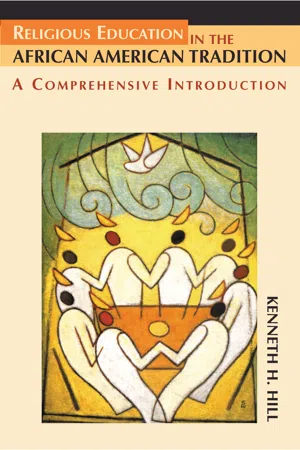
This book is a comprehensive survey of African American Christian Religious Education (AACRE). It addresses historical, theological, and ministerial issues. Kenneth H. Hill defines concepts and explores history, considers the diverse voices that are addressing AACRE, and focuses on educational theory and practice. Religious Education in the African American Tradition considers a diversity of voices, including those of evangelical, pentecostal, liberation, and womanist African American theologians.
eBook - ePub
Religious Education in the African American Tradition
A Comprehensive Introduction
- 224 pages
- English
- ePUB (mobile friendly)
- Available on iOS & Android
eBook - ePub
About this book
Information
Topic
Teología y religiónSubtopic
ReligiónPART ONE
CHAPTER ONE
Understanding the Discipline
The Rise of African American Christian Religious Education
Prior to 1974, African American Christian religious education (AACRE) was relatively unsystematized in whatever forms in which it was expressed. Grant Shockley’s research in 1974 contributed significantly to the liberation of Black Christian religious education history and consciousness.1 Moreover, his research contributed to the development of AACRE as an academic discipline. His research brought to the attention of theological educators, Black and White, the relevance of the academic study of African American religion and education. The term “African American Christian religious education” should not be taken to mean that no scholarly works by African Americans were produced before 1974. To name a few, scholars such as W. E. B. Dubois, Carter G. Woodson, E. Franklin, and Benjamin E. Mays attest to the presence of scholarly interest in the study and interpretation of African American religion well before the 1960s.
What kind of research and scholarship has been done on AACRE? What can be said about the general state of the literature? Research on AACRE prior to the 1880s is part of the history of White Christian religious education. White scholarship on the history of religious instruction of enslaved Blacks tells more about White Christianity and the White religious mission than about the religion of the slaves. From the beginning of the Atlantic slave trade, conversion of the African to Christianity was used as a justification for enslavement of Africans. Gomes Eannes De Azurara, a chronicler of the fifteenth century, observed, “The greater benefit belonged not to the Portuguese adventurers but to the captive Africans, for though their bodies were now brought into some subjection, that was a small matter in comparison of their souls, which would now possess true freedom for evermore.”2 Azurara’s mid-fifteenth century observation was to be repeated for four centuries by successive generations of White scholars, intellectuals, and researchers of slavery—a very “White Christianity” view of the situation. In addition, despite the widely held justification of slavery as a means of spreading the gospel, religious instruction of slaves was blocked by major obstacles, not the least of which was antipathy of the slavers and colonists themselves. Therefore, one of the tasks of Christian education is revision. The task of revision is construed primarily as a corrective of the omissions made by “White Christian education.”
The earliest account of efforts to instruct Blacks in the Christian faith was published in 1842, The Religious Instruction of the Negroes in the United States, by Charles C. Jones. His work, like other early research on the Black religious experience, assumed that Blacks were culturally uncivilized, religiously heathen, and biologically subhuman. Unfortunately, Jones’s examination of slaves’ lives and thoughts about Christianity failed to appreciate the religion of the slaves (e.g., African Traditional Religion). He wrote, “The superstitions brought from Africa have not been wholly laid aside…A plain and faithful presentation of the Gospel usually weakens if not destroys these superstitions.”3 Shockley reminds us that research in AACRE had a history. He documented the extent to which religious education among Blacks before the Civil War accommodated the interests of slaveholders, and later in the nineteenth century seldom related itself to the experience of racism that dominated the lives of African Americans.4
Origins of the Discipline
African American religious studies, as an academic discipline, began as a political demand that had its origin in both the Black studies and “Black Power” movements of the 1960s. However, it was not until the Black studies movement erupted on seminary campuses in the 1970s, when there were critical masses of Black students, that we began to hear of Black church studies, or African American religious studies programs.5 The initial thrust of the Black student movement on seminary campuses was to organize Black seminarians into a self-conscious organization capable of defining and advocating their interests.
Prior to the contemporary Black theological movement in seminaries and divinity schools, African Americans could not study and concentrate on African American religion as a legitimate academic subject area. Black theology made the study and interpretation of African American religious thought a genuine possibility in institutions of higher learning. For example, one of my classmates at Harvard Divinity School was studying to earn a Ph.D. in Old Testament. However, a dissertation proposal on comparing sacrifice in the Old Testament with African Traditional Religion was rejected by the chair of the dissertation committee as an illegitimate area of study.
The second thrust of the Black student movement on seminary campuses began with the demand for African American religious studies. For example, I served as the leader of this movement at Harvard Divinity School in 1975. The Black seminarian organization “Harambee,” which I served as the first president, held a demonstration at the divinity school that changed the way the school related to Black seminary students, hired Black faculty, and established courses on the African American religious experience. Today many of these former classmates have become premier preachers, theologians, and educators worldwide. I think of Temba L. Mafico, Cornell West, Robert Franklin, Elliott Mgogo, Frank Madison Reid, Fred Lucas, Sunday Mbang, Kathy Gatson, Samuel Hogan, Eugene Rivers, Melvin Brown, Eleanor Ivory, Andy Cleo Lewter, Dexter Wise, Rita Dixon, Thomas Scott, and Simon Maimela.
The third thrust focused on the task of legitimization. Grant Shockley’s thinking and writing provided legitimacy for the academic study of AACRE. Shockley might be considered the architect of the new discipline of AACRE. He was certainly steeped in the subject that would come to be a source for the new discipline. Shockley has been the most influential and prolific Black religious education theorist and writer of the past twenty-five years. As an academic he drew heavily on the scholarship and writings of Black Power, theology, and liberation. Shockley’s engagement with the interplay of religious education and Black theology contributed to our understanding of AACRE as a distinct academic discipline within Christian religious education.
Shockley was typically the only Black person writing on Black Chris tian education and lacked the resources, sources, and colleagues needed to articulate indigenous Black religious and educational traditions. Nonetheless, his research brought to the attention of religious scholars and church educators the history of Black religious education. His articles in the 1970s were the beginning for the emerging Black Christian religious education consciousness. In more recent times, other writers and educators have continued the legacy of Shockley.
Relevance of the Discipline
One of the most important concepts in the Black student movement was relevance. It emanated from Christian education’s contribution to liberation. Thus, Shockley would contribute to providing quality and relevant scholarship, teaching the African American religious experience, and helping us to understand Christian education within the African American context. His research efforts resulted in assembling and creating a body of knowledge, which was contributive to religious and intellectual liberation.
Shockley’s scholarship linked the seminary and the church and was enhanced by his unique position as churchman and scholar. This relationship was best posed in his statement, “Christian educators in the Black church are beginning to recognize…the new questions for Christian education are essentially contextual. From goal-setting to evaluating, Black educators…are viewing the educational process in relation to the kind of learning and teaching that considers the Black experience as central and the liberation of Black people as its focal point.”6 The intent here was to serve and elevate the life conditions and consciousness of Blacks and reinforce the student’s relationship with the church through theological and educational discourse. Thus the classic alienation between the religious intellectual/academy and the church is thwarted where knowledge is shared and applied in the service of liberation.
Finally, the current thrust is to establish AACRE as a legitimate, respected, and permanent discipline. This remains both an academic and political problem. The political problem is to win the battle of acceptance with administrators and other departments that question its relevance and viability. The academic problem is to answer the critics of African American religious studies with counterarguments, critical research, solid intellectual production, and effective teaching.
The criticism, however, does not really hold weight given African American religious studies history of teaching, research, and service to students and the university. The relevance of AACRE is its contribution to Christian religious education in general. AACRE poses a more inclusive view of religious education in the United States. It provides an essential theoretical and critical corrective to religious education. It has also demonstrated its relevance as a contribution to the reconstruction of Black history and religion, rejecting the racists myths assembled to deny them.
A final expression of the relevance of AACRE is its contribution to the development of an intellectual/professional stratum where knowledge and social competence translate as a vital contribution to the liberation of the Black church and community. It is at this point that the academy and church benefit from AACRE and become an expression of knowledge placed in the service of community. It is also reflected in the educational philosophy of African American universities, colleges, and seminaries, which have historically structured curricula and instruction to produce the leaders, educators, and pastors society needs.
Scope of the Discipline
The scope of AACRE is interdisciplinary, with its own particular focus on the interplay between theology and education. The scope of the discipline is the totality of theological, historical, and religious thought and practice, even as it allows for and encourages an integrative approach to subject areas within the discipline. As interdisciplinary, AACRE becomes a paradigm for the multidimensional approach to Black religious reality. It is a model of a holistic approach, not simply focusing on Blacks, but including third-world peoples, women, and Whites. It is critical and corrective of the inadequacies and omissions of Eurocentric approaches. Moreover, as a new discipline it is not restricted by the old paradigms, methodologies, and theories of earlier research.
My contention is that in the history of AACRE there have been a number of classic works.7 These works of Christian education have not received the attention of religious educators, mainly because of the need to establish the legitimacy of AACRE as an academic discipline. AACRE brings theory and practice together to make academic study and religious education praxis an experience of both personal formation and transformation in the quest for human liberation. Thus, AACRE becomes the discipline for praxis between the Black church and the academy.
Reflections on the Status of Research
What is the state of current research on the theory and practice of AACRE? To set that question in its broader context in contemporary graduate theological education, I will venture some observations on the challenges of AACRE as an educational enterprise. As previously stated, AACRE has suffered a dearth of scholarship, which exacerbates the situation for researchers, professors, and scholars interested in the topic. A cursory survey of the literature in the field of religious education from the Black perspective indicates relatively few books but numerous articles.
The literature of AACRE is diverse and limited: diverse when considered within the broader discussions and literature of Christian religious education before the 1960s, and limited when considered as the product of our own scholastic communities. However, a breakthrough is noticed in the literature beginning with the post-civil rights movement period. The 1960s marked the rise of research on AACRE. E. Franklin Frazier’s The Negro Church in America became the seminal book on the educative role of the Black church. What theoretical, methodological, and research directions have occurred in the development of AACRE?
Substantive methodological changes occurred in the 1970s, which broaden our understanding of AACRE. These books include Olli Alho’s The Religion of the Slaves: A Study of the Religious Tradition and Behavior of Plantation Slaves in the United States 1830–1865, and Albert J. Raboteau’s Slave Religion. The importance of these studies is that they rely on slave narratives, spirituals, Black autobiographies, folk tradition, and African tradition religion as sources for the study of religious instruction. Alho and Raboteau focused on the communal role of the slave family and ritual as the primary structures of education.
In the genesis of AACRE as a distinct field, a number of important essays by such leaders as Grant Shockley and Olivia Pearl Stokes established the agenda to which a later generation of scholars has contributed. These authors provide an important analysis of the theological and cultural factors that have shaped AACRE.
Grant Shockley’s essay, “Christian Education and The Black Church: A Contextual Approach,” frames the thinking about the Black religious education experience.8 His attention was drawn to the institutional and socio-cultural experience of Blacks in America.
Olivia Pearl Stokes’s “The Educational Role of Black Churches in the 70’s and 80’s” was both clearer and more cultural. Stokes was aware of both the potentials and limitations of Black religious education. In relating Christian education to the Black religious experience, Stokes states, “We must have a curriculum that reflects the values of the Black experience and develops techniques for liberation.”9 For her, research in religious education was clearly a theological and cultural search for understanding. The understanding that these formative figures had of Black religious education as a discipline is significant to our search for identity. They did not understand their task as simply borrowing insights from the other disciplines. Although they were deeply informed by philosophy, history, theology, and the other sciences of education, they saw this discipline as providing only raw data to be reconstructed into new theoretical concepts.
AACRE is coming into its own as a distinct field. Intensified efforts in recent years provide a new self-understanding of the richness of the educational dimensions of the African American religious education experience. The new additions to the corpus of literature include a sociocultural perspective on AACRE. The Black Church in the African American Experience offered a sociological examination of the influence of Black consciousness on the educational content of the Black church and to the provision of Black role models in Sunday school materials. This study revealed that Christian religious education needs to be sensitive to the cultural world and worldview created by African Americans.10
Other important studies by Joseph V. Crockett and Anne S. Wimberly broaden the field to increase awareness of the hermeneutical and pedagogical concerns.11 There are signs that research in AACRE is passing from childhood into adulthood, which had been envisioned by our progenitors. The twenty-first century has accumulated a growing body of literature about the “discipline in search of an identity.” AACRE as a body of knowledge and field of study is still in progress. There is a self-conscious community of scholars who study, practice, and teach this body of knowledge.
Presently the discipline of AACRE is developing in three directions. Each of these directions is rooted in the history of the discipline and is represented by major thinkers. The first direction centers on the attempt to formulate a Black theology of education. Religious education scholars agree that an intimate relationship exists between theology and Christian education. The work of James Evans, James H. Harris, Grant Shockley, Olivia Stokes, and Okechukwu Ogbonnaya provides major representation of this direction. These scholars affirm Black theology as the primary focus for African Americans. A close look raises a number of issues about the role of theology. The issues are: Black theology as the content for Christian education theory and practice; contemporary Christian education theory and practice in African and Christian communal understanding of God and humanity; the use of Black theology by educators/pastors to train clergy and laity and other leaders who in turn explain and defend it; the necessity of Christian education and Black theology to engage in dialogue to bridge the gap between theory and practice; and collaboration between Black theologians and Black church intellectuals to enlarge Black religious thought.
The second direction focuses on the theory and practice of religious education. How do we educate? What approaches have found their way into ...
Table of contents
- Cover Page
- Halftitle Page
- Title Page
- Copyright Page
- Contents
- Acknowledgments
- Preface
- Foreword
- Introduction
- Part One
- Part Two
- Part Three
- Notes
- Bibliography
Trusted by 375,005 students
Access to over 1.5 million titles for a fair monthly price.
Study more efficiently using our study tools.
Frequently asked questions
Yes, you can cancel anytime from the Subscription tab in your account settings on the Perlego website. Your subscription will stay active until the end of your current billing period. Learn how to cancel your subscription
No, books cannot be downloaded as external files, such as PDFs, for use outside of Perlego. However, you can download books within the Perlego app for offline reading on mobile or tablet. Learn how to download books offline
Perlego offers two plans: Essential and Complete
- Essential is ideal for learners and professionals who enjoy exploring a wide range of subjects. Access the Essential Library with 800,000+ trusted titles and best-sellers across business, personal growth, and the humanities. Includes unlimited reading time and Standard Read Aloud voice.
- Complete: Perfect for advanced learners and researchers needing full, unrestricted access. Unlock 1.5M+ books across hundreds of subjects, including academic and specialized titles. The Complete Plan also includes advanced features like Premium Read Aloud and Research Assistant.
We are an online textbook subscription service, where you can get access to an entire online library for less than the price of a single book per month. With over 1.5 million books across 990+ topics, we’ve got you covered! Learn about our mission
Look out for the read-aloud symbol on your next book to see if you can listen to it. The read-aloud tool reads text aloud for you, highlighting the text as it is being read. You can pause it, speed it up and slow it down. Learn more about Read Aloud
Yes! You can use the Perlego app on both iOS and Android devices to read anytime, anywhere — even offline. Perfect for commutes or when you’re on the go.
Please note we cannot support devices running on iOS 13 and Android 7 or earlier. Learn more about using the app
Please note we cannot support devices running on iOS 13 and Android 7 or earlier. Learn more about using the app
Yes, you can access Religious Education in the African American Tradition by Kenneth H. Hill in PDF and/or ePUB format, as well as other popular books in Teología y religión & Religión. We have over 1.5 million books available in our catalogue for you to explore.