Building on the success of his 1992 collection Foundations of Ministry (over 17,000 sold), Michael Anthony offers Introducing Christian Education to fill the need in the C.E. curriculum for an introductory foundations textbook--one that provides an overview and understanding of the broad range of subjects included in C.E.--for college and seminary use.
Thirty-one chapters are offered under the following sections: 1) Foundations of C.E.; 2) Developmental Perspectives of C.E.; 3) Educational Implications of C.E.; 4) Organization, Administration, and Leadership; 5) C.E. Applied to the Family; and 6) Specialized Ministries. Contributors include Robert Pazmiño, Jim Wilhoit, Julie Gorman, Klaus Issler, and Ted Ward.
FROM THE FOREWORD BY LESTER C. BLANK JR.
Introducing Christian Education will become a major resource text for church leaders and Christian education leaders who are professors of Christian education. It will be a valuable resource in my personal library. The desired outcome will be Psalm 78:72: "He cared for them with a true heart and led them with skillful hands."
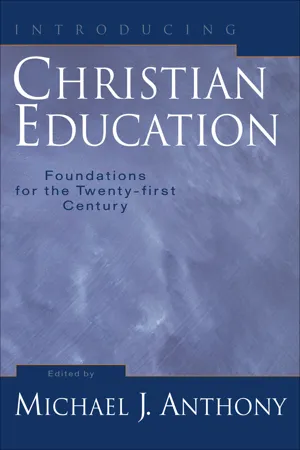
eBook - ePub
Introducing Christian Education
Foundations for the Twenty-first Century
- 304 pages
- English
- ePUB (mobile friendly)
- Available on iOS & Android
eBook - ePub
Introducing Christian Education
Foundations for the Twenty-first Century
About this book
Information
Topic
Theology & ReligionSubtopic
ReligionFoundations of Christian Education
HISTORICAL FOUNDATIONS OF CHRISTIAN EDUCATION
1
1
Kevin E. Lawson
Christian education can be viewed as an effort to encourage people to gain an authentic relationship with God. A variety of approaches to achieve this end have been employed throughout time. Beginning with the Old Testament, this chapter traces the various formal and informal means developed by God’s people to encourage others to grow in their relationship with him. Reading this historical overview will provide the reader with an appreciation for what others have done to facilitate the spiritual formation of God’s people.
TEACHING AND LEARNING IN THE OLD AND NEW TESTAMENTS
Jewish Education before the Exile
Throughout the early history of Israel, the family was the chief educational institution of society. Children learned through informal participation in family life and by parental example. Fathers were to teach their children God’s law and a trade to earn a living. Deuteronomy 6:4–9, the Shema, presents both the goal and process of education. The people were called to acknowledge and love the one true God and to teach his Word to their children in the daily activities of life. There were no formal schools for the children to attend, but as parents grew in their knowledge of God’s law, they were to teach it to their children and reinforce it through their own example and conversation.
The Levites served as priests for the people, representing them before God in acts of worship and prayer, and as teachers, instructing them in the observance of God’s laws. They led the nation in celebrating the various rites, feasts, and festivals that God had decreed. These ceremonies helped the people remember what God had done in the past and provoked curiosity in the children so that they would ask questions and be instructed by their parents. The Feast of Weeks, Feast of Trumpets, Day of Atonement, and other festivals were times for remembering and instructing (Exod. 12:25–27; Lev. 23). For example, the special foods and preparation that preceded Passover served to mark that night as different from all others throughout the year. The children noticed these differences, and their questioning became the opportunity for parents to tell how God had delivered Israel out of Egypt.
Jewish Education after the Exile
Because of Israel’s disobedience and unfaithfulness to him, God used the expanding Babylonian empire to send Israel into captivity. Separated from their homeland, the people came to understand the importance of God’s law, the Torah, and their need to know and obey it. The written Torah included the Law (the Pentateuch), the Prophets (historical and prophetic books), and the Holy Writings (Psalms and wisdom literature). Oral interpretations of the written Torah, the Mishnah, were also passed down through the generations.1
The scribes were religious leaders who studied and interpreted the law and taught it to the people. Following the exile, synagogues where the Scriptures could be read and explained to the people were established in every village in Palestine. On the Sabbath, the people gathered for the recitation of the Shema, prayer, the reading of the Torah and Prophets, and the blessing. These times of instruction were geared for adults, who in turn were expected to instruct their own children.2
With the importance attached to knowing and understanding God’s Word, education was highly valued, and the teacher, or rabbi, was held in highest esteem within Jewish culture. Education was viewed as a precious privilege because it allowed one to know God better and understand how to live in obedience to him. Over time, people like the Pharisees carefully studied both Scripture and the Mishnah and established rules that served as a hedge to help people keep from violating God’s laws. These traditions came to be as binding on the people as Scripture itself.
Teaching and Learning in the New Testament
Compared with the scribes and Pharisees of his day, Jesus’ teaching ministry was unique in many ways. First, Jesus taught as one with authority. When he taught Scripture, he gave his own interpretation, not one memorized from the Mishnah or presented on the authority of tradition (Mark 1:22). Second, he taught many people on whom the teachers of his day would not have wasted their time—women, Gentiles, and “sinners.” He welcomed children and did not send them away. Third, he taught wherever he went—in the synagogue, in homes, by the sea, on hillsides, wherever the people were. Fourth, he used a wide variety of teaching methods. Object lessons, parables, dialogue, and puns helped people remember what he taught while hiding the truth from those who did not want to understand and respond to it. Finally, Jesus perfectly lived out what he taught, thus providing a model for understanding what it means to love God and our neighbors in our everyday lives. Jesus’ ministry of teaching helped prepare his followers to understand the meaning of his life, death, and resurrection (Matt. 28:18–20).
The Book of Acts shows how Christ’s disciples began to live out the Great Commission (Acts 2:42; 5:42; 6:2). Almost immediately we see them preaching and teaching concerning Christ’s death and resurrection, exhorting people to place their faith in him and receive eternal life. The apostles gave themselves to the task of teaching those who responded to the gospel. Their teaching focused on five areas: (1) the good news of the gospel of Christ; (2) the interpretation of the Hebrew Scriptures in light of Christ’s life, death, and resurrection; ( 3) the confession of faith held by Christians; (4) the teachings of Jesus; and (5) how to live in response to God’s love and saving work.3 Their investment in teaching others helped the church to grow and to become strong, equipped to stand against the persecution that soon came.
So important was this teaching task to the church that the ability to teach was one of the criteria in the selection of church leaders (1 Tim. 3:2). Paul taught that the Holy Spirit gave the gift of teaching to select members of the church in order that they might use this gift to build up the body of Christ (1 Cor. 12; Eph. 4:11–16). This ministry of teaching was not to be taken lightly due to the heavy responsibility of leading others into the truth ( James 3:1).
LAYING FOUNDATIONS FOR FAITHFUL LIVING: EDUCATIONAL MINISTRY IN THE EARLY CHURCH
As the church transitioned from the leadership and teaching of the apostles to those who would serve future generations of believers, their educational efforts began to take new forms. What had been a predominantly Jewish movement became increasingly Gentile. Many people became Christians as adults and needed basic instruction in the faith, especially to strengthen and guide them in times of intense persecution.
In the first few centuries after Christ’s birth, there was debate and confusion over diverse teachings as doctrinal issues began to be more carefully examined. Apologists were church leaders who wrote in response to persecution and to counter false accusations regarding Christian beliefs. Their works were originally addressed to the Roman emperor but were widely read by church leaders and used to instruct others concerning the faith. Bishops began to teach with doctrinal authority, using their positions to identify and counter heretical teachings. A bishop held the teaching chair or cathedra in the major church of a region. He was responsible for educating new converts and instructing and supervising other church leaders.4
Catechumenal schools were developed to prepare new converts for baptism. Candidates spent two to three years listening to sermons and being instructed in basic interpretation of Bible doctrine and prayer. The catechumenoi ended their training by being baptized.
By the late second century, some of the catechumenal schools began to expand their curriculum to include higher theological training as well as philosophy, logic, and rhetoric. One goal of these catechetical or cathedral schools was to refute heresy that had crept into the church after the death of the apostles. In A.D. 179 Pantaenus became head of the school in Alexandria, Egypt. To the religious instruction already in place, he added Greco-Roman philosophy and classic literature as well as other academic disciplines. The goal was to equip Christians of all ages and both genders to converse with educated nonbelievers and share the gospel with them. This growing movement exemplified the views of Justin Martyr, a teacher and church leader of the early to mid-second century, who wrote, “Whatever has been uttered aright by any man in any place belongs to us Christians; for, next to God, we worship and love the Logos which is from the unbegotten and ineffable God.”5 Catechetical schools remained a strong influence in Christian education until the fourth century.
In general, Christian educational institutions grew and gained governmental support. Through the fourth and fifth centuries, many church leaders began to consider the kind of education Christians should receive and how it should be carried out. For Gregory of Nyssa, because people were created as rational beings, education was necessary to bring the image of God in humanity to full bloom. John Chrysostom of Constantinople, a renowned preacher, wrote extensively on the responsibilities of parents, especially fathers, to instruct their children in the Christian faith and encourage proper moral conduct.6 Cyril of Jerusalem developed the curriculum for teaching new converts. His writings in this area were widely circulated and used at other schools throughout the last half of the fourth century.7 Augustine of Hippo, a major leader in the early church, wrote on how to teach those coming for catechetical instruction, emphasizing the need for patience, adapting instruction to student needs, and involving the student in the learning process through dialogue.8 Augustine is also noted for his ideas about the relationship between faith and reason in the Christian life. He believed that reason is a God-given tool to draw people to him but that faith takes precedence when reason struggles to comprehend God’s truth. Centuries later, his educational theories and practices became the root for both Lutheran and Counter-Reformation catechetical instruction.9
Overall, the educational movement within Christianity continued to grow and flourish through the fourth and into the fifth century, with the catechumenal approach dominating instruction of the laity. However, in the midst of tensions over doctrinal orthodoxy, catechetical schools gained reputations as seedbeds for heresy and came under closer scrutiny. Most dwindled in size and influence during the fifth century, reducing the availability of formal education for prospective clergy. Many clergy members of the late fifth century and following were illiterate, having come into their positions through an apprenticeship model of leadership development without the benefit of formal instruction. Loyalty to the church and its doctrines became more important than extensive education, even in the study of Scripture. Obedience to church hierarchy and tradition characterized the growing institutionalism of the church and the weakening of its educational institutions.10
EDUCATION AND THE DESIRE FOR GOD: EDUCATIONAL MINISTRY IN THE MEDIEVAL CHURCH
For many historians, the year 476 marks the end of the old Roman Empire in the West and the beginning of the Middle Ages. For the next thousand years, as various empires and countries rose and fell, the church became the dominant force in Western culture. Most educational efforts of the early church continued but underwent changes in how they were implemented. Society came to rely more heavily on the church for initiative, leadership, and resources for formal education, and it was shaped more thoroughly by the informal educational influences of life under the church’s control.
Medieval society was divided into three “estates”— the clergy (priests, monks), who were to pray for all people; the nobility (nobles, knights), who were to govern and protect them; and the commoners (merchants, peasants, laborers), who were to feed them. Formal educational efforts were tailored to the demands of each estate.
Typically, commoners received little formal education. Catechumenal instruction prior to baptism of adult converts was reduced to a ceremonial ritual enacted on behalf of infants at their baptism. In some parish schools, which were descendants of the earlier catechumenal schools, basic instruction was given to commoners in the Ten Commandments, the Seven Deadly Sins, the Seven Cardinal Virtues, the Apostles’ Creed, and the Lord’s Prayer. Instruction consisted of rote memorization wi...
Table of contents
- Cover
- Title Page
- Copyright Page
- Contents
- Contributors
- Foreword
- Introduction
- Part 1: Foundations of Christian Education
- Part 2: Developmental Perspectives on Christian Education
- Part 3: Educational Implications of Christian Education
- Part 4: Organization, Administration, and Leadership
- Part 5: Christian Education Applied to the Family
- Part 6: Specialized Ministries
- Back Cover
Trusted by 375,005 students
Access to over 1.5 million titles for a fair monthly price.
Study more efficiently using our study tools.
Frequently asked questions
Yes, you can cancel anytime from the Subscription tab in your account settings on the Perlego website. Your subscription will stay active until the end of your current billing period. Learn how to cancel your subscription
No, books cannot be downloaded as external files, such as PDFs, for use outside of Perlego. However, you can download books within the Perlego app for offline reading on mobile or tablet. Learn how to download books offline
Perlego offers two plans: Essential and Complete
- Essential is ideal for learners and professionals who enjoy exploring a wide range of subjects. Access the Essential Library with 800,000+ trusted titles and best-sellers across business, personal growth, and the humanities. Includes unlimited reading time and Standard Read Aloud voice.
- Complete: Perfect for advanced learners and researchers needing full, unrestricted access. Unlock 1.5M+ books across hundreds of subjects, including academic and specialized titles. The Complete Plan also includes advanced features like Premium Read Aloud and Research Assistant.
We are an online textbook subscription service, where you can get access to an entire online library for less than the price of a single book per month. With over 1.5 million books across 990+ topics, we’ve got you covered! Learn about our mission
Look out for the read-aloud symbol on your next book to see if you can listen to it. The read-aloud tool reads text aloud for you, highlighting the text as it is being read. You can pause it, speed it up and slow it down. Learn more about Read Aloud
Yes! You can use the Perlego app on both iOS and Android devices to read anytime, anywhere — even offline. Perfect for commutes or when you’re on the go.
Please note we cannot support devices running on iOS 13 and Android 7 or earlier. Learn more about using the app
Please note we cannot support devices running on iOS 13 and Android 7 or earlier. Learn more about using the app
Yes, you can access Introducing Christian Education by Anthony, Michael J., Michael J. Anthony in PDF and/or ePUB format, as well as other popular books in Theology & Religion & Religion. We have over 1.5 million books available in our catalogue for you to explore.