2022 Martin Institute/Dallas Willard Center Book Award Finalist
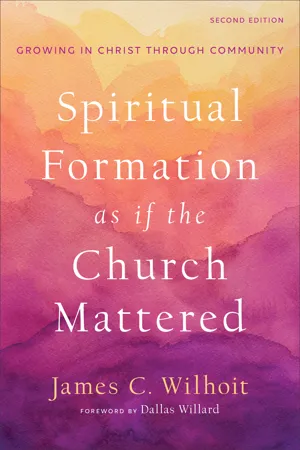
Most books on spiritual formation focus on the individual. But spiritual formation is at the heart of the church's whole purpose for existence. It must be a central task for the church to carry out Christ's mission in the world. This book offers an introduction to spiritual formation set squarely in the local church. The first edition has been well received and widely used as a textbook. The second edition has been updated throughout, incorporates findings from positive psychology, and reflects an Augustinian formation perspective. Foreword by Dallas Willard.
eBook - ePub
Spiritual Formation as if the Church Mattered
Growing in Christ through Community
- 271 pages
- English
- ePUB (mobile friendly)
- Available on iOS & Android
eBook - ePub
About this book
Information
Topic
Theology & ReligionSubtopic
Christian MinistryONE
Formation through the Ordinary
The Pathway to Flourishing in Christ
Therefore, go and make disciples of all the nations, baptizing them in the name of the Father and the Son and the Holy Spirit. Teach these new disciples to obey all the commands I have given you. And be sure of this: I am with you always, even to the end of the age.
Jesus (Matt. 28:19–20 NLT)
I know of no current denomination or local congregation that has a concrete plan and practice for teaching people to do “all things whatsoever I have commanded you.”
Dallas Willard1
It takes time, and the penetration of the truth, to make a mature saint.
Richard F. Lovelace2
Spiritual Formation: The Task of the Church
The church exists to carry out Christ’s mission in the world, and accomplishing this spiritual formation must be a central task of the church.3 It represents neither an interesting, optional pursuit by the church nor an insignificant category in the job description of the body of Christ. Spiritual formation (hereafter referred to as Christian Spiritual Formation, or CSF) is at the heart of its whole purpose for existence.4
Christian Spiritual Formation is the pathway to flourishing in Christ. It is the way of rest for the weary and the overloaded. It is the way of Jesus’s easy yoke and light burden (Matt. 11:28–30), of the good tree that cannot bear bad fruit (Luke 6:43), of building one’s life on the foundation provided by Christ (1 Cor. 3:10–15), of “being rich in good deeds” (1 Tim. 6:18 NIV), of clothing yourself with love (Col. 3:14), of accepting the word planted in you (James 1:21), and of abiding in the vine and bearing much fruit (John 15). On this path, we discover that God’s “commands are not burdensome” (1 John 5:3 NIV). We learn that Jesus, the Good Shepherd, “came that they may have life, and have it abundantly” (John 10:10). We see that in those who truly abide in God’s love there indeed flow “rivers of living water” to a thirsty world (John 7:38). We are more inclined to do that which the Lord requires of us—namely, “to do justice, and to love kindness, and to walk humbly with your God” (Mic. 6:8) and to live so that “mercy triumphs over judgment” (James 2:13).5
The message we need to hear is not one of self-improvement but the good news of the gospel—the message that Jack Miller taught many of us: “Cheer up! You are worse than you think” and “Cheer up! God loves you more than you know!”6 You couldn’t be more loved than you already are. The Lord has already provided for us every provision that we need: “By his divine power, God has given us everything we need for living a godly life” (2 Pet. 1:3 NLT). You can’t earn any more love and acceptance by your striving. So you are free to be your own person, the person you were truly meant to be. In seasons of self-doubt, I have taken great comfort from Revelation 2:17, which tells us that Jesus knows us so deeply that he will call us by name—a name we have never heard—and we will immediately recognize it: “And I will give to each one a white stone, and on the stone will be engraved a new name that no one understands except the one who receives it” (NLT). God knows you fully, loves you, and calls you to rest in his love.
The church was formed to form. Our charge, given by Jesus himself, is to make disciples, baptize them, and teach them to obey his commands (Matt. 28:19–20). The witness, worship, teaching, and compassion that the church is to practice all require that Christians be spiritually formed. Although formation describes the central work of the church, and despite a plethora of resolutions, programs, and resources, the fact remains that spiritual formation has not been the priority it should be in the North American church.
Spiritual Formation Is Similar to Public Health
A safe food supply, clean drinking and recreational waters, sanitation, and widespread vaccinations have improved the quality of our lives. These interventions have eliminated diseases like smallpox and polio. These advances, and scores more, are part of the fruit of the public health movement that came to fruition in the twentieth century. I take many of these for granted, assuming they are just part of life, but in many parts of the world, they are not. Currently, 150,000 children die every year from measles, a disease easily prevented through vaccinations.7 We take for granted public health initiatives of the last century that have had measurable, positive social benefits. In medicine, the two tasks of prevention and cure must work hand in hand. Cures may provoke media attention and buzz; however, the preventative measures and public health interventions generally provide the real “bang for your buck.” Likewise, CSF makes its most significant contribution through quiet, hardly noticeable, behind-the-scenes work that places an emphasis on “prevention” and equipping rather than just on crisis interventions or headline-grabbing public conferences and programs.
Consider the effects of the painstakingly established public health infrastructure in the United States. According to the Centers for Disease Control and Prevention (CDC), “Since 1900, the average lifespan of persons in the United States has lengthened by greater than 30 years; 25 years of this gain are attributable to advances in public health.”8 The quiet and seemingly ordinary work of public health has made a tremendous difference in life expectancy and the overall quality of life. When one looks at the list of the CDC’s “Ten Great Public Health Achievements,” the achievements appear so reasonable that their implementation seems to be evident to all. The list includes now widely accepted “best practices” such as vaccination, motor vehicle safety, safer and healthier foods, and the recognition of tobacco use as a health hazard. Yet society implemented these strategies, which seem so commonsensical today, only after long struggles, careful science that established their efficacy, and the slow and ongoing work of public education.
Some years ago, a young physician summarized his medical-care trip to Central America by telling of the long days he worked caring for patients. He concluded his story by saying that he was convinced that he could have done more long-term good with one hundred meters of PVC pipe. So many of the people he treated suffered from medical conditions that were the result of the village’s contaminated water supply—a problem that could have been easily remedied.
In this chapter, I want to begin to identify what the spiritual formation equivalent of safe drinking water and vaccinations might be. What are the patterns in Christian community life that make a positive contribution to CSF? What are the community practices that we can so easily overlook or underutilize but that help create a climate of formation in a church?
Methodology and Approach
For many years I have been listening to the stories of how faithful people have grown in grace. These accounts pulse with deep drama. I’ve realized that Paul was not using hyperbole when he told the Galatians, “I am again in the pain of childbirth until Christ is formed in you” (Gal. 4:19). These stories are unique—unique as the people who tell them—and I want to be careful not to simply reduce these amazing tales of grace to a few abstract principles. While themes and patterns do emerge when we look at the stories as a whole, there does not exist anything approaching a “technology of spiritual formation.” Formation remains a messy and imprecise business in which character, wisdom, and faith play a far more significant role than theories and techniques. Ironically, one value of deliberate engagement in formation is that it drives us to prayer because it reminds us, more than popular how-to books do, that true formation comes from grace and by grace, channeled through our humble efforts. This is not to deny what others have observed, that “spiritual formation in Christ is an orderly process.”9 CSF is certainly a multifactorial process that requires us to continually ask God what we should be doing rather than rely on our power and skill.
C. S. Lewis famously set out in his World War II BBC “Broadcast Talks” to explain in a compelling way “mere Christianity,” the beautiful and straightforward core of the faith that has marked the church throughout the centuries.10 In a similar vein, I am seeking to set forth “mere spiritual formation,” which has characterized the best practices of the church from its founding. And so because I desire to be helpful to the various faith traditions of my readers, when we come to essential practices like the Lord’s Supper, I am going to write in a general way; therefore, I will be less specific than if I were writing just for my church or tradition. However, unlike Lewis’s popular theology, any applied writing on CSF needs to be placed in a specific context. For this book, that context is the evangelical church in North America.
In this book, I will suggest principles and patterns for communal CSF, and the reader will understandably wonder about my evidence: Why do I suggest that my approach is “the best way to do spiritual formation”? In response to that excellent question, I will demur and say my claim is more modest than that. I am not suggesting that I am setting forth “the best way,” but I will identify patterns and practices that I discern to be compatible with the great pastoral tradition of the church, patterns and practices that are grounded in orthodox theology and informed by findings from contemporary studies of human flourishing and well-being.
I understand CSF to be, first and foremost, a theological discipline. The word spiritual has come to mean, in the broader culture, a positive, subjective experience of an interior/nonmaterial/sacred dimension. That is a far cry from the New Testament’s understanding of the term spiritual, and yet this vague sense of spirituality has affected contemporary writing on spiritual formation. For example, at a recent conference, several prominent speakers on spiritual formation focused on spiritual formation as the process of shaping, healing, and forming one’s interior through coaching and spiritual practices. There was virtually no reference to the work of the Holy Spirit. An interior focus is a necessary part of spiritual formation, but first and foremost, by CSF, we mean formation by the Holy Spirit. We are only facilitators for the work of the Spirit in CSF; all actual formation is the work of God.
Gordon Fee has persuasively argued that in the New Testament, spiritual (pneumatikos) “refers universally and unequivocally to the Holy Spirit” and “has to do with who the Spirit is and what the Spirit is doing.”11 He documents how English translations have consistently hidden the Holy Spirit’s work by using the vague adjective spiritual. The foremost New Testament Greek lexicon makes a similar point that pneumatikos “in the great majorit...
Table of contents
- Cover
- Endorsements
- Half Title Page
- Title Page
- Copyright Page
- Dedication
- Contents
- List of Figures
- Foreword
- Preface
- 1. Formation through the Ordinary
- 2. Curriculum for Christlikeness
- 3. Receiving
- 4. Remembering
- 5. Responding
- 6. Relating
- 7. High-Impact Practices
- Appendix: Assessment: Questions
- Scripture Index
- Subject Index
- Back Cover
Trusted by 375,005 students
Access to over 1.5 million titles for a fair monthly price.
Study more efficiently using our study tools.
Frequently asked questions
Yes, you can cancel anytime from the Subscription tab in your account settings on the Perlego website. Your subscription will stay active until the end of your current billing period. Learn how to cancel your subscription
No, books cannot be downloaded as external files, such as PDFs, for use outside of Perlego. However, you can download books within the Perlego app for offline reading on mobile or tablet. Learn how to download books offline
Perlego offers two plans: Essential and Complete
- Essential is ideal for learners and professionals who enjoy exploring a wide range of subjects. Access the Essential Library with 800,000+ trusted titles and best-sellers across business, personal growth, and the humanities. Includes unlimited reading time and Standard Read Aloud voice.
- Complete: Perfect for advanced learners and researchers needing full, unrestricted access. Unlock 1.5M+ books across hundreds of subjects, including academic and specialized titles. The Complete Plan also includes advanced features like Premium Read Aloud and Research Assistant.
We are an online textbook subscription service, where you can get access to an entire online library for less than the price of a single book per month. With over 1.5 million books across 990+ topics, we’ve got you covered! Learn about our mission
Look out for the read-aloud symbol on your next book to see if you can listen to it. The read-aloud tool reads text aloud for you, highlighting the text as it is being read. You can pause it, speed it up and slow it down. Learn more about Read Aloud
Yes! You can use the Perlego app on both iOS and Android devices to read anytime, anywhere — even offline. Perfect for commutes or when you’re on the go.
Please note we cannot support devices running on iOS 13 and Android 7 or earlier. Learn more about using the app
Please note we cannot support devices running on iOS 13 and Android 7 or earlier. Learn more about using the app
Yes, you can access Spiritual Formation as if the Church Mattered by James C. Wilhoit in PDF and/or ePUB format, as well as other popular books in Theology & Religion & Christian Ministry. We have over 1.5 million books available in our catalogue for you to explore.