"[An] insightful exploration of Christian discipleship in the digital age."--Publishers Weekly
This book offers theological perspectives on the challenges of discipleship in a digital age, showing how new technologies and the rise of social media affect the way we interact with each other, ourselves, and the world. Written by a Gen X digital immigrant and a Millennial digital native, the book explores a faithful response to today's technology as we celebrate our embodied roles as followers of Christ in a disembodied time.
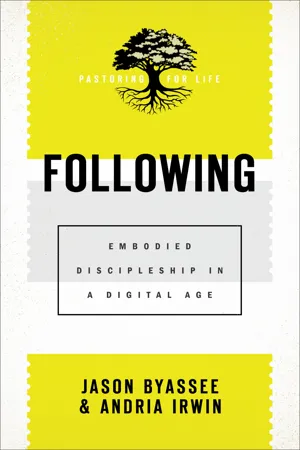
eBook - ePub
Following (Pastoring for Life: Theological Wisdom for Ministering Well)
Embodied Discipleship in a Digital Age
- 192 pages
- English
- ePUB (mobile friendly)
- Available on iOS & Android
eBook - ePub
Following (Pastoring for Life: Theological Wisdom for Ministering Well)
Embodied Discipleship in a Digital Age
About this book
Information
Topic
Theology & ReligionSubtopic
Christian MinistryONE
Putting on the New Self
The opening chapter of Genesis seems like as good a place as any to begin a book on discipleship in a digital age. You will notice that I (Andria) will sway slightly from Jason’s more critical approach in the chapters to follow through one constant refrain: this place, and who we are in it, has been proclaimed good (Gen. 1:31). The digital age, as we are calling it, has extended an invitation to bring our whole selves, made and blessed in the divine image, into a new place where we can choose who exactly we want to be. Who we are in such a technological time isn’t just a question for new generations, digital literacy classes, and social media marketers. It’s a question for all of us, especially those of us who are Christians, as we work to discern how to tell our story in a loud and hyper-distracted world.
There is a wild permission available in this place for those who care to take it—a permission not only to follow but to teach, to serve, and to love. How we do this is changing every day, but the story we tell stays the same. Before we tell that story, however, we should know ourselves, and that journey of a life is different here in the digital landscape than anywhere else.
In September 1999, a young valley girl opened up a Hotmail account with the username “californiasurfangel18.” Sandy brown hair, fingernails bitten to the quick, and shoulders twice as wide as she was tall, she chose to imagine herself instead like a character in a Sweet Valley High novel: tan, athletic, popular, and perhaps named Jessica.
Three years earlier, in a warehouse in Santa Clara County, Sabeer Bhatia and Jack Smith had successfully launched Hotmail.com, a first of its kind—anonymous, easily accessible, entirely remote, and free email service that would change the way people communicated overnight. Now, as Jessica launched herself into a new life on the World Wide Web, Bhatia and Smith celebrated the launch of their newest service, an instant messaging program they called MSN Messenger.
Californiasurfangel18 sat in front of her computer monitor on a Friday afternoon, painstakingly constructing her first ever MSN Messenger name. It had to be something clever. The popular ASL (Age, Sex, Location) wouldn’t do. It had to reflect the “real” her; the person she aspired to be, not the freckle-faced girl with chapped lips and barrettes in her hair. Like many of her friends, Jessica began her journey of self-exploration on this virtual platform. It would not be the last time she put on a new self (Col. 3:10).
It worked. For a whole weekend Jessica was the new girl in school. She befriended the cheerleaders, the ballerinas, the entire roster of the boys’ junior hockey team—and they all talked to her. For three days, Jessica was able to virtually embody her wildest dreams. The chance to shed the skin she had been given and to step into a masked version of herself left her feeling, perhaps for the first time, worthy.
Can you remember the last time you felt as worthy as God declared you? Good without adornment or status, simply deserving of love by virtue of existing? It is not likely, in our consume-and-compare culture, that we experience the assurance of the opening chapter of Genesis with any form of regularity—at least not when we spend our time immersed in the highlight reels of others. We cry out not enough! in the face of what we perceive others to have. Or, at the very least, we clamber over piles of dirty laundry with our laptops for a conference call to settle in the one corner of the house that might, to the untrained eye, appear “tidy.” Not enough! A challenge is set before us in this digital age. The children of postmodernity in our midst (Gen Y, Gen Z, Gen Alpha) have the particular task of becoming in a world focused on belonging.
Such a world is not as it might seem. Belonging in our Western culture is not the biblical concept of being neither slave nor free, gentile nor Jew. Instead, it is the concept that launched a thousand acronyms—ASAP, MIA, FOMO, YOLO, BRB—abbreviations of our most valued sentiments, which would seem to be production and prominence based.
We are made to feel, through no fault of our own, that we are not enough simply by way of seeing what we think others are. We bury our faces into our hands, pose ourselves in lament, and pray to be better, bolder, more productive next week, yet we arise on Monday the same as we were before. In Jessica’s case, that was a young girl living in a valley not like the one that would become known as Silicon Valley but instead one that runs along the North Thompson River in the westernmost province of Canada, twelve hundred miles away from the warm surf of the California Pacific. Not named Jessica at all but Andria (me again!).
To belong, some of us are willing to do anything except become the selves already pronounced beloved by our maker. Our identities are designed through the slow, lifelong penning of stories, creating caricatures of ourselves that feel worthy of the lives we think we should be living. We wear, according to modern psychology, masks of ourselves. A kind of costume parade that lasts, hellishly, from birth until death.
This idea of trying on the self is not new. In the sixteenth century Italians popularized the masquerade, a celebration during which masking one’s identity could encourage people to live and let live. By shielding our faces, the beasts of ourselves could run wild into the night, while our dignity could awake the next morning intact, the faint howl of a headache ringing in the distance.
The freedom of this kind of anonymity was a siren call into the online world in the late ’90s and early 2000s. Forums, blogging, and multiuser experiences became places where people could be themselves or not, with no one the wiser. This falsely utopic world was brimming with possibilities for manipulation, abuse of power, and crime, but it also created an environment that allowed people, some for the first time, to start over. For those with genuine intentions of alternative expression and re-creation, this fantastical place of faceless personalities was one of welcome and escape. People were welcomed into this community and seen in ways they had never been seen before. At the same time, this new realm offered respite from an unwanted body or persona or circumstance. It was the heaven we grew up hearing about—the one where our physical and emotional ailments would ail us no longer and we would be free from the conditions that traumatize us here on earth.
This kind of co-reality in which people were able to exist in two places at once, as two people at once, was a new game. People endeavored to play creator of themselves and their lives in ways that took little effort and had the potential of immediate gratification. You, too, could have the beautiful girl if you showed her a photo of a man twenty years your junior and told her about your offshore accounts (catfish). You, too, could finally have your controversial opinion heard in the comment section of the local newspaper despite them never putting your op-eds to print (troll). You, too, could offer self-help coaching to unsuspecting, hurting individuals despite never having had any coaching yourself (scam). Dividing the self into split experiences of reality is something we have seen go violently wrong. Instead of working through selfish or harmful desires in the safety of professional or peer accompaniment, the physical self represses these yearnings while the online self acts out. It is easy to find horror stories of fantasies running rampant on the darknet and of abusers lurking behind innocent online avatars, and we wonder what the justification for anonymity ever was.
Yearning to be a new person, however, is not inherently dangerous or deceptive. It is our core identity as disciples of Jesus to be like him (John 15:12) and to grow in our desires and actions until we find ourselves unable to be separated from our true identity as children of God. Until we know how to make this transition, however, we will not use the tools we have for their highest potential.
Into this place the church can speak. Created in Jesus for good works (Eph. 2:10), we follow the One who tells us the troubles of the world are cast aside through him (John 16:33). While the internet certainly has its dark corners, so does our human experience. The formative work of Christian community is to accompany us through the discerning moments, turning us always toward our greater identity—an identity that openly celebrates the Divine’s image of life for us—one in which we feel that we are enough.
Peter Rollins, the provocative Irish storyteller and lecturer who has penned seasonal devotionals with titles like “Atheism for Lent,”1 recounts a supposedly true story of a twentieth-century theologian who was discreetly invited to participate in a masked orgy involving everyone who was anyone at the time. The theologian, disregarding the rules of the soirée, showed up wearing nothing—not even something to conceal his identity. When the shocked host pulled him aside to tell him the event was a masked one (because arriving nude was the normal part here), the theologian allegedly responded, “Why, my dear friend, what you see is my mask.”2
The shift from anonymity to exposure came almost overnight in 2004 with the introduction of Mark Zuckerberg’s Facebook. The emergence of this new social media, along with its user agreements and browser tracking, named the embodied presence behind the screen name as a value to wider society.3 Suddenly people were being held accountable to the lives they were living both online and offline.
The masks we wear online these days are easily called out by those who know us IRL or those who can search for us by IP address. Our online selves are liable for more than we ever have been before. The responsibility bestowed on today’s youth is now akin to growing up as a child star, and even with only thirty-five Facebook friends and an auto-generated Twitter handle, the pressure to perform is great. The masks we choose to wear no longer disguise us but instead filter us into a reconstruction not entirely beyond recognition but perhaps just beyond reality. At what point does the “reality” of our online selves render our true selves worthless? If we can feel good about ourselves only as the people we are on Facebook (filtered, curated, “liked”), we lose touch with the awe-inspiring beauty of human life itself.
The experience of our flesh—underneath which we are “a soul at work”4—is, at its core, the only garment of identity we ought to put on (Gen. 3:21). If we model ourselves after Christ and live as followers of the One both divine and human, we are active in what Augustine calls “the great swap” in which Christ took on our flesh that we might receive his spirit.5 The façade required by the world around us is not required by God. To live as disciples of Jesus is to accept our identity as both children of the divine and recipients of the gift of a human experience. To shy away from either of these in pursuit of anonymity or acceptance is a refusal to embody our true and inherited identity as beloved.
Yet our identities as individuals in this show-and-tell culture are encouraged to be much more than this. Ask any fifteen-year-old social media aficionado to describe their personal aesthetic and they may well present you with nothing short of a branding document, complete with color swatches, lightroom settings, top-performing hashtags, and a font manual. The mask might be what we wear in person, but online we’re nothing short of in drag. The exploration of self-expression that the technology of today enables is something to be celebrated—that is, if the result is an ever-expansive love of one’s neighbor.
In his 1968 postapocalyptic novel, Do Androids Dream of Electric Sheep?, science fiction prophet Philip K. Dick explores the tension of this future reality. The majority of earth’s animals have become extinct in the radioactive aftermath of a world war, and owning animals has become the ultimate status symbol. The production and acquisition of lifelike android animals for the sake of keeping up with the Joneses is commonplace, and whether one’s animals are real or robotic is the usually unasked question. “Nothing could be more impolite,” says the main character. “To say, ‘is your sheep genuine?’ would be a worse breach of manners than to inquire whether a citizen’s teeth, hair, or internal organs would test out authentic.”6
Fifty years later, to ask if people’s social media life is an honest representation of themselves is to suggest their intentionally curated collection of snapshots is not good enough, despite the effort to belong. The standards we feel the need to live up to exist only because of our encounters with the curated world of social media. What was created as a form of personal expression and connection has drawn us farther away from ourselves and one another.
But what if we trusted that we are intimately known? Being freed from the botched narrative we have written for ourselves could liberate us to use our social media in a whole new way. In his article “Digital Privacy: A Squandered Gift,” Eric Stoddard argues: “If we assume that God has perfect knowledge of us down to the most mundane and most intimate detail, privacy could easily be evacuated of meaning.”7 What would our feeds look like if we weren’t trying to construct or maintain a certain appearance but were trying to faithfully serve by openly witnessing to one another? Casting aside the idea of ...
Table of contents
- Cover
- Endorsements
- Half Title Page
- Series Page
- Title Page
- Copyright Page
- Dedication
- Contents
- Series Preface
- Acknowledgments
- Introduction
- 1. Putting on the New Self
- 2. A Pastoral Personality
- 3. The Opposite of Technology
- 4. Jesus’s Own Family
- 5. Undistracted Friendship
- 6. The Internet Is (Kind of) a Place
- 7. Virtual Virtue
- 8. Daring to Speak for God
- Conclusion
- Notes
- Index
- Back Cover
Trusted by 375,005 students
Access to over 1.5 million titles for a fair monthly price.
Study more efficiently using our study tools.
Frequently asked questions
Yes, you can cancel anytime from the Subscription tab in your account settings on the Perlego website. Your subscription will stay active until the end of your current billing period. Learn how to cancel your subscription
No, books cannot be downloaded as external files, such as PDFs, for use outside of Perlego. However, you can download books within the Perlego app for offline reading on mobile or tablet. Learn how to download books offline
Perlego offers two plans: Essential and Complete
- Essential is ideal for learners and professionals who enjoy exploring a wide range of subjects. Access the Essential Library with 800,000+ trusted titles and best-sellers across business, personal growth, and the humanities. Includes unlimited reading time and Standard Read Aloud voice.
- Complete: Perfect for advanced learners and researchers needing full, unrestricted access. Unlock 1.5M+ books across hundreds of subjects, including academic and specialized titles. The Complete Plan also includes advanced features like Premium Read Aloud and Research Assistant.
We are an online textbook subscription service, where you can get access to an entire online library for less than the price of a single book per month. With over 1.5 million books across 990+ topics, we’ve got you covered! Learn about our mission
Look out for the read-aloud symbol on your next book to see if you can listen to it. The read-aloud tool reads text aloud for you, highlighting the text as it is being read. You can pause it, speed it up and slow it down. Learn more about Read Aloud
Yes! You can use the Perlego app on both iOS and Android devices to read anytime, anywhere — even offline. Perfect for commutes or when you’re on the go.
Please note we cannot support devices running on iOS 13 and Android 7 or earlier. Learn more about using the app
Please note we cannot support devices running on iOS 13 and Android 7 or earlier. Learn more about using the app
Yes, you can access Following (Pastoring for Life: Theological Wisdom for Ministering Well) by Jason Byassee,Andria Irwin, Byassee, Jason, Jason Byassee in PDF and/or ePUB format, as well as other popular books in Theology & Religion & Christian Ministry. We have over 1.5 million books available in our catalogue for you to explore.