This update of Craddock's original work on inductive preaching remains one of the most important contributions to homiletic scholarship. Revised with three new sermons, inclusive language, and NRSV texts, it is still as fresh and provocative as ever.
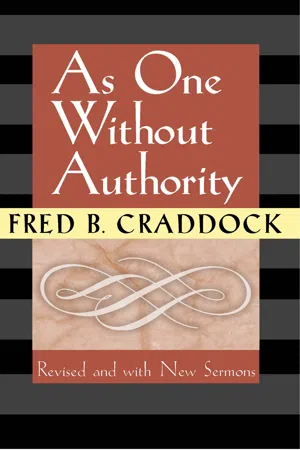
- 168 pages
- English
- ePUB (mobile friendly)
- Available on iOS & Android
eBook - ePub
About this book
Information
Topic
Theology & ReligionSubtopic
Christian Ministry
CHAPTER 1
The Pulpit in the Shadows
We are all aware that in countless courts of opinion the verdict on preaching has been rendered and the sentence passed. All this slim volume asks is a stay of execution until one other witness be heard. The tardiness of this witness is not to be construed as dramatic timing. It is, rather, due to a cowardice born of that familiar fear of rising to defend that which has been derided by close and learned friends. And, in addition, one is painfully hesitant to speak in behalf of a defendant who is not entirely innocent of the charges brought against him.
The alarm felt by those of us still concerned about preaching is not a response solely to the noise outside in the street, where public disfavor and ridicule have been heaped upon the pulpit. On the contrary, most preachers are quite skilled at translating such criticism into “crosses to be borne” and appropriating for themselves the blessing lodged in some proper text, such as, “Beware when all men speak well of you.” These are not new sounds; to a large extent, the pulpit has from the first century received poor reviews (2 Cor. 10:9–10). To explain this general reaction, perhaps one need not look for reasons profound; it may be simply that these critics have heard us preach!
More disturbing has been the nature and character of those who have been witnesses for the prosecution. Increasingly, the brows that frown upon the pulpit are not only intelligent, but often theologically informed, and quite often deeply concerned about the Christian mission. Their judgments about preaching cannot be regarded as reflections of a general disinterest in religion, nor dismissed as the usual criticisms hurled at the familiar caricature in the pulpit, droning away in stained-glass tones with pretended convictions about matters uninteresting, unimportant, and untrue. Some of these critics have themselves been preachers in the churches. In short, the major cause for alarm is not the broadside from the public, nor the sniping from classroom sharpshooters, but the increasing number who are going AWOL from the pulpit. Some of these people move into forms of the ministry that carry no expectation of a sermon, or out of the ministry altogether. In addition, there are countless others who continue to preach, not because they regard it as an effective instrument of the church but because of the combined force of professional momentum and congregational demand.
It is the sober opinion of many concerned Christians, some who give the sermon and some who hear it, that preaching is an anachronism. It would be granted, of course, by all these critics that the pulpit has, in other generations, forcefully and effectively witnessed to the gospel, initiating personal and social change. It would be regarded by them as proper, therefore, for the church to celebrate the memory of preaching in ways appropriate to her gratitude and to affix plaques on old pulpits as an aid to those who tour the churches. But the church cannot live on the thin diet of fond memories. New forms of ministry are being forged and shaped overnight to meet the morning’s need. And these ministries are without pulpit.
One need only look into the seminaries to get a clear picture of the tenuous position of preaching. Some seminaries offer little, or at best only marginal, work in homiletics. It should be said immediately, however, in defense of such lacunae, that there is, in some quarters, a serious reexamination of the wisdom of having instruction in preaching as a separate curriculum item. This reappraisal is due in part to an appreciation for the complexity of preaching and its inextricable relation to the other disciplines. It is in this mood that Joseph Sittler has written:
And, therefore, the expectation must not be cherished that, save for modest and obvious instruction about voice, pace, organization, and such matters, preaching as a lively art of the church can be taught at all…Disciplines correlative to preaching can be taught, but preaching as an act of witness cannot be taught.1
All too frequently, however, seminary education in preaching consists of training under a speech teacher or exposure to the toothless reminiscences of a kindly old pastor reactivated from retirement. In the former case, preaching is quite aside from the rest of the seminary curriculum because preaching so taught has its form defined not by the content of the gospel nor the nature of Christian faith but by Greek rhetoric. As will be discussed later, the separation of form and content is fatal for preaching, for it fails to recognize the theology implicit in the method of communication. When a person preaches, the method of communication, the movement of the sermon, reflects the hermeneutical principles, the view of the authority of scripture, church, and clergy, and especially one’s doctrine of humanity. This is revealed verbally and nonverbally in the point of contact made with the listeners and the freedom to respond permitted them. It is a fact that much preaching contradicts by its method the content of its message. It is not reasonable to expect a speech teacher to guide a seminarian in a method of preaching that incarnates the message. The discussion of such a method is the major burden of this book. And, of course, when preaching is taught by a pastor, retired or active, the course suffers, deservedly or not, from that particular brand of harsh laughter reserved by students and faculty for that which lacks academic respectability. As a natural consequence, preaching continues for another generation as “a marginal annoyance on the record of a scientific age.”2
This characterization of the minor role of preaching in some seminaries is not intended as an accusation of the seminaries as the source and cause of a poor pulpit. Seminaries not only create but reflect the general condition of the churches they serve and the cultures in which they live. It is in this larger context that the major reasons for the disrepute into which preaching has fallen are to be found. A brief examination of some of these reasons may function as the diagnosis that leads to recovery of health and power.
It is generally recognized that many blows struck against the pulpit come not because of its peculiar faults but because it is a part of a traditional and entrenched institution, and all such institutions—religious, political, or otherwise—are being called into question. Strong winds of change blow over the land, and strange new shadows fall across the comfortable hearths where we have taken long naps. Some pulpits feel threatened as the novelty of the new obscures distinctions between apparent and real values. Reactionary idealism, as the cutting edge of change, necessarily makes large room for error, but in the midst of uncertainty, it must not be overlooked that many pulpits have welcomed the interruption of triviality and are grateful for the chance to be faithful in such a time.
A primary reason, both in point of time and significance, for the general low estimate of preaching is to be found in the nature of American Christianity. Perhaps the most characteristic mark of the American church as distinguished from the church elsewhere in the world has been activism. The Social Gospel Movement was native to this soil and to the understanding of the Christian faith that is captured in the motto “Deeds, not words.” After the churches in Europe have heatedly debated the truth claims of a theological position, the American churches appropriate that portion of it that will “work.” In critical times, the demand for relevance becomes so strong that the sole canon by which a ministry is measured is the degree of its participation in the skirmish of the day. When this atmosphere prevails, the whole Bible is reduced to Matt. 25:31–46, and criticisms against preachers as those who “just talk” create a reaction of silent busyness. While this accent has been not only the power of the American church but its fundamental witness to the church elsewhere, it has at the same time unfairly obscured the place of the sermon. In fact, the power of the sermon to initiate and sustain movements for social change has often been overlooked because sermons were “words, words, words.” While some American pulpits have been outstanding, on the average corner on an average Sunday, preaching has been tolerated and the ministers have given sermons that were tolerable. Where the expectation is low, the fulfillment is usually lower.
Implicit in what has just been said is the minimization of the power of words to effect anything: to create or to destroy, to bind or to loose, to bless or to curse. This common denial of the efficacy of words has been with us long enough to be enshrined in a number of proverbs: “Talk is cheap”; “It is not what you say but what you do that counts”; “I’d rather see a sermon than hear one any day”; “Sticks and stones may break my bones, but words…” Obviously, there is enough truth in these expressions to keep them alive. In them is some deserved judgment against a church that gives recitations, lifeless words cut off from the hearts and minds of those who speak and those who listen. Søren Kierkegaard, the great Danish philosopher, captured this state of affairs in his parable of the man who saw in a shop window a sign, Pants Pressed Here. He went in and immediately began removing his pants. The startled shopkeeper stopped him, explaining that he did not press pants; he painted signs. Beneath these deprecatory statements about words lies a view of speaking that, if subscribed to, is fatal for preaching. Certainly no one can preach who has no respect for words, who allows them to creep over the tongue and sneak out the corners of the mouth, self-conscious and sheepish, as though hoping to fall to the ground and steal away unheard.
That there is in our time a language crisis, a general experience of the loss of the power of words, is all too evident. Needless to say, this means a crisis in preaching. The starting point for the study of homiletics has been radically shifted. All considerations of structure, unity, movement, use of text, and so forth, must wait upon the prior consideration of what words are and what they do. Any young preacher who does not take time to develop some grasp of the nature and meaning of words and of what happens when words are shared in communication will soon fall silent, frustrated, disenchanted, weary of the sound of her own voice, and convinced that what descended upon her was not a dove but an albatross. In these primary considerations, the preacher will find many resources, for the study of the meaning of words is a central issue in contemporary philosophy, theology, and biblical interpretation. This fact alone indicates the immensity of the problem, but it also holds rich prospects for the renewal of preaching.
Why in our time is a person “the victim of linguistic estrangement from his tradition and linguistic confusion among his contemporaries”?3 Why the sickness of language, the degeneration of the streets and avenues of communication into “slum districts”?4 Some partial answers lie near at hand.
No doubt the fact that we are today bombarded with words has contributed to the decay of meaning. By limitless new forms, made possible primarily by electronic media, we are surrounded by words. The eyes and ears have no relief, and all the old silent haunts are now scarred with billboards and invaded by public-address systems.
When language is no longer related to silence, it loses its source of refreshment and renewal and therefore something of its substance…By taking it away from silence we have made language an orphan.5
A second reason for the loss of power and meaning in words may lie in the nature of traditional religious language. Gerhard Ebeling has properly observed that “out of mistrust of religious words there grows contempt for words as such.”6 But why this mistrust of religious language? It is in part, of course, due to the language lag that has always plagued the church, a hesitation to lay aside old terms and phrases for fear of laying aside something vital to the faith itself. Hence, unfortunately, the church has no retirement program for old words that fought well at Nicea, Chalcedon, and Augsburg; they are kept in the line of march even if the whole mission is slowed to a snail’s pace and observers on the side are bent double in laughter.
In our time, however, the failure of the church’s language has been accelerated by the ascendancy of the language of science. By this is meant not simply the vocabulary of science but the fundamental understanding of what words are and what they can and cannot do.
Undoubtedly the modern revolution in the natural sciences has had a profound effect upon language—or better, upon our consciousness and conceptualization of language. Science has made us profoundly uneasy about how we can or cannot use language. It has brought on a new thirst for clarity, precision, and freedom from ambiguity, all to be construed in terms of the models of the scientific method itself.7
One’s immediate response is favorable if this means simply that the church must do her homework, choose carefully her words, and be clear in her proclamation. But more than this is meant, for the model of the scientific method understands words as signs, as indicators pointing to information that can be verified. For language to be meaningful, it is said, it must keep itself to this task. Were the pulpit to acquiesce and promise to speak according to these rules, it would have to forfeit its evocative use of words, its use of language to create new situations, its use of the parable and the myth. Under such editorship, the church’s language would be “cleaned up,” striking all symbolic and mythological uses as preliterate, primitive, and meaningless. The results would, of course, be tragic. While the scientific use of language to designate is an important function of words and necessary to some disciplines, to permit words only this function would be sterilizing reductionism. Words have too many other rich and full functions in all human thinking, learning, feeling, and sharing to be pulled through this small knothole.
It is a tragic fact, however, that the pulpit in many places accepted this restricted and restricting view of language. Perhaps these preachers at first felt secure in the scientific world because it reinforced their view of their task: to communicate knowledge, a special kind of knowledge, information about God and eternity. Recently, however, some pulpits have discovered that this very definition of words, that is, as signs to point to verifiable information, has made highly questionable the legitimacy of even using the word “God.” Suddenly feeling trapped, some have unwisely reacted in antiscience belligerence while others have silently tossed in the towel. On the other hand, there are signs here and there that the church is discovering it is neither antiscientific nor antiintellectual to refuse to abide by a single definition of the function of words. No longer overawed, the church is discovering that science also has its limitations. After all, the “schemata which science evolves in order to classify, organize, and summarize the phenomena of the real world turn out to be nothing but arbitrary schemes…which express not the nature of things, but the nature of mind.”8
In the opinion of some observers, a third reason for the current wordsickness lies in the changed shape of the human sensorium as a result of television. According to this interpretation, the visual has removed the oral from the field, or at least has created a crisis between eye and ear. The pulpit has traditionally used word and story and history, but now television has reorganized the sensorium for image and picture. In the opinion of some, the success of the Christian proclamation depends on the church’s ability to make the transition so people can see. Against such a view, however, it should be kept in mind that the Bible favors the ear over the eye in attempting to present its message about God who communicates. If it be objected that this can be explained by reference to the Bible’s primitive context, one should remember that in the same primitive context, the Hellenists gave ascendancy to the eye. Perhaps the difference can be explained by the fact that the Hellenists were concerned with the static conditions of the nature and being of reality while the Judeo-Christian interest was in the dynamic activity of God.9 In a way unequalled by any of the other senses, the ear receives the temporal sequence of sensations appropriate to the communication of activity and the unfolding of the history of a people. One has to raise the question whether there is involved here something so fundamental to the Christian faith that, television to the contrary, the oral must remain in the center of the field of Christian proclamation.
Whatever conclusion one reaches on this point, no one could be more affected than the preacher by the changes in the structure of the human psyche and the shifts in the areas of sensitivity within the modern person’s sensorium. If the...
Table of contents
- Cover
- Also from Chalice Press by Fred B. Craddock
- Title Page
- Copyright
- Contents
- Preface
- Part 1 - The Present Situation
- Part 2 - A Proposal on Method
- Appendix A - The Sermon Process
- Appendix B - Doxology
- Appendix C - Asleep in the Storm
- Appendix D - Nothing Is Impossible with God
- Appendix E - And They Said Nothing to Anyone
- Notes
Trusted by 375,005 students
Access to over 1.5 million titles for a fair monthly price.
Study more efficiently using our study tools.
Frequently asked questions
Yes, you can cancel anytime from the Subscription tab in your account settings on the Perlego website. Your subscription will stay active until the end of your current billing period. Learn how to cancel your subscription
No, books cannot be downloaded as external files, such as PDFs, for use outside of Perlego. However, you can download books within the Perlego app for offline reading on mobile or tablet. Learn how to download books offline
Perlego offers two plans: Essential and Complete
- Essential is ideal for learners and professionals who enjoy exploring a wide range of subjects. Access the Essential Library with 800,000+ trusted titles and best-sellers across business, personal growth, and the humanities. Includes unlimited reading time and Standard Read Aloud voice.
- Complete: Perfect for advanced learners and researchers needing full, unrestricted access. Unlock 1.5M+ books across hundreds of subjects, including academic and specialized titles. The Complete Plan also includes advanced features like Premium Read Aloud and Research Assistant.
We are an online textbook subscription service, where you can get access to an entire online library for less than the price of a single book per month. With over 1.5 million books across 990+ topics, we’ve got you covered! Learn about our mission
Look out for the read-aloud symbol on your next book to see if you can listen to it. The read-aloud tool reads text aloud for you, highlighting the text as it is being read. You can pause it, speed it up and slow it down. Learn more about Read Aloud
Yes! You can use the Perlego app on both iOS and Android devices to read anytime, anywhere — even offline. Perfect for commutes or when you’re on the go.
Please note we cannot support devices running on iOS 13 and Android 7 or earlier. Learn more about using the app
Please note we cannot support devices running on iOS 13 and Android 7 or earlier. Learn more about using the app
Yes, you can access As One Without Authority by Fred B Craddock in PDF and/or ePUB format, as well as other popular books in Theology & Religion & Christian Ministry. We have over 1.5 million books available in our catalogue for you to explore.