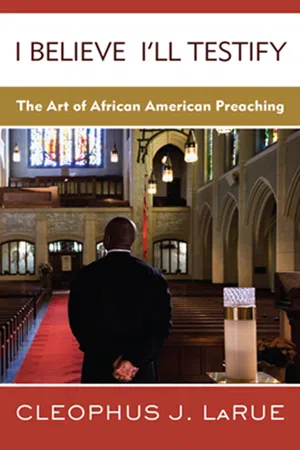
Filled with telling anecdotes, LaRue's book recognizes that while great preaching comes from somewhere, it also must go somewhere, so preachers need to use the most artful language to send the Word on its journey.
- 144 pages
- English
- ePUB (mobile friendly)
- Available on iOS & Android
eBook - ePub
About this book
Cleo LaRue is one of the best-loved preachers and writers about preaching. In past volumes, he has brought together great collections of African American preaching to showcase the best preaching from across the country. Here he offers his own insights into what makes for great preaching.
Information
Subtopic
Ministère chrétienChapter 1
One Preacher’s Journey
I was born and raised in Corpus Christi, Texas, a seaport town near the southern tip of the state on the Gulf of Mexico. I came to faith in Calvary First Baptist Church under the same pastor who received my grandmother into the fellowship and baptized my mother and most of the LaRue/Rice offspring. I, along with other young people in my community, came up through what was then called “the total program of the church,” which means we were involved in every aspect of the church’s life—from Sunday school to Sunday morning worship, to the Baptist Training Union, and finally to the evening worship service. Just about every day of my life was spent being around, thinking about, or participating in something pertaining to church life. I understand that today my kind of church upbringing is rare, for many times we get people in seminary that were not associated with the church as children and only came to Christ through a Campus Crusade ministry or later in life as adults searching for more meaning in life.
Pastor Henry Clay Dilworth Jr. drilled the Scriptures into us at every opportunity. He told us to read the Bible before we read anything else in the morning. And that Bible we were instructed to read was none other than the King James Version. As a child, I just knew that was the version Jesus used. Along with the Scriptures, a healthy smattering of what Baptists believed and practiced was thrown in for good measure. Because the black church makes little distinction between the sacred and the secular, I learned to look for God’s presence in every aspect of the human situation. Some mainliners are aghast when I tell them that politicians frequented our church and were allowed to make their case on Sunday mornings. However, when they were done, Rev. Dilworth thundered a prophetic note of justice right in the faces of the squirming politicians. The National Association for the Advancement of Colored People (NAACP) was allowed to solicit memberships in the narthex on Sunday mornings, but they, too, were called to account by Rev. Dilworth if they did not speak up for the poor to his liking. From the participation of politicians, civic leaders, business people, and others in our congregation from time to time, I learned that nothing was off-limits for the church. The church’s witness was meant to be heard and seen everywhere and in all places. I grew up believing that the church—the people of God—was to be involved in all of life as witness to God’s rule and reign upon the earth.
My life and my ministry were shaped by the turbulent 1950s and 1960s. I was brought up in a low-income home with a mother, father, brother, and two sisters. The family, church, school, and community were the center of our daily existence. Although my parents struggled to make ends meet, life did not seem difficult to me as a child because everyone else in the community was pretty much in the same economic condition. As I look back on my childhood, I remember growing up in the segregated South as some of the happiest days of my life. I went to a completely segregated school for the first six years of my public education. I was taught by some of the most able black teachers of that day. They maintained class discipline with a stern look and a smooth paddle.
There was also a large Mexican American population in Corpus Christi, but the segregationists were so intent on keeping that system in place that we were not allowed to associate with the Mexican American children at school even though we all lived in the same neighborhood. The Mexican Americans had their school, and the blacks had theirs. They were within rock-throwing distance of one another, but contact was strictly forbidden, for Mexican Americans were recognized as white in the eyes of the law. The whites who lived on the other side of town were completely separated from us. Occasionally sporting events brought the races together, but such times were few and far between. We had no cafeteria at the all-black George Washington Carver Elementary School, so we had to use the cafeteria at the Mexican American school 150 yards away. Each day—in good weather or bad—our teachers lined us up and marched us across campus to the visiting cafeteria. But even then we were not allowed to eat with the Mexican Americans, for that, too, was against the law. The blacks had to wait outside until the Mexican American students had eaten and completely vacated the building before we were allowed to enter and eat our lunch. In later years both schools were demolished and replaced with a single structure. The new school took the name of the demolished Mexican American school while the name of the black school was dropped altogether.
I remember the civil rights movement and its impact on America, for it had an immediate effect on my life. With the passage of the Civil Rights Act in 1964 the public school systems of America started on their arduous desegregation tracks, even though they had been ordered by the Supreme Court to do so a decade earlier. Also, I vividly recall listening to Martin Luther King Jr. on television the day he gave his “I Have a Dream” speech from the steps of the Lincoln Memorial in August of 1963. I remember sitting in my fourth grade classroom the Friday we heard the news that John Kennedy had been shot. I also remember the Sunday in 1965 when Malcolm X was gunned down in Harlem and also how sick I felt the evening the news broke in 1968 that Martin Luther King Jr. had been assassinated. Bobby Kennedy’s death a few months later rounded out that very troubled decade in American history. The Vietnam War was both real and frightening to me, for when I turned eighteen I took a bus downtown to register for the draft.
I have also felt the sting of racism and its dehumanizing effects. As an eleven-year-old boy, I remember traveling on a Greyhound bus to El Paso with my mother and other siblings to be reunited with my father, who had traveled there to take a better paying job at a steel mill. When it was time to reboard the bus on our layover in San Antonio, according to bus regulations, we were entitled to reboard the bus first since we were among the original travelers coming up from Corpus Christi. When the white driver saw a black woman and her four children trying to board the bus first, he became incensed, turned flush red, and ordered us to the back of the line. My mother—thinking he did not understand that we had ridden the early bus up from Corpus Christi—showed her ticket stubs and asked if she could reboard so we could be seated together. Visibly angry at this point, the driver shouted at my mother, “Hell no! I told you to get to the back of the line.” He then took his forearm and forcefully shoved my mother aside. Without missing a beat, in a very different tone of voice, he turned to the white passengers and invited them to board the bus. My heart hurt for my mother. It was more than I could bear. I soon felt warm tears streaming down my face as we watched everyone else get on the bus, including the driver, who then ordered my mother and her four children to get on board or be left behind.
Needless to say, the rest of that much anticipated seven-hundred-mile trip was ruined. I couldn’t help but wonder what we had done to make the bus driver so angry when we were simply following the rule of allowing originating passengers to reboard the bus first. I am not angry at the world for such incidents in my past, nor do I go around thinking about them every day. But I also cannot pretend that I have not been shaped by those incidents in ways possibly unknown to me. Without a doubt, they are a part of my context.
But raw encounters with racism have not been the whole story of my life. I love history today because a white seventh-grade teacher named Cappi Ascencio made the past come alive for me. Mrs. Ascencio, who loved to recount the battles of the Civil War, was in her element describing the strategies and eccentricities of the generals who fought those battles. I became interested in journalism because a white high school teacher named Bunny Steele had a knack for getting kids interested in the subject. I decided to attend Baylor University in Waco, Texas, because that’s where Mrs. Steele had gone to school, and I majored in journalism because she made it so interesting and exciting to me. The worst scolding of my public school days came from Mrs. Steele when I intentionally missed my high school’s award ceremony where I was to receive a top, statewide honor in journalism. I skipped the ceremony because I was afraid the other black students would laugh at me for being too bookish. Needless to say, Mrs. Steele was not happy. She saw right through my lame excuse and let me have it from all sides. While she talked to me, tears welled up in her eyes. I knew then she was upset with me because she cared about my future. In later years I would never make a major decision without picking up the phone to consult with her. Both women were quite helpful in my formative years. They were tough, insistent, and demanding on all of us, and they did not brook any foolishness when they thought you were not giving it your best.
I was admitted into Baylor because several white Southern Baptists took an interest in me. Glenn Huston, the local school board president, whose daughter had recently graduated from Baylor, was determined that I, too, would have the same chance as his daughter to get a decent start in life. Huston put me in touch with Ralph Storm, a Baptist layman and Baylor trustee who changed the trajectory of my life. Storm told me in later years that he “gently nudged” Baylor to reconsider my application after I was denied admission the first time I applied. His timely intervention taught me a very important lesson: To the extent that any of us succeed in life it is often because somebody helped us at a very critical juncture along the way. These stories and many more constitute my context. They have shaped who I am and how I view the world.
The Call to Christian Ministry
From my early teens onward I felt the call of God upon my life. But it was not until Rev. A. Louis Patterson, a gifted preacher from Houston, came to my hometown to preach the citywide revival that I accepted my call to ministry. Patterson made an indelible impression on me with his knowledge, commitment to excellence, and preaching gifts. He was a highly educated, extremely articulate person who preached the gospel with power and conviction. There were no histrionics and pyrotechnics in his preaching, yet his style was riveting and impressive. He stood and preached without notes in a reflective, thoughtful, and life-altering manner. Patterson became the connecting link between my past and my future in the church.
Often I had been disappointed with the backward-thinking, anti-intellectualism that was so typical of the black religious experience in Texas. Because of that kind of antiquated thought, I was convinced that God’s call and claim on my life could not possibly involve ministry and most certainly not in Texas. In A. Louis Patterson, however, I found a model and mentor worthy of emulation. In time I would come under the influence of other significant preachers on the order of P. S. Wilkinson Sr., Manuel L. Scott Sr., Caesar A. W. Clark, James A. Forbes Jr., and Gardner C. Taylor. But as a nineteen-year-old young man still sorting through vocational choices, I saw in Patterson a healthy mixture of the old and the new; I saw in him what was best about the black church’s past and most hopeful for its future. I announced my call to ministry one month after Patterson left town. I knew after listening to his preaching that my life would never be the same and was convinced that I would have to make the necessary sacrifices to prepare for ministry through formal study. Patterson made me know that school was not an option but a requirement. The road to that education would be lengthy and circuitous, but it was one I knew I had to travel.
From Texas Pastor to Princeton Professor
In a manner of speaking, I put the cart before the horse as it relates to my seminary education and subsequent return to ministry. I moved in what many would claim to be the reverse order of the normal course of ministerial preparation since I was actively involved in pastoral ministry for fourteen years before I enrolled as a MDiv student at Princeton Theological Seminary. In my pursuit of a theological education, I moved from actual practice to theory and finally to reflection on both practice and theory in my current capacity as a professor of homiletics.
An Early Spiritual Call and a Late Academic Start
I was called to the gospel ministry at the age of nineteen. Given the preeminence of preaching in Baptist circles, we usually referred to it as the call to preach. In black Baptist circles formal education was not a requirement for Christian ministry. That de facto rule had its strengths and weaknesses. As strength, it allowed a young, untrained minister to plunge immediately into the thick of ministry. As a weakness, it left one without the benefit of a theological foundation in ministry and thus no means of engaging in informed reflection and formation on the how-to, why, and what of Christian ministry.
We literally learned to do ministry by watching and being watched by Rev. Dilworth. A number of us were in our teens when we announced our call, and one minister was as young as six when he was allowed to go forward in the expression and use of his preaching gifts. Our parents totally entrusted us to Pastor Dilworth’s care and guidance. He was the worship leader each Sunday morning. He appointed the devotion leaders (those responsible for the preservice prayers and songs), and he decided who would participate in the worship service and where each participant’s contribution best fit. He guided us not simply in the knowledge of the various functions of Christian ministry but in all of life. He instructed us on how to dress as well as how to conduct ourselves in the church and in the community. He insisted on a high standard of pulpit decorum and ministerial ethics. Rev. Dilworth was modest in his manner and frowned on any young minister whom he thought had gotten “a little too big for his britches.” If he detected any sense of entitlement in his young under-studies, he didn’t hesitate to call us to account publicly and to insist that the offending minister mend his ways.
Rev. Dilworth was for many of us a walking seminary. He taught us the Scriptures on at least six different occasions through the week. He sat patiently with us and talked to us out of his vast wealth of experience about how to engage in effective pastoral care. He took us with him to visit the sick, the poor, and those who were struggling to overcome scandal or other unfortunate incidents in life. He was our first homiletics teacher because he critiqued all of our sermons and would not hesitate to stop us midway and ask us to sit down if he felt we had not made sufficient preparation. When it came time to license a minister, a positive church vote was never a foregone conclusion. Some ministerial candidates were sent back to ponder a while longer what they believed God had called them to do. To this day all the young ministers who went through that grueling process under Rev. Dilworth’s guidance are still actively involved in ministry.
I pastored my first church just like Rev. Dilworth pastored my home church. He was the model of a successful minister to me in the early years of my ministry. However, I came in time to recognize that I was doing ministry out of a preset mold, strictly by Rev. Dilworth’s book. Even though his pastoral experience shaped a faith community for over fifty years, I came to realize that a mere imitation of his ministry would never allow me the freedom to be my own person. I would not be able to think through an issue on my own, for I had no training or skill in how to engage in informed biblical and theological reflection. I could only think by way of a template that had been established for me by a much-beloved pastor. To think within the confines of a box because one has no other choice is a restrictive process that causes ministers to become narrow in their clerical outlook. They are thus more likely to be threatened by change and the different perspectives that inevitably come before them in the very public sphere of Christian ministry.
Any matter that did not conform to my traditional understanding of the faith was suspect to me. I felt threatened because I simply did not understand how so-called Christians could see the world so differently from Pastor Dilworth and the tradition in which I was shaped. Consequently I felt I had no other recourse but to denigrate and speak disparagingly of anything different because I did not have the necessary tools to engage in theological vision and discernment. I didn’t know how to think and reason theologically. I had no sense of the broader history of the church, no exposure to classical theology, and no skill in different approaches to Scripture, interpretive strategies, and other vitally important hermeneutical issues. And I was convinced that the kingdom of God consisted only of the National Baptist Convention and its few faithful adherents. To imitate a tradition in the name of faithfulness eventually smothers the one who has embraced it as a source of life and sustenance.
A Desperate Desire to Attend Seminary
In the two churches I pastored prior to coming to seminary, I experienced many things in pastoral ministry that I literally had no clue how to deal with and absolutely no theological skills for thinking through. I could only go on the previous pastoral experience of others or very painful trial and error, which more often than not hurt the people who were the object of the trial and victims of the error. For example, in my early twenties I experienced one of the biggest church fights of my life, which could have been avoided with a better understanding of church polity and conflict management, and an understanding of systems and how they operate.
One time a little girl in our congregation was raped and brutally murdered. A neighbor who lived nearby was charged with the crime. The police waited for me to arrive before entering the house to tell the heartsick parents that their little girl had been found dead 150 yards from their home. I did not have the ability to deal with this horrendous tragedy in the lives of this distraught family or for the larger church family that agonized over this incident. I was literally flying by the seat of my pants. An informed understanding of issues surrounding grief and tragedy would have been most helpful to me in this situation.
For years young women in the congregation who became pregnant out of wedlock had to come before the church and beg the church’s pardon. It was one of the most humiliating things I had ever witnessed in my life, even when growing up as a child in my home church. When I became a pastor, I continued to inflict this inhumane sentence on young women. No such out-of-wedlock apology was ever expected from the male offender. In my heart I knew this practice was wrong and wanted to stop it but did not have sufficient grounding in theology or pastoral care to do so. When we finally stopped, it came at a heavy price to the congregation, especially for those who felt the church’s moral standards were being weakened. Again, I acted from gut instinct as opposed to informed theological insight.
My die-hard stance against women preachers was another area of my ministry that I so desperately wanted to change as a young pastor, but I simply did not know how to accomplish it without tearing my church apart. There were many in the congregation who were adamantly opposed to women taking any kind of leadership role that had traditionally been relegated to men. More often than not they based their discriminatory stance against women on the Scriptures. And to make bad matters worse, the Scriptures they cited were often interpreted by white fundamentalist preachers who were on the wrong side of all the social justice issues with respect to the advancement of black people in this country. Yet the black church used the biblical and theological arguments of conservative whites to bar black women from the ministry. I wanted to argue for women and against the tradition, but I felt I did not have sufficient biblical and theological grounding.
One night a quiet, unassuming member of our church was beaten to death by her husband. I had no sense of the telltale signs of her misery, but I learned later that other church members knew of the abuse. I always worried that there was nothing in my preaching or teaching to lead that woman to believe she could confide in me, and to this day I regret that I was not of more help to her in her struggle to break free from her repressive and abusive husband. Again, I knew I needed to broaden my preaching and teaching, but I simply did not know how.
In time I came to see that I was not really developing as a preacher. Even though my churc...
Table of contents
- Cover Page
- Half-title Page
- Title Page
- Copyright Page
- Dedication Page
- Contents
- Preface
- Acknowledgments
- Chapter 1: One Preacher’s Journey
- Chapter 2: Black Preaching and White Homiletics
- Chapter 3: Pulpits without Purpose
- Chapter 4: The Shape of Colored Preaching in the Twenty-first Century
- Chapter 5: African American Preaching and the Bible
- Chapter 6: Imagination and the Exegetical Exercise
- Chapter 7: Why Black Preachers Still Love Artful Language
- Chapter 8: On the Preparation and Delivery of Sermons
- Chapter 9: How Does One Get Better at the Foolishness of Preaching?
- Appendix A: Oral Formulas in the Black Culture
- Appendix B: “What Are You Afraid Of?” (Matt. 25:14–30)
- Notes
- Index
Trusted by 375,005 students
Access to over 1.5 million titles for a fair monthly price.
Study more efficiently using our study tools.
Frequently asked questions
Yes, you can cancel anytime from the Subscription tab in your account settings on the Perlego website. Your subscription will stay active until the end of your current billing period. Learn how to cancel your subscription
No, books cannot be downloaded as external files, such as PDFs, for use outside of Perlego. However, you can download books within the Perlego app for offline reading on mobile or tablet. Learn how to download books offline
We are an online textbook subscription service, where you can get access to an entire online library for less than the price of a single book per month. With over 1.5 million books across 990+ topics, we’ve got you covered! Learn about our mission
Look out for the read-aloud symbol on your next book to see if you can listen to it. The read-aloud tool reads text aloud for you, highlighting the text as it is being read. You can pause it, speed it up and slow it down. Learn more about Read Aloud
Yes! You can use the Perlego app on both iOS and Android devices to read anytime, anywhere — even offline. Perfect for commutes or when you’re on the go.
Please note we cannot support devices running on iOS 13 and Android 7 or earlier. Learn more about using the app
Please note we cannot support devices running on iOS 13 and Android 7 or earlier. Learn more about using the app
Yes, you can access I Believe I'll Testify by Cleophus J. LaRue in PDF and/or ePUB format, as well as other popular books in Théologie et religion & Ministère chrétien. We have over 1.5 million books available in our catalogue for you to explore.