eBook - ePub
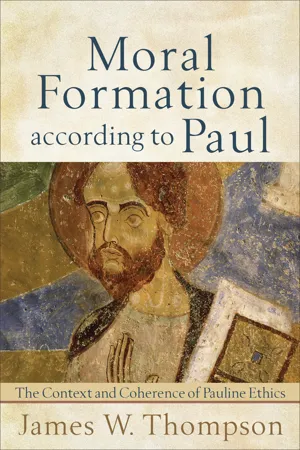
Moral Formation according to Paul
The Context and Coherence of Pauline Ethics
- 272 pages
- English
- ePUB (mobile friendly)
- Available on iOS & Android
eBook - ePub
About this book
This fresh treatment of Paul's ethics addresses this question: how, according to Paul, can Christian communities know how God wants them to live? Leading biblical scholar James Thompson explains that Paul offers a coherent moral vision based not only on the story of Christ but also on the norms of the law. Paul did not live with a sharp dichotomy of law and gospel and recognized the continuing importance of the law. Thompson makes a distinctive contribution by locating the roots of Paul's concrete ethical thought in Hellenistic Judaism rather than Hellenistic moral philosophy. Students of New Testament ethics and Pauline theology will value this work.
Information
Topic
Theology & ReligionSubtopic
Biblical Studies1
Ethics in Hellenistic Judaism
Maintaining Jewish Identity in the Diaspora
Paul’s challenge to gentiles to “turn to God from idols to serve the living and true God” (1 Thess. 1:9) resulted in the formation of communities that had rejected the majority culture’s worldview and way of life. His first task, therefore, was to maintain a group not bound by familial or ethnic ties as a minority community within the larger society. This group would inevitably be confronted by the religious, social, and philosophical values of the majority culture. Thus, like all minority communities, Paul’s churches would survive only if they distinguished themselves from the larger society by a group identity and shared ethos.[75] Paul created a “group ethos” to unite the community.[76]
Jewish communities of the Diaspora had faced a similar challenge prior to Paul’s ministry. Although some Jews assimilated to the larger culture, the literature of Hellenistic Judaism demonstrates the urgency with which Jewish leaders attempted to maintain Jewish identity by sustaining the boundary markers between them and the larger society. Although these writers did not create a comprehensive code like the Mishnah, they shared a commitment to the law, which they interpreted for their own context. The law provided their symbolic world and identity as God’s chosen people. Thus, just as the Pentateuch required Israelites to confirm their identity by not doing “as they do in the land of Egypt” (Lev. 18:3), the writers of the Diaspora distinguished sharply between the morality of Israel and that of the majority culture. According to the Letter of Aristeas, in giving the law to Israel, God “surrounded [the people] with unbroken palisades and iron walls to prevent [them] from mixing with any of the other peoples in any matter” (139). The Third Sibyl accuses the Greeks and other nations of idolatry, homosexuality, and other offenses (599–600). Wisdom distinguishes sharply between the righteous and the ungodly (1:15–16)—between the readers of this work and their enemies (12:22). The latter commit the outrageous offenses described in Wisdom 13–14. A common theme is the difference between the morality of those who keep the law and the immorality of the surrounding nations.
Although Diaspora Jews were diverse in many ways, they shared a commitment to the law. They expressed this commitment selectively in order to meet the needs of the communities. Philo’s Hypothetica and Josephus’s Against Apion summarized the law in remarkably similar ways. Interpreters have observed the extensive parallels between these summaries and the poem Sentences of Pseudo-Phocylides, which was undoubtedly written by a Jew under the name of the ancient Greek writer. This poem echoes the law at numerous points without overtly citing it. The parallels of these three works are evident in table 1.1 and the listed commands.[77] These writers, and other Hellenistic Jews as well, took their summaries of the law primarily from the Holiness Code (Lev. 17–26) and the Decalogue (Exod. 20:2–17; Deut. 5:6–21). Indeed, the laws of Leviticus 19 parallel the Decalogue at many points.[78] Laws also appear that are not explicitly in the Torah, but interpret and actualize the Torah for the circumstances of the readers. Some laws show concern about marriage and family life (table 1.2); others for the oppressed and the weak and for animals and birds (table 1.3); still others about drunkenness and the need for self-control (table 1.4).
Table 1.1. Proscribed Sexual Behaviors in Philo, Josephus,
and Sentences of Pseudo-Phocylides
and Sentences of Pseudo-Phocylides
| Hypothetica 7 | Ag. Ap. 2 | Ps.-Phoc. | Torah | |
| homosexual practices | 7.1 (pederesty) | 199, 215 | 3, 190–91 | Lev. 18:22; 20:13 |
| adultery | 7.1 | 201, 215 | 178 | Exod. 20:14; Lev. 18:20; 20:10 |
| rape | 7.1 | 201, 215 | 198 | Deut. 22:23–29 |
| bestiality | 7.7 | 213 | 188 | Exod. 22:19; Lev. 18:23; 20:15–16; Deut. 27:21 |
| purification after intercourse | 203 | Lev. 15:18 | ||
| sexual relations with relatives | 200 | 179–83 | Lev. 18:7–18; 20:11–21 | |
| abortion | 7.7 | 202 | 184–85 | |
| violating a virgin | 198 | Exod. 22:16; Deut. 22:23–30 | ||
| inappropriate intercourse with wife | 186, 193–96 |
Table 1.2. Marriage and Family Life in Philo, Josephus,
and Sentences of Pseudo-Phocylides
and Sentences of Pseudo-Phocylides
| Hypothetica 7 | Ag. Ap. 2 | Ps.-Phoc. | Torah | |
| submission of wives | 7.3–4 | 201 | ||
| raising of children | 7.3 | 207–16 | ||
| honoring of parents and the aged | 7.2 | 206 | 221 | Exod. 20:12; Deut. 5:16 |
| treatment of slaves | 7.2 | 223–27 |
Table 1.3. The Oppressed and Animals in Philo, Josephus,
and Sentences of Pseudo-Phocylides
and Sentences of Pseudo-Phocylides
| Hypothetica 7 | Ag. Ap. 2 | Ps.-Phoc. | Torah | |
| protection of birds | 7.9 | 213 | Deut. 22:6 | |
| protection of animals | 7.9 | 213 | Exod. 23:4; Deut. 22:1–4 | |
| unjust scales | 7.8 | 216 | Lev. 19:35–36; Deut. 25:13–16 | |
| bribing of judges | 207 | Exod. 23:8; Lev. 19:15; Deut. 16:19 | ||
| care of strangers | 210 | Exod. 22:21; 23:9; Lev. 19:33–34 |
Table 1.4. Drunkenness and Self-Control in Philo, Josephus,
and Sentences of Pseudo-Phocylides
and Sentences of Pseudo-Phocylides
| Hypothetica 7 | Ag. Ap. 2 | Ps.-Phoc. | Torah | |
| lies and the tongue | 48–50 | |||
| drunkenness (metrō piein) | 69 | |||
| envy (phthonos) | 70–71 | |||
| rage (thymos) | 63 | |||
| dissension (eris) | 75, 78 | |||
| gluttony (metrō edein) | 69 | |||
| anger (orgē) | 64 |
These summaries both refer to the Torah and add to it with common emphases. All three emphasize sexual matters, prohibiting homosexual practices, adultery, rape, and bestiality. They also include matters of family life (submission of wives, raising of children, honor to parents). All three prohibit abortion. Matters of social justice also play a major role. The dominant Old Testament passage in the summaries comes from the Holiness Code (Lev. 17–26). These summaries are also notable for what they do not include. They do not refer to circumcision, the Sabbath, the food laws, or laws exclusively determining Israelite national identity.[79]
The function of the law in maintaining Jewish identity in the Diaspora is also evident in works that appeal to the law in urging appropriate conduct but do not summarize the law. In such works as Tobit, 4 Maccabees, the Wisdom of Solomon, and the Testaments of the Twelve Patriarchs, the authors indicate which parts of the law are important in maintaining Jewish identity. Here the degree of openness to other sources of ethics varies among the authors.
Ethics of Tobit
The book of Tobit describes the challenges of living in the Diaspora. Through the medium of the novella, the author describes the ideal of the pious man of the Diaspora who is firmly rooted in the Jewish tradition.[80] In the first section of this work, the aged Tobit describes his life of obedience to the Torah (1:1–3:6). In his youth, before the deportation from Judea, he sacrificed in the temple (1:4) and attended the festivals (1:6–8). Living in the Diaspora, he avoided the bread of the gentiles (1:10–11), gave alms to the poor (1:16), and fed the hungry and clothed the naked (1:17).[81] He expresses many of the same values in the testament he gives his son Tobias before dying. He urges his son not to transgress God’s commandments (4:5) and offers a summary of the statutes that Tobias should keep. Two major themes dominate the testament: social obligations within the community and sexual purity. Tobit expresses his concern about social obligations by his instruction that his son must bury his mother and father properly and honor his mother all of her life (4:3–4; cf. Exod. 20:12). He also echoes numerous passages from the Old Testament on social justice and care for the poor (4:11, 14, 16; cf. Exod. 22:21–27; Lev. 19:9–10). He instructs Tobias, “Love your kindred” (agapa tous adelphous, 4:13), elaborating on the command with the counsel not to marry a non-Israelite. Tobias must express this love by marrying within the covenant community (4:13). Tobit states these obligations in negative terms with an apparent paraphrase of Leviticus 19:18: “And what you hate, do not do to anyone” (4:15 NRSV). He echoes the warnings against excessive drinking (4:15) from the Wisdom literature (cf. Prov. 20:1; 23:29–35; Sir. 31:28–29). Tobit’s concern with sexual purity appears in his warning against fornication (4:12). The story of Tobias and Sarah illustrates the value of both love for kindred and chastity as Tobias seeks a woman from among his people, praying, “I now am taking this kinswoman of mine, not because of lust, with sincerity” (8:7 NRSV). Like the summaries of the law described above, Tobit focuses on the law’s demands for protection of Jewish identity, social justice, and sexual purity within the Diaspora situation.
Ethics of 4 Maccabees
Ethical instruction is a central concern of 4 Maccabees, a work written in Greek by an unknown author who was both firmly rooted in the Jewish tradition and open to the influences of Greek culture.[82] The author recasts the story of the Maccabean martyrs, employing the language of Hellenistic ethics to describe their struggle with tyranny and edify his audience, as the opening line indicates. The work consists of two major sections framed by an exordium (1:1–12) and a peroratio (17:7–18:24).[83] The first section (1:13–3:18) contains the theoretical basis for the thesis, which the author announces in 1:1: “Devout reason (ho eusebēs logismos) rules the emotions (pathē).” Here he states both the genus (philosophōtatos logos) and the content and purpose of his work.[84] This claim becomes the refrain for the entire book (1:1, 5–7, 9, 13–14, 19, 29; 2:4, 7, 9, 15, 24; 3:1, 5; 6:31; 7:1, 16; 13:1; 15:23; 16:1). In some instances, the author attributes the control of the passions to “pious reason,” as in 1:1 (cf. 6:31; 7:16; 13:1; 15:23; 16:1; 18:2), while in other instances he attributes this power only to reason. He sometimes alters the refrain, claiming that reason (logismos) rules over the appetites (orexeis, 1:33), anger (thymos, 2:19–20), and desires (epithymiai, 1:4; 3:2). The true philosophy, therefore, has an ethical orientation, for ethics is concerned with the control of various emotions and desires. Those who control the passions exhibit the cardinal virtues of justice (dikaiosynē), courage (andreia), temperance (sōphrosynē), and wisdom (phronēsis, 1:6, 18).
The author begins to develop the thesis in 1:2, indicating the relationship among three Hellenistic concep...
Table of contents
- Cover
- Title Page
- Copyright Page
- Dedication
- Contents
- Preface
- Abbreviations
- Introduction
- 1 Ethics in Hellenistic Judaism
- 2 Shaping an Identity
- 3 From Catechesis to Correspondence
- 4 Pauline Catechesis and the Lists of Vices and Virtues
- 5 Paul, the Law, and Moral Instruction
- 6 Paul, the Passions, and the Law
- 7 Putting Love into Practice
- 8 Ethics and the Disputed Letters of Paul
- Conclusion
- Works Cited
- Index of Subjects
- Index of Modern Authors
- Index of Ancient Sources
- Notes
Trusted by 375,005 students
Access to over 1.5 million titles for a fair monthly price.
Study more efficiently using our study tools.
Frequently asked questions
Yes, you can cancel anytime from the Subscription tab in your account settings on the Perlego website. Your subscription will stay active until the end of your current billing period. Learn how to cancel your subscription
No, books cannot be downloaded as external files, such as PDFs, for use outside of Perlego. However, you can download books within the Perlego app for offline reading on mobile or tablet. Learn how to download books offline
Perlego offers two plans: Essential and Complete
- Essential is ideal for learners and professionals who enjoy exploring a wide range of subjects. Access the Essential Library with 800,000+ trusted titles and best-sellers across business, personal growth, and the humanities. Includes unlimited reading time and Standard Read Aloud voice.
- Complete: Perfect for advanced learners and researchers needing full, unrestricted access. Unlock 1.5M+ books across hundreds of subjects, including academic and specialized titles. The Complete Plan also includes advanced features like Premium Read Aloud and Research Assistant.
We are an online textbook subscription service, where you can get access to an entire online library for less than the price of a single book per month. With over 1.5 million books across 990+ topics, we’ve got you covered! Learn about our mission
Look out for the read-aloud symbol on your next book to see if you can listen to it. The read-aloud tool reads text aloud for you, highlighting the text as it is being read. You can pause it, speed it up and slow it down. Learn more about Read Aloud
Yes! You can use the Perlego app on both iOS and Android devices to read anytime, anywhere — even offline. Perfect for commutes or when you’re on the go.
Please note we cannot support devices running on iOS 13 and Android 7 or earlier. Learn more about using the app
Please note we cannot support devices running on iOS 13 and Android 7 or earlier. Learn more about using the app
Yes, you can access Moral Formation according to Paul by James W. Thompson in PDF and/or ePUB format, as well as other popular books in Theology & Religion & Biblical Studies. We have over 1.5 million books available in our catalogue for you to explore.