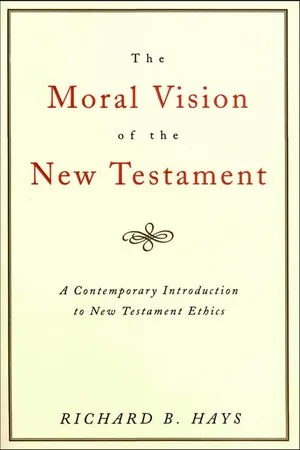
A leading expert in New Testament ethics discovers in the biblical witness a unified ethical vision -- centered in the themes of community, cross and new creation -- that has profound relevance in today?s world. Richard Hays shows how the New Testament provides moral guidance on the most troubling ethical issues of our time, including violence, divorce, homosexuality and abortion.
The first task of New Testament ethics is to describe the content of the individual writings in the New Testament canon. But how is such a description to be attempted? A systematic exegetical treatment of the ethical teachings of the New Testament could fill several volumes.1 Because this book seeks to move beyond description to the synthetic, hermeneutical, and pragmatic tasks, we must limit ourselves to summary accounts of the moral visions of the major New Testament witnesses. Taking in turn each writing or body of writings (e.g., Paul’s letters, the Johannine literature), we shall ask what sort of moral logic informs the writer’s vision of a life lived faithfully before God. What are the major symbols, themes, and concerns that come to expression in the text, and what are the underlying assumptions and convictions about the shape of the Christian life? How does each author reason in discerning God’s will for the community of faith? We shall, in other words, offer a sketch of the moral perspective embodied in each of these texts.
The selection of sketches will be representative rather than comprehensive, concentrating attention on the witnesses that are most important by virtue of their substance and historic influence: Paul, the four Gospels, Acts, and Revelation.2 As a consequence of this approach, the Pauline letters will receive selective coverage, with the letters usually classed as deutero-Pauline (i.e., Colossians, Ephesians, and the pastoral Epistles) receiving only cursory attention; the Johannine Epistles will be considered along with the Gospel of John; and Hebrews and the general Epistles (James, 1 and 2 Peter, and Jude) will not be discussed at all. If the texts not fully treated in this survey did in fact contain ethical emphases or teachings that stood in tension with the other New Testament texts, they would have to be reckoned with in Part II (“The Synthetic Task”); however, in my judgment, that is not the case. The goal of this first part of the book is not to present an exhaustive account of the ethical content of the New Testament but to illustrate the descriptive enterprise and to display a representative sample of the material with which we must work in doing New Testament ethics.
The order in which the texts are to be explored here is a matter demanding some explanation. Most surveys of New Testament ethics begin with a historical reconstruction of the ethics of Jesus and then trace the development of traditions through the early church and into the Gospels.3 I have chosen, however, to begin with Paul. Why? There are three compelling reasons not to follow the customary pattern.
First, beginning with the Gospels tends to create a perspectival distortion. The letters of Paul are actually the earliest extant Christian writings, the oldest texts in the New Testament. When we begin with Jesus and the Gospel traditions, we foster, consciously or unconsciously, the impression that Paul is interpreting or reacting to the Gospels. In fact, however, the Gospels that we know were written well after Paul’s death, and Paul makes only a few passing references to the teachings of Jesus (e.g., 1 Cor. 7:10, 11:23–25). The virtual absence of references in Paul to synoptic Jesus-tradition is a classic problem for New Testament research; for the purposes of the present study, we cannot pursue the arguments about possible allusions to Jesus’ teaching in Paul’s letters.4 In any case, we stand a better chance of appreciating Paul’s distinctive patterns of moral reasoning if we consider his letters in their own right before turning to the Gospel materials.
Second, of all the New Testament writers, Paul offers the most extensive and explicit wrestling with ethical issues. In his correspondence we can see how he encounters specific problems and reasons his way through to a solution. The processes of moral logic are, as it were, exposed and on the surface, so that we can see how his reasoning unfolds. Thus, for heuristic reasons, it is useful to begin with Paul: reading his work will allow us to develop analytical categories that will prove useful in examining other New Testament texts in which the logic of moral argument is less explicit.
Finally, the purpose of this book is not to present a developmental history of early Christian ethics; it is, rather, to reflect critically on the ethical import of the canonical New Testament. Our primary interpretive interest lies not in the hypothetical prehistory of the texts but in their final form and subsequent interpretation.5 The reconstructive historical task is valid and interesting—perhaps even necessary—but it is subsidiary to the concerns of New Testament ethics as a theological discipline. Does it matter for the church’s normative ethical reflection whether Jesus of Nazareth really told the parable of the unforgiving servant (Matt. 18:23–35) or whether it is an imaginative creation of Matthew’s community? In either case, the parable stands in the canonical texts and exerts a normative claim on the Christian tradition. Without minimizing the complexity and importance of our efforts to understand the original historical setting of the New Testament texts, the present study focuses on the witness of the canonical documents.
Why, then, it might be asked, is the Gospel of Mark discussed in this book before the Gospel of Matthew? Why not simply follow the canonical order? Again, this order of presentation seeks to avoid perspectival distortion. For many reasons, a majority of New Testament scholars agree that Mark is the earliest of the canonical Gospels.6 The particular emphases of Matthew and Luke stand out more sharply when their portrayals of Jesus are seen as adaptations and supplementations of the portrait painted by Mark. On the other hand, the order in which the texts are read here is merely a question of heuristic clarity. Our basic concern is to hear the voice of each witness individually; consequently, nothing crucial would be lost if the order of presentation were different.
NOTES
1. The point is illustrated by the existence of several book-length studies of the ethics of individual NT writers: e.g., Via (1985) on Mark; Furnish (1968) and Sampley (1991) on Paul. This is not to mention the extensive body of commentaries and monographs on even smaller units, such as the Sermon on the Mount.
2. To focus an extended discussion on “the ethics of Jude,” for example, would be an exercise in excessive critical scrupulosity.
3. For example, Schnackenburg 1965; J. T. Sanders 1975; Verhey 1984; Schrage 1988; Schulz 1987.
5. For a spirited defense of the legitimacy of such interpretive interests, see Levenson 1993.
6. For presentation of the argument, see Streeter 1924; Kümmel 1975 [1973], 52–64, 84–85; Sanders and Davies 1989.
Chapter 1
Paul
The Koin
nia of His Sufferings
1. Is Paul’s Ethic Theologically Grounded?
Paul was first of all a missionary, an organizer of far-flung little communities around the Mediterranean that united clusters of disparate people in the startling confession that God had raised a crucified man, Jesus, from the dead and thus initiated a new age in which the whole world was to be transformed. The letters of Paul that survive in the New Testament are his pastoral communications with these mission outposts. Though separated from them, he continued to offer them exhortation and counsel about how to conduct their common life “in a manner worthy of the gospel of Christ” (Phil. 1:27).
All of the letters except Romans were written to communities that Paul himself had founded, communities that were well acquainted with his preaching and teaching; consequently, much is left unsaid, taken for granted. As belated readers of the letters, we are left to imagine how the gaps should be filled in. How had Paul preached the gospel to them originally? What norms of behavior had he already sought to inculcate? What shared assumptions were so fundamental that they remained implicit rather than explicit in Paul’s correspondence? The letters give us some clues, but when we read them we repeatedly encounter the tantalizing challenge of the unspoken, just as though we were listening to one end of a telephone conversation.
Paul nowhere sets forth a systematic presentation of “Christian ethics.” Nor does he offer his communities a “manual of discipline,” a comprehensive summary of community organization and duties. Such summaries were not uncommon in the ancient world: in various ways, the genre is represented by the Community Rule (1QS) found among the Dead Sea Scrolls, the presentation of Jesus’ teaching in the Gospel of Matthew, the Didache, and the codification of Jewish Halakah in the Mishnah. Paul, however, does not formulate such a code. As we shall see, he has theological reasons for preferring not to do so. Instead, he responds ad hoc to the contingent pastoral problems that arise in his churches. Should Gentile believers be circumcised? Should converts to Paul’s movement divorce their unbelieving spouses? Are Christians obligated to obey the Roman authorities? In every case, Paul offers answers.
But are his answers based on some coherent set of theological convictions?1 Has he unreflectively taken his moral norms from traditional sources, or are they derived from a logic internal to his gospel?
New Testament scholars have sometimes suggested that there is no direct connection between Paul’s ethical prescriptions and his theological proclamation. Martin Dibelius, one of the founders of form criticism, proposed that the blocks of moral advice that characteristically occur at the end of Paul’s letters should be understood as parenesis, general collections of maxims adopted from popular Hellenistic philosophy.2 According to Dibelius, the early Christians expected the end of history to occur almost immediately; consequently, they did not concern themselves with formulating an ethic. When the parousia did not occur as expected, they filled the ethical vacuum by appropriating philosophical parenesis. Thus, in Dibelius’s view, the ethical teachings in, for example, Galatians 5–6 and Romans 12–15 are not integrally related to Paul’s gospel or derived from “revelation” (see Gal. 1:12); rather, they recycle a general moral wisdom widely shared in Hellenistic culture.3
Although Dibelius’s description of the Pauline ethical material has been strongly challenged,4 his sharp disjunction between the theological and ethical aspects of the letters has continued to find significant support. For example, Hans Dieter Betz, in his major commentary on Galatians, writes this with regard to Galatians 5:1–6:10:
Paul does not provide the Galatians with a specifically Christian ethic. The Christian is addressed as an educated and responsible person. He is expected to do no more than what would be expected of any other educated person in the Hellenistic culture of the time. In a rather conspicuous way Paul conforms to the ethical thought of his contemporaries.5
According to Betz’s account, Paul’s gospel may provide motivation to do what is right, but it does not generate a singularly Christian account of “what is right”; Paul adopts his moral norms from the surrounding educated culture.
The implications of such an analysis are great: if there is no integral relation between Paul’s ethics and his theology, the normative status of his particular ethical teachings is tenuous. When the Christian gospel moves in time or space to a different culture, one could presumably substitute a different set of cultural norms without dif...
Table of contents
Dedication
Contents
Preface
Introduction: The Task of New Testament Ethics
PART ONE The Descriptive Task: Visions of the Moral Life in the New Testament
PART TWO The Synthetic Task: Finding Coherence in the Moral Vision of the New Testament
PART THREE The Hermeneutical Task: The Use of the New Testament in Christian Ethics
PART FOUR The Pragmatic Task: Living Under the Word—Test Cases
Conclusion
Works Cited
Permissions
Searchable Terms of Scripture and Other Ancient Writings
Author Searchable Terms
Topic Searchable Terms
About the Author
Praise
Copyright
About the Publisher
Trusted by 375,005 students
Access to over 1.5 million titles for a fair monthly price.
Study more efficiently using our study tools.
Frequently asked questions
Yes, you can cancel anytime from the Subscription tab in your account settings on the Perlego website. Your subscription will stay active until the end of your current billing period. Learn how to cancel your subscription
No, books cannot be downloaded as external files, such as PDFs, for use outside of Perlego. However, you can download books within the Perlego app for offline reading on mobile or tablet. Learn how to download books offline
Perlego offers two plans: Essential and Complete
Essential is ideal for learners and professionals who enjoy exploring a wide range of subjects. Access the Essential Library with 800,000+ trusted titles and best-sellers across business, personal growth, and the humanities. Includes unlimited reading time and Standard Read Aloud voice.
Complete: Perfect for advanced learners and researchers needing full, unrestricted access. Unlock 1.5M+ books across hundreds of subjects, including academic and specialized titles. The Complete Plan also includes advanced features like Premium Read Aloud and Research Assistant.
Both plans are available with monthly, semester, or annual billing cycles.
We are an online textbook subscription service, where you can get access to an entire online library for less than the price of a single book per month. With over 1.5 million books across 990+ topics, we’ve got you covered! Learn about our mission
Look out for the read-aloud symbol on your next book to see if you can listen to it. The read-aloud tool reads text aloud for you, highlighting the text as it is being read. You can pause it, speed it up and slow it down. Learn more about Read Aloud
Yes! You can use the Perlego app on both iOS and Android devices to read anytime, anywhere — even offline. Perfect for commutes or when you’re on the go. Please note we cannot support devices running on iOS 13 and Android 7 or earlier. Learn more about using the app
Yes, you can access The Moral Vision of the New Testament by Richard B. Hays in PDF and/or ePUB format, as well as other popular books in Theology & Religion & Biblical Studies. We have over 1.5 million books available in our catalogue for you to explore.