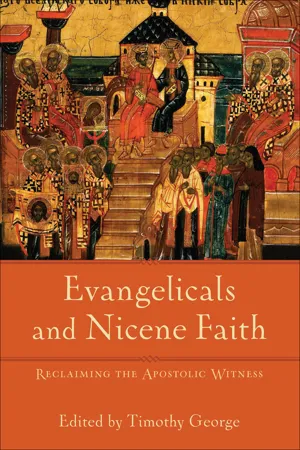
eBook - ePub
Evangelicals and Nicene Faith (Beeson Divinity Studies)
Reclaiming the Apostolic Witness
- 272 pages
- English
- ePUB (mobile friendly)
- Available on iOS & Android
eBook - ePub
Evangelicals and Nicene Faith (Beeson Divinity Studies)
Reclaiming the Apostolic Witness
About this book
The Nicene Creed is the most universally accepted statement of Christian faith by Protestant, Catholic, and Orthodox believers alike. In this volume, top scholars examine the Nicene Creed's connection with the evangelical tradition, helping readers see evangelicalism as a renewal movement within the one holy catholic and apostolic church. Particular focus is given to the Creed's practical outworking in the life of the church--its theology, spirituality, worship, and mission. Topics include pastoral work, biblical exegesis, the emerging phenomena, and Christian orthodoxy's revival in the Global South. The book helps readers present the traditional Christian faith to twenty-first-century people. Contributors include Thomas C. Oden, Gerald Bray, Carl E. Braaten, Curtis W. Freeman, Elizabeth Newman, and Ralph C. Wood, among others.
Information
Topic
Theology & ReligionSubtopic
Christian Theology
1
The Faith Once Delivered

Beloved, although I was very eager to write to you about our common salvation, I found it necessary to write appealing to you to contend for the faith which was once for all delivered to the saints.
Jude 3
Introduction
In this essay I am asking how. My dialogue hopes for visible evidences of the concrete implementation of how. How to do what?—Present the faith! Bring life to faith! Bring faith to life! Not just any generalized faith, but the faith once delivered to the saints. The apostolic faith. The faith of the original eyewitnesses to God’s own coming to give humanity a new start.
The apostles were chosen and sent by the risen Lord into all the world—to every culture in every language—to embody this faith. Does this faith change with changing times? Trust the apostolic witness on this: “Jesus Christ is the same yesterday and today and forever. Do not be led away by diverse and strange teachings” (Heb. 13:8–9). This goes against the grain of our modern pretensions to improve on the apostles. The gospel does not change with each new cultural situation. The style of language may vary, since the history of language changes. But the content of the witness, the gospel, remains the same. The deposit is rock-hard, like Peter (petros, “the rock”), who was called to guard the apostolic teaching: to “feed my sheep.”
This faith is not first delivered to one audience as truth and then later to another audience as a modified truth or an altered view corrected by time. The faith is only once delivered to specific apostles sent to proclaim the changeless truth of God’s coming, once, for all, in every language and culture. Count them: twelve, symbolic of a newly covenanted Israel.
Their deposit was delivered to whom? The saints—the gathered community of worship whenever and wherever they meet to celebrate the truth made known in the incarnate Lord. All these varied forms of Christian community in history have in common their shared life in Christ, who is just as alive with each of them as he was in his Last Supper with his closest disciples.
Why is this testimony needed today? Because it is life-giving and culture-transforming? Yes, but wait—there is more. This testimony is needed today because it is true. Ours is an age of increasing syncretism and radical pluralism. We imagine that we have at last become inoculated against the fantasy of the truth. Postmodernity, which lacks orthodoxy, has only minimal interests in truth claims. Truths, it says, are just competing finite powers with winners and losers. The winner is the truth socially recognized, but only for a time. Just wait till the next alleged truth comes along. Postmodern orthodoxy is wholly focused on one pivotal truth claim: Jesus Christ is Lord.
So how do we present the apostolic testimony, the faith once delivered to the saints, one by one to persons who are living in a culture spinning out into fragmentation? That is the question that brings us together for this essay. Let us look more closely.
“Our Common Salvation”: Ancient Creed and Modern Confession
Upholding the Original Apostolic Tradition
Timothy was instructed: “Follow the pattern of the sound words that you have heard from me, in the faith and love that are in Christ Jesus. By the Holy Spirit who dwells within us, guard the good deposit entrusted to you” (2 Tim. 1:13–14). The first task of the Christian teacher is to “hold fast” to the sound teaching passed on from the apostles. Timothy was not at liberty to teach his own private opinions or prejudices. Paul had provided a living model for the Christian leader to follow (Tertullian, Praescr. 25).
Jesus taught his disciples that the Spirit is being given to “guide you into all the truth” (John 16:13). Paul faithfully passed on the tradition he had received, which he regarded as unalterable: “For I delivered to you as of first importance what I also received.” What is the core of it? That “Christ died for our sins in accordance with the Scriptures” (1 Cor. 15:3).
Paul regarded those in public ministry as “stewards of the mysteries of God” who are required to “be found trustworthy” in passing along the tradition (1 Cor. 4:1–2). Timothy was implored to “guard the deposit entrusted to you. Avoid the irreverent babble and contradictions of what is falsely called ‘knowledge,’ for by professing it some have swerved from the faith” (1 Tim. 6:20–21). Along with objective accuracy, there remains a personal element in the transmission of tradition: “Continue in what you have learned and have firmly believed, knowing from whom you learned it and how from childhood you have been acquainted with the sacred writings, which are able to make you wise for salvation through faith in Christ Jesus” (2 Tim. 3:14–15; cf. Gal. 1:8–9; Jerome, Letters 52.7).
The Creed
The apostolic faith is concisely summarized in the creed. The purpose of preparation for baptism is to learn the core teachings that come directly from the apostles, in order to know what your baptism means and to avoid false advertising. Get this apostolic faith wrong, and everything else about Christianity will be misdirected. Nicea was called to define that core ecumenically—east and west, north and south, on the broadest possible scale—and to defend it against distortions. Nicea was a milestone not because it presented something new, but because it held to that same faith that had been received directly from the apostles through the Spirit and with minimal perversion. The Creed of Caesarea of 325 ended: “We have thought all this in heart and soul ever since we knew ourselves, and we now so think and speak in truth, being able to show by evidence and to convince you that we in past times so believed and preached accordingly” (Eusebius, in Socrates of Constantinople, CH 1.8, COC 2:30). By 431 AD, it was consensually defined that no one within classic Christian teaching has acquired the right “to declare or at any rate to compose or devise a faith other than [Greek, heteran] that defined by the holy fathers who with the Holy Spirit came together at Nicea” (Third Ecumenical Council, Ephesus, SCD 125).
But don’t we need a different foundation for our modern audience? Paul answers: “For no one can lay a foundation other than that which is laid, which is Jesus Christ” (1 Cor. 3:11). Those who pretend to lay a new foundation other than the apostolic testimony do so in vain; such an attempt is like building out of straw. They have already decided to do something else, to build up something quite different from the foundation, “which is Jesus Christ.” The foundation is all about a person, and a personal relation with this person. Our relation to this person is what brings us together.
Revitalizing Ancient Ecumenical Teaching: A New Ecumenism
Today, evangelicals are already embodying what is now being called the new ecumenism. This does not mean a new organization, but rather a rediscovery of our unity with ancient and contemporary Christian believers. Until recently, evangelicals have not had an adequate or viable ecumenical presence. That is partly due to the false but prevailing definition of ecumenism. Some have not yet recognized that this older, modern ecumenism has lost vital contact with the oldest, ancient ecumenism. That primitive experience of unity in personal trust in Jesus Christ is the emerging work of the Spirit. Those who define the ecumenical movement by church officials negotiating their institutional relations with each other—rather than by celebrating the unity of their personal relation with the incomparable Person, the incarnate risen Lord—will here become hard of hearing. But the day of ecumenism being defined by politics is over. That has not been blessed by the Spirit. The rapid demise of the twentieth-century ecumenical movement is due to its detachment from the ancient ecumenical movement. But the Spirit is doing something new, as the Spirit is always prone to do.
I hesitate to even bring up the term ecumenism, because it has been so long distorted. Its closest cognates are catholic and orthodox, both of which have been battered in modernity. So I will write only of ecumenism in an ancient, orthodox, and catholic sense. Confessing evangelicals are uniting to call for the vital recovery of ancient ecumenical teaching today. They constitute living evidence that God the Spirit is calling into being a renewed awareness of our unity in Christ—a new ecumenism. Confessing Christians are seeking the recovery of doctrinal integrity throughout the whole range of world Christianity. This healing is not a mere fantasy but already a palpable reality.
Evangelicals are no longer thinking of the renewing body of Christ simply within the context of recently created denominational walls. Walls that have been erected between Christian institutions have often been bound within the narrow limits of modern assumptions, hence without reference to the communion of saints. Contrary to a popular stereotype, evangelicals are no longer prone to venting spleen, but rather showing their unity in the body of Christ and its plausibility through faith active in love.
This Spirit-filled, personally grounded form of unity in Christ is most alive among young people, many of whom live in Asia and Africa. I have seen their faces. They are weary of accommodating to modernity. They are seeking grounding in ancient ecumenical teaching. Modern ecumenism rightly began in worldwide evangelical mission movements. I speak of the earliest expressions in the World Evangelical Alliance of 1846, and extending to the Edinburgh Conference of 1910. But sadly, by 1966 this modernizing movement had lapsed into a merger mentality represented by defensive bureaucracies, and it finally deteriorated into divisive advocacy and extreme politicization.
Postliberal ecumenism is actively returning to the wellsprings of unity in apostolic truth and classic Christian teaching. Wise Catholic leadership has recognized the weaknesses of the bureaucratic and liberal Protestant ecumenical elites and is now engaging actively in an ongoing conversation with worldwide evangelicals. Wherever lives are hidden in the risen Christ, we have much to consider.
Nicea and Evangelical Confession
A modest expression of this unity and vitality is the Ancient Christian Commentary on Scripture (ACCS), a project once located in Drew University but now is at Eastern University in Philadelphia. A lengthy project begun in 1993, the last of its twenty-nine volumes was recently completed.These early exegetes are supplying Catholics, Orthodox, and Protestants—both evangelical and liberal—with new roots in patristic teaching and exegesis.
Beeson Divinity School in 2009 was the proper place and time for announcing and celebrating the launch of the newest extension of the ACCS effort: the Ancient Christian Doctrine Series. It is a successor series—a five-volume patristic compendium of classic doctrinal definitions, organized around the familiar key phrases of the Nicene Creed. Each volume unpacks the most widely received classic definitions, often called articles, of the Niceno-Constantinopolitan Creed of 325 (with clarifications in 381).
Here the richest doctrinal treasures of the patristic period are being mined and ordered as a commentary on this most authoritative and widely received doctrinal confession of the early church. The Nicene Creed remains the most commonly confessed affirmation of worldwide Christians concerning the heart of the biblical revelation.
These classic texts from the first eight centuries illumine those key decisive phrases of that summative creed. Nicea was written under heretical challenges that defined, for subsequent Christian preaching, liturgy, and catechetics, the boundaries of the faith received from the apostles. The Spirit-blessed efforts of the consensus-bearing exegetes of Scripture are again proving to be the most reliable basis for holding together the core of early Christian teaching, the gist of the gospel.
Relearning the Meaning of Our Baptism
The orderly teaching of Christian doctrine arose out of prebaptismal teaching based on consensually received scriptural exegesis. Drawing the whole course of Christian teaching into a single, cohesive statement was the motive of every early Christian teacher commissioned to prepare persons for baptism.
The creed was a convenient way of drawing together the entire diverse narrative meaning of the Old and New Testament Scriptures into a simple, memorizable affirmation of baptismal faith. This is why Christians all over the world still appeal to this most widely received of all ancient confessions.
Christians have a right to know the meaning of their baptism. Clergy have a sacred duty to teach it. Those rightly prepared for baptism understand what it means to believe in God the Father Almighty and in God the Son, illumined through God the Spirit.
This ancient confession still serves as the most fitting and durable framework for the postmodern rediscovery of classic Christian teaching. Like all ancient baptismal confessions, it is set forth in a triune sequence. The three articles of the creed summarize the being and work of the one God who reveals himself in history as Father, Son, and Spirit. This is the one God to which all of Scripture attests.
The core of this sequence for summary teaching appeared in short form in Matthew 28:19–20 in the formula for baptism, in which the resurrected Lord concluded his earthly teaching with this charge: “Go therefore and make disciples of all nations, baptizing them in the name of the Father and of the Son and of the Holy Spirit, teaching them to observe all that I have commanded you. And behold, I am with you always, to the end of the age.” In this way, the Lord Jesus himself forever linked two crucial acts: baptizing and teaching. In all subsequent periods of Christian history, they have remained intimately interwoven.
The room for private opinion is vast among Christians of very different languages and cultures and historical times, provided those opinions are not repugnant to the core of biblical faith (John Chrysostom, Hom. 2 Tim. 2–3). Nothing is required of any believer other than that which is revealed by God the Spirit to conscience through Scripture, as necessary for salvation and as affirmed consensually by the Christian community.
Baptism is intrinsically voluntary. No one can be rightly forced to believe. It is a free response to a free gift. The task of Christian teaching is to clarify, illuminate, cohesively interpret, and defend the convictions distinctive to Christianity that empower and enable life in Christ (Mark 7:4–9; 1 John 2:12–14).
The most influential teaching summaries of the creed were written as catechetical lectures on the creed by Cyril of Jerusalem (Catechetical Lectures), Gregory of Nyssa (The Great Catechism), John Chrysostom (Baptismal Instructions), and Augustine (Catechizing the Uninstructed and Faith and the Creed). From these came systematic theology.
Teachers as varied as Augustine, Thomas Aquinas, and Luther have held that the Nicene Creed is the best of the condensed statements of Christian faith and the most reliable way to learn the heart of faith. In professing the form of the creed received in Jerusalem, Cyril explains that the believer is helped to keep close to the center of the faith once delivered by the apostles,
which has been built up strongly out of all the Scriptures. For since all cannot read the Scriptures, some being hindered from the knowledge of them by lack of learning, and others because they lack leisure to study, in order that the soul should not be starved in ignorance, the church has condensed the whole teaching of the Faith in a few lines. This summary I wish you both to commit to memory when I recite it, and to rehearse it with all diligence among yourselves, not ...
Table of contents
- Cover
- Series
- Title Page
- Copyright Page
- Dedication
- Contents
- Preface
- Contributors
- Introduction
- Part 1: Identity
- Part 2: History
- Part 3: Practice
- Abbreviations
- Notes
- Index
Trusted by 375,005 students
Access to over 1.5 million titles for a fair monthly price.
Study more efficiently using our study tools.
Frequently asked questions
Yes, you can cancel anytime from the Subscription tab in your account settings on the Perlego website. Your subscription will stay active until the end of your current billing period. Learn how to cancel your subscription
No, books cannot be downloaded as external files, such as PDFs, for use outside of Perlego. However, you can download books within the Perlego app for offline reading on mobile or tablet. Learn how to download books offline
Perlego offers two plans: Essential and Complete
- Essential is ideal for learners and professionals who enjoy exploring a wide range of subjects. Access the Essential Library with 800,000+ trusted titles and best-sellers across business, personal growth, and the humanities. Includes unlimited reading time and Standard Read Aloud voice.
- Complete: Perfect for advanced learners and researchers needing full, unrestricted access. Unlock 1.5M+ books across hundreds of subjects, including academic and specialized titles. The Complete Plan also includes advanced features like Premium Read Aloud and Research Assistant.
We are an online textbook subscription service, where you can get access to an entire online library for less than the price of a single book per month. With over 1.5 million books across 990+ topics, we’ve got you covered! Learn about our mission
Look out for the read-aloud symbol on your next book to see if you can listen to it. The read-aloud tool reads text aloud for you, highlighting the text as it is being read. You can pause it, speed it up and slow it down. Learn more about Read Aloud
Yes! You can use the Perlego app on both iOS and Android devices to read anytime, anywhere — even offline. Perfect for commutes or when you’re on the go.
Please note we cannot support devices running on iOS 13 and Android 7 or earlier. Learn more about using the app
Please note we cannot support devices running on iOS 13 and Android 7 or earlier. Learn more about using the app
Yes, you can access Evangelicals and Nicene Faith (Beeson Divinity Studies) by George, Timothy, Timothy George in PDF and/or ePUB format, as well as other popular books in Theology & Religion & Christian Theology. We have over 1.5 million books available in our catalogue for you to explore.