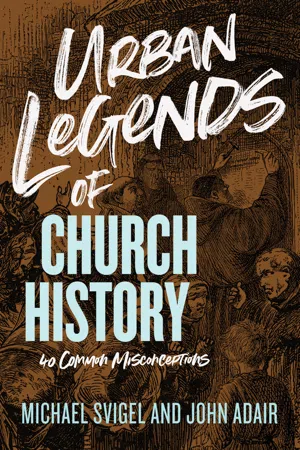
Urban Legends of Church History surveys forty of the most commonly misunderstood events of church history from the period of the early church through the modern age. While these "urban legends" sometimes arise out of falsehood or fabrication, they are often the product of an exaggerated recounting of actual historical events. With a pastoral tone and helpful explanations, authors John Adair and Michael Svigel tackle legendary misconceptions, such as the early church worshiping on Saturday and the unbroken chain of apostolic succession. Urban Legends of Church History will correct misunderstandings of key events in church history and guide readers in applying principles that have characterized the Christian church since the first century.
- 320 pages
- English
- ePUB (mobile friendly)
- Available on iOS & Android
eBook - ePub
About this book
Information
Topic
Theology & ReligionSubtopic
History of ChristianityPART I

Urban Legends of the Early Church (50–500)
| Early Church Time Line (Some of the dates below are approximate.) |
| 35–95: Age of the Apostles |
| 35–99: Clement of Rome |
| 35–110: Ignatius of Antioch |
| 40–95: New Testament written |
| 50–70: Didache written |
| 53–117: Emperor Trajan |
| 56–120: Tacitus |
| 64: Roman fire under Nero |
| 66–73: First Jewish Revolt and destruction of the temple |
| 69–155: Polycarp of Smyrna |
| 75–134: Aristides of Athens |
| 75–135: Epistle of Barnabas written |
| 90–140: Shepherd of Hermas written |
| 100–165: Justin Martyr |
| 110–180: Melito of Sardis |
| 120–180: Celsus |
| 120–185: Theophilus of Antioch |
| 120–200: Irenaeus of Lyons |
| 132–135: Jewish Bar Kokhba Revolt |
| 133–190: Athenagoras of Athens |
| 150–200: Solidifying the New Testament canon |
| 150–215: Clement of Alexandria |
| 160–225: Tertullian of Carthage |
| 170–240: Hippolytus of Rome |
| 184–253: Origen of Alexandria |
| 200–258: Cyprian of Carthage |
| 200–268: Dionysius of Rome |
| 200–300: Further clarifying of the New Testament canon |
| 213–270: Gregory the Wonderworker |
| 234–304: Porphyry of Tyre |
| 244–311: Emperor Diocletian |
| 250: The Decian Persecution |
| 250–325: Lactantius |
| 260–336: Arius of Alexandria |
| 263–339: Eusebius of Caesarea |
| 272–337: Emperor Constantine |
| 290–374: Athanasius of Alexandria |
| 303–304: Great Diocletian persecution |
| 313: Edict of Milan |
| 313–386: Cyril of Jerusalem |
| 325: Council of Nicaea |
| 330–390: Gregory of Nazianzus |
| 335–396: Gregory of Nyssa |
| 339–397: Ambrose of Milan |
| 349–407: John Chrysostom |
| 379–395: Theodosius I |
| 380: Edict of Thessalonica |
| 381: Council of Constantinople |
| 300–400: Settling of the New Testament canon |
| 347–420: Jerome |
| 354–430: Augustine of Hippo |
| 360–418: Pelagius |
| 360–435: John Cassian |
| 400–461: Leo I (the Great) |
| 418: Council of Carthage |
| 431: Council of Ephesus |
| 451: Council of Chalcedon |
| 529: Second Council (Synod) of Orange |
| 529: Founding of Benedictine Order |
| 540–604: Pope Gregory I (the Great) |
| 553: Council of Constantinople II |
CHAPTER 1
The Earliest Christians Worshipped on Saturday
The Legendary Story
Exodus 20:8 says, “Remember the Sabbath day, to keep it holy.” This command isn’t a random ordinance tucked away in the ceremonial law of the Levites. This is one of the BIG TEN! No wonder the early church gathered for worship on Saturday, the Sabbath. But by the time of Emperor Constantine (272–337), the day of worship for Christians had changed from the biblical Sabbath (Saturday) to Sunday to make life easier for the mob of pagans suddenly flooding the churches. Accustomed to worshipping the sun god on Sunday, church authorities changed the day of worship to accommodate the masses. Since that time, Christian observers of the Sabbath have been picked on, put down, or even persecuted for staying true to the Christian Sabbath as Jesus, the disciples, and the earliest Jewish Christians had observed in obedience to the Ten Commandments.
Introduction: Unraveling the Legend
The actual historical evidence shows that even the earliest Jewish disciples of Jesus in the first century commemorated Christ’s resurrection every Sunday. Though many Jewish Christians may have also continued to observe the Sabbath as part of their Jewish heritage, culture, and tradition, the first day of the week (Sunday) was the normal day of gathering for corporate worship because that was the day of the Lord’s resurrection. In fact, evidences that the original followers of Jesus worshipped on Sunday—not Saturday—are “numerous, unanimous, and unambiguous.”1 Why, then, do some people claim the early church observed the Jewish Sabbath?
The Sabbath-to-Sunday Myth
Over the years we’ve encountered several sects that gather for worship on Saturday (the Jewish Sabbath) rather than Sunday.2 When asked why they do this, the responses vary. Some believe the regulation in the Ten Commandments still requires Christians to observe the Sabbath day on Saturday.3 Others claim this was the day the New Testament believers and the ancient church assembled for worship, and they want to return to that original practice.4 Obviously, if the earliest Jewish followers of Jesus worshipped on Saturday, somewhere along the way somebody changed the day of Christian worship.
In 2003 the urban legend of the original Christians’ worshipping on Saturday went mainstream. In his best-selling novel The Da Vinci Code, Dan Brown put the myth of Sabbath-keeping Christians on the lips of the undeterred protagonist, Robert Langdon: “Originally . . . Christianity honored the Jewish Sabbath of Saturday, but Constantine shifted it to coincide with the pagans’ veneration day of the sun. . . . To this day, most churchgoers attend services on Sunday morning with no idea that they are there on account of the pagan sun god’s weekly tribute—Sunday.”5 Like several cults, sects, and hack historians before him, Dan Brown laid the charge of the switch from Saturday to Sunday at the feet of Emperor Constantine, motivated by the popularizing and thus paganizing of Christianity.
Putting the Sabbath to Rest
Several years ago, I (Mike) attended a series of scholarly presentations on the role of Emperor Constantine in the history of the early church.6 One of the presentations directly addressed the issue of Sabbath keeping and Sunday worship.7 As I listened to fellow patristic scholar Paul Hartog carefully walk through the actual historical facts, I got the feeling some of us in the room were a little embarrassed about having to address this issue in a scholarly venue. There were just no good historical evidences and arguments to support the myth that original Sabbath worship was replaced by Sunday worship centuries later.
The earliest Christians gathered on “the Lord’s Day.”8 By AD 95, the phrase “the Lord’s Day” (Gk. kyriakē hēmera) had apparently become a common term for the day of Christian corporate worship centered on preaching and the Lord’s Supper (called the “Eucharist” or “thanksgiving”). The apostle John so used it in Rev 1:10, assuming his readers in western Asia Minor would know immediately what he meant by “the Lord’s Day.”9
Before that, the apostles referred to Sunday as “the first day of the week,” on which Christ rose from the dead (Matt 28:1; Mark 16:2, 9; Luke 24:1; John 20:1). Already in the earliest days of the church, the apostles and their disciples gathered together for worship on the “first day of the week,” that is, Sunday, in commemoration of the resurrection of the Lord Jesus Christ. Acts 20:7 says, “On the first day of the week, we assembled to break bread. Paul spoke to them, and since he was about to depart the next day, he kept on talking until midnight.” The practice of “breaking bread” is probably a reference to the corporate worship of the believers, centered on the Lord’s Supper and fellowship around the preaching of the Word (see chapter 4). We also see Paul addressing the collection of money for the churches in 1 Cor 16:1–2, instructing the Corinthians to make the collection “on the first day of the week” (16:2). Because this was a collection from among members of the church, it indicates this was the day they regularly gathered as a corporate body.10
Now, we do know that on the Sabbath the apostles would go to the Jewish synagogues to preach about Christ to the Jews and God-fearing Gentiles (Acts 13:14; 13:42; 13:44; 16:33). But this evangelism was not the same as gathering together for the apostles’ teaching, the breaking of bread, and prayer—characteristics of early Christian worship (Acts 2:42). It also seems likely that the very first Jewish believers continued to observe many aspects of the law, including the Saturday Sabbath rest,11 but this did not interfere with the very early adoption of a Sunday-morning observance as well.12
So, from the New Testament we see an early emphasis on Sunday, the “Lord’s Day,” the day the Lord rose from the dead, also called the “first of the week.” When we move forward in church history to the very next generation of Christians—to people who actually sat under the teaching of the apostles and their disciples—the picture becomes even clearer.13
In the Didache, a church manual that, according to an emerging consensus of specialists, was probably written around Antioch between AD 50 and 70, the instruction is simple: “On the Lord’s own day [kata kyriakēn de kyriou] gather together and break bread and give thanks.”14 The “Lord’s own day” parallels the term used in Rev 1:10.
At about the same time (around AD 80 or so), an anonymous but highly respected writing (later attributed to “Barnabas”) makes it clear that Christians intentionally worshipped not on the “seventh day” (the Sabbath), but on the “eighth day,” Sunday, as a memorial of the resurrection: “We spend the eighth day in celebration, the day on which Jesus both arose from the dead and, after appearing again, ascended into heaven.”15
Around AD 110, Ignatius, leader of the church of Antioch, wrote a letter to the church in Magnesia of Asia Minor while on his way to execution in Rome. In that letter he addressed the problem of Judaizers’ infecting the church with divisions and false doctrine. He found himself having to explain the Christian practice of worshipping on Sunday rather than on the Sabbath, which was the practice of Judaizers rather than orthodox Chri...
Table of contents
- Introduction
- Part I: Urban Legends of the Early Church (50–500)
- Part II: Urban Legends of the Medieval Period (500–1500)
- Part III: Urban Legends of the Protestant Era (1500–1700)
- Part IV: Urban Legends of the Modern Age (1700–Present)
- Name and Subject Index
Trusted by 375,005 students
Access to over 1.5 million titles for a fair monthly price.
Study more efficiently using our study tools.
Frequently asked questions
Yes, you can cancel anytime from the Subscription tab in your account settings on the Perlego website. Your subscription will stay active until the end of your current billing period. Learn how to cancel your subscription
No, books cannot be downloaded as external files, such as PDFs, for use outside of Perlego. However, you can download books within the Perlego app for offline reading on mobile or tablet. Learn how to download books offline
Perlego offers two plans: Essential and Complete
- Essential is ideal for learners and professionals who enjoy exploring a wide range of subjects. Access the Essential Library with 800,000+ trusted titles and best-sellers across business, personal growth, and the humanities. Includes unlimited reading time and Standard Read Aloud voice.
- Complete: Perfect for advanced learners and researchers needing full, unrestricted access. Unlock 1.5M+ books across hundreds of subjects, including academic and specialized titles. The Complete Plan also includes advanced features like Premium Read Aloud and Research Assistant.
We are an online textbook subscription service, where you can get access to an entire online library for less than the price of a single book per month. With over 1.5 million books across 990+ topics, we’ve got you covered! Learn about our mission
Look out for the read-aloud symbol on your next book to see if you can listen to it. The read-aloud tool reads text aloud for you, highlighting the text as it is being read. You can pause it, speed it up and slow it down. Learn more about Read Aloud
Yes! You can use the Perlego app on both iOS and Android devices to read anytime, anywhere — even offline. Perfect for commutes or when you’re on the go.
Please note we cannot support devices running on iOS 13 and Android 7 or earlier. Learn more about using the app
Please note we cannot support devices running on iOS 13 and Android 7 or earlier. Learn more about using the app
Yes, you can access Urban Legends of Church History by John Adair,Michael Svigel in PDF and/or ePUB format, as well as other popular books in Theology & Religion & History of Christianity. We have over 1.5 million books available in our catalogue for you to explore.