Outreach Magazine's 2012 Resource of the Year Award Winner
2012 Book of the Year Award, Foreword Magazine
The entire material world can be divided between the Natural Environment and the Built Environment. Over the past forty years, the Natural Environment has received more attention of the two, but that is beginning to change. With a renewed interest in "place" within various academic disciplines and the practical issues of rising fuel costs and scarcity of land, the Built Environment has emerged as a coherent and engaging subject for academic and popular consideration.
While there is a growing body of work on the Built Environment, very little approaches it from a distinctly Christian perspective. This major new work represents a comprehensive and grounded approach. Employing tools from the field of theology and culture, it demonstrates how looking at the Built Environment through a theological lens provides a unique perspective on questions of beauty, justice, and human flourishing.
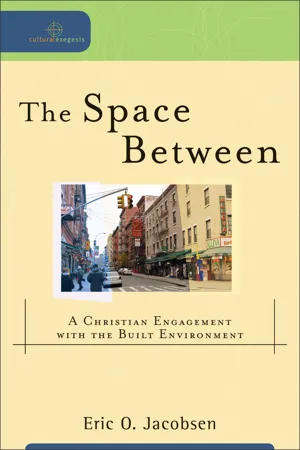
eBook - ePub
The Space Between (Cultural Exegesis)
A Christian Engagement with the Built Environment
- 298 pages
- English
- ePUB (mobile friendly)
- Available on iOS & Android
eBook - ePub
The Space Between (Cultural Exegesis)
A Christian Engagement with the Built Environment
About this book
Trusted by 375,005 students
Access to over 1.5 million titles for a fair monthly price.
Study more efficiently using our study tools.
Information
Topic
Teologia e religioneSubtopic
Teologia cristianaPart I
Orientation
Do you know what this is a picture of?

Fig. 0.5. The Most Advanced Civilization in the World
This is a picture of the most advanced civilization in the world.[10]
Does something about that seem wrong to you? This picture shows a rather unremarkable scene that could be anywhere in North America. You’ve probably seen places like this countless times and may never have given them a second thought.
More specifically, this is a snapshot of the public realm that most of us have come to expect in our everyday life. In most places throughout history, the public realm was where a country showed the rest of world what it valued and what it was capable of. The public realm is where a citizenry would put its most gracious plazas and its most beautiful buildings.
But the public realm in this country is, with few exceptions, rather unremarkable and even depressing. And this somehow seems wrong to us. Not only does this seem out of order in one of the richest countries in the world, it doesn’t seem like a fitting setting for the human species wherever we happen to be. We are, after all, part of God’s good creation—the ones made in God’s image and the ones called to partner with God in the redemption and fulfillment of creation. It seems like we were made for better than this.
And in fact, we were made for better than this. There is a special word for this “something better” condition in which we are supposed to live our lives. That word is shalom and it includes our built environment and much more. Shalom can be translated as “peace,” but unlike our use of the word peace, it means more than just the absence of conflict. Shalom involves restored fellowship with our Creator, human flourishing, justice, and relational wholeness for everyone. And shalom is unmistakably beautiful.
Each one of us carries a longing for shalom deep within. This image of shalom fuels our hope.[11] We respond with a twinge of joy when we see a glimmer of this image in our everyday life. And something just seems wrong when the place that we find ourselves bears not the slightest hint of that blessed condition that is described in the Bible.
In the introduction we looked at a garden and a city as two settings where humanity is shown to be living in harmony with one another, with the rest of creation, and with God. Those settings can be described as being characterized by shalom. But we also noted that we do not currently live in either of those settings. We live somewhere between the garden and the city. The question that we considered then, and will repeat here, is how do we live faithfully between the garden and the city? Or, what should we do in the present time with these longings for shalom?
In the introduction we drew a line between the garden and the city to show how the city can be seen as a realization or flowering of the potential that God intended for the garden. But that line can also be seen as a picture of the possibility for shalom that exists between the garden and the city. When we are obedient to God’s command in the context of the communities and places to which we have been called, we often find that we can experience a degree of shalom in the present time. For this reason, this line can be labeled shalom or obedience.
Of course, “being obedient to God’s command” is not always as easy as it sounds. In what ways can we point to the picture shown above in terms of specific acts of disobedience to God’s command? And how would a decision to be obedient to God’s command translate into specific recommendations for this dismal corner of the public realm?

Fig. 0.6. Between the Garden and the City (II)
The first thing we need is to undergo a kind of orientation. We need to be oriented in such a way that we can begin to see where this shalom line might be located in the context of our places and our communities. And we need to be oriented to see how close or how far our places and communities are from the shalom to which we have been called.
There is nothing unusual about a brief orientation before taking on a new challenge. You may remember participating in orientation before your freshman year of college or getting oriented on the first few days of a mission trip in another country. But it is especially appropriate for us to get oriented before exploring the built environment from a Christian perspective, because the very word orientation is steeped in geography and theology.
The word is based on the Latin oriri, which means “to rise”—as in where the sun rises. From the West, where this term originates, oriri refers to the east. The original context for this word has to do with the siting of churches. If you are unfamiliar with this word, siting has to do with how a building is placed on its lot. The altar of a church (in the West) was supposed to be directed to the east, so that worshipers would be facing Jerusalem as they celebrated the Eucharist together. Churches were built with the narthex to the west, and the apse (where the altar was supposed to be) to the east. When the church building had been properly sited in this way, it was said to be oriented correctly.
The orientation that we undergo in this first section has nothing to do with identifying geographical coordinates so that a church can be properly directed toward the east. Rather, we will be identifying a different set of coordinates that will help to determine whether you are properly directed toward shalom. Rather than plotting your coordinates on a directional grid of north, south, east, and west, we will be plotting your coordinates on a grid consisting of four gifts that have been given to each one of us by our Creator to assist in our striving toward shalom.
- The first gift is embodied existence. Your body was not a mistake, an oversight, or a barrier to your relationship with God. Rather, your body is part of the “very good” that God declared when he completed the work of creation. You were meant to experience the world through the mediation of your five senses at the speed at which your two legs can carry you. These things don’t need to be fixed or overcome in order for you to experience shalom.
- The second gift is a place in which to thrive. God not only created humanity good, God also placed us in a good setting. This setting was both sufficient to meet our material needs and a delightful place characterized by beauty and variety. To not be attached to a particular place (or to be displaced) is portrayed in Scripture as a dreadful consequence of sin, and not a marker of freedom. To experience shalom is not to be delivered from place, but to experience sustenance and delight in a particular place as we wait for the good place that is being prepared for us.
- The third gift is the gift of community. Community is not a panacea against loneliness, nor is it a strategy for making life more interesting. Community is fundamental to our existence. God reveals the divine self to us as a community of Father, Son, and Holy Spirit. We enter the world as part of a natural community of mother, father, and child. And we are called as disciples of Jesus Christ in the context of the community known as the church. We cannot create community from scratch, nor can we truly leave the communities that shape us. We can encourage healthy community, or we can inhibit it through our actions and decisions. But only God can give us the experience of community that we need.
- The fourth gift is the gift of time. When God divided the light from the dark, many believe God created time itself as a fundamental condition of created reality. Time is not therefore a foregone conclusion but is an intentional gift from our Creator. If we miss this basic fact, we are likely to misunderstand time itself and subject ourselves to frustration and disappointment. Some, looking backward, see time as a burden as it accumulates baggage from our history. Others, looking forward, see time as a commodity that can be leveraged as we “create” our own destiny. But as God’s people, we can see time as a gift that can be enjoyed as we learn to receive it, attuned to its various rhythms under the careful guidance of the One who gives it.
1
Who Are You?
Human Being or Automobile Operator?
In the movie Elf, Will Ferrell plays the part of a human (Buddy) who, due to a Christmas mix-up at an orphanage, is raised by elves at the North Pole. The reality of his situation comes into clear focus when one of the elves lets it slip that Buddy doesn’t really fit in because Buddy is a human. As disturbing as this revelation is, it finally makes sense of why he physically doesn’t fit in his bed, the shower, or in any of the chairs.
It may very well be the case that many of us need to experience a similar “aha moment” with regard to our built environment. We humans are embodied beings, but for the past half-century many of us have been living in environments designed around the needs of automobiles. Coming to this realization may help explain numerous situations where it felt vaguely as if we just didn’t fit in.
Curb Radii
To explore this possibility for yourself, find the closest sidewalk and go to the corner. Look down to where the street turns and note what you see.

Fig. 1.1. Curb Radii
Does the corner look like the diagram on the left or the one on the right? The difference between these two types of turns can be captured by taking a measurement known as curb radius. Curb radius is measured by taking the curve of the sidewalk at the corner as one segment of a circle. If you were to complete the circle and then measure the radius of that circle, you would have the curb radius.
The first drawing above shows a curb radius of eight feet, typical for a traditional pre-WWII neighborhood. The second picture shows a curb radius of twenty-five feet, which is typical for a postwar exurban neighborhood.
The purpose of the larger curb radius is to allow automobiles to travel faster by allowing them to turn the corner without slowing down. Unfortunately, the larger curb radius makes it quite a bit more dangerous for pedestrians.
In addition to the danger of crossing a street that allows fast-moving cars, the larger curb radius increases the distance that pedestrians have to travel to reach the other side of the street. If an eight-foot curb radius creates a forty-two-foot crossing distance, a twenty-five-foot crossing may create a sixty-six-foot crossing distance. The crossing distance is also increased as lanes for traffic are increased; and postwar exurbs also tend to have streets that are four, six, and even eight lanes wide. The larger the crossing distance, the longer the span of time the pedestrian is in danger of being hit by a car.
Pedestrian safety is a significant concern in this country. Every year, roughly four thousand pedestrians are killed, and another fifty-nine thousand are injured.[12] Compare this to residential fires, which in 2009 claimed the lives of twenty-five hundred and injured thirteen thousand.[13]
Concern over residential fire safety has led to numerous requirements for things like smoke alarms and clear access to exits. Why, then, has there not been a comparable set of rules about putting limits on curb radii? Or why do we continue to build streets with multiple lanes for traffic? The most logical explanation is that when we leave our homes, we are expected to be in automobiles. We are not really expected to walk around. That is to say, when it comes to the built environment, humans in their natural state are in a disadvantaged position.
This may help explain why, when we find ourselves trying to navigate the built environment by walking around, we sometimes feel as if we just don’t fit in. But we have become so accustomed to “not fitting in” that we hardly notice it any longer and need to do strange things like measure curb radii and count traffic lanes to begin to perceive the reality of our situation.
Pizza and Slice
Another way to help us see the strangeness of our current situation is to use the human experience of certain phenomena as a reality check for our evaluative criteria. This is how we often think about the medical profession. Not all of us know how to do what medical doctors do, because they are trained specialists who work in a complex field. However, as complicated as the medical field is, the product for which that field is responsible (good health) must at some level be perceptible to the nonspecialist. Most people can recognize whether a doctor has done his or her job well, because we have an innate sense of what sickness and wellness look like.
The architect Léon Krier uses the analogy of a pizza to draw out the commonsense aspect of zoning versus traditional neighborhood development.[14] A traditional city, according to Krier, is like a pizza. There are lots of different sizes and types of pizza, and they are generally well regarded. Despite the great variety of pizzas available, there is one rule that governs all pizza. That rule is that one slice of pizza must be representative of the whole. That is to say, whatever kind of pizza you have, each slice will contain most of the ingredients that make it an enjoyable culinary experience. For example, if your friends have ordered a Hawaiian pizza and you receive a slice that doesn’t have any Canadian bacon, you are justified in feeling cheated.
Krier claims that cities are like pizzas, and slices of pizza are like neighborhoods. That is to say every neighborhood should contain most of what you love about your city. You should be able to experience and enjoy the city at the level of your neighborhood. This is a rule that in most cases hasn’t needed to be enforced. It was a natural consequence of the fact that most people throughout history have experienced the built environment on foot. When a significant number of people in an area don’t own cars, the natural consequence is that neighborhoods develop where most needs can be met within a relatively short distance.
As populations expanded beyond distances that one could easily reach on foot, new neighborhoods were formed around the emergi...
Table of contents
- Cover
- Series Page
- Title Page.
- Copyright Page
- Endorsements
- Dedication
- Contents
- Illustrations
- Acknowledgments
- Introducing the Built Environment
- Part I: Orientation
- Part II: Participation
- Part III: Engagement
- Conclusion
- Notes
- Index
- Back Cover
Frequently asked questions
Yes, you can cancel anytime from the Subscription tab in your account settings on the Perlego website. Your subscription will stay active until the end of your current billing period. Learn how to cancel your subscription
No, books cannot be downloaded as external files, such as PDFs, for use outside of Perlego. However, you can download books within the Perlego app for offline reading on mobile or tablet. Learn how to download books offline
Perlego offers two plans: Essential and Complete
- Essential is ideal for learners and professionals who enjoy exploring a wide range of subjects. Access the Essential Library with 800,000+ trusted titles and best-sellers across business, personal growth, and the humanities. Includes unlimited reading time and Standard Read Aloud voice.
- Complete: Perfect for advanced learners and researchers needing full, unrestricted access. Unlock 1.5M+ books across hundreds of subjects, including academic and specialized titles. The Complete Plan also includes advanced features like Premium Read Aloud and Research Assistant.
We are an online textbook subscription service, where you can get access to an entire online library for less than the price of a single book per month. With over 1.5 million books across 990+ topics, we’ve got you covered! Learn about our mission
Look out for the read-aloud symbol on your next book to see if you can listen to it. The read-aloud tool reads text aloud for you, highlighting the text as it is being read. You can pause it, speed it up and slow it down. Learn more about Read Aloud
Yes! You can use the Perlego app on both iOS and Android devices to read anytime, anywhere — even offline. Perfect for commutes or when you’re on the go.
Please note we cannot support devices running on iOS 13 and Android 7 or earlier. Learn more about using the app
Please note we cannot support devices running on iOS 13 and Android 7 or earlier. Learn more about using the app
Yes, you can access The Space Between (Cultural Exegesis) by Eric O. Jacobsen, Dyrness, William A., Johnston, Robert, William A. Dyrness,Robert Johnston in PDF and/or ePUB format, as well as other popular books in Teologia e religione & Teologia cristiana. We have over 1.5 million books available in our catalogue for you to explore.