Find academic sophistication, pastoral sensitivity, and accessibility in the award-winning BECNT series
In this addition to the award-winning BECNT series, highly regarded New Testament scholar Douglas Moo offers a substantive yet accessible commentary on Galatians.
Moo leads readers through all aspects of the book of Galatians--sociological, historical, and theological--to help them better understand its meaning and relevance.
As with all BECNT volumes, this informative, balanced commentary features:
● Detailed interaction with the Greek text
● Extensive research
● Chapter-by-chapter exegesis
● A blend of scholarly depth and readability
● An acclaimed, user-friendly design
The BECNT series aims for academic sophistication with pastoral sensitivity and accessibility, making it a useful tool for pastors, church leaders, students, and teachers.
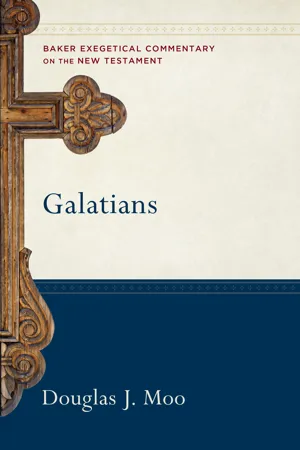
eBook - ePub
Galatians (Baker Exegetical Commentary on the New Testament)
- 544 pages
- English
- ePUB (mobile friendly)
- Available on iOS & Android
eBook - ePub
Galatians (Baker Exegetical Commentary on the New Testament)
About this book
Information
Topic
Theology & ReligionSubtopic
Biblical Commentary
II. The Truth of the Gospel (1:11–2:21)
III. The Defense of the Gospel (3:1–5:12)
IV. The Life of the Gospel (5:13–6:10)
V. Closing: Cross and New Creation (6:11–18)
I. Introduction: The Cross and the New Age (1:1–10)
Following the general pattern of letters in the Greco-Roman world, Galatians has three basic parts: opening, body, closing. Galatians 1:1–10 is the letter opening. It falls into two parts: the typical epistolary salutation (vv. 1–5) and an identification of the letter’s occasion (vv. 6–10). Paul’s letter openings typically include four formal elements: an identification of the sender(s), an identification of the recipient(s), a “grace and peace” wish, and a thanksgiving. The first three are readily identifiable in verses 1–3. But the fourth is absent. In the place where we would usually find the thanksgiving, we have instead a doxology (v. 5), after which Paul somewhat abruptly turns to the situation in the Galatian churches. He expresses consternation that the new believers are paying serious attention to false teachers (v. 6) and condemns the false teachers in very strong terms (vv. 7–9). This departure from Paul’s usual style (Titus is the only other Pauline letter that lacks a thanksgiving) reflects the situation he is addressing.[1] He has neither the time nor the inclination to thank God for the Galatians when their very identity as Christians hangs in the balance; as Chrysostom puts it, the letter “breathes an indignant spirit” (Comm. Gal. on 1:1 [NPNF1 13:1]).
I. Introduction: The Cross and the New Age (1:1–10)
B. Rebuke: The Occasion of the Letter (1:6–10)
A. Prescript (1:1–5)
The first five verses of Galatians form the prescript of the letter—the somewhat formalized introductory elements. The standard form of this introduction in ancient letters is quite simple, usually taking the form of “X to Y, greetings” (see Acts 15:23). Most of Paul’s Letters follow this pattern with minimal adaptation and elaboration. In Galatians, however, as in some of his other letters (e.g., Romans and Titus), Paul adds quite a lot of material to this simple opening formula. These elaborations in Galatians, like the omission of the thanksgiving, probably reflect the situation in focus. Thus his typical identification of himself as an apostle is followed immediately by a defense of the divine authority of his office (v. 1)—an initial hint of an important argument in the letter (1:11–2:10). Another signal about the course of the argument comes in verse 4, where Paul describes Christ as the one who “gave himself for our sins in order that he might rescue us from the present evil age” (v. 4). The cross, and especially the epochal significance of the cross, is the fulcrum of Paul’s strategy for persuading the Galatians to reject the overtures of the false teachers (see esp. 2:19–20; 3:1, 13; 6:14). More surprising is the brief reference at the end of verse 1 to the resurrection of Christ. Only in Romans, among the other Letters of Paul, is there any reference to the resurrection (1:4), and there is no further reference to the resurrection in Galatians. Paul may be reminding the Galatians of the “gospel” that he preached among them (cf. 1 Cor. 15:1–3). But the allusion probably also serves to underline the fundamental break in salvation history that the coming of Christ has created, for resurrection, against the background of the OT and Jewish theology, also signals the arrival of the new age.
Exegesis and Exposition
1Paul—an apostle chosen not by human beings nor by a human being but by Jesus Christ and God the Father, who raised him from the dead—2and all the brothers and sisters who are here with me to the churches of Galatia: 3Grace to you and peace from ⌜God our Father and the Lord⌝ Jesus Christ, 4who has given himself ⌜for⌝ our sins in order that he might rescue us from the present evil age, according to the will of our God and Father—5to whom be glory forever and ever. Amen.
[1:1] Paul begins his Letter to the Galatians by identifying himself, as he does in all his letters, with his hellenized “Roman” name, Paul (Παῦλος, Paulos). Paul’s “Hebrew” name, Σαῦλος (Saulos, Saul), used in the early narratives about Paul in Acts, is never used by Paul himself in his letters. It has been theorized that Paul first took his Greek name in honor of his high-ranking convert, Sergius Paulus (Acts 13:6–12; Luke first uses “Paul” in 13:13). But it is much more likely that “Paul” was the apostle’s Latin cognomen (see, e.g., Bruce 1974: 38). Paul also typically designates himself an “apostle” in his letter openings (although the title is absent in Philippians, 1 and 2 Thessalonians, and Philemon). The word “apostle” (ἀπόστολος, apostolos) means “one who is sent,” an envoy; as Origen puts it, “Everyone who is sent by someone is an apostle of the one who sent him” (Origen, Comm. Jo. 32.17; quoted by H. D. Betz, ABD 1:309). Paul can use the word in a simple nontechnical sense (e.g., Phil. 2:25; 2 Cor. 8:23) and to denote Christians who have been sent as accredited missionaries (e.g., Rom. 16:7). But when describing himself, he uses apostolos to claim equal status with the original twelve apostles (e.g., Luke 6:13; see esp. 1 Cor. 9:1–5 and Gal. 1:17, 19). When he claims apostolic status in his letter openings, Paul will often also trace that status to the call of God, but only here in Galatians does Paul set that divine calling in contrast to any possible human derivation.[2]
Paul has been chosen to be an apostle (the idea “chosen” [“sent” in NRSV and NIV; “appointed” in NLT] is implied in the word “apostle”) “by Jesus Christ and God the Father,” and not “by human beings” (ἀπ᾿ ἀνθρώπων, ap’ anthrōpōn) nor “by a human being” (δι᾿ ἀνθρώπου, di’ anthrōpou). The denial of any human involvement in Paul’s apostolic status is echoed in his later claim that his gospel was not of human origin (1:11–12). The most likely reason for this concern is that the agitators were attempting to undermine Paul’s authority with the Galatians by arguing that his status and teaching depended on the Jerusalem apostles, whose views (as represented by the agitators) should therefore trump Paul’s.[3] Paul not only highlights this denial by placing it before his reference to his divine commissioning; he also repeats the point for emphasis.
This repetition has sparked discussion because of the way Paul shifts the wording. He moves from the preposition apo to dia and from the plural anthrōpōn to the singular anthrōpou. The latter change may signal a move from general to particular: Paul does not owe his apostolic status to “human beings” in general; nor does he owe it to any particular human being—perhaps someone such as James or Peter (e.g., Martyn 1997: 84). Such a distinction is possible, but it is perhaps more likely that the shift from plural to singular is simply stylistic. The change from apo to dia might also be stylistic, since the two prepositions have a semantic overlap in the idea of “ultimate origin” (on both prepositions, see BDAG 105–7, 223–26). However, dia more often refers to an intermediate agent: “through” rather than “from” or “by” (see the careful distinction in 1 Cor. 8:6: “For us there is but one God, the Father, from [ἐξ, ex] whom all things came and for whom we live; and there is but one Lord, Jesus Christ, through [διά, dia] whom all things came . . .”).
Paul therefore is probably making two slightly different points in these phrases: the ultimate source of his apostleship was not human; nor did he receive it from, or through, any human being (“source” vs. “agency” [A. Robertson 1934: 567]; “fountain-head” versus “channel” [Lightfoot 1881: 71]; see also R. Longenecker 1990: 4; Silva 2003: 6). This interpretation fits Paul’s general use of the two prepositions (see the additional note on 1:1) and satisfactorily explains why he uses both phrases. Of course, Paul does not intend to deny all human involvement in his calling and ministry, such as Ananias’s laying hands on Paul when he was converted (Acts 9:10–19) or the church at Antioch’s commissioning him and Barnabas for their first missionary journey (Acts 13:1–3). Paul’s point, rather, is that his apostolic status and authority do not depend on human beings in any essential way.[4]
An assertion of the divine origin of his apostleship is typical in Paul’s letter openings, but the particular way he puts it here is again unique. Usually Paul attributes his apostleship simply to God: “called to be an apostle . . . by the will of God” (1 Cor. 1:1; cf. Rom. 1:1, “called to be an apostle”); “by the will of God” (2 Cor. 1:1; Eph. 1:1; Col. 1:1; 2 Tim. 1:1). Here, however, he attributes his calling to both “Jesus Christ” and “God the Father.” Paul does this also in 1 Tim. 1:1 (“by the command of God our Savior and of Christ Jesus our hope”), but putting Christ before God still makes Galatians distinct. Paul reverses the usual order so that he can add to God’s name a reference to his raising Christ. It is probably because Christ’s name comes first that Paul uses the preposition διά (rather than, e.g., ἀπό, apo, from/by) before both divine names.
To be sure, as we have seen above, this preposition can refer to ultimate agency, and a number of scholars think this must be its meaning here (Bruce 1982b: 73). But it is more likely that the preposition retains its usual instrumental meaning and that Paul is already thinking of the revelation of Jesus Christ to him as the point of his apostolic calling: he was chosen as an apostle “through” Jesus Christ as he was manifested to him on the road to Damascus (see 1:15–16; e.g., Dunn 1993a: 27–28; C. Campbell 2012: 244–45). The difficulty then is to understand what this preposition means when it governs “God the Father”—for God is the originator rather than the mediator of Paul’s apostleship.
One option is to think that the meaning of the preposition shifts from instrumental agent to ultimate agent.[5] But it is more likely that the preposition has the same instrumental sense in relation to both Christ and God the Father. Without denying that the Father is the ultimate agent of his apostleship, the Father is, along with the Son, the instrumental agent as well (Lightfoot 1881: 72; Dunn 1993a: 27). Moreover, we should refrain from insisting on too much precision in Paul’s language. Note, for instance, that in verse 3 Paul can use the preposition ἀπό to govern both the Father and the Son (Lagrange 1918: 3). The introduction of a second and different preposition in either verse would detract from Paul’s obvious concern to associate the Father and the Son as closely as possible. In such verses we find the building blocks of an incipient trinitarian theology.
The distinctive nature of Paul’s apostolic identification is seen again at the end of verse 1. Only in Galatians does Paul attribute his apostolic status to “God the Father”; and only here does he mention the resurrection with that status. (Paul does allude to the resurrection in the prescript of Romans [1:4], but it is not connected to Paul’s apostleship.) Some scholars think that the reference to God the Father here and twice again in the letter’s salutation (vv. 3 and 4) reflects an emphasis in the letter as a whole on God as the Father who adopts children to be his own (see 4:1–7; Betz 1979: 39; Martyn 1997: 84). Yet the fatherhood of God does not play that great a role in Galatians; it is, for instance, far more prominent in Ephesians. Perha...
Table of contents
- Cover
- Series Page
- Title Page
- Copyright Page
- Dedication
- Contents
- Series Preface
- Author’s Preface
- A Note to the Reader
- Abbreviations
- Transliteration
- Map
- Introduction to Galatians
- I. Introduction: The Cross and the New Age (1:1–10)
- II. The Truth of the Gospel (1:11–2:21)
- III. The Defense of the Gospel (3:1–5:12)
- IV. The Life of the Gospel (5:13–6:10)
- V. Closing: Cross and New Creation (6:11-18)
- Works Cited
- Index of Subjects
- Index of Authors
- Index of Greek Words
- Index of Scripture and Other Ancient Writings
- Notes
- Back Cover
Trusted by 375,005 students
Access to over 1.5 million titles for a fair monthly price.
Study more efficiently using our study tools.
Frequently asked questions
Yes, you can cancel anytime from the Subscription tab in your account settings on the Perlego website. Your subscription will stay active until the end of your current billing period. Learn how to cancel your subscription
No, books cannot be downloaded as external files, such as PDFs, for use outside of Perlego. However, you can download books within the Perlego app for offline reading on mobile or tablet. Learn how to download books offline
Perlego offers two plans: Essential and Complete
- Essential is ideal for learners and professionals who enjoy exploring a wide range of subjects. Access the Essential Library with 800,000+ trusted titles and best-sellers across business, personal growth, and the humanities. Includes unlimited reading time and Standard Read Aloud voice.
- Complete: Perfect for advanced learners and researchers needing full, unrestricted access. Unlock 1.5M+ books across hundreds of subjects, including academic and specialized titles. The Complete Plan also includes advanced features like Premium Read Aloud and Research Assistant.
We are an online textbook subscription service, where you can get access to an entire online library for less than the price of a single book per month. With over 1.5 million books across 990+ topics, we’ve got you covered! Learn about our mission
Look out for the read-aloud symbol on your next book to see if you can listen to it. The read-aloud tool reads text aloud for you, highlighting the text as it is being read. You can pause it, speed it up and slow it down. Learn more about Read Aloud
Yes! You can use the Perlego app on both iOS and Android devices to read anytime, anywhere — even offline. Perfect for commutes or when you’re on the go.
Please note we cannot support devices running on iOS 13 and Android 7 or earlier. Learn more about using the app
Please note we cannot support devices running on iOS 13 and Android 7 or earlier. Learn more about using the app
Yes, you can access Galatians (Baker Exegetical Commentary on the New Testament) by Douglas J. Moo, Yarbrough, Robert W., Stein, Robert, Robert W. Yarbrough,Robert Stein in PDF and/or ePUB format, as well as other popular books in Theology & Religion & Biblical Commentary. We have over 1.5 million books available in our catalogue for you to explore.