eBook - ePub
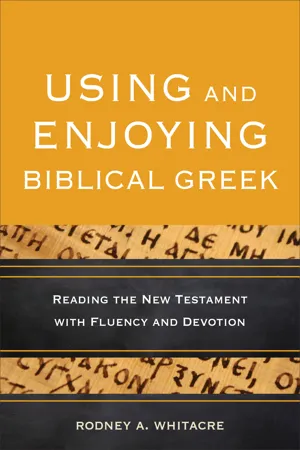
Using and Enjoying Biblical Greek
Reading the New Testament with Fluency and Devotion
- 272 pages
- English
- ePUB (mobile friendly)
- Available on iOS & Android
eBook - ePub
Using and Enjoying Biblical Greek
Reading the New Testament with Fluency and Devotion
About this book
Many who study biblical Greek despair of being able to use it routinely, but veteran instructor Rodney Whitacre says there is hope! By learning to read Greek slowly, students can become fluent one passage at a time and grasp the New Testament in its original language. Whitacre explains how to practice meditation on Scripture (lectio divina) in Greek, presenting a workable way to make Greek useful in life and ministry. Ideal for classroom use and for group or individual study, this book helps students advance their knowledge of Greek and equips them to read the original texts with fluency and depth.
Information
Topic
Theology & ReligionSubtopic
Biblical Reference1
INTRODUCTION
A knowledge of the basics of Greek opens to you the greatest mental and spiritual adventure, the most edifying study. With Greek you have unique access to some of the world’s greatest literature and, most significantly, the power and beauty of God’s Scriptures, the very oracles of God (τὰ λόγια τοῦ θεοῦ, Rom. 3:2).1
The question “Why study Greek?” was raised some years ago in an internet discussion group devoted to Greek. The six reasons given by a woman who had studied Greek in a class at her church sum it up very nicely:
1. I love the language. I did not anticipate this when I started it. 2. I do get nuances out of the text that I don’t get in English. 3. Reading from the Greek slows me down and makes me think. 4. I now know enough to recognize faulty arguments made by other speakers. 5. I find reading from the Greek more moving. I was gripped by reading the Passion passages in the Gospels, something I don’t think I get from reading English. 6. I am a resource for the Bible study I am in. I don’t answer a question every week, but there’s an interpretation question I can answer, or get the answer to, with some frequency. Sometimes it’s as simple as whether “you” is in the singular or plural.2
Would that all students of Greek had such an experience! I want to help you engage Greek texts in ways that will bring such benefits. In this introduction I will give you an overview of what I have in mind.
“Before we sip the Scriptures, we should guzzle them.” This is great advice for how all Christians should approach the Scriptures. Augustine spends most of his time in On Christian Doctrine explaining how to interpret Scripture, and his first step is to “read them all and become familiar with their contents” (II.12 [chap. 8]). He encourages believers “to read them so as to commit them to memory, or at least so as not to remain wholly ignorant of them” (II.14 [chap. 9]).
Such extensive reading is all the more important for teachers and preachers. I remember Harold John Ockenga, when he was president of Gordon-Conwell Theological Seminary, saying that before he began to preach through a book of the Bible he read it forty times. He guzzled the book before sipping individual passages and preaching them to others.
In this book I want to encourage you to guzzle and sip the text in Greek. The methods I share in this book for gaining an ability to engage the text in these ways are neither complex nor difficult. You can use these two approaches right from the outset in basic Greek and then continue them throughout your life. It certainly takes time to become fluent, but there are ways to move toward fluency that are very enjoyable and valuable. I will not focus on exegesis,3 though these approaches complement exegetical study of texts and can deepen your ability to do exegesis. As we will see, fluency and meditation have their own values.
Fluency
Reading extensively, guzzling, requires some level of fluency in reading a text in Greek. Fluency is often understood as the ability to read, write, and speak a language with a high level of accuracy and without stumbling over words, forms, or constructions. Rosetta Stone language courses, for example, are designed for such fluency.4 An ability to speak and write Greek is certainly a deeper level of familiarity with the language than just the ability to read. But fluency in reading can be a goal in itself that produces great rewards.5
In discussions of learning to read a second language, fluency is often “a relatively undefined, informal concept,”6 but William Grabe highlights four elements.7 A person who reads fluently is able to process the signals in a text rapidly, accurately, and automatically, that is, without needing to stop and analyze the form, function, or meaning of a word or expression. Such fluency also includes the ability to recognize the rhythmical flow of the structural units of a passage.8 Reading in this way, however, does not mean that there are no pauses, even for those reading their native language.
Fluency does not describe a stage in which a reader is able to decode all words instantly; rather, we become fluent word by word. Studies in which the eye movements of readers are tracked have shown that a skilled reader pauses at between 50 and 80 percent of the words in a text. He needs to fixate on the words, essentially to scan them in, but does so very, very quickly because the words—their spelling patterns and pronunciations—are well known to him.9
Some discussions of reading a second language “separate fluency from accuracy; that is, fluency comes at the expense of accuracy, and accuracy comes at the expense of fluency.”10 In this case, fluent reading does not include attending to all the details, but rather getting the main ideas of the text and something of how they are developed.
Such rapid reading is a valuable exercise. C. S. Lewis describes the large sections of Homer his tutor assigned him to read each day and commented, “He appeared at this stage to value speed more than absolute accuracy. The great gain was that I very soon became able to understand a great deal without (even mentally) translating it; I was beginning to think in Greek.”11
This rapid reading is one of the key practices for gaining fluency. But as you are learning a language, it is also important to practice reading with attention to the details.12 As Grabe notes, “Getting the language right, even if tentatively, should be the precursor of fluency development.”13 Commenting on a child learning their native language, Shaywitz says, “To acquire a new word for his vocabulary, a child must scrutinize the inner details of the word and not gloss over it.”14 So along with rapid reading there is this more careful reading.
The analogy with learning to play a musical instrument is often used. For many instruments, you need to learn some music theory and practice scales and work on various exercises in order to become accomplished and play smoothly and freely, even improvising. Common advice when practicing a scale or a piece is that you begin slowly enough to make few, if any, mistakes. The mantra is “practice does not make perfect; practice makes permanent.” So you should begin slowly in order to lay a solid foundation. Then speed and interpretation come with familiarity with the basics. Once some competence is gained, it is good to include times of pushing yourself to play more quickly than is comfortable. Similarly, once the basics of Greek are in place, you should continue to read carefully but also practice reading fast. Such reading will probably include some mistakes and less clarity in understanding the passage, but it helps you learn to process the data more quickly and will highlight areas that need further work.
In chapter 5 I will discuss strategies and resources for practicing both rapid reading and careful reading. The more time you have for reading, the faster you will gain comfort and fluency in the language, of course. But even if you have limited time you can make progress by focusing on one sentence at a time and one passage at a time. Approaching Greek in this way means you are able to enjoy and benefit from amazing texts immediately, even as you build your knowledge and skill to become increasingly fluent in the language. “How to become fluent one passage at a time” is a major focus in this book.
Unfortunately, most students of Biblical Greek, in my experience, view even this limited sort of fluency as a goal far beyond their reach. Indeed, they often view this goal as not only impossible for them but also unnecessary since their focus will be on the exegesis of short passages. The multitude of excellent resources available for help with exegesis may seem to make the knowledge of Greek unnecessary, beyond perhaps knowing the alphabet and a few rudiments of the language needed for following the discussion in these resources.
Such a limited view of Greek’s value may be part of the reason many students of Biblical Greek lose much of what they learn in Greek courses. One recent study of the use of Greek among a group of pastors found that the majority of them do not consult the Greek text directly for sermon preparation.15 Rather, they draw upon their training in Greek to help with word studies and in the use of good reference material. Thus, instead of engaging the text in Greek themselves, they engage the English text and make use of resources to explore particular details in the Greek. Use of Greek on this level is helpful but misses much of what the language has to offer through more in-depth exegesis, as well as through meditation and fluency. Perhaps this group of pastors is unusual, but rumor has it that many people who learn basic Greek let their Greek go.16
The good news is that familiarity with particular bodies of literature is not beyond the reach of anyone who is able to learn basic Greek. It does not require an extraordinary investment of time, nor do you have to wait for years before enjoying the benefits of this more limited sort of fluency.
Note that such reading is not the same as translation. Reading is gathering the content of a passage straight from the Greek, without turning it into English. C. S. Lewis has an apt description of the difference:
Those in whom the Greek word lives only while they are hunting for it in the lexicon, and who then substitute the English word for it, are not reading the Greek at all; they are only solving a puzzle. The very formula, “Naus [ναῦς] means a ship,” is wrong. Naus and ship both mean a thing, they do not mean one another. Behind Naus, as behind navis or naca,17 we want to have a picture of a dark, slender mass with sail or oars, climbing the ridges, with no officious English word intruding.18
Learning to read Greek in this way enables you to feel at home in the text and sets you free to explore a wide selection of passages, as well as return to well-known passages repeatedly to discover new insights. A. T. Robertson, in the preface to his 1,500-page Greek grammar, noted, “I have never gone to the Greek New Testament without receiving fresh illumination on some point. . . . Each student has the joy of discovery as the Greek opens its beauties to his mind and to his soul.”19 Elsewhere he says, “Three of the most gifted ministers of my acquaintance make it a rule to read the Greek Testament through once a year.”20 I remember Ockenga telling us of coming home from preaching one Sunday and relaxing by reading through Paul’s Letter to Titus in Greek. I do not know how well Ockenga knew Greek, but there is joy and refreshment that come with familiarity, even if we are fluent in only a few texts.
Meditation
Along with reading portions of text you also can benefit greatly from engaging specific passages in depth through meditation. By meditation I mean repeating a passage over and over, listening to its sounds and reflecting on its details. This “sipping” exercise enables you to become intimately connected to the text so that, in a sense, you come to inhabit it and it becomes a living voice within you. Such reading of sacred texts is part of many religions, and, as we will see, professors of Classics sometimes recommend such an approach to passages from Greek and Latin authors. Meditation on God...
Table of contents
- Cover
- Title Page
- Copyright Page
- Dedication
- Contents
- Preface
- Abbreviations
- 1. Introduction
- 2. Building Vocabulary
- 3. Essential Parsing
- 4. Making Sense of Sentences
- 5. Gaining Familiarity and Fluency
- 6. Utilizing Greek in Meditation
- 7. Practice Passages
- Appendix 1: Sentence Mapping
- Appendix 2: Labels for Sentence Maps
- Appendix 3: Reader’s Notes for John 3:16–18
- Appendix 4: Core Patterns for Greek Morphology
- Appendix 5: Greek Verbs—Two Current Topics
- Bibliography
- Scripture Index
- Subject and Name Index
- Notes
- Back Cover
Trusted by 375,005 students
Access to over 1.5 million titles for a fair monthly price.
Study more efficiently using our study tools.
Frequently asked questions
Yes, you can cancel anytime from the Subscription tab in your account settings on the Perlego website. Your subscription will stay active until the end of your current billing period. Learn how to cancel your subscription
No, books cannot be downloaded as external files, such as PDFs, for use outside of Perlego. However, you can download books within the Perlego app for offline reading on mobile or tablet. Learn how to download books offline
Perlego offers two plans: Essential and Complete
- Essential is ideal for learners and professionals who enjoy exploring a wide range of subjects. Access the Essential Library with 800,000+ trusted titles and best-sellers across business, personal growth, and the humanities. Includes unlimited reading time and Standard Read Aloud voice.
- Complete: Perfect for advanced learners and researchers needing full, unrestricted access. Unlock 1.5M+ books across hundreds of subjects, including academic and specialized titles. The Complete Plan also includes advanced features like Premium Read Aloud and Research Assistant.
We are an online textbook subscription service, where you can get access to an entire online library for less than the price of a single book per month. With over 1.5 million books across 990+ topics, we’ve got you covered! Learn about our mission
Look out for the read-aloud symbol on your next book to see if you can listen to it. The read-aloud tool reads text aloud for you, highlighting the text as it is being read. You can pause it, speed it up and slow it down. Learn more about Read Aloud
Yes! You can use the Perlego app on both iOS and Android devices to read anytime, anywhere — even offline. Perfect for commutes or when you’re on the go.
Please note we cannot support devices running on iOS 13 and Android 7 or earlier. Learn more about using the app
Please note we cannot support devices running on iOS 13 and Android 7 or earlier. Learn more about using the app
Yes, you can access Using and Enjoying Biblical Greek by Rodney A. Whitacre in PDF and/or ePUB format, as well as other popular books in Theology & Religion & Biblical Reference. We have over 1.5 million books available in our catalogue for you to explore.