An Accessible, Up-to-Date Intermediate Greek Grammar
This intermediate grammar for students of New Testament Greek incorporates the advances of recent linguistic research in an accessible and understandable way. Drawing on years of teaching experience at a leading seminary, the authors help students extend their grasp of Greek for reading and interpreting the New Testament and related writings. They make extensive use of New Testament texts to illustrate each grammatical category. Long enough to provide substantial help yet concise enough for frequent practical use, this book is ideal for intermediate Greek and Greek exegesis classes. It is also a valuable resource for preachers and others.
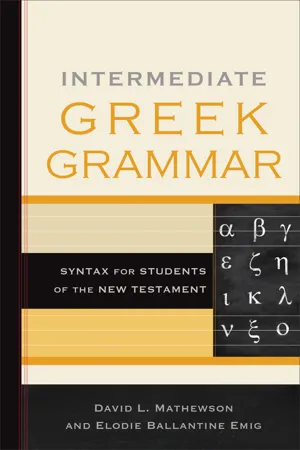
eBook - ePub
Intermediate Greek Grammar
Syntax for Students of the New Testament
- 336 pages
- English
- ePUB (mobile friendly)
- Available on iOS & Android
eBook - ePub
Intermediate Greek Grammar
Syntax for Students of the New Testament
About this book
Information
Topic
Theology & ReligionSubtopic
Biblical Reference1
THE CASES
1.1. As an inflected language, Greek uses a system called “case” to mark a group of words, nominals (nouns, pronouns, adjectives, adjectival participles, and articles), in order to indicate their grammatical function and relationship to other words within a sentences (e.g., subject, predicate nominative, direct object, indirect object). In English we primarily follow word order to determine grammatical function. If we change the order of “The player hit the ball” to “The ball hit the player,” the grammatical function (subject, object) of “player” and “ball” changes. In Greek it is the inflected endings, not word order, that indicate such things. If we follow the formal endings of the Greek case system, there are at most five cases: nominative, accusative, genitive, dative, vocative.1
The choice of a case ending by an author communicates a specific meaning, which is refined by how it relates to its broader context. A common approach to the cases is to create multiple labels (such as nominative of appellation, possessive genitive, instrumental dative) to name the various ways they function in representative contexts. So, for example, Wallace (72–175) provides some thirty-three labels for the genitive case and twenty-seven for the dative. Analyzing the cases in NT interpretation, then, sometimes consists of simply attaching the correct label or category to each occurrence of a Greek case (a method we call “pin the label on the grammatical construction”). The following points are meant to introduce our treatment of cases in the rest of this chapter.
1.2. It is helpful to distinguish, as Porter (81–82) does, between (a) the meaning contributed by the semantics of the case itself, (b) the meaning contributed by other syntactical features, and (c) the meaning contributed by the broader context. Thus the interpreter must consider all three of these in arriving at the meaning of a given case construction: the case (e.g., a genitive), other syntactical features (e.g., the genitive follows a noun that semantically communicates a verbal process), and the broader context (e.g., this construction occurs in a given context of one of Paul’s Letters).
1.3. This grammar will follow a “minimalist” approach to the cases. That is, it focuses on the basic, more common, or exegetically significant usages of the cases rather than multiplying numerous categories with their respective labels. This is not to suggest that there are no other valid usages or categories than those listed below. But it is important to remember that “these names are merely appellations to distinguish the different contextual variations of usage, and that they do not serve to explain the case itself.”2 It is important to distinguish the semantics of the case forms from the pragmatic usage of the cases in different contexts. These different labels (appellations) are not the meanings of the cases, but reflect the different contextual realizations of the meanings of the case forms. This approach also allows for ambiguity in the case functions. Sometimes more than one potential label will “fit” when there is not enough evidence to select a specific category with confidence. In such cases the interpreter should refrain from feeling the need to pin down a given case function. The focus should be on the meaning the case contributes to the context. Many grammars often illustrate different case functions with the clearest examples they can find. The problem is that students may think that in every case they must discover “the correct label.” But ambiguous examples often prove more fruitful for teaching exegesis in that they resist so easily pinning a category or label on a given case. At times NT authors may have been ambiguous as to the exact function of the case, or a single label may not capture the function of the case in a given context. At other times there is simply not enough evidence to confidently label a given case usage.
1.4. Although we hope that a “minimalist” approach to case usage will free students of the Greek NT to give their full attention to the forest rather than the trees, we acknowledge our great debt to those who have created and refined case labels. Labels help us think logically and systematically about language. There is obvious value in the discipline of considering the many ways in which one might understand, for example, τὴν πίστιν τοῦ θεοῦ (subjective genitive, objective genitive, possessive genitive, or genitive of source come to mind for τοῦ θεοῦ). Problems can and do arise, however, when we think language usage is always logical and systematic rather than intuitive—as if case endings were themselves inflected for further meaning, or as if the au...
Table of contents
- Cover
- Title Page
- Copyright Page
- Dedication
- Contents
- Acknowledgments
- Abbreviations
- Introduction
- 1. The Cases
- 2. Pronouns
- 3. Adjectives and Adverbs
- 4. The Article (ὁ, ἡ, τό)
- 5. Prepositions
- 6. The Greek Verb System
- 7. The Verb: Voice, Person, and Number
- 8. Mood
- 9. Infinitives
- 10. Participles
- 11. Clauses, Conditional Clauses, and Relative Clauses
- 12. Dependent Clauses and Conjunctions
- 13. Discourse Considerations
- Appendix: Principal Parts of Verbs Occurring Fifty Times or More in the New Testament
- Index of Scripture References
- Index of Subjects
- Notes
- Back Cover
Trusted by 375,005 students
Access to over 1.5 million titles for a fair monthly price.
Study more efficiently using our study tools.
Frequently asked questions
Yes, you can cancel anytime from the Subscription tab in your account settings on the Perlego website. Your subscription will stay active until the end of your current billing period. Learn how to cancel your subscription
No, books cannot be downloaded as external files, such as PDFs, for use outside of Perlego. However, you can download books within the Perlego app for offline reading on mobile or tablet. Learn how to download books offline
Perlego offers two plans: Essential and Complete
- Essential is ideal for learners and professionals who enjoy exploring a wide range of subjects. Access the Essential Library with 800,000+ trusted titles and best-sellers across business, personal growth, and the humanities. Includes unlimited reading time and Standard Read Aloud voice.
- Complete: Perfect for advanced learners and researchers needing full, unrestricted access. Unlock 1.5M+ books across hundreds of subjects, including academic and specialized titles. The Complete Plan also includes advanced features like Premium Read Aloud and Research Assistant.
We are an online textbook subscription service, where you can get access to an entire online library for less than the price of a single book per month. With over 1.5 million books across 990+ topics, we’ve got you covered! Learn about our mission
Look out for the read-aloud symbol on your next book to see if you can listen to it. The read-aloud tool reads text aloud for you, highlighting the text as it is being read. You can pause it, speed it up and slow it down. Learn more about Read Aloud
Yes! You can use the Perlego app on both iOS and Android devices to read anytime, anywhere — even offline. Perfect for commutes or when you’re on the go.
Please note we cannot support devices running on iOS 13 and Android 7 or earlier. Learn more about using the app
Please note we cannot support devices running on iOS 13 and Android 7 or earlier. Learn more about using the app
Yes, you can access Intermediate Greek Grammar by David L. Mathewson,Elodie Ballantine Emig in PDF and/or ePUB format, as well as other popular books in Theology & Religion & Biblical Reference. We have over 1.5 million books available in our catalogue for you to explore.