eBook - ePub
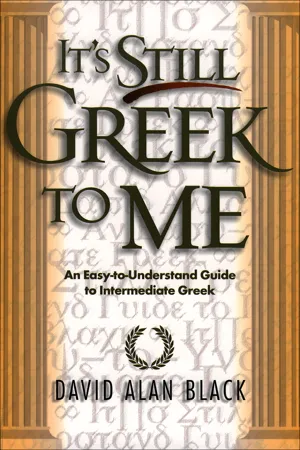
It's Still Greek to Me
An Easy-to-Understand Guide to Intermediate Greek
- 192 pages
- English
- ePUB (mobile friendly)
- Available on iOS & Android
eBook - ePub
About this book
Proof that learning grammar doesn't have to be boring. This easy-to-understand and humorous guide is for students in their second year of Greek study.
Information
Topic
Theology & ReligionSubtopic
Languages
1
There’s No Place like Rome
The Parts of Speech and Their Function
If you were an architect, you wouldn’t talk about a building you’ve designed without mentioning its parts—bricks, girders, glass, and so on. In much the same way, grammarians discuss sentences in terms of their parts and the functions of those parts.
Both the grammarian and the architect find it convenient to use a specialized vocabulary in discussing their subjects. Architects speak of joists and bearing walls; grammarians speak of verbs and participles—the language of grammar.
When I lead workshops on grammar, people invariably ask me where they can find a comprehensive, simple guide to the terminology of grammar. Consider the first two chapters of this book as such a guide. Here you’ll find the basic definitions, principles, and examples that anyone must understand to be grammatically informed.
Some readers may ask, “Do I need to know all these technical terms?” Let me answer this way: how would you like to have your car serviced by this team of mechanics?
“Think we ought to check this whatchamacallit?”
“No, that doodad over there seems to be the problem.”
“Okay, hand me that thingamabob.”
“The what?”
“You know, the doohickey.”
“This?”
“No, the gizmo underneath it!”
Yes, you need to know the terms in chapters 1 and 2. The remainder of this book builds on these foundational concepts.
The Parts of Speech
The parts of speech are the pieces you use to put sentences and paragraphs together. To put them together properly, you need to know what each piece is called and what role it plays.
For centuries, words have been put into eight different categories, depending on the role they play in sentences. These categories are all derived from Latin, a language that provides an incredible portion of our minimum daily requirement of grammatical vocabulary. The Latin grammarians, of course, borrowed freely from the Greeks, but that was how the Romans operated in those days. (Greek and Latin share the same Indo-European origin and have a great deal in common.) The upshot was a general agreement on the following parts of speech:
- nomen (noun)
- pronomen (pronoun)
- verbum (verb)
- adverbium (adverb)
- participium (participle)
- praepositio (preposition)
- conjunctio (conjunction)
- interjectio (interjection)
All but the last of these were lifted virtually in mint condition from the Greeks, and English, perhaps the most notorious language borrower of all time, has followed suit by lifting them all. A quick look at the kinds of words that belonged to each category may be helpful.
Nouns
Nomen originally meant “name.” A word was considered a nomen if it “named” a substance or quality. Thus, book, house, truth, and wise would all have belonged to the class nomen. Some members of the nomen family could be used to describe other members. A nomen that was used to describe another was called a nomen adjectivum, which means, roughly, “an assistant nomen.” Thus, in the sentence “she’s a wise person,” wise and person would each have been considered a nomen. Wise would have been a nomen adjectivum, while person would have been a run-of-the-mill nomen. Today we would classify wise as an adjective, and person as a noun. Any part of speech that functions as a noun is called a substantive.
One reason the early grammarians classed nouns and adjectives together was to avoid the question of what to call an adjective that is used as a noun (as in “a word to the wise is sufficient”). Besides, all the members of the nomen class had the same structure. Each could be seen as a sequence of two elements: a stem followed by an ending. The stem carried the basic meaning of the word, while the ending told you whether the word was singular or plural and gave you some idea of what the word was doing in the sentence. English still bears a faint resemblance to this Indo-European trait in such words as dog, dogs, dog’s, and dogs’.
In Greek there were five different kinds of endings that all members of the nomen class carried around with them. (Latin nouns had six sets of endings.) These different kinds of endings are called cases, and they are: nominative, vocative, genitive, dative, and accusative.
- Nouns appeared in the nominative case chiefly when they were the subject of the verb. In the sentence “Sam works for me,” Sam would appear in the nominative case.
- In the sentence, “Sam, you’re fired,” Sam would appear in the vocative case.
- The genitive case was frequently used to express possession. In the sentence “Sam’s friends were not surprised,” Sam’s would be in the genitive case.
- A noun appears in the dative case when it is an indirect object. In the sentence “I gave Sam his severance pay,” Sam would be in the dative case.
- Finally, direct objects appeared in the accusative case, as in “I still like Sam,” where Sam would be in the accusative case.
Three more things need to be said about nouns. First, each noun in Greek and Latin belonged to one of three genders: masculine, feminine, or neuter (the term neuter simply means “neither” in Latin). If you’re not used to it, this matter of gender can be a bit discomfiting. In his famous essay “The Awful German Language,” Mark Twain spoofs the confusion produced by German gender by translating literally a conversation in a German Sunday-school book:
Gretchen: Wilhelm, where is the turnip?
Wilhelm: She has gone to the kitchen.
Gretchen: Where is the accomplished and beautiful English maiden?
Wilhelm: It has gone to the opera.
To Germans, of course, all of this makes perfectly good sense. They know that a tree is masculine, its buds are feminine, its leaves are neuter; that horses are sexless, clocks are feminine, and tables are masculine. Greek works in exactly the same way: it, too, has grammatical gender—time is masculine, day is feminine, and year is neuter. But keep in mind that the vast majority of nouns are not put in these three classes because there is something masculine, feminine, or neuter about them.
The ending of a Greek noun is often a guide to its gender, but gender must usually be learned by observation. In general, the names of winds, rivers, and months are masculine; the names of countries, islands, towns, trees, and abstract nouns (like truth or love) are feminine; and the names of fruits are neuter. Some nouns may be either masculine or feminine (e.g., ὁ θεός is god, but ἡ θεός is goddess). These nouns are said to be of common gender.
In addition to asking about the gender of a noun, you also have to ask which declension the noun belongs to. A declension, of which there are three in Greek and five in Latin, is a specific set of case endings. In Greek, the first declension is used almost exclusively for feminine nouns, the second is used mostly for masculine and neuter nouns, while the third is catch-as-catch-can.
Finally, Greek nouns can be singular or plural, and there are different endings f...
Table of contents
- Cover
- Title Page
- Copyright Page
- Dedication
- Contents
- Preface
- A Word to the Teacher
- Acknowledgments
- List of Abbreviations
- PART 1: Up the Greek without a Paddle: This Thing Called Grammar
- PART 2: The Greeks Had a Word for It: The Greek Noun System
- PART 3: Rho, Rho, Rho Your Boat: The Greek Verb System
- PART 4: From Alpha to Omega: Finishing Touches
- Postscript
- Key to the Exercises
- Appendix 1: Greek Verb Conjugations
- Appendix 2: Principal Parts of Selected Verbs
- Summary of Topics
- Subject Index
- Greek Word Index
- Scripture Index
- Notes
- About the Author
- Other Books by Author
Trusted by 375,005 students
Access to over 1.5 million titles for a fair monthly price.
Study more efficiently using our study tools.
Frequently asked questions
Yes, you can cancel anytime from the Subscription tab in your account settings on the Perlego website. Your subscription will stay active until the end of your current billing period. Learn how to cancel your subscription
No, books cannot be downloaded as external files, such as PDFs, for use outside of Perlego. However, you can download books within the Perlego app for offline reading on mobile or tablet. Learn how to download books offline
Perlego offers two plans: Essential and Complete
- Essential is ideal for learners and professionals who enjoy exploring a wide range of subjects. Access the Essential Library with 800,000+ trusted titles and best-sellers across business, personal growth, and the humanities. Includes unlimited reading time and Standard Read Aloud voice.
- Complete: Perfect for advanced learners and researchers needing full, unrestricted access. Unlock 1.5M+ books across hundreds of subjects, including academic and specialized titles. The Complete Plan also includes advanced features like Premium Read Aloud and Research Assistant.
We are an online textbook subscription service, where you can get access to an entire online library for less than the price of a single book per month. With over 1.5 million books across 990+ topics, we’ve got you covered! Learn about our mission
Look out for the read-aloud symbol on your next book to see if you can listen to it. The read-aloud tool reads text aloud for you, highlighting the text as it is being read. You can pause it, speed it up and slow it down. Learn more about Read Aloud
Yes! You can use the Perlego app on both iOS and Android devices to read anytime, anywhere — even offline. Perfect for commutes or when you’re on the go.
Please note we cannot support devices running on iOS 13 and Android 7 or earlier. Learn more about using the app
Please note we cannot support devices running on iOS 13 and Android 7 or earlier. Learn more about using the app
Yes, you can access It's Still Greek to Me by David Alan Black in PDF and/or ePUB format, as well as other popular books in Theology & Religion & Languages. We have over 1.5 million books available in our catalogue for you to explore.