eBook - ePub
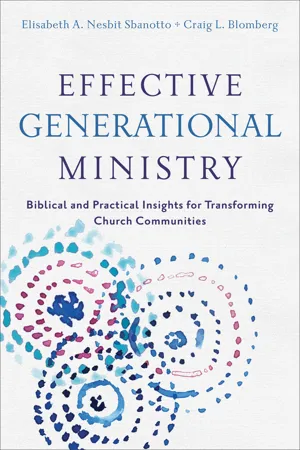
Effective Generational Ministry
Biblical and Practical Insights for Transforming Church Communities
- 304 pages
- English
- ePUB (mobile friendly)
- Available on iOS & Android
eBook - ePub
Effective Generational Ministry
Biblical and Practical Insights for Transforming Church Communities
About this book
Understanding generational differences is a key to effective ministry in a multigenerational church. This book offers students and practitioners cutting-edge research and biblical analysis of three generations--Boomers, GenXers, and Millennials--so churches can minister more effectively within and across generational lines. The authors, one an expert on generational differences and the other a respected New Testament scholar, represent different generations and areas of expertise. The book explores key characteristics of each generation, provides biblical-theological analysis of generational attributes, and offers specific suggestions for ministry.
Information
Topic
Theology & ReligionSubtopic
Christian Church1
Boomers at Large
Loud, proud, and in charge! From the time of their birth, Baby Boomers have had a significant hand in shaping, influencing, and contributing to the defining elements of American culture. Eager to join together to promote a cause or fight an injustice, Boomers bring an optimism, idealism, and drive to life.1 As we will see, much of what is commonly understood as “American culture” is actually representative of Boomer culture, as this enormous cohort has had that significant of an influence on American society over the past five decades.
The Oldest Child
In the family system that is American culture, the Boomer generation serves as the oldest child. While we are well aware that there have been plenty of generations to come before the Boomers, something happened culturally that allowed Boomers to really take hold of American society and make it their own, almost setting a “launch” or “reset” button that catapulted the culture forward. Similar to an oldest child within a family, Boomers acted like the firstborn who sets the precedent for family expectations and norms and in many ways represents the magnified values, beliefs, and worldview of their family. They often become the token or model child. Interestingly enough, the description psychologists give of an oldest child succinctly captures the defining characteristics that we see in Boomers as a group: “perfectionist, reliable, conscientious, a list maker, well organized, hard driving, a natural leader, critical, serious, scholarly, logical, doesn’t like surprises, a techie.”2
As we discussed in the introduction, not every individual Boomer will perfectly fit the characteristics of their generational cohort, but as a collective, generational descriptions consistently hold true.3 As we continue to unfold the values, beliefs, and worldview of Boomers, watch for the valuable and unique elements that make a Boomer a Boomer, while simultaneously letting the individual Boomers in your life say, do, think, feel, and believe in ways that deviate from their cohort. Each person you meet is shaped by both shared and individual identity, bonding over the shared humanness while delighting in individual uniqueness.
Boomers’ Place in the World
Born between 1946 and 1964, primarily to World War II–era parents, the Baby Boomer generation boasts a current membership of approximately 83 million members in the United States alone.4 Formerly the largest generational cohort in American history, the Boomers have had over half a century to make a loud and indelible mark on American culture. Boomers, by and large, are proud to be Boomers and see their generational identity as an integral part of their personal identity.
Getting their name from their place in history, the Boomer generation is identified as beginning with the “boom” in birth rates that occurred immediately following World War II (1946) and ending when the number of annual live births went back down below 3.8 million in 1964.5 Every generational cohort is shaped by the shared, lived experiences that happen during key developmental times in the lives of its members, and Baby Boomers are no exception. If anything, Baby Boomers provide a quintessential example of how lived, shared experiences can shape a generation. When asked what events shaped their sense of themselves and their place in the world, Boomers listed defining national and international events such as the John F. Kennedy and Martin Luther King Jr. assassinations, the moon landing, the civil rights movement, the Vietnam War, and the Roe v. Wade decision.6 While younger generations also identify these same events as critical times in American history, for Boomers they are significant lived experiences rather than simply significant historical events.
Baby Boomers, Media, and Technology
The presence and use of technology, and the perspectives on it, are also unique factors in how each generation sees themselves and their place in the world. For Boomers, technology grew as they grew. Let’s take the older Boomers for example. Starting with a radio in their home as young children, they then moved to black-and-white television, to color television, to a top-loading VCR that popped up to receive a VHS tape (complete with a corded remote control), to a front-loading VCR (and cordless remote control), to a DVD player, to a plasma or LCD television with a Blu-Ray player and DVR, and finally to an HD or even 3-D television with a touch screen. To compare a radio to a 3-D touch-screen television is to truly see the technological advances and development that have happened during the life span of the Boomers. A similar comparison could be made with telephones (operator controlled to cellular), typing instruments (from typewriters to iPads with keyboards), music-playing devices (record players to iPods), and on and on.7 The technological world grew as Boomers grew, and in many ways it represents Boomers’ drive toward growth and development. Going back to television in particular, Boomers have a lived experience of the introduction of television into everyday life that enables them to see and feel the unifying and frightening impact that television has had on their sense of self and the world, an impact unique to their cohort.
For Boomers, the introduction of television as a mainstay in the home simultaneously made the world larger and smaller. It became larger by bringing the events in New York City or Phnom Penh into the living room of rural Iowa farmers, expanding their sense of awareness and exposure to the broader world. This same act simultaneously made the world smaller, as news no longer came with a delay or simply with a narrative report; it was now relatively immediate, up close, and personal. One Boomer captured well the effects of television on the Boomer worldview by stating,
Everybody, in all parts of the country, wherever we lived, watchin’ the same TV: “Ah, this is how the people [live], this is what they wear, this is how they talk to each other.” You know? I mean, the radio’s one thing, but television and radio and music, and you know, all being exposed to these same things has a homogenizing effect.8
Another Boomer spoke of additional unifying effects in that “[media] brought the world to us. Like before, we knew nothing about the world. And now, with, you know, all this technology it’s brought the world to us.” But Boomers also see the growth of technology as having negative repercussions, fostering fear and distrust. With more news and information sources available to the public, less certainty remained about whom or what could be trusted. As one Boomer put it, “You could trust Walter Cronkite, [now] everything’s got a spin-factor to it; you’ve really got to search to figure out what’s really happening, who’s really telling you the truth.” Because this is a recurring remark by Boomers, we’ll come back to the significance of Cronkite later in our discussion.
A Sense of Self in Comparison to Others
When asked to reflect on who as a cohort they see themselves to be, Baby Boomers stated that they saw themselves as “clearly the best generation” or at the least “the generation that was responsible for creating the best” (referring to the children of Boomers). It always makes me (Elisabeth) chuckle when I go to speak to different organizations about generational differences and introduce the Boomers. Almost without fail, someone in the crowd lets out a loud “Woohoo!” complete with arms raised and pointer fingers extended. There is something about being a part of this generation that stirs up a sense of pride and identity not found to the same degree in any of the other generational cohorts. More than either cohort that comes after them, Boomers communicate a sense of feeling connected with their generational identity and see this collective identity as something positive, powerful, and beneficial within their community.
United We Stand
A collective identity has fared well for Baby Boomers as they have engaged together in civil rights protests, education reform, and various other national-level advocacy movements throughout their lives. They have experienced the power of numbers and the change that can happen when people are united for a shared cause. The combined values of being responsible and accountable for their actions and influence in the world are key underpinnings to the Boomer identity and greatly influence their drive to collectively make change in their world. For this generation, collective activism on a large scale is not only important but foundational to their sense of self. They see themselves as system changers and system builders and deeply believe that persistence, determination, and a united voice will bring about the change they want to see in the world around them. They are the generation of sit-ins, picket signs, and marches on Washington, DC, not out of spite or a critical spirit but out of hope, optimism, and dedication to what they believe America can be.
When asked, Boomers often describe who they were based on how they differed from Generation Xers and Millennials. Specifically, they see themselves as possessing greater traits of accountability, integrity, and responsibility than younger cohorts, having more empathy and understanding for the effects of war, and being more intentional and dedicated to the work they do, whether in a vocation, volunteer position, or parenting. One Boomer captures the generation’s sentiment by stating,
I think it’s very, very important that if a person says they’re going to do something, they’re going to do it. And when I say I’m going to do something, I’m going to do it. And I think, real close to 100 percent of the time I live that, but some of these younger generations that you’re also working with I don’t think they have that same, even, meaning.
Significant People and Heroes
While Boomers criticize Xers and Millennials, they also speak of feeling sadness for the younger cohorts and for the lack of strong role models available to them within the family, community, or church. In comparison, Boomers have a sense of collective heroes—those individuals within political, military, social, and religious domains that ...
Table of contents
- Cover
- Title Page
- Copyright Page
- Dedication
- Contents
- Preface
- Introduction
- 1. Boomers at Large
- 2. Boomers in Light of the Bible
- 3. Priorities for Ministry with Boomers
- 4. Generation X
- 5. Xers in Light of the Bible
- 6. Priorities for Ministry with Xers
- 7. Millennials
- 8. Millennials in Light of the Bible
- 9. Priorities for Ministry with Millennials
- Conclusion
- Scripture Index
- Subject Index
- Back Cover
Trusted by 375,005 students
Access to over 1.5 million titles for a fair monthly price.
Study more efficiently using our study tools.
Frequently asked questions
Yes, you can cancel anytime from the Subscription tab in your account settings on the Perlego website. Your subscription will stay active until the end of your current billing period. Learn how to cancel your subscription
No, books cannot be downloaded as external files, such as PDFs, for use outside of Perlego. However, you can download books within the Perlego app for offline reading on mobile or tablet. Learn how to download books offline
Perlego offers two plans: Essential and Complete
- Essential is ideal for learners and professionals who enjoy exploring a wide range of subjects. Access the Essential Library with 800,000+ trusted titles and best-sellers across business, personal growth, and the humanities. Includes unlimited reading time and Standard Read Aloud voice.
- Complete: Perfect for advanced learners and researchers needing full, unrestricted access. Unlock 1.5M+ books across hundreds of subjects, including academic and specialized titles. The Complete Plan also includes advanced features like Premium Read Aloud and Research Assistant.
We are an online textbook subscription service, where you can get access to an entire online library for less than the price of a single book per month. With over 1.5 million books across 990+ topics, we’ve got you covered! Learn about our mission
Look out for the read-aloud symbol on your next book to see if you can listen to it. The read-aloud tool reads text aloud for you, highlighting the text as it is being read. You can pause it, speed it up and slow it down. Learn more about Read Aloud
Yes! You can use the Perlego app on both iOS and Android devices to read anytime, anywhere — even offline. Perfect for commutes or when you’re on the go.
Please note we cannot support devices running on iOS 13 and Android 7 or earlier. Learn more about using the app
Please note we cannot support devices running on iOS 13 and Android 7 or earlier. Learn more about using the app
Yes, you can access Effective Generational Ministry by Craig L. Blomberg,Elisabeth A. Nesbit Sbanotto in PDF and/or ePUB format, as well as other popular books in Theology & Religion & Christian Church. We have over 1.5 million books available in our catalogue for you to explore.