- 224 pages
- English
- ePUB (mobile friendly)
- Available on iOS & Android
eBook - ePub
About this book
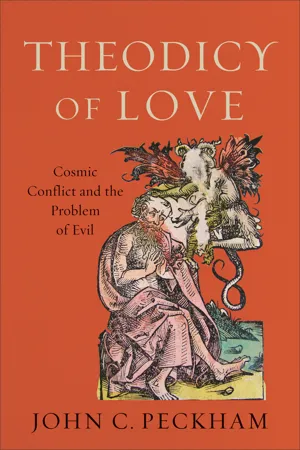
If God is all powerful and entirely good and loving, why is there so much evil in the world? Based on a close canonical reading of Scripture, this book offers a new approach to the challenge of reconciling the Christian confession of a loving God with the realities of suffering and evil. John Peckham offers a constructive proposal for a theodicy of love that upholds both the sovereignty of God and human freedom, showing that Scripture points toward a framework for thinking about God's love in relation to the world.
Information
Topic
Theology & ReligionSubtopic
Christian Theology1
The Problem of Evil and the Free Will Defense
“Life is outrageous. Hardly anyone will deny that conclusion outright. Tragedy, pain, injustice, premature death—all of these and more waste us away. No explanation seems quite able to still our anger, hostility, and sadness.”1 So says John K. Roth in his essay advocating for what he calls a “theodicy of protest.”2 This is not unlike what many biblical authors themselves say in protest against the evil in this world.
Job suffers so much that he wishes he were never born (Job 3). In the midst of his suffering, he questions God’s justice, saying,
The earth is given into the hand of the wicked;
He covers the faces of its judges.
If it is not He, then who is it? (Job 9:24; cf. 16:9, 11)
I cry out to You for help, but You do not answer me. . . .
You have become cruel to me;
With the might of Your hand You persecute me. . . .
When I expected good, then evil came;
When I waited for light, then darkness came. (Job 30:20–21, 26)
Isaiah adds,
Justice is far from us,
And righteousness does not overtake us;
We hope for light, but behold, darkness,
For brightness, but we walk in gloom. . . .
We hope for justice, but there is none. (Isa. 59:9, 11; cf. Hab. 1:4)
The author of Ecclesiastes similarly decries injustice in this world, declaring, “I have seen under the sun that in the place of justice there is wickedness” (Eccles. 3:16; cf. 7:15; 8:14). Elsewhere, he repeatedly describes the “grievous evil” that he has seen (5:13, 16; cf. 6:1; 10:5) and declares it would be “better” to have never existed and thus “never seen the evil activity that is done under the sun” (4:3). This world includes “abominable injustice” and corruption; “there is no one who does good, not even one” (Ps. 53:1, 3).
The state of this world raises major questions about God’s justice and hiddenness in the face of evil and suffering. “Why has the way of the wicked prospered? / Why are all those who deal in treachery at ease?” (Jer. 12:1; cf. Pss. 10:5, 13; 94:3–7; Mal. 2:17). “Why has the LORD our God done all these things to us?” (Jer. 5:19). “Why have these things happened to me?” (Jer. 13:22; cf. 16:10; Ezek. 18:2). “Why is the land ruined, laid waste like a desert, so that no one passes through?” (Jer. 9:12). “‘Where is the God of justice?’” (Mal. 2:17; cf. Ps. 94:3–7). “Why are You silent when the wicked swallow up / Those more righteous than they?” (Hab. 1:13; cf. Job 12:6; 21:7, 9). “Why do You stand afar off, O LORD? / Why do You hide Yourself in times of trouble?” (Ps. 10:1; cf. 10:11; 30:7). Even Jesus himself cries out, “My God, My God, why have You forsaken Me?” (Matt 27:46; cf. Mark 15:34). Why has God not prevented or mitigated evil or at least brought justice in response to it? Evil seems to continue unabated, so much so that psalmists repeatedly ask, “How long, O LORD?” (Pss. 13:1; 79:5; cf. 77:7–10; 94:3). In light of the horrendous evil in this world, where are the providence, goodness, and love of God?
Scripture contains no shortage of depictions of and laments over the problem of evil (e.g., 2 Kings 6:29). However, according to some, there is a severe shortage of adequate solutions to the problem offered by Scripture and, for that matter, by the broad tradition of Christian theism. In his book God’s Problem: How the Bible Fails to Answer Our Most Important Question—Why We Suffer, Bart Ehrman argues that Scripture provides no adequate approach to the problem of evil. Instead he argues that “the Bible contains many and varied answers to the problem of why there is suffering in the world.” Yet he claims that “many of these answers are at odds with one another, and at odds with what most people seem to think today.”3 Because “life is a cesspool of misery and suffering” for so many people, Ehrman finds it impossible to “believe that there is a good and kindly disposed Ruler who is in charge” of this planet.4 In his view, if there is a God, “he certainly isn’t the one proclaimed by the Judeo-Christian tradition, the one who is actively and powerfully involved in the world.”5
Much has been written toward resolving issues like these and the numerous other enormous problems that evil in this world presents for Christian theism, minimally defined as the view that the triune God is “an omnipotent and perfectly good being.”6 In recent times, the task of addressing the problem of evil has been undertaken primarily by philosophers, with varying degrees of success.7 Much less has been written that addresses the problem of evil as it is depicted and approached in Scripture.8 Given the claims of Ehrman and others, however, it seems apparent that more work needs to be done to bridge the realms of philosophy and biblical theology in this regard, with the goal of ascertaining and exploring some avenues for approaching the problem of evil that might be both intellectually satisfying and consistent with Christian theism and its sacred canon of Scripture.9
This book aims to set forth and explore one promising avenue in this regard, articulating a constructive proposal for a theodicy of love that is based on a close canonical reading of Scripture.10 This biblically based, philosophically informed, and theologically systematic treatment builds on and goes beyond the basic free will defense, articulating a theodicy that is rooted in the nature of God’s love within the framework of a cosmic conflict. This theodicy of love affirms a robust account of God’s omnipotence, providence, and involvement in this world that is consonant with Christian theism as described above, while denying that evil is necessary for some greater good or goods. In brief, I argue that God’s love (properly understood) is at the center of a cosmic dispute and that God’s commitment to love provides a morally sufficient reason for God’s allowance of evil, with significant ramifications for understanding divine providence as operating within what I call covenantal rules of engagement.11
This theodicy of love is set forth, piece by piece, in the following chapters. This first chapter begins by introducing the problem of evil relative to Christian theism, the basic parameters of the free will defense, and some significant objections and perceived shortcomings of the free will defense, along with some of the more prominent proposals that advocate alternatives or additions to the free will defense. Through this introduction to the problem of evil, it will become clear that while the existing approaches offer considerable resources for addressing the problems that evil presents for Christian theism, significant issues remain, which might be illuminated by closer consideration of the nature of God’s love. This introduction thus sets...
Table of contents
- Cover
- Half Title
- Title Page
- Copyright Page
- Contents
- Preface
- Acknowledgments
- Abbreviations
- 1. The Problem of Evil and the Free Will Defense
- 2. Love, Evil, and God’s Unfulfilled Desires
- 3. The Cosmic Conflict Framework
- 4. The Nature of the Conflict and Rules of Engagement
- 5. Evil Defeated but Not Yet Destroyed
- 6. Evaluating the Theodicy of Love
- Bibliography
- Scripture Index
- Author Index
- Subject Index
- Back Cover
Trusted by 375,005 students
Access to over 1.5 million titles for a fair monthly price.
Study more efficiently using our study tools.
Frequently asked questions
Yes, you can cancel anytime from the Subscription tab in your account settings on the Perlego website. Your subscription will stay active until the end of your current billing period. Learn how to cancel your subscription
No, books cannot be downloaded as external files, such as PDFs, for use outside of Perlego. However, you can download books within the Perlego app for offline reading on mobile or tablet. Learn how to download books offline
Perlego offers two plans: Essential and Complete
- Essential is ideal for learners and professionals who enjoy exploring a wide range of subjects. Access the Essential Library with 800,000+ trusted titles and best-sellers across business, personal growth, and the humanities. Includes unlimited reading time and Standard Read Aloud voice.
- Complete: Perfect for advanced learners and researchers needing full, unrestricted access. Unlock 1.5M+ books across hundreds of subjects, including academic and specialized titles. The Complete Plan also includes advanced features like Premium Read Aloud and Research Assistant.
We are an online textbook subscription service, where you can get access to an entire online library for less than the price of a single book per month. With over 1.5 million books across 990+ topics, we’ve got you covered! Learn about our mission
Look out for the read-aloud symbol on your next book to see if you can listen to it. The read-aloud tool reads text aloud for you, highlighting the text as it is being read. You can pause it, speed it up and slow it down. Learn more about Read Aloud
Yes! You can use the Perlego app on both iOS and Android devices to read anytime, anywhere — even offline. Perfect for commutes or when you’re on the go.
Please note we cannot support devices running on iOS 13 and Android 7 or earlier. Learn more about using the app
Please note we cannot support devices running on iOS 13 and Android 7 or earlier. Learn more about using the app
Yes, you can access Theodicy of Love by John C. Peckham in PDF and/or ePUB format, as well as other popular books in Theology & Religion & Christian Theology. We have over 1.5 million books available in our catalogue for you to explore.