- 192 pages
- English
- ePUB (mobile friendly)
- Available on iOS & Android
eBook - ePub
About this book
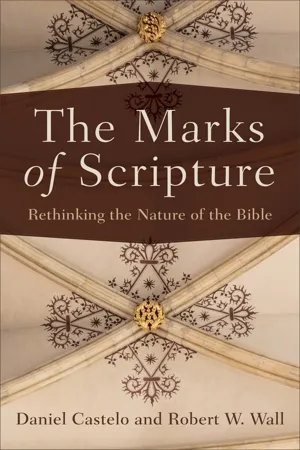
This volume written by a theologian and a biblical scholar offers a fresh model for understanding Scripture as God's Word. The authors work out the four Nicene marks of the church--one, holy, catholic, and apostolic--as marks of Scripture, offering a new way of thinking about the Bible that bridges theology and interpretation. Their ecclesial analogy invites us to think of Scripture in similar terms to how we think of the church, countering the incarnational model propagated by Peter Enns and others.
Information
Topic
Theology & ReligionSubtopic
Biblical Studies1
The Ontology and Teleology of Scripture
What is Scripture? What is its purpose? These are two key questions any thoughtful, earnest, and God-loving reader of the Bible should ask. And yet, rarely do Christians raise them in their reading and reflective practices. The first question can be said to be the ontological question: What is the nature of Scripture’s essence and so its identity? The second question can be labeled teleological: What is the function of Scripture, and for what end do people read it? These are such basic questions that one simply assumes Christians intuitively have answers at their disposal. “The Bible is God’s word and so truth,” one could say, further adding, “and Christians read it in order to know God and God’s truth.” These claims, however, are largely tautologous; they simply affirm and reaffirm a commitment one has to Scripture’s authority, but they do little to secure that authority within a wider paradigm. They suggest nothing in terms of different conceptions of truth, the character of God, or the general nature of interpretation overall. Rather than being deliberate answers to the ontological and teleological questions, these responses are deferrals that bypass the hard work of reflecting about Scripture.
Reflecting about Scripture must be undertaken by Christians in the sense that Scripture is not simply a text they read: it is also a theological category. When Christians speak of Scripture, appeal to it, or assume its authority, they do so in ways that are inherently theological; they implicitly recognize Scripture as being theologically significant, even though they may not consciously acknowledge the gesture. Perhaps this point was more obvious for previous generations who were inclined to call the Bible “Holy Writ,” “the Holy Bible,” or “the sacred Word.” Calling this text “holy” can suggest that it operates in God’s “economy of sanctification”—the ways and means by which a holy God shapes and transforms a community into a holy people. Whether it is recognized as such in the contemporary scene, Scripture is a category of theological consequence. It has a role to play in God’s manifest work, and this role helps constitute both its identity and its function in the life of the faithful.
Remarkable about academic and popular approaches to Christian Scripture, however, is that something on occasion happens. Rather than thinking of Scripture as a theological category, many look to Scripture as a basis, source, or foundation for doing theology. The difference in this claim is slight but significant. Rather than being a theological category, Scripture is sometimes employed as a resource for theologizing. In this approach, Scripture provides the “source material” for doing theology, but Scripture is not considered outright as theological at its very core. This approach to Scripture is not altogether wrong, but it does present a number of challenges that cannot be easily overcome on their own. Some of these difficulties are highlighted by the following questions: If Scripture is not understood as a theological category, then how can it be categorized or classified? If Scripture is used strictly as a resource for theology, then what does that say about how theology is pursued and the kind of theology that will ensue from this casting? Do other ways of understanding Scripture exist, and if so, why is this first model often privileged? These questions are crucial, particularly since Christians generally, and Protestants particularly (given the way they cast their specific identity), have so much at stake with matters related to the Bible. No Christian will deny the importance of the Bible for Christian identity, but different proposals are available as to how to understand its authority. These differences matter because they reflect and determine various intellectual and spiritual sensibilities that are at work in interpreting and applying Scripture, and differences on these scores in turn will inevitably shape how one views the Christian life and the Christian God.
In what follows, we will begin a process of engaging Scripture as a theological category by considering it as canon and as a means of grace. In this way, Scripture will be cast as theologically consequential rather than instrumental, a topic of proper theological consideration rather than one that is passed over so as to rush to the pursuit of doing “real theology.” We consider this work crucial as we begin this text; these understandings will inflect all that we subsequently say about the Bible.
As to the first term, “canon” has the advantage of being a theological category that prominently involves both anthropological and pneumatological dimensions. We argue that the same can be said for the term “Scripture,” yet since the Bible is so significantly determined by many Christian constituencies, those points (the anthropological and pneumatological) may be harder to identify and promote, at least at the outset of a discussion. A focus on canon can show that this text is both historical and revelatory, human- and Spirit-generated, and this makes for a more nuanced treatment of the many features of Scripture as a theological phenomenon.
As to the second term, a “means of grace” suggests a different kind of tension: how God and humans are involved in spiritual formation and sanctification. Christians of all kinds read Scripture devotionally in order to foster growth and development in their spiritual journeys. In this, they are approaching Scripture as a means of grace. This kind of activity and practice associated with Scripture is theologically significant. It is academically noteworthy because any treatment of Scripture within the theological academy needs to account for the theological significance of this kind of appropriation; otherwise, we believe, the treatment will be theologically myopic.
With the terms “canon” and “means of grace,” then, Scripture can be thought of in more ways than simply a deposit of theological building blocks. With these alternative castings, the ontology and teleology of the Bible may become clearer and more relevant, and if so, then its place within the life of the faithful can be richer and more explicitly and practically formative.
Scripture as Canon
Christians have always been people of the book. The special status granted to the church’s Bible in Christian formation is sounded by the theological terms associated with it: “Scripture,” “sacrament,” “word,” “canon,” and so on. In particular, the idea that the Bible is a canon of sacred texts signifies it as a book that God’s people should read and use in worship, catechesis, devotions, and discussions in order to learn about God and to form a manner of life and faith pleasing to God. The Bible is canon not because it is a singular rule that outperforms every other medium through which God’s Spirit makes God known; rather, the Bible is canon precisely because of the indispensable, formative tasks it performs as an auxiliary of the Spirit in directing the church’s life toward God. And because they are special in this particular way, the biblical texts selected, collected, and presented as canonical should be picked up, again and again, by every Christian congregation as required reading.
The language of “selection,” “collection,” and “presentation” suggests a dynamic that on occasion worries some Christians because it can seem too dependent on a historical process. Many wonder about and are even suspicious of this process. Given the conspiracy theories and hypothetical scenarios abounding in popular culture, people may puzzle over why certain books were included while others were not. But a more fundamental worry for many is highlighted via the following question: How can a book that is assumed to be theologically authoritative as the “word of God” be so enmeshed in a process that is very much driven by human judgments and factors, ones that are prone to bias, limits, and ignorance? Of course, this worry is not ancillary to a discussion about Scripture’s authority, but on theological grounds, this process cannot be reduced simply to a historical, human dynamic. The postbiblical circumstances and social world that now frame the historian’s discussion of the canonical process should be understood in theological terms if Scripture is agreed upon as being a theological category. While John Webster agrees that canonization is a process of “human decision-making,” he also describes it in terms of the sanctifying participation of the Spirit, whose presence intends to extend the apostolic testimony of the historical Jesus into the future.1 In this sense, the various phenomena that historians ascribe to canonization can also be understood as Spirit-led events that safeguard and textually establish the normative truth about Christ.
As an act of confession, the church recognizes that among its membership in ages past it came to decide which texts best performed a canonical role in its common life. But this act of confession was not based on the church’s savviness or trustworthiness throughout this process; more basically, the church’s confession on this score is that the Holy Spirit inspired these texts, drove these texts to communal prominence, and guided the church in its selection processes so that fitting texts were included for the task of shaping a holy community. Far from spontaneous or chaotic, the canonization process—from a text’s initial composition to its eventual canonization as part of a canonical collection in the church’s two-Testament Bible—is both providential and purposeful. No point of this historical process is arbitrary or accidental; it is from beginning to end a creaturely process superintended by God’s sanctifying Spirit for holy ends in the global church’s worship, catechesis, mission, and personal devotions.2 Put another way, as human-generated as this process may look when viewed through one lens (i.e., a “canonization from below”), viewed through another lens it is very much a God-determined development (i.e., a “canonization from above”). Humans did not simply make choices. Rather, God-fearing saints made certain judgments within a Spirit-drenched context, one in which the Spirit was involved at the beginning, during the process, and toward the end of a complex series of developments called “canonization.”
The church’s “canon-consciousness,” then, is the graced (God-given) capacity to discern what substantively agrees with the apostolic testimony of Jesus from what does not. The church’s act of discernment is not a magical performance. This recognition of a text’s canonicity, if properly led by the Spirit, is necessarily honed in worship by prayer and in faithful use when teaching and training God’s people.3 Canonization is a process of and for the church in which God’s Spirit is present, performing the role for which the Spirit was sent (see John 14–16). There is no need for a biblical canon if there is no church, and without a biblical canon the church would be spiritually impoverished. For this practical reason, we insist (to highlight one of our major commitments in this book) that the marks of a Spirit-led community, which is competent to produce and use a canon of Scripture, will necessarily be of a piece with the marks of that book it produces and uses. This is the essential circularity of the canonical process.
Canonization is a complex but crucial phenomenon for the current discussion because its careful construction can help shape how one answers the ontological and teleological matters sketched above. In terms of Scripture’s essence, one has to reply in light of the developmental nature of canonization that Scripture is not simply a category but a running argument, one that requires an ongoing set of judgments. And at one level, these judgments are ecclesial in nature: the worshiping faithful came to use and recognize certain texts as “useful for teaching, for reproof, for correction, and for training in righteousness” (2 Tim. 3:16) for those in its fold.
The church’s episcopacy made these judgments at a moment of history wrapped in its own social world and exigencies.4 Most historical studies of what we are calling a “canonization from below” are framed by the reconstruction of a variety of threats, both internal and external, which occasioned an epistemic crisis—“What is truth?”—that incited the formation of a Christian Bible. Although we are convinced that the community’s canon-consciousness, shaped by its use of Israel’s scripture and apostolic writings from the beginning (see 1 John 1:1–2), would have made the formation of this book inevitable, we agree that the urgency of doing so was made more so by the contested reception of the apostolic tradition during the second century. There were a variety of Christianities, which required a stable textual boundary within which theological and ethical matters could be debated and resolved as a practical matter of the church’s unity.5
The pivotal figure in Adolf von Harnack’s programmatic narrative on these matters is Marcion (ca. 85–ca. 160), whom the Apologists considered a rival of the apostles (although a Pauline tradent6) but who is reputed to be the first teacher to design and use a Christian Bible for catechetical purposes. According to Harnack’s narrative, Marcion objected to the prevailing version of apostolic Christianity and sought to purify it of its Jewish theology and Hellenistic ethics by establishing a canon of Pauline Letters as revelatory of Christ’s genuine gospel. In response to Marcion, the Apologists proposed a canon of their own, which enfolded Marcion’s Pauline collection into a Christian Bibl...
Table of contents
- Cover
- Half Title Page
- Title Page
- Copyright Page
- Dedication
- Contents
- Preface
- 1. The Ontology and Teleology of Scripture
- 2. Speaking of Scripture
- 3. Unity
- 4. Holiness
- 5. Catholicity
- 6. Apostolicity
- 7. The Church’s Practice of Scripture
- Bibliography
- Scripture and Ancient Writings Index
- Subject Index
- Back Cover
Trusted by 375,005 students
Access to over 1.5 million titles for a fair monthly price.
Study more efficiently using our study tools.
Frequently asked questions
Yes, you can cancel anytime from the Subscription tab in your account settings on the Perlego website. Your subscription will stay active until the end of your current billing period. Learn how to cancel your subscription
No, books cannot be downloaded as external files, such as PDFs, for use outside of Perlego. However, you can download books within the Perlego app for offline reading on mobile or tablet. Learn how to download books offline
Perlego offers two plans: Essential and Complete
- Essential is ideal for learners and professionals who enjoy exploring a wide range of subjects. Access the Essential Library with 800,000+ trusted titles and best-sellers across business, personal growth, and the humanities. Includes unlimited reading time and Standard Read Aloud voice.
- Complete: Perfect for advanced learners and researchers needing full, unrestricted access. Unlock 1.5M+ books across hundreds of subjects, including academic and specialized titles. The Complete Plan also includes advanced features like Premium Read Aloud and Research Assistant.
We are an online textbook subscription service, where you can get access to an entire online library for less than the price of a single book per month. With over 1.5 million books across 990+ topics, we’ve got you covered! Learn about our mission
Look out for the read-aloud symbol on your next book to see if you can listen to it. The read-aloud tool reads text aloud for you, highlighting the text as it is being read. You can pause it, speed it up and slow it down. Learn more about Read Aloud
Yes! You can use the Perlego app on both iOS and Android devices to read anytime, anywhere — even offline. Perfect for commutes or when you’re on the go.
Please note we cannot support devices running on iOS 13 and Android 7 or earlier. Learn more about using the app
Please note we cannot support devices running on iOS 13 and Android 7 or earlier. Learn more about using the app
Yes, you can access The Marks of Scripture by Daniel Castelo,Robert W. Wall in PDF and/or ePUB format, as well as other popular books in Theology & Religion & Biblical Studies. We have over 1.5 million books available in our catalogue for you to explore.