eBook - ePub
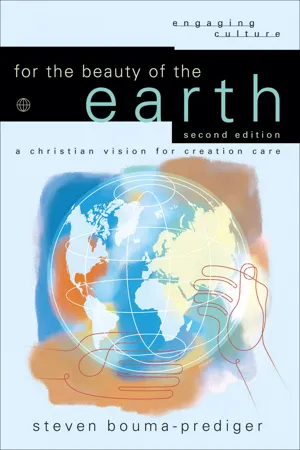
For the Beauty of the Earth (Engaging Culture)
A Christian Vision for Creation Care
- 240 pages
- English
- ePUB (mobile friendly)
- Available on iOS & Android
eBook - ePub
For the Beauty of the Earth (Engaging Culture)
A Christian Vision for Creation Care
About this book
Caring for the environment is a growing interest among evangelicals. This award-winning book provides the most thorough evangelical treatment available on a theology of creation care. "Authentic Christian faith requires ecological obedience," writes Steven Bouma-Prediger. He urges Christians to acknowledge their responsibility and privilege as stewards of the earth. The second edition has been substantially revised and updated with the latest scientific and environmental research.
Information
Topic
Theology & ReligionSubtopic
Christian Theology
An individual is not distinct from his place; he is that place.
What do you remember from your childhood about the earth? What from your growing-up years comes most to mind when you think about the natural world? Perhaps you remember your family flower garden—daffodils, geraniums, impatiens, petunias. Or maybe it is the vegetable garden—sweet corn, string beans, radishes, lettuce, rhubarb. Or maybe it is playing in the local creek—looking for tadpoles, stalking salamanders, catching crayfish. Or maybe you remember walks in the local park or swinging under the shade trees in the school playground down the street.
What animals come to mind? Pet dog Fido or cat Florence? Horses or chickens or pigs? A turtle or a parakeet or a snake? Deer (or its scat), skunk (or its smell), raccoon (or its print)? Or do you remember a particular tree: sap-rich white pine, scaly sycamore, white-bark birch, bent-topped hemlock, towering maple or oak or beech?
Or maybe what you remember are the seasons. The sweet scent of spring—that freshness of early April when the breathing earth sucks in carbon dioxide and exhales oxygen for us, the days that grow slowly longer, the night rains that wash our fields and sidewalks and souls. The lushness and fullness of summer—freshly cut grass, swimming in the local lake or pond or pool, family camping trips at Ludington or Yellowstone or Grandma’s backyard. The waning light of autumn—a crisp chill in the October air, dead leaves, cold rain, and the first flakes of snow. The wonder of winter—short days, frosted windows, snowdrifts covered with footprints and snow angels and animal tracks.
But, alas, these are, by and large, memories from the American upper Midwest.
If you grew up in another part of North America, maybe in your mind’s eye you see southern magnolia, or feel a Pacific silver fir, or smell the delicious vanilla-cinnamon aroma of ponderosa pine. Or perhaps your memories include sighting California condors, or catching Mississippi catfish, or swatting the Minnesota state bird—the mosquito. Or maybe you hear the crash of the North Sea surf, or the trickle of a meadow stream high up in the Alps, or the cry of howler monkeys in the muggy Belizean night. In your mind’s eye right now, what do you remember? What do you see and hear, smell and taste and feel?
But these are memories of places rural and wild. Most of us these days grow up and live in cities and towns. So perhaps what you hear is the cooing of mourning doves or the caw-caw-caw of crows in the treetops. Maybe what you see are blue jays at the feeder or an opossum dead by the side of the road. Even in large cities you may smell a skunk or spy a falcon roosting atop a skyscraper. Such urban memories, like their country cousins, attest to at least some knowledge of and feeling for particular places. And these remembrances point to the power of place in shaping who we are and how we see the world. As Spanish philosopher Jose Ortega y Gasset famously put it, “Tell me the landscape in which you live and I will tell you who you are.”[2]
Such musings, furthermore, prompt the following questions: Do we know our place? Do we know where we are? What exactly does that mean? And what might greater knowledge of place mean for how and why we care for the earth? Or put differently, could it be that contemporary ecological degradation is a result, in part, of us not knowing our places, our own local habitats on this our home planet? All too often, I fear, we do not know our places, and such ignorance contributes to the ecological despoilation we see today. Precisely what the nature and extent of that degradation is will be discussed in the next chapter. Here our focus is on places and what we can learn about ourselves and the earth if we attend with care to what is around us.
Ecological Perception of Place
Do you know where you are? Certainly you can state that you are on 12th Street or 10th Avenue, in Lansing or Lincoln or Los Angeles, in Oregon or Ontario, in the United States or the United Kingdom or the United Arab Emirates. But ecologically speaking, do you know where you are? In a more than geopolitical sense, do you know where you are? What is your ecological perception of place? Some questions might help us gauge our awareness of where we are.
What is the soil like around your home? Silty loam? Loamy sand? Sandy clay? Rocks and pebbles? Wet or dry? A few precious inches of soil atop ancient Canadian shield, or eighteen inches of rich, fertile gardener’s gold? What are five agricultural plants in your region? Corn, wheat, alfalfa, beans, sorgum? Or maybe grapes or cherries or oranges? And how long is the growing season? A precious few weeks? Or all year long? What geological events or processes have influenced the land where you live? Glaciers, volcanoes, earthquakes? Uplifting mountains or rivers carving canyons to the sea? What confluence of water and wind?
What trees live where you do? Sitka spruce or Douglas fir, bald cypress or incense cedar, Norway maple or American chestnut? Northern white cedar or western hemlock, Ohio buckeye or California live oak, beech or basswood or birch? Desert mesquite or water-loving cottonwood? Young upstart poplar or ancient bristlecone pine? What about birds, resident and migratory? The common loon or the uncommon meadowlark? Mallard or merganser? House finch or goldfinch? A goose with a gaggle or a murder of crows? Yellow-bellied sapsucker or white-crested warbler? Bluebird or blackbird or redheaded woodpecker? Kingfisher or cormorant or sandhill crane? What raptors roam the skies above your house? Osprey, northern harrier, red-tailed hawk? What owls dine at night? Barred owl, barn owl, burrowing owl?
What flowers bloom where you live? Poppies or peonies? Tiger lilies or tulips? Daisies or daffodils? Crocus or columbine? Bird-of-paradise or star-of-Bethlehem? What animals share your place? Long-tailed weasel or white-tailed deer? Grey wolf or red fox? Alligator or armadillo? Manatee or marmot or moose? Which animals are extinct in your neck of the woods? Wolverine, grizzly bear, passenger pigeon, prairie dog?
How many days until the moon is full? And what kind of moon is it: waxing or waning, crescent or gibbous? Were the stars out last night? If so, what constellations did you see? When did it last rain or snow or sleet or hail? From where you are reading this, which way is north? From what direction do the prevailing winds blow? From where does your water come? To where does your garbage go?
These questions test our knowledge of our place. And they all too often, truth be told, expose our ecological ignorance. To face such a battery of questions forcibly reminds us of how little we know about the world and how it works. Do we know our place? Do we know the natural history of the land? Do we know its flora and fauna? And perhaps most importantly, do we know how what we do affects the world around us?
If the answer to these questions is “no,” then we really do not know where we are. Despite our education we remain ecologically illiterate. Or perhaps because of our education we remain ignorant of how the world works. As Aldo Leopold perceptively puts it: “One of the requisites for an ecological comprehension of land is an understanding of ecology, and this is by no means co-extensive with ‘education’; in fact, much higher education seems deliberately to avoid ecological concepts.”[3] Contemporary environmental activist and culture critic David Orr agrees. In no uncertain terms he presents the challenge ahead.
The crisis of sustainability, the fit between humanity and its habitat, is manifest in varying ways and degrees everywhere on earth. It is not only a permanent feature on the public agenda; for all practical purposes it is the agenda. No other issue of politics, economics, and public policy will remain unaffected by the crisis of resources, population, climate change, species extinction, acid rain, deforestation, ozone depletion, and soil loss. Sustainability is about the terms and conditions of human survival, and yet we still educate at all levels as if no such crisis existed.[4]
Hence, we desperately need, according to Orr, increased ecological literacy. Just as we educate for numeracy, or the ability to calculate, and literacy, or the ability to read, so also we must educate for the ability to understand how the world works—“ecolacy,” as famous biologist Garrett Hardin calls it. Like Orr, Hardin argues that such a mental filter or way of viewing the world is absolutely essential if we are to live responsibly and wisely.[5]
But what exactly is ecolacy? What does it mean to be ecologically literate? In a clear and compelling account, Orr argues that the essence of ecological literacy is “that quality of mind that seeks out connections.”[6] In contrast to the narrow specialization that characterizes so much education today—across virtually all the academic disciplines—an ecological frame of mind seeks to integrate, to bring together, to see things whole. In Orr’s words, “The ecologically literate person has the knowledge necessary to comprehend interrelatedness, and an attitude of care or stewardship,” and this must be accompanied by “the practical competence required to act on the basis of knowledge and feeling.” Hence “knowing, caring, and practical competence constitute the basis of ecological literacy.”[7] Not only must we know; we must care. And not only must we care, but we must have the wherewithal to act responsibly, informed by such knowledge and passion.
But concretely what does this mean? If we are truly to know our place, what do we need to learn? Orr offers a list of five necessary components of seeing things whole. First, we need “a broad understanding of how people and societies relate to each other and to natural systems, and how they might do so sustainably.”[8] This presumes knowledge of how the world as a biophysical system works—knowledge of keystone species and succession, entropy and energy flow, niches and food chains. Ecological literacy, in short, implies a modicum of knowledge about the inextricable interconnectedness of all creatures great and small.[9]
Second, we need to know “something of the speed of the crisis that is upon us.”[10] While some would argue that “crisis” is too strong a term, the preponderance of evidence suggests otherwise.[11] Hence, we need to know the vital signs of our home planet—the trends concerning population growth and climate change, soil loss and species extinction, deforestation and desertification, energy use and air pollution.[12] A prescription is only as good as the diagnosis on which it is based. Our attempts to achieve wellness must, therefore, be based on a sober and honest assessment of the health of the earth.
Third, ecological literacy, according to Orr, “requires a comprehension of the dynamics of the modern world.”[13] In other words, we need some understanding of the historical, political, economic, and religious forces that have molded the modern world. What social pressures have brought us to where we are today? What economic and political systems mold our everyday life? And that all too often neglected question: how has religion played a part in shaping the world in which we live? To be more specific, how did “the Columbian exchange” of 1492 and subsequent years influence both old and new worlds?[14] What was (and still is) nature’s role in American history?[15] And how exactly do societies choose to fail or succeed, and what are the major contributing factors to societal collapse or flourishing?[16] In short, what ideas and forces have shaped the world in which we live?
Fourth, ecological literacy requires “broad familiarity with the development of ecological consciousness.”[17] Of special importance here is explicit attention to ethics and the nature of nature. Environmental issues are laden with questions of value. Are we humans, for example, “conqueror of the land-community” or “plain member and citizen of it?”[18] Do animals or plants or endangered species or ecosystems have value, and if so, why? And how do we portray the natural world: as “red in tooth and claw,” as an Edenic paradise, or neither? Whether and how we “follow nature,” to use Holmes Rolston’s phrase,[19] depends in large part on our idea of what it is. Is it nature or Nature or the environment or the biosphere or Creation? Are humans included in it? Is God? Ecological literacy does not require an elaborate answer to each of these questions, but it does presuppose some wrestling with issues such as these.
Fifth and finally, Orr maintains that we need “alternative measures of well-being” and “a different approach to technology.”[20] For example, in contrast to the typical indicators of societal well-being, such as the Gross Domestic Product (GDP), we need more inclusive and more accurate metrics to honestly assess how our society is doing.[21] For example, the Index of Sustainable Economic Welfare (ISEW) includes the depletion of nonrenewable natural resources and the costs of water and air pollution in its calculation of overall welfare, as does the Genuine Progress Indicator (GPI), while the Weighted Index of Social Progress (WISP) includes both social and environmental conditions.[22] What all these indicators show is that while GDP has grown in the United States over the last decades, genuine well-being has not. And along with these alternative measures of well-being we need to rethink our use of technology. The work of E. F. Schumacher, to mention only one well-known example, illustrates how technology can and must be appropriate to the scale and needs of a people and its culture.[23] Many other examples exist, almost all of which emphasize sustainability and a proper sense of place.[24]
Ecological literacy, Orr states in summary, echoing one of the central tenets of the Christian tradition, is “built on a view of ourselves as finite and fallible creatures living in a world limited by natural laws.”[25] Ecological literacy, in other words, is founded upon the theological insight that we are creatures—limited and liable to error—living in a world not of our own making. Being ecologically literate, hence, ought to engender humility and a thoughtful keeping of God’s earth.
Such a detailed description of ecological literacy may seem quite daunting. How is it possible to learn so much? Gain knowledge of entropy, economic history, ethics? Read Thoreau, Ehrlich, Schumacher? Build bat houses and compost bins? Surely, some may argue, such a program of “knowing, caring, and practical competence” is utterly unrealistic—a pipe dream unattainable for those paddling upstream in the powerful currents of popular culture. While it may be difficult, increasing one’s ecological literacy is not as daunting, nor as dour, as it may seem. Learning more about how the world works is interesting and exciting. And it can be a joy-filled learning process in countless ways as we go about our everyday lives.[26] Regardless of difficulty, David Orr is right: “the fit between humanity and its habitat” is the agenda of the twenty-first century, a matter of human survival. We simply must become more ecologically literate. We have no choice.
Learning from Our Home Planet
If ecological literacy of the sort described by Orr is a desideratum of knowing where we are, how best do we gain the kinds of knowledge described above? How do we develop the ability to see things whole? How do we attain the “knowing, caring, and practical competence” required to live properly in our place? The hardest piece of this puzzle has to do with cultivating an attitude of care. Knowledge of the second law of thermodynamics and the ability to build a compost bin mean nothing without an affection for place (and the placed people) that puts that knowledge and skill to work. So one fruitful beginning point for cultivating care is reflection on specific places.
My modest strategy here is simply to focus on three places and see what can be learned about the natural world and our role in it. These places have not been randomly selected. They are, rather, places that have taught me something about how the world works and fostered in me a care-full attitude toward the earth.[27] We all have such places. As Gabriel Marcel states in the epigraph for this chapter, in a real sense we are the places that have formed us. And more than that, we have an inbuilt love of place. To use the neologism of cultural geographer Yi-Fu Tuan, we humans exhibit topophilia.[28] Not only are we formed by places, but we have an abiding affection for places. Here are three of my favorites.
Forest
A riot of green visually greets you as you first encounter the rain forest in Belize. Shades and hues of green abound in all directions. One hundred thirty feet and more into the sky, an emergent layer of scattered trees towers above the canopy, itself sixty to ninety feet from the floor. With sunlight aplenty and a seemingly impenetrable ceiling of chlorophyll green, the canopy produces 80 percent of the forest’s food. Tropical rain forests are impressive solar collectors, capturing more sunlight per unit area than any other natural ecosystem.[29] Though you can see little of it, the sunlight-bathed canopy is abuzz with a plethora of living things: flowering trees, lianas, orchids, bromeliads, not to mention bees, bats, and a profusion of birds. And of course there are larger (and more well-known) animals, such as howler monkeys and three-toed sloths.
Of the trees perhaps the most conspicuous to your eye is the cecropia or trumpet tree, with its thin, gray, circular-ring...
Table of contents
- Cover
- Series Page
- Title Page
- Copyright Page
- Dedication
- Contents
- List of Illustrations
- Acknowledgments
- Introduction: Ecology and Theology in Dialogue
- 1. Where Are We? An Ecological Perception of Place
- 2. What’s Wrong with the World? The Groaning of Creation
- 3. Is Christianity to Blame? The Ecological Complaint against Christianity
- 4. What Is the Connection between Scripture and Ecology? Biblical Wisdom and Ecological Vision
- 5. How Should We Think of the Earth? A Theology and Ethic of Care for the Earth
- 6. What Kind of People Ought We Be? Earth-Care and Character
- 7. Why Worry about Galapagos Penguins and the Jack Pine? Arguments for Earth-Care
- 8. Where Is There Hope? Christian Faith at Home on Earth
- Notes
- Bibliography
- Subject Index
- Scripture Index
- Back Cover
Trusted by 375,005 students
Access to over 1.5 million titles for a fair monthly price.
Study more efficiently using our study tools.
Frequently asked questions
Yes, you can cancel anytime from the Subscription tab in your account settings on the Perlego website. Your subscription will stay active until the end of your current billing period. Learn how to cancel your subscription
No, books cannot be downloaded as external files, such as PDFs, for use outside of Perlego. However, you can download books within the Perlego app for offline reading on mobile or tablet. Learn how to download books offline
Perlego offers two plans: Essential and Complete
- Essential is ideal for learners and professionals who enjoy exploring a wide range of subjects. Access the Essential Library with 800,000+ trusted titles and best-sellers across business, personal growth, and the humanities. Includes unlimited reading time and Standard Read Aloud voice.
- Complete: Perfect for advanced learners and researchers needing full, unrestricted access. Unlock 1.5M+ books across hundreds of subjects, including academic and specialized titles. The Complete Plan also includes advanced features like Premium Read Aloud and Research Assistant.
We are an online textbook subscription service, where you can get access to an entire online library for less than the price of a single book per month. With over 1.5 million books across 990+ topics, we’ve got you covered! Learn about our mission
Look out for the read-aloud symbol on your next book to see if you can listen to it. The read-aloud tool reads text aloud for you, highlighting the text as it is being read. You can pause it, speed it up and slow it down. Learn more about Read Aloud
Yes! You can use the Perlego app on both iOS and Android devices to read anytime, anywhere — even offline. Perfect for commutes or when you’re on the go.
Please note we cannot support devices running on iOS 13 and Android 7 or earlier. Learn more about using the app
Please note we cannot support devices running on iOS 13 and Android 7 or earlier. Learn more about using the app
Yes, you can access For the Beauty of the Earth (Engaging Culture) by Steven Bouma-Prediger in PDF and/or ePUB format, as well as other popular books in Theology & Religion & Christian Theology. We have over 1.5 million books available in our catalogue for you to explore.