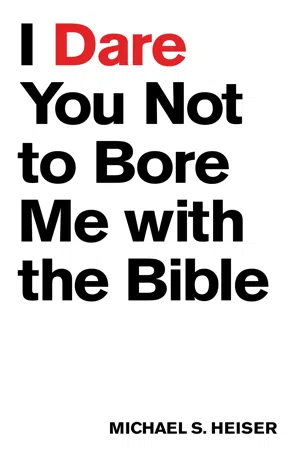
Read this book, and you'll never be bored by the Bible again.
The Bible is filled with passages that are so baffling we tend to ignore them. Yet the passages that seem weird might be the most important.
This collection of essays from Bible Study Magazine will shock you, intrigue you, and completely change the way you view the Bible. Dr. Michael S. Heiser visits some of the Bible's most obscure passages, unveiling their ancient context to help you interpret them today.
- 240 pages
- English
- ePUB (mobile friendly)
- Available on iOS & Android
eBook - ePub
I Dare You Not to Bore Me with the Bible
About this book
Information
Topic
Theology & ReligionSubtopic
Biblical ReferencePart One:
Old Testament
The Ancient’s Guide to the Galaxy
God chose a specific time, place, and culture to inspire people to produce what we read in the Old Testament: the ancient Mediterranean and the ancient Near East of the second and first millennia BC. Understanding the worldview of this culture can lead to more faithful understandings of Scripture on our part, especially when it comes to understanding how the Israelites viewed God and the universe.
Old Testament Cosmology
“Cosmology” refers to the way we understand the structure of the universe. The biblical writers’ conception of how the heavens and earth were structured by God represents a particular cosmology.
The Israelites believed in a universe that was common among the ancient civilizations of the biblical world. It encompassed three parts: a heavenly realm, an earthly realm for humans, and an underworld for the dead. These three tiers are reflected in the Ten Commandments: “You shall not make for yourself a carved image, or any likeness of anything that is in heaven above, or that is in the earth beneath, or that is in the water under the earth” (Exod 20:4).
The Heavens
We find an Israelite understanding of the heavens in Genesis 1:6–8, which describes it as an expanse, with waters above and below: “And God said, ‘Let there be an expanse (רקיע, raqiaʾ) in the midst of the waters, and let it separate the waters from the waters.’ … And it was so. And God called the expanse (רקיע, raqiaʾ) Heaven.”
The sky, thought to be a solid firmament, separated the waters above from the waters below: “When he established the heavens, I [Wisdom] was there; when he drew a circle on the face of the deep, when he made firm the skies above, when he established the fountains of the deep” (Prov 8:27–28).
The firmament dome surrounded the earth, with its edge meeting at the horizon—“the boundary between light and darkness” (Job 26:10). It was supported by “pillars” or “foundations,” thought to be the tops of mountains, whose peaks appeared to touch the sky. The heavens had doors and windows through which rain or the waters above could flow upon the earth from their storehouses (Gen 7:11; 8:2; Pss 78:23; 33:7).
God was thought to dwell above the firmament, as described in Job 22:14: “Thick clouds veil him, so that he does not see, and he walks on the vault of heaven.”
The Earth
The earth sat upon the watery deep. The “waters below” speak not only to waters that people use, but also the deeper abyss. Thus, the earth was surrounded by the seas (Gen 1:9–10), having arisen out of the water (2 Pet 3:5). The earth was thought to be held fast by pillars or sunken foundations (1 Sam 2:8; Job 38:4–6; Psa 104:5).
The Underworld
The realm of the dead was located under the earth. The most frequent term for this place was sheol (שאול; Prov 9:18; Psa 6:4–5; 18:4–5). The word for “earth” (ארץ, ʾerets) is also used—the graves dug by humans represented gateways to the Underworld. In Job, the realm of the dead is described in watery terms: “The dead tremble under the waters and their inhabitants. Sheol is naked before God, and Abaddon has no covering” (Job 26:5–6).
Jonah’s description is perhaps the most vivid. Though in the belly of the great fish, Jonah says he is in the Underworld: the watery deep “at the roots of the mountains,” a “pit” that had “bars” that closed forever (Jonah 2:5–6).
Becoming familiar with the ancient Near Eastern worldview can help us interpret the Old Testament. By understanding the Israelites’ concept of cosmology, we have a better idea of their perceptions of God.
Walk Like an Israelite
Cuneiform tablets changed my life. I’m not kidding. As I look back on my 15 years of graduate school in biblical studies, the turning point in how I view the Bible was my course in Ugaritic, a cuneiform language very similar to biblical Hebrew. This class compelled me to transform “read the Bible in context” from a naïve platitude to an issue of spiritual integrity.
A Bible Study Epiphany
I had the impression that interpreting the Bible in context meant learning about a piece of pottery here, an odd custom there, or having a factual acquaintance with who was alive, and what those people were doing at the time of the biblical events.
But in my Ugaritic course, I learned that all of that can divorce the Bible from the ancient world in one critical way: It can exclude religious or theological ideas from all the “context talk.” It’s easy to presume that most of the Bible’s theological content was unique to Israel. I basically thought that Israel shared some cultural customs with pagan Gentiles—like diet, dress, marriage, and family structure. But I thought Israel’s religious worldview was handed down from heaven, having no common links with paganism. Not true—and the content of the tablets I had to translate in my graduate school course was Exhibit A.
For starters, the people of Ugarit, a city-state in ancient Syria, described their gods with words and phrases that were in the Old Testament—in a number of cases word for word. Their chief deity shared the same name (El) as the God of Abraham, Isaac, and Jacob. (But the El of Ugarit could hardly be called holy by biblical standards.) The honorary titles and other descriptions of the Ugarit El and his primary assistant, Baal, are applied to the God of Israel in many passages in the Old Testament.
There are other examples. The behavior of prophets and the use of divination (casting lots, consulting the ephod) have clear ancient Near Eastern parallels. The design and purpose of the ark of the covenant align well with the use of sacred boxes known as palanquins in ancient Egypt. Trial by ordeal—such as that found in Numbers 5, where a woman accused of adultery must drink a potion to test her fidelity—occurred in surrounding cultures. Terms for Israelite sacrifices are found in ancient Gentile religious texts. The belief that the sky was solid is part of the ancient Near Eastern cosmology shared by the Bible (Job 37:18; Prov 8:28).1 The notion that the seat of our intellect and emotions was our kidneys or intestines was common throughout the ancient world.2
Spiritual Lessons and Implications
Discovering all this was a little shocking. But God used that temporary discomfort to produce honesty with the biblical text. I needed to think like an ancient Israelite to understand the Old Testament.
Israelite religion had some significant divergences from the religions of other surrounding nations, but on the whole, there were more similarities than differences. I came to the realization that the correct interpretive context for the Bible is not the early church, the Protestant Reformation, the Puritans, or modern evangelicalism. Those historical contexts are alien to the Bible. Rather, the context for understanding the Bible is the historical, literary, intellectual and religious context in which it was written.
Although He could have done so, God didn’t change Israel’s culture wh...
Table of contents
- Cover
- Title Page
- Copyright
- Contents
- Foreword
- Introduction
- Part One: Old Testament
- Part Two: New Testament
- About the Author
Trusted by 375,005 students
Access to over 1.5 million titles for a fair monthly price.
Study more efficiently using our study tools.
Frequently asked questions
Yes, you can cancel anytime from the Subscription tab in your account settings on the Perlego website. Your subscription will stay active until the end of your current billing period. Learn how to cancel your subscription
No, books cannot be downloaded as external files, such as PDFs, for use outside of Perlego. However, you can download books within the Perlego app for offline reading on mobile or tablet. Learn how to download books offline
Perlego offers two plans: Essential and Complete
- Essential is ideal for learners and professionals who enjoy exploring a wide range of subjects. Access the Essential Library with 800,000+ trusted titles and best-sellers across business, personal growth, and the humanities. Includes unlimited reading time and Standard Read Aloud voice.
- Complete: Perfect for advanced learners and researchers needing full, unrestricted access. Unlock 1.5M+ books across hundreds of subjects, including academic and specialized titles. The Complete Plan also includes advanced features like Premium Read Aloud and Research Assistant.
We are an online textbook subscription service, where you can get access to an entire online library for less than the price of a single book per month. With over 1.5 million books across 990+ topics, we’ve got you covered! Learn about our mission
Look out for the read-aloud symbol on your next book to see if you can listen to it. The read-aloud tool reads text aloud for you, highlighting the text as it is being read. You can pause it, speed it up and slow it down. Learn more about Read Aloud
Yes! You can use the Perlego app on both iOS and Android devices to read anytime, anywhere — even offline. Perfect for commutes or when you’re on the go.
Please note we cannot support devices running on iOS 13 and Android 7 or earlier. Learn more about using the app
Please note we cannot support devices running on iOS 13 and Android 7 or earlier. Learn more about using the app
Yes, you can access I Dare You Not to Bore Me with the Bible by Michael S. Heiser in PDF and/or ePUB format, as well as other popular books in Theology & Religion & Biblical Reference. We have over 1.5 million books available in our catalogue for you to explore.