Properly original, the new version of this essay intends both to nourish debate and differentiate points of view. In its new articulation, the book justifies work that has been carried out since. It justifies the sense of Franciscan rootedness that has never been denied and at the same time opens to the discovery of another reading of the Dominican Thomas Aquinas. The preface specially composed for this American edition, the opening debate with famous medievalist Etienne Gilson, and above all the afterword entitled "Saint Thomas Aquinas and the entrance of God into Philosophy" make it a radically new book.
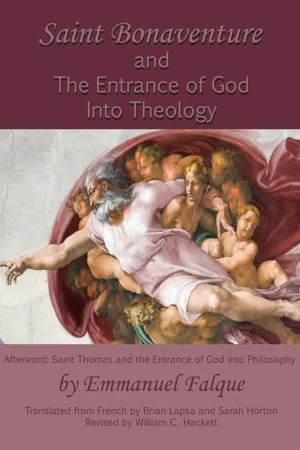
- 362 pages
- English
- ePUB (mobile friendly)
- Available on iOS & Android
eBook - ePub
Saint Bonaventure and the Entrance of God Into Theology
About this book
Information
Topic
Teología y religiónSubtopic
TeologíaPART ONE
GOD AND THEOLOGY
CHAPTER I
TOWARD A DESCRIPTIVE THEOLOGY
(Brev. prol.)
The Breviloquium, then, is concerned in part with “beginning”, with learning how to begin. To judge from the text, nothing, it seems, would serve as a better beginning for a work of theology than a prologue (prologus) that sets the stage for everything else by way of genuflection: “I bend my knees (flecto genua mea) to the Father of our Lord Jesus Christ, from whom all paternity in heaven and on earth takes its name…”1 And to begin well—at least in the sense of recognizing that one must attempt a worthy beginning, and then pulling it off—we must start where God himself, in an act of self-revelation, addresses man: in Scripture. For at the heart of Scripture are the things hidden in the depths of God (abscondita). It is thus these things that the theologian, almost phenomenologically, must make manifest (manifestare) or bring to light (producere in lucem):
Since Scripture (Scriptura) conceals multiple meanings under a single letter, he who expounds it must bring what is hidden to light (abscondita producere in lucem) and make manifest (manifestare) what is thus brought to light, by recourse to other passages whose meanings are more evident.2
In other words, just as phenomenology needs its own method “because phenomena are initially and most frequently not given,”3 so, too, theology demands its own particular mode, since the divine Trinity’s divine appearance is not immediately given from itself, but is on the contrary presented through the multiplicity of meanings within Scripture. Right at the threshold of the Breviloquium it is thus necessary to define a method, called the method of “exposition”—or better, the method of “description”—which finally does not destroy the specificity of divine phenomenality appearing precisely as divine phenomenality, at least in Christianity: the method retains, in other words, its Trinitarian manifestation, spelled out in Scripture and relaying to us, at least in our post-lapsarian state, a book of creation that has sometimes become, if not illegible, at least clouded to our eyes.4
§1. A SUMMA OF REVEALED TRINITARIAN THEOLOGY
A) SCRIPTURE AND THEOLOGY: TRINITARIAN ORIGINS
According to the Breviloquium’s Prologue, the origins of “Scripture,” which Bonaventure insists on calling “theology” (sacra Scriptura quae theologia dicitur), are to be sought “under the influence of the Most Blessed Trinity”: “ortum Scripturae attendi secundum influentiam beatissimae Trinitatis.”5 As I see it, the Trinity thoroughly predetermines the nature of both Scripture and theology for Bonaventure, to an extent that is insufficiently appreciated outside of specialized debates on the status of Scriptural theology in his work.6 To confirm my hypothesis, the Prologue’s equation of sacra Scriptura and theologia is found for a second time in an even more explicitly Trinitarian context right at the beginning of Part I: “Holy Scripture or theology (sacra Scriptura sive theologia) is the science that gives us sufficient knowledge of the first principle (de primo principio)”; and that knowledge recognizes this “first principle as God, both three and one (de primo principio scilicet de Deo trino et uno).7
The claim that the Trinity alone accounts for the equivalence of Scripture and theology in Bonaventure prohibits us from considering them either in a simple identity or in pure opposition: both originally find in their Trinitarian source, and only there, the community to which they both belong, as well as the principle of their differentiation. In this sense, contrary to the conclusions suggested in many exegeses of Bonaventure, we should be content neither with affirming that “we can infer nothing about the relationship between these two terms” (Bougerol) nor with placing them unilaterally “alongside” each other according to a methodological difference supposedly capable of safeguarding the identity of their contents (Tavard).8 Only the affirmation of a Trinitarian a priori, rarely invoked for this distinction, can provide its key and hold together in a single stroke—sacra Scriptura sive (dicitur) theologia—the assertions in the Prologue (no. 1) and Part I (Brev. I, 1, no. 2), and thus also maintain the unity of the whole text. The recourse, indeed the return, to Scripture and theology toward the end of the Prologue, and thus on the threshold of the exposition on the Trinity in Part I, can be explained by the common return to their shared and exclusive origin—the Trinity. For, in the formulation of the opening of the treatise on the Trinity, “theology speaks ‘princepally’9 of the first principle, of God three and one” (Brev. I, 1, no. 1). This corresponds to the introduction to the subject in the Prologue, which claims that “the origins of Scripture are to be sought under the influence of the Most Blessed Trinity” (Prol. no. 1). Both formulations take the absolute fontality of the Trinity as the principle of both theology (Brev. I) and Scripture (Prologue). As I shall show, in contrast to the various—and false—a posteriori dichotomies between the theological and the Scriptural, these approaches manage to express, in an original and exemplary way, the mode of proceeding (modus procedendi) proper to Scripture as a style that also conforms to its mode of teaching (modus exponendi), in which theology, too, shares. In these reciprocal exchanges of the Scriptural and the theological, the purely descriptive ambition of the one and the expository ambition of the other both become clear by means of a mode of descriptivity and performativity that, once again, permits the possibility of a phenomenological rereading.10
B) THE BREVILOQUIUM: A SUMMA OF REVEALED THEOLOGY
Much has been written on the Scripture-theology relation, with regard as much to its form as to its content, at the heart of the Prologue (especially in the last four paragraphs). Bonaventure exegetes are divided into three different interpretative camps. First, there are those who say it treats Scripture as revealed wisdom and distinguishes Scripture from—indeed, opposes it to—theology as a human science (e.g. Bougerol). Second, there are those who claim it highlights the specificity and importance of the Scriptural method but yet laments its alleged absence from theological exposition (Tavard). Third, there are those who argue—and I believe this to be the most fruitful hypothesis—that behind the dichotomy is in fact an accident of the circumstances of the text’s composition, for it may be that Bonaventure started out by using one of his academic lectures (from the beginning of the Prologue to Prol. 6,3) to which he then added an introduction properly speaking on the other (Prol. 6, 4-6) (Bérubé).11 Whether there is some theological motive, or some Scriptural imperative, or some quirk of composition, the debate might distract us and draw us into a discussion in which the deficiencies in form from the very beginning might by used to undermine its reliability and utility. This, at least, would explain its omission, at least historically, from the standard lists of theological reference books (cf. above, note 5, p. 27). As such, it would be easy to prefer, as many historians and theologians tend to do, the more emphatically mystical Itinerarium as Bonaventure’s principal contribution, and then to leave to Thomas Aquinas the task or the honor of pulling off a true “summary” (summa), he being the only real authority (auctoritas) capable of bearing the weight of this charge. Nonetheless, and paradoxically, the Franciscan master’s aim as expressed in the Prologue of the Breviloquium was the very same as Thomas’s:
This doctrine [the plan of salvation], as much in the writings of the saints as in those of the doctors of the Church, is transmitted in a manner so diffuse that for those who come to Holy Scripture to understand it, it cannot be understood at all—because of which young theologians (novi theologi) frequently have an aversion to Holy Scripture itself (…). My brothers have asked me to say something brief (aliquid breve), with my own poor and limited knowledge, in a summa on the truth of theology. I have submitted to their requests, and have consented to write a Breviloquium.12
I can probably do no more than merely emphasize here that the project of a summary of theology (summa theologiae) was not the privilege of Thomas Aquinas alone, that others before him had already blazed the trail (Alexander of Hales, for example, and Albert the Great), and that Bonaventure was following the same course. For of the goals set by both Thomas and Bonaventure in the Prologues to their respective summae (the Breviloquium in 1257, and the Prima pars of Thomas’s Summa theologica in 1268), it was only really Bonaventure who managed to achieve his—a fact not without a certain irony, considering the history of theology from those days to our own. And yet Thomas Aquinas promised to do much the same thing as Bonaventure, just as explicitly and in very similar terms:
The doctor of Catholic truth ought not only to teach those who are most advanced, but also to instruct beginners (incipientes) … Our intent in this book is thus to treat of whatever belongs to the Christian religion, in a manner suited to the instruction of beginners … We shall try, trusting in God’s help, to set forth whatever is included in sacred doctrine as briefly (breviter) and clearly (ac dilucide) as the matter itself may allow.13
In light of the intentions set forth in the two prologues, it would be an understatement to claim that it was Bonaventure, not Thomas Aquinas, who really kept his word. In fact, their goals are so similar that one wonders whether they didn’t make some sort of pact (before their respective appointments as masters in the Faculty of Theology at Paris?) to undertake the same kind of project someday. Even the word choices are similar: to write “something brief” (a...
Table of contents
- Cover Page
- Halftitle Page
- Title Page
- Copyright Page
- Author’s Note to the American Edition
- Note on the Revision
- Table of Contents
- Acknowledgments
- Author’s Preface to the American Edition
- Opening: Confrontation with Étienne Gilson
- Preliminary Matter: Letter from Martin Heidegger to a Doctoral Student
- Foreword: A Note on the Methodology
- Introduction: The Breviloquium and the Phenomenological Hypothesis
- Part One: God and Theology
- Part Two: God in the Beginning
- Part Three: The Manifestation and Naming of God
- Conclusion: From the “Brief Summary” to the Poem on Creation
- Afterword: St. Thomas Aquinas and the Entrance of God into Philosophy
- Index
Trusted by 375,005 students
Access to over 1.5 million titles for a fair monthly price.
Study more efficiently using our study tools.
Frequently asked questions
Yes, you can cancel anytime from the Subscription tab in your account settings on the Perlego website. Your subscription will stay active until the end of your current billing period. Learn how to cancel your subscription
No, books cannot be downloaded as external files, such as PDFs, for use outside of Perlego. However, you can download books within the Perlego app for offline reading on mobile or tablet. Learn how to download books offline
Perlego offers two plans: Essential and Complete
- Essential is ideal for learners and professionals who enjoy exploring a wide range of subjects. Access the Essential Library with 800,000+ trusted titles and best-sellers across business, personal growth, and the humanities. Includes unlimited reading time and Standard Read Aloud voice.
- Complete: Perfect for advanced learners and researchers needing full, unrestricted access. Unlock 1.5M+ books across hundreds of subjects, including academic and specialized titles. The Complete Plan also includes advanced features like Premium Read Aloud and Research Assistant.
We are an online textbook subscription service, where you can get access to an entire online library for less than the price of a single book per month. With over 1.5 million books across 990+ topics, we’ve got you covered! Learn about our mission
Look out for the read-aloud symbol on your next book to see if you can listen to it. The read-aloud tool reads text aloud for you, highlighting the text as it is being read. You can pause it, speed it up and slow it down. Learn more about Read Aloud
Yes! You can use the Perlego app on both iOS and Android devices to read anytime, anywhere — even offline. Perfect for commutes or when you’re on the go.
Please note we cannot support devices running on iOS 13 and Android 7 or earlier. Learn more about using the app
Please note we cannot support devices running on iOS 13 and Android 7 or earlier. Learn more about using the app
Yes, you can access Saint Bonaventure and the Entrance of God Into Theology by Emmanuel Falque in PDF and/or ePUB format, as well as other popular books in Teología y religión & Teología. We have over 1.5 million books available in our catalogue for you to explore.