In this deeply personal and daring meditation, eminent theologian Jürgen Moltmann challenges many closely held beliefs about the experience of dying, the nature of death, and the hope of eternal life. Moving deftly between biblical, theological, and existential domains, Moltmann argues that while we know intimately the experience of dying--both our loved ones' dying and, ultimately, our own--death itself is a mystery. Are those who have died in fact dead? If the dead are alive, how or in what respect? When the dead awaken to eternal life, who wakes? Moltmann's interrogations yield surprising and beautiful fruits. The living soul that awakens to eternal life is not a ghost in a machine, but the Lebensgestalt, the shape and story of a life, its human and divine contexts, its "whole." Drawing on themes from his oeuvre's entire arc, Resurrected to Eternal Life testifies to the inner unity of Moltmann's theology: the cross, the Spirit, the kingdom, the end, and the hope that makes the end present here and now. Seasoned readers of Moltmann will find in these pages a capstone of a lifetime of theological exploration, while those new to his complex thought will find a concise and elegant entry point into his voluminous work.
eBook - ePub
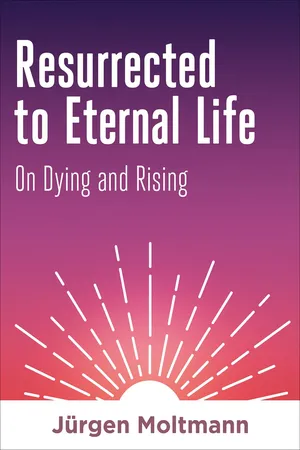
Resurrected to Eternal Life
On Dying and Rising
- 115 pages
- English
- ePUB (mobile friendly)
- Available on iOS & Android
eBook - ePub
About this book
Information
Topic
Teologia e religioneSubtopic
Teologia cristiana1
Two Questions
Is There Life after Death?
After Whose Death?
Many of those who ask the question of whether there is life after death think instinctively of their own death. What comes after death, if anything? When asking this question, it is important to realize that we do not experience our own death. We experience our own dying but not our own death. Strictly speaking, we cannot even say that those who have died are “dead” but rather only that they have died. No one has ever experienced their own death, for even near-death experiences are part of life before death.
The same can be said of the “nothing” that many people expect to find after death: no one has ever seen it.
But what about life after the death of others in our lives? Is there life after the death of a beloved child or a cherished partner?
For many people, this is an essential life question. We experience our own dying but not our death. It is only when loved ones die that we experience death. We experience their death through our love for them and their lives.
How are we to go on living after this love has died? How are we to live this life without them? What is the outlook for those “left behind,” for those from whom the death of a loved one has robbed any joie de vivre—and often even the will to live? This is a true death experience.
It helps those of us left behind to go on living after the death of our loved ones if we can believe in and sense their secondary presence in the unseen world that surrounds the world we see. This does not, however, alleviate our grief, which is as deep as our love was. Grief is more than self-pity; self-pity has no place in mourning the loss of a loved one. In our grief, our loved ones are with us. This is why our grief “never ends,” as Paul writes of love. Is our love for the dear one who has died “as strong as death,” as the Song of Solomon claims? Or is death in fact stronger than mortal love?
The joy of love transcends the death of a loved one, for in the joy of love we hear echoes of eternal life. Goethe knew this when he wrote, “Yet, to be loved, what happiness! What happiness, ye gods, to love!”1
And believers know the following:
Where true charity and love abide, God is dwelling there—Ubi caritas et amor, Deus ibi est.(ELW 642)
Our mortal love of those we cherish is an echo of the divine love, and in love’s happiness lies a spark of divine joy.
Eternal Life: What Are We Asking?
Before we can try to answer the question, we must be more specific about what we mean and narrow our focus.
Eternal life cannot seriously mean the infinite extension of this life. Advances in modern medicine and genetic engineering have nothing to do with the religious concept of eternal life, for eternity is not the same as infinity. The immortality for which so-called transhumanists strive would be the end of mankind. An endless life of the sort we have here in this world would be meaningless and terribly boring.
Neither should eternal life be equated with the immortalization of an individual’s short life. The way obituaries sometimes speak of the deceased being immortalized is evidence of this folly. For, in that case, we could expect nothing new of eternity but rather only the end of this life and—as it is often called—eternal rest. But is eternal rest something other than eternal death?
It helps if we speak of an eternal liveliness rather than an eternal life; this shifts the focus to the intensity rather than the longevity of the experience. It is not the temporal length of life but the momentary depth of our experience that comes close to the primacy of that which we call “eternity.”
Chronological time has nothing to do with this eternity of experience but rather only with the dying of life. A moment of true contentment is like an atom of eternity, and its light is like a flicker of the eternal light. When we are happy, we say that “time stands still.” It is love that makes life lively and sparks our joy in living. The delight we take in loving and living leads us to seek the fullness of life and call it eternal life.
Our lives here and now are in the temporal realm. When we look to the past, we speak of how time is fleeting. When we look to our death, we are focused on our own mortality as the limitation of our “life-time.” But temporal life is in every instant nascent life as long as we look to the future and remain conscious of our birth. Every moment in time is the beginning of the future, and the past is the future that is now behind us. Just as birth precedes death, the future precedes the past.
The fleeting moments of the past have been consigned to death, while nascent time is a life blessed with a future. If we look beyond the dark horizon of death through to the dawn of God’s new day, it is the nascence of all those things we love that fill us with life. We greet each and every new morning in the light of that “bright and morning star” as the hymn proclaims, an eternal dawn. The liveliness of this beginning promises a life fulfilled. We experience life with a sense of fulfillment when that life is at one with itself and pervaded by an affirmation of life that nips the poison of negativity in the bud. It must be a life in the eternal present without dwelling on what was or what is not yet. It must be a life in the here and now, without missing out on life or getting lost in one’s visions of what could be. Humans have sought this experience in the mystical nunc aeternum—the eternal moment—and found it in silence.
1 Johann Wolfgang von Goethe, “Welcome and Farewell,” in Selected Poems, ed. and trans. Christopher Middleton, vol. 1 (Princeton, NJ: Princeton University Press, 1994), 11.
2
The Resurrection of Jesus Christ
It is only because the women who had been close disciples of Jesus and the apostles encountered Jesus after his death that we know anything of Christ. If not for these “postmortem” experiences with Jesus, there would be no Christianity. The Christian faith can thus be seen to have its very origin in the event that the apostles and these women called “Christ’s resurrection from the dead.” It happened to Jesus of Nazareth, who had died and been buried; his “resurrection from the dead” lifted him up in their eyes as the “Son of God,” as Paul writes in an early Christian confession of faith (Rom 1:4). They remembered the story of Jesus in the light of his resurrection, and they told and proclaimed it as a story of Christ, relevant for their age. They hoped to be woken to eternal life along with Christ, and they conceived of their lives in the fellowship of Christ as bringing them into the new creation of the world (2 Cor 5:17). How did this happen? What was “the resurrection of Jesus Christ from the dead” and what does it mean for us? What are its consequences for our own lives and our own dying?
1. The Hope of the Apostles Crucified
The Gospels provide ample testimony to the apostles’ flight from the crucifixion and Peter’s denial of his master. The story of Gethsemane is the key to what happened to Jesus and the apostles at Golgotha. Jesus’s prayer to “Abba, Father” to “remove this cup from me” goes unheard (Mark 14:36). Jesus dies having been forsaken by God. With his last breath, he asks, “My God, my God, why have you forsaken me?” (Mark 15:34). Judas “betrays” him to the Romans (Mark 14:44); Peter, who had been the first to confess that Jesus was Christ (Mark 8:29), denies him three times (Mark 14:66–72); all the apostles leave him and flee. Jesus dies a lonely death on a Roman cross, condemned as a “terrorist” against the Roman Empire. There was no miracle. He died helplessly. Betrayed, denied, abandoned. Those are not just words of mortal weakness and infidelity; they reflect a deep sense of disappointment.
When Jesus had entered Jerusalem, the oppressed had cried out, “Blessed is the coming kingdom of our ancestor David!” (Mark 11:10). “But we had hoped that he was the one to redeem Israel,” lamented the disciples on the road to Emmaus (Luke 24:21). For those who had left everything to follow Jesus, who harbored messianic hopes for the liberation of Israel from Roman occupation and the restoration of David’s kingdom, Jesus’s powerlessness and God’s silence at Golgotha were bitter disappointments. They betrayed, denied, and abandoned him, for he had betrayed, denied, and abandoned them. Jesus’s crucifixion and God’s silence put an end to their hopes in him. They turned back to Galilee from whence they had come and returned to their work as fishermen.
2. The Women’s Faith in the World Destroyed
While the men who followed Jesus fled, the women steadfastly accompanied him to his death and watched “from a distance.” In other words, they maintained eye contact with their friend. These women are named in the Gospels (e.g., Mark 15:40). They were not alienated by death, and it could not disrupt their love for Jesus. When Shabbat was over, Mary Magdalene, Mary the mother of James, and Salome went to their friend’s grave and heard the voice of an angel: “He has been raised; he is not here” (Mark 16:6). It was only before the empty tomb that they succumbed to fear and trembled.
In front of the empty tomb, there was no Easter joy but only unspeakable dismay. Like birth, death is part of our finite, mortal existence. Trusting in the natural course of life includes trusting in death. “We all have to die once,” people say. What shocked the women as they stood before the empty tomb and heard the voice of the angel was the collapse of this natural order of life and death. If death is no longer certain, we can no longer be certain that the deceased are truly dead. From its inception, the mystery of Jesus’s resurrection was terrifying—a mysterium tremendum. The conclusion of the Gospel of Mark provides ample evidence of this.
3. Mary Magdalene
Of all the apostles and Jesus’s disciples, the one who was closest to Jesus was a woman named Mary, who came from the village of Magdala on the Sea of Galilee. As a result of the closeness of their relationship, men have sought to discredit Mary Magdalene and any memory of her from the very beginning. To this end, the church fathers equated her with the “sinful woman” (Luke 7), and noncanonical texts of early Christianity—and even modern historical fantasy novels—sought to dismiss her relationship to Jesus as (merely) romantic.
Pope Gregory I preached in 597 CE, “She whom Luke calls the sinful woman, whom John calls Mary, we believe to be the Mary from whom seven demons were ejected according to Mark. And what did these seven demons signify if not all the vices? It is clear, brothers, that the woman previously used the unguent to perfume her flesh in forbidden acts.”1
The pope thereby conflated four different stories about four different women and attributed all the negative aspects of them to Mary from Magdala. It was only the Second Vatican Council in 1965 that corrected this image, and in 2016, Pope Francis honored Mary Magdalene with a formal feast day, thus setting her equal with the male apostles. Even today, however, she remains the object of men’s sexual fantasies, this magna peccatrix, the great sinner, a prostitute, devastated by her own vices. The “seven demons” from which Jesus healed her were equated with the “seven deadly sins.” There is a long tradition of images of the crucifixion depicting her embracing the cross, her long hair flowing about her.
The attempts to discredit Mary began in the Gospel of John: Peter and the other apostles did not believe her when she told them that the tomb was empty. The disciples raced to the open tomb to see for themselves (John 20:1–10). In the Gnostic gospels, which were not included in the canon, Peter is reported to have said, “Make Mary leave us, for females are not worthy of life.”2 Nevertheless, Peter asks Mary to share with him and the other apostles that which the Savior had revealed exclusively to her, whom he loved more than the other women. When Mary describes a conversation she had had with Jesus about a vision in a dream, Peter is incredulous: “Has the Saviour spoken secretly to a woman and not openly so that we would all hear?”3
This suggests an open rivalry between Peter and Mary of Magdala in the first congregation. The apostles found this woman to be disconcerting: “My Lord,” Peter says in the Pistis Sophia, another apocryphal text, “we will not endure this woman, for she taketh the opportunity from us and hath let none of us speak, but she discourseth many times.”4 Is Paul’s instruction that “women should be silent in the churches” directed toward her?
Who Was the Mary from Magdala in the Bible?
Mary of Magdala was present at Jesus’s crucifixion and death, she was there when his corpse was laid in the tomb, and she was the first person to behold the empty tomb and the resurrected Jesus. She is the perfec...
Table of contents
- Cover
- Title Page
- Copyright Page
- Contents
- Foreword
- 1. Two Questions
- 2. The Resurrection of Jesus Christ
- 3. Our Resurrection in the Hour of Our Death
- 4. The Death and Resurrection of a Living Soul
- 5. Resurrection: The Primal Light Shines in the Midst of Darkness
- Works Cited
- Bibliography
- Index
Trusted by 375,005 students
Access to over 1.5 million titles for a fair monthly price.
Study more efficiently using our study tools.
Frequently asked questions
Yes, you can cancel anytime from the Subscription tab in your account settings on the Perlego website. Your subscription will stay active until the end of your current billing period. Learn how to cancel your subscription
No, books cannot be downloaded as external files, such as PDFs, for use outside of Perlego. However, you can download books within the Perlego app for offline reading on mobile or tablet. Learn how to download books offline
Perlego offers two plans: Essential and Complete
- Essential is ideal for learners and professionals who enjoy exploring a wide range of subjects. Access the Essential Library with 800,000+ trusted titles and best-sellers across business, personal growth, and the humanities. Includes unlimited reading time and Standard Read Aloud voice.
- Complete: Perfect for advanced learners and researchers needing full, unrestricted access. Unlock 1.5M+ books across hundreds of subjects, including academic and specialized titles. The Complete Plan also includes advanced features like Premium Read Aloud and Research Assistant.
We are an online textbook subscription service, where you can get access to an entire online library for less than the price of a single book per month. With over 1.5 million books across 990+ topics, we’ve got you covered! Learn about our mission
Look out for the read-aloud symbol on your next book to see if you can listen to it. The read-aloud tool reads text aloud for you, highlighting the text as it is being read. You can pause it, speed it up and slow it down. Learn more about Read Aloud
Yes! You can use the Perlego app on both iOS and Android devices to read anytime, anywhere — even offline. Perfect for commutes or when you’re on the go.
Please note we cannot support devices running on iOS 13 and Android 7 or earlier. Learn more about using the app
Please note we cannot support devices running on iOS 13 and Android 7 or earlier. Learn more about using the app
Yes, you can access Resurrected to Eternal Life by Jürgen Moltmann, Ellen Yutzy Glebe, Ellen Yutzy Glebe in PDF and/or ePUB format, as well as other popular books in Teologia e religione & Teologia cristiana. We have over 1.5 million books available in our catalogue for you to explore.