Is culture a luxury? In this era of austerity, the value of the arts has been a topic of heated debate in Greece, where the country’s economic troubles have led to drastic cuts in public funding and much contention over the significance of cultural institutions and government-funded arts initiatives. At issue in these debates are larger questions regarding the very notions of publicness, hierarchies of value, and functions of the state that structure collective life. Beginning with the Thessaloniki International Film Festival, The Public Life of Cinema tracks this turbulence as it unfolded in the Greek film world in the early years of the crisis. Investigating the different forms of citizenship and collectivity being negotiated in cinema’s social spaces, this book considers how the arts and cultural production may illuminate the changing conditions of, and possibilities for, public and collective life in the neoliberal era.
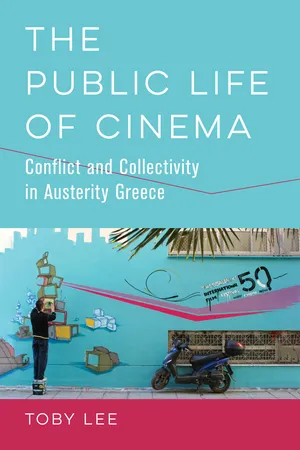
- 210 pages
- English
- ePUB (mobile friendly)
- Available on iOS & Android
eBook - ePub
About this book
Information
CHAPTER 1
Locating the Festival
First encounters, in retrospect, always seem fateful. My first brush with the Thessaloniki International Film Festival was far removed in both space and time from the troubled cultural terrain of austerity-era Greece, but that early experience left me with lasting impressions and larger questions that would later become central to my investigations of that terrain. That first encounter took place in the spring of 2000, when an abridged version of the festival’s Greek and Balkan programs from the previous year was traveling around the world and made a stop at New York’s Anthology Film Archives. I had recently started studying Modern Greek language and culture, and a professor had suggested that I attend one of the screenings as an exercise in language immersion. It was thus that I found myself in a dark theater in the East Village, watching See You in Hell, My Darling (1999), an obscure film by Greek cult director Nikos Nikolaidis. The film—a bizarre, noirish erotic thriller with little plot and lots of shock value—certainly left an impression, but what I found most striking was the screening itself, and the fact that such an obscure Greek film was playing to a full house in a theater far from the traditionally Greek immigrant neighborhoods in and around New York. Looking around at the audience, I began to wonder what kind of public was being constituted in that moment. How were linguistic and cultural identity, shared history, and notions of ethnicity and nationality intersecting with transnational aesthetic traditions, viewing practices, and forms of cinephilia? What was the particular sense of social or cultural collectivity that was being forged in the process? And in what ways did this public shift as the program traveled from Thessaloniki to London, New York, Chicago, and Los Angeles, its itinerary mapping the Greek diaspora?

FIGURE 2. Opening night. Credit: Toby Lee.
Thus, my first experience of the Thessaloniki festival crystallized two important ways in which international film festivals operate. On the one hand, they articulate scales of circulation and belonging, functioning as points of connection or conflict between the local, the national, the regional, and the global. On the other hand, they gather complex publics, serving as spaces for negotiating diverse forms of publicness and collectivity. In this chapter, I attend to these two operations as I introduce the Thessaloniki Film Festival as event and institution. Tracing the festival’s entanglements with local, national, and transnational histories of cultural production, modernization, and Europeanization, as well as histories of publics and public life as these have evolved in Greece over the past half-century, this chapter highlights the complex nature of the institution and its position in the country’s cultural landscape. On another level, this chapter also begins to sketch the outlines of a larger relationship between notions of scale and publicness, to be elaborated in subsequent chapters.
TANGLED LOCALITIES
In the years following that initial encounter at Anthology, with my curiosity piqued by the questions it raised, I began to research the Thessaloniki festival in earnest. This research would lead me to return to the festival year after year, each time deepening both my engagement with the institution and my appreciation of its social and cultural complexity. By the time I arrived in Greece for a more extended period of research, in the lead-up to the festival’s landmark fiftieth anniversary, I had come to understand it as being much more than the relatively bounded, coherent event that it is understood to be in popular conceptions of film festivals. Far beyond films and screenings, the festival marks a sprawling and variegated social space, defined as much by its porous periphery as by its supposed centers, and crisscrossed by diverse agendas and investments—social, cultural, political, and economic—that connect it to other spaces, times, and fields of discourse and practice. To help get our bearings, I begin this introduction with an ethnographic “tour” of its 2009 jubilee edition, deliberately focusing on spaces, practices, and institutional structures rather than films, screenings, or programming in order to focus on the festival as a larger social field.1 By no means comprehensive or exhaustive, this tour is meant to serve as an entry point into a field site that, compressed as it is both spatially and temporally, can feel dense and disorienting. At the same time, the tour also aims to trouble our sense of place and location, bringing into relief the festival’s complicated relationship to space and scale.
Given this latter aim, it is fitting that our tour starts rather far from Thessaloniki: about 300 miles south, in the center of Athens. Here, in the festival’s main offices, the staff are busy packing large cardboard boxes with DVDs, stacks of folders, binders, books, posters, hard drives, even computer towers and monitors. With less than a week before the festival is to begin, the organization is not moving office, at least not permanently. Rather, they are preparing for their yearly migration north, when the Athens branch of the festival organization—which includes the offices of the festival director, all the major programming departments, the film market, the coproduction forum, the script-development fund, publications, and domestic and foreign press offices—packs up and relocates north. Joining the festival departments that are permanently located in Thessaloniki, including the production team, public relations, and educational programs, the Athens staff set up in rented offices, move into hotel rooms, and settle in for the duration of the festival, only to pack up again at the end and return to Athens.
Thus, we begin with a story of center and periphery: Athens, definitively the cultural, economic, and political center of Greece, bursting with more than a third of the country’s population, and Thessaloniki, less than a third of the size of Athens, pushing up against the country’s far northern border. In Greece, Athens is the dominant, unmarked category. While one often hears Peloponnesians stereotyped as being shrewd and cunning, Cretans as proud and violent, and Thessalonicans as laid back or even lazy, one is hard-pressed to come up with such blanket characterizations of Athenians. It is not unusual for Athenian friends and acquaintances to tease me about my slight Thessaloniki accent, with its drawn out l’s and grammatical shortcuts, but one rarely hears such remarks going in the opposite direction. In most respects, Athens is assumed to be the standard, the center against which Thessaloniki, the country’s second-largest city, is often marked as provincial (eparchiaki) and peripheral (perifereiaki). But with the festival staff in Athens hurriedly preparing for their annual trip north, we see that this story of center and periphery is not a static one, as the center moves to the periphery, literally but also figuratively, with Thessaloniki taking over as the center of festival operations, and the center of the Greek film world, for the ten days of the festival’s duration.
Within Thessaloniki, the festival has its own centers and peripheries. One center is undoubtedly the Olympion, the institution’s main building, located at one of the most prestigious addresses in the city, on central Aristotelous Square overlooking the waterfront. The Olympion houses the festival’s Thessaloniki offices, which are open throughout the year and primarily handle the logistics of festival production, as well as the year-round screenings in the building’s two theaters. The main theater is a stately, old-fashioned cinema that goes by the same name as the building itself. Spacious, with everything lined in sumptuous red velvet, two levels of balconies, a large stage, and crystal chandeliers, the Olympion theater is the most coveted of the festival’s spaces for screenings and presentations. On the fifth floor of the building is a smaller screening space, named after the festival’s founder, Pavlos Zannas. Also on the fifth floor is the entrance to a fashionable café with an impressive view of the square and the sea beyond, which serves as a meeting place not only for festival-goers but for stylish city residents year-round. Throughout the year, the building tends to see a steady stream of people, owing to the almost nightly screenings in the two screening halls; the various educational programs, conferences, meetings, and workshops that take place there, either organized by the festival or by other organizations renting space from the festival; and the regular flow of Thessaloniki residents who frequent the building’s two cafés. But during the ten days of the festival, the Olympion is busier than ever. The production, logistics, and accounting teams are located in offices on the upper floors, and the most important events of the festival—opening and closing ceremonies, screenings of films with top billing, the awards ceremony, and special events honoring the most important festival guests—all take place in the Olympion theater. On numerous occasions during each festival, the lobby becomes packed with standing-room only crowds awaiting a film or hoping to slip into a particular ceremony. At other times, it fills with photographers and television crews awaiting stars and special guests: directors, producers, politicians, the heads of major local businesses and organizations, and socialites who make their way past the crowds outside and down the red carpet.
However, it was not at the Olympion that I started my day on the morning of November 13, the first day of the 2009 festival. Well before the commotion of the opening ceremony that would officially mark its beginning later that evening, I made my way to a small public high school, half-hidden on a quiet pedestrian street a few blocks east of Aristotelous Square. There, a handful of graffiti artists were busy spray-painting a large, colorful mural onto a wall enclosing the school yard. One artist was painting a tower of old television monitors, with eyes peering out from the screens; another was outlining blocky letters that spelled out “CINEMA.” At the far end was spray-painted “50th Thessaloniki International Film Festival,” together with the 2009 festival slogan, “Why Cinema Now?” The artists, speckled and smeared in colorful paint, wielding aerosol cans and dirty rags, made for an odd sight in the morning light. People on their way to work paused to do a double take, while others, holding bags of groceries or strings of worry beads, lingered, looking puzzled. A woman stopped to take photographs of the developing mural, and she asked one of the artists what they were doing, to which he replied, “We’re part of the film festival.” She raised her eyebrows in slight confusion, took a few more pictures, and went on with her day.
Indeed, they were part of the film festival. Before the opening ceremony, before any guests had arrived, even before a single film had been screened, one of the festival’s sidebar programs, called “Street Cinema” (O kinimatographos stous dromous tis polis), had already started popping up around Thessaloniki. Conceived especially for the fiftieth-anniversary edition, Street Cinema was a program in which the festival commissioned local art, music, and performance groups to stage happenings and installations in public spaces throughout the city, starting a few days prior to the opening of the festival and extending through the full ten days. As I will discuss in more detail in the following chapter, the program was designed to strengthen and make more visible the connections between the festival and its host city, and to foster a greater sense of public engagement, or at least an appearance of it, particularly at a time when it was facing criticism for what many perceived as its lack of engagement with issues of increasing concern to the public. Street Cinema was one of countless such sidebar programs that year which gave the festival its sprawling character, blanketing the city with events and exhibits, some of which seemed only tangentially, if at all, related to cinema, and which were often produced in conjunction with many other local, national, and international organizations and agencies. These sidebar programs included art, photography, video, and even jewelry exhibitions in venues throughout the city; a full schedule of concerts, talks, master classes, roundtables, and open discussions; an environmental program that included participatory public art works, tree-plantings, and recycling and green transportation initiatives; and student volunteer programs organized with local educational institutions. Given this size and spread, not uncommon for the festival but notably increased for its fiftieth anniversary celebrations, it is no wonder that the average attendee would have trouble getting her bearings and navigating the festival, or even discerning its boundaries.
Anticipating the crowds that would soon overtake the festival, I left the graffiti artists and quickly made my way to the accreditations office to pick up my badge. The office is located on the city’s old port, or palio limani, which for most of the year occupies a rather peripheral position, about half a kilometer west along the waterfront from Aristotelous Square. On a long strip of land reaching out into the Thermaic Gulf, a series of renovated warehouses sit on either side of a cobblestone street, administered by the municipality and the Thessaloniki Port Authority. For most of the year, these warehouses remain empty; foot traffic in the old port is limited to the occasional visitor to the Cinema Museum, Photography Museum, or the small Center for Contemporary Art, which are housed in some of the renovated warehouses. But every year since 1999, the festival has rented the empty warehouses for a couple of weeks each November, transforming the usually sleepy limani into a buzzing center of operations. Some of the warehouses are used for screenings, master classes, panel presentations, and open discussions, while another houses the offices of the Athens staff and serves as the administrative and social hub of the festival. Here, we find the office of the festival director, all the programming departments, publications, the press office, print traffic, accreditations, and guest services, as well as a large, airy café that serves as one of the main gathering spots for both staff and festival-goers. The cavernous ground floor of this warehouse—lined with the information kiosks of Greek television channels, film organizations, and funding bodies—serves as the stage for press conferences, as well as for the main concerts and parties that take place throughout the course of the festival. With the festival occupying so much of the old port, the limani becomes one of the city’s most bustling areas, with audiences streaming in and out throughout the day; staff members hurriedly shuttling between warehouses; news crews roaming the cobblestone streets; and industry professionals, such as producers, directors, sales agents, and distributors, making their way from one meeting to another. Vendors set up stands selling roasted chestnuts and hot spiced drinks; teenagers pass out flyers for concerts, parties, and local businesses; and festival-goers meet friends and see familiar faces at screenings, at the various cafés temporarily set up in the warehouses, and in passing on the street. Thus, the picturesque port, which usually occupies a peripheral position in the city’s social and cultural landscape, is transformed into a central location for the festival.
At the accreditations office, I met a film sales agent from Germany and a screenwriter from Bulgaria, who are were also there to pick up their badges, and together we walked over to the Industry Center, housed that year in a large warehouse at a distance from the others. Inaugurated in 2005, the Industry Center is an umbrella department whose primary purpose is to support and foster the business of filmmaking, which it does through a number of industry-oriented activities and services aimed at film professionals from Greece, throughout Europe, and around the world. In 2009, these included the Agora, or Film Market, where the 250 films showing at the festival that year, plus a handful of films selected only to be part of the Market, were available for viewing by accredited industry professionals to facilitate sales of both Greek and international films to domestic and international markets. Another Industry Center program that year was the Balkan Fund, a script-development competition open to film projects with directors or producers from Balkan countries; in 2009, ten films were competing for a number of cash prizes, as well as introductions to potential funders, coproducers, sales agents, and distributors. In the Crossroads Co-production Forum, which supports Mediterranean and Balkan films in more advanced stages of production, filmmakers from seventeen different projects were given the opportunity to pitch their films to a variety of industry professionals, with one project ultimately chosen to receive a cash award and free accreditation in the Producer’s Network program at the 2010 Cannes Film Festival. Finally, in the Salonica Studio program, part of the EU MEDIA Program’s educational initiatives, students from film schools across Europe participated in an intensive workshop to develop and attempt to secure funding for their proposed projects, with access to al...
Table of contents
- Title
- Copyright
- Contents
- List of Illustrations
- Acknowledgments
- Note on Translation and Transliteration
- Introduction: “Is Culture a Luxury?”
- 1. Locating the Festival
- 2. Forms of Publicness
- 3. Histories of Conflict and Collectivity
- 4. Dissensus and Its Limits
- 5. The Value of Mereness
- Notes
- Bibliography
- Index
Trusted by 375,005 students
Access to over 1.5 million titles for a fair monthly price.
Study more efficiently using our study tools.
Frequently asked questions
Yes, you can cancel anytime from the Subscription tab in your account settings on the Perlego website. Your subscription will stay active until the end of your current billing period. Learn how to cancel your subscription
No, books cannot be downloaded as external files, such as PDFs, for use outside of Perlego. However, you can download books within the Perlego app for offline reading on mobile or tablet. Learn how to download books offline
Perlego offers two plans: Essential and Complete
- Essential is ideal for learners and professionals who enjoy exploring a wide range of subjects. Access the Essential Library with 800,000+ trusted titles and best-sellers across business, personal growth, and the humanities. Includes unlimited reading time and Standard Read Aloud voice.
- Complete: Perfect for advanced learners and researchers needing full, unrestricted access. Unlock 1.5M+ books across hundreds of subjects, including academic and specialized titles. The Complete Plan also includes advanced features like Premium Read Aloud and Research Assistant.
We are an online textbook subscription service, where you can get access to an entire online library for less than the price of a single book per month. With over 1.5 million books across 990+ topics, we’ve got you covered! Learn about our mission
Look out for the read-aloud symbol on your next book to see if you can listen to it. The read-aloud tool reads text aloud for you, highlighting the text as it is being read. You can pause it, speed it up and slow it down. Learn more about Read Aloud
Yes! You can use the Perlego app on both iOS and Android devices to read anytime, anywhere — even offline. Perfect for commutes or when you’re on the go.
Please note we cannot support devices running on iOS 13 and Android 7 or earlier. Learn more about using the app
Please note we cannot support devices running on iOS 13 and Android 7 or earlier. Learn more about using the app
Yes, you can access The Public Life of Cinema by Toby Lee in PDF and/or ePUB format, as well as other popular books in Media & Performing Arts & 21st Century History. We have over 1.5 million books available in our catalogue for you to explore.