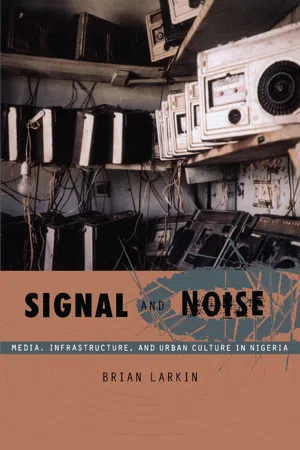
Media technologies were introduced to Nigeria by colonial regimes as part of an attempt to shape political subjects and create modern, urban Africans. Larkin considers the introduction of media along with electric plants and railroads as part of the wider infrastructural project of colonial and postcolonial urbanism. Focusing on radio networks, mobile cinema units, and the building of cinema theaters, he argues that what media come to be in Kano is the outcome of technology's encounter with the social formations of northern Nigeria and with norms shaped by colonialism, postcolonial nationalism, and Islam. Larkin examines how media technologies produce the modes of leisure and cultural forms of urban Africa by analyzing the circulation of Hindi films to Muslim Nigeria, the leisure practices of Hausa cinemagoers in Kano, and the dynamic emergence of Nigerian video films. His analysis highlights the diverse, unexpected media forms and practices that thrive in urban Africa. Signal and Noise brings anthropology and media together in an original analysis of media's place in urban life.
- 328 pages
- English
- PDF
- Available on iOS & Android
eBook - PDF
About this book
Mainstream media and film theory are based on the ways that media technologies operate in Europe and the United States. In this groundbreaking work, Brian Larkin provides a history and ethnography of media in Nigeria, asking what media theory looks like when Nigeria rather than a European nation or the United States is taken as the starting point. Concentrating on the Muslim city of Kano in the north of Nigeria, Larkin charts how the material qualities of technologies and the cultural ambitions they represent feed into the everyday experiences of urban Nigeria.
Information
Publisher
Duke University Press BooksYear
2008Print ISBN
9780822341086
9780822340904
eBook ISBN
9780822389316
Table of contents
- Acknowledgments
- Introduction
- 1 Infrastructure, the Colonial Sublime, and Indirect Rule
- 2 Unstable Objects: The Making of Radio in Nigeria
- 3 Majigi, Colonial Film, State Publicity, and the Political Form of Cinema
- 4 Colonialism and the Built Space of Cinema
- 5 Immaterial Urbanism and the Cinematic Event
- 6 Extravagant Aesthetics: Instability and the Excessive World of Nigerian Film
- 7 Degraded Images, Distorted Sounds: Nigerian Video and the Infrastructure of Piracy
- Conclusion
- Notes
- Bibliography
- Index
Trusted by 375,005 students
Access to over 1.5 million titles for a fair monthly price.
Study more efficiently using our study tools.
Frequently asked questions
Yes, you can cancel anytime from the Subscription tab in your account settings on the Perlego website. Your subscription will stay active until the end of your current billing period. Learn how to cancel your subscription
No, books cannot be downloaded as external files, such as PDFs, for use outside of Perlego. However, you can download books within the Perlego app for offline reading on mobile or tablet. Learn how to download books offline
Perlego offers two plans: Essential and Complete
- Essential is ideal for learners and professionals who enjoy exploring a wide range of subjects. Access the Essential Library with 800,000+ trusted titles and best-sellers across business, personal growth, and the humanities. Includes unlimited reading time and Standard Read Aloud voice.
- Complete: Perfect for advanced learners and researchers needing full, unrestricted access. Unlock 1.5M+ books across hundreds of subjects, including academic and specialized titles. The Complete Plan also includes advanced features like Premium Read Aloud and Research Assistant.
We are an online textbook subscription service, where you can get access to an entire online library for less than the price of a single book per month. With over 1.5 million books across 990+ topics, we’ve got you covered! Learn about our mission
Look out for the read-aloud symbol on your next book to see if you can listen to it. The read-aloud tool reads text aloud for you, highlighting the text as it is being read. You can pause it, speed it up and slow it down. Learn more about Read Aloud
Yes! You can use the Perlego app on both iOS and Android devices to read anytime, anywhere — even offline. Perfect for commutes or when you’re on the go.
Please note we cannot support devices running on iOS 13 and Android 7 or earlier. Learn more about using the app
Please note we cannot support devices running on iOS 13 and Android 7 or earlier. Learn more about using the app
Yes, you can access Signal and Noise by Brian Larkin in PDF and/or ePUB format, as well as other popular books in History & African History. We have over 1.5 million books available in our catalogue for you to explore.