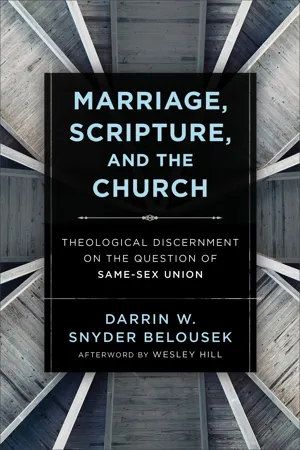
eBook - ePub
Marriage, Scripture, and the Church
Theological Discernment on the Question of Same-Sex Union
- 352 pages
- English
- ePUB (mobile friendly)
- Available on iOS & Android
eBook - ePub
Marriage, Scripture, and the Church
Theological Discernment on the Question of Same-Sex Union
About this book
This book takes a distinctive approach to the same-sex-union debate by framing the issue as a matter of marriage. Darrin Snyder Belousek demonstrates that the interpretation of Scripture affects whether the church should revise its doctrine of marriage for the sake of sanctioning same-sex union. Engaging charitably yet critically with opposing viewpoints, he delves deeply into what marriage is, what it is for, and what it means as presented in the biblical narrative and the theological tradition, articulating a biblical-traditional theology of marriage for the contemporary church. Afterword by Wesley Hill.
Information
Topic
Theology & ReligionSubtopic
Christian MinistryPart 1: Surveying the Situation
1
Stand at the Crossroads
TAKING A BEARING
Thus says the LORD:
Stand at the crossroads, and look.
Jeremiah 6:16
The Way We’ve Come
The main question this book addresses is whether the church should sanction same-sex union as true marriage, and thus extend its rite of nuptial blessing to same-sex couples, or not.1 The church has traditionally taught that sexual intercourse belongs within the monogamous union of man and woman. This traditional teaching contains two interrelated norms: sexual intercourse belongs to the marriage bond, and marriage is man-woman monogamy. With respect to traditional teaching, to advocate sanction of same-sex union could, logically, be to advocate one or other of two things: revise the definition of marriage to include same-sex union or rescind the restriction of sexual intercourse to allow sex outside monogamous marriage for sexual minorities. The church’s debate over same-sex union, for the most part, has concerned the definition of marriage. As I will show, however, the church’s debate also implicates the restriction of sex to marriage.
In the matter of same-sex union, cultural winds in Western society have shifted sharply in a short span. Political and legal changes have followed in step with cultural shifts. Recognition of same-sex union is now the legal norm in the United States, Canada, England, Australia, and other Western nations. These changes have not come all of a sudden. Same-sex union ascended to social approval and legal status in a single generation. Yet more fundamental shifts lie behind and beneath this latest in a series of changes concerning sex and marriage. Such changes—contraception, pornography, sexual liberation, sex education, divorce, cohabitation, abortion—have been working their way through society over a century.2
As Western society has been altering its law, and image, of marriage, Christians in every quarter have been caught up in those cultural shifts. Different denominations have followed varied strategies in response to the sexual-social upheaval of the 1960s onward. Protestant mainline denominations have tended to pursue a strategy of accommodating Christianity to the shifting culture to maintain the intellectual respectability of Christian belief and social relevance of Christian institutions, while evangelical and Anabaptist groups have tended to follow a strategy of nonconformist resistance to cultural forces to preserve orthodox doctrine and distinctive witness.3 Despite differing responses, however, Protestant groups off the mainline have found themselves replicating the same debates over sex and marriage that have played out in mainline denominations. Cultural changes in sex and marriage have put pressure on Christian practice and reshaped Christian understanding of sex and marriage.4
Because the cultural and ecclesial shift on same-sex union is the latest chapter in a century-long story of sexual-social change, the church cannot adequately address the question of same-sex union in isolation from the several shifts on sex and marriage that have preceded it. Discerning the question of same-sex union in the church will implicate the ways in which Christians have already become accommodating in practice, if not affirming in principle, of pornography, cohabitation, contraception, divorce, and so on.
The debate over same-sex union in North America is not new. Protestant mainline denominations, especially, have been dealing with this matter for decades. As this debate courses through the denominations, Protestant mainline groups tend to be about a generation ahead of evangelical and Anabaptist groups in both debating and deciding on this matter. The debate also finds different denominations following diverging paths—and even differing factions within denominations diverging into distinct groups.
Some Protestant denominations have already resolved debate and officially moved to redefine marriage and approve blessing of same-sex couples. Other denominations, while formally maintaining a traditional teaching, have continued in dispute over the matter without resolution. And still other denominations, whether because of lack of consensus or on account of church polity, have resolved debate by leaving the matter to local decision by congregations and clergy. My denomination maintains a traditional teaching as its confessional position, but differences in belief and dynamics of polity are moving it toward resolving dispute by local decision. For those North American denominations that belong to worldwide communions, denominational disputes have threatened global division. Many evangelical and Anabaptist groups, along with the worldwide communions of Catholicism and Orthodoxy, maintain a traditional teaching on sex and marriage. Yet winds of change are blowing in conservative camps, as some prominent evangelical leaders and Catholic theologians have changed minds and advocated publicly for blessing same-sex couples.
To take a bearing in the present situation, let’s look back to see the way we’ve come over the last few decades. I won’t attempt to rehearse the whole history of this debate. Charting a few data points will show an overall trend. In 1983, Robin Scroggs began his landmark book, The New Testament and Homosexuality, with a brief survey of debates among three Protestant mainline denominations that were underway in the late 1970s and early 1980s. At that time, the disputed question within denominational bodies was whether “practicing homosexual” persons could be ordained, which was connected to another disputed question of whether same-sex intercourse is intrinsically immoral. Blessing of same-sex couples in marriage was not (yet) up for formal discussion by denominational bodies. About twenty years later, C. Norman Kraus made a contribution to the ongoing debate among Mennonites. He framed the question for discussion in terms of justifying same-sex union as an exceptional situation: “Even if its [i.e., same-sex erotic attraction] expression in a monogamous covenanted context is recognized as moral, it can only be justified as an exception for a small minority.”5 Another twenty years later, the question for debate has shifted again. Now, while some mainline denominations have decided to sanction same-sex union, even some off-mainline denominations have moved beyond debating whether to justify same-sex couples as an exceptional situation and into debating whether to sanction same-sex union as marriage. The debated question has thus evolved: from whether same-sex intercourse should be judged as intrinsically immoral, to whether same-sex union may be justified as exceptionally moral, to whether same-sex union should be blessed as true marriage.
The Way We’re Going
Given this bearing, we may look ahead to see the way we might be going. What will be the next debate? I expect that the church will soon find itself debating whether to rescind restriction of sex to marriage and allow sex outside marriage. As observed above, the church’s debate over same-sex union has, for the most part, challenged the definition of marriage as man-woman monogamy while keeping the restriction of sex to marriage. Cultural shifts in society and theological shifts within the church, however, have put pressure also on the traditional restriction of sex to marriage, especially concerning sexual minorities.
One rationale advanced for rescinding restriction of sex to marriage concerning sexual minorities is the claim that marriage is a “heteronormative” construct or a patriarchal institution that should not be required of sexual minorities who desire sexual relationships. This rationale has secular origins in the 1960s and 1970s among postmodern philosophers and political radicals who rejected monogamous marriage as an oppressive structure from which queer sexuality needs liberation.6 This way of thinking has moved from the secular arena into the church. Elizabeth Stuart, taking a lesbian-liberationist stance, characterizes marriage as “an institution that was born, formed, and structured for and by patriarchy.”7 Accordingly, she rejects marriage as a normative model for sexual relationships because, she argues, it is both unacceptable from the perspective of women’s experience of suffering and inappropriate to the way that lesbian and gay persons understand their relationships. She advocates friendship as an alternative model for sexual relationships, which would require relationships of justice and mutuality but would allow pursuit of passion beyond the bounds of marriage and monogamy.8
Other theologians also have advanced variations of this theme—that sexual minorities need not be constrained by the heterosexual norm, thus rescinding restriction of sexual relations to monogamous marriage—over decades of debate about same-sex union. In the 1970s Tom Driver argued that affirming same-sex relationship “as a valid behavior and way of life” does not ask the church to abandon marriage. Yet it does ask the church to accept two things incompatible with tradition: the liberation of sex from marriage (“Life o...
Table of contents
- Cover
- Endorsements
- Title Page
- Copyright Page
- Dedication
- Contents
- Acknowledgments
- Living in the Midst
- Part 1: Surveying the Situation
- Part 2: Framing the Question
- Part 3: Evaluating the Case
- Part 4: Seeking a Direction
- Afterword
- Bibliography
- Index of Scripture and Ancient Christian Literature
- Index of Subjects
- Back Cover
Trusted by 375,005 students
Access to over 1.5 million titles for a fair monthly price.
Study more efficiently using our study tools.
Frequently asked questions
Yes, you can cancel anytime from the Subscription tab in your account settings on the Perlego website. Your subscription will stay active until the end of your current billing period. Learn how to cancel your subscription
No, books cannot be downloaded as external files, such as PDFs, for use outside of Perlego. However, you can download books within the Perlego app for offline reading on mobile or tablet. Learn how to download books offline
Perlego offers two plans: Essential and Complete
- Essential is ideal for learners and professionals who enjoy exploring a wide range of subjects. Access the Essential Library with 800,000+ trusted titles and best-sellers across business, personal growth, and the humanities. Includes unlimited reading time and Standard Read Aloud voice.
- Complete: Perfect for advanced learners and researchers needing full, unrestricted access. Unlock 1.5M+ books across hundreds of subjects, including academic and specialized titles. The Complete Plan also includes advanced features like Premium Read Aloud and Research Assistant.
We are an online textbook subscription service, where you can get access to an entire online library for less than the price of a single book per month. With over 1.5 million books across 990+ topics, we’ve got you covered! Learn about our mission
Look out for the read-aloud symbol on your next book to see if you can listen to it. The read-aloud tool reads text aloud for you, highlighting the text as it is being read. You can pause it, speed it up and slow it down. Learn more about Read Aloud
Yes! You can use the Perlego app on both iOS and Android devices to read anytime, anywhere — even offline. Perfect for commutes or when you’re on the go.
Please note we cannot support devices running on iOS 13 and Android 7 or earlier. Learn more about using the app
Please note we cannot support devices running on iOS 13 and Android 7 or earlier. Learn more about using the app
Yes, you can access Marriage, Scripture, and the Church by Darrin W. Snyder Belousek in PDF and/or ePUB format, as well as other popular books in Theology & Religion & Christian Ministry. We have over 1.5 million books available in our catalogue for you to explore.