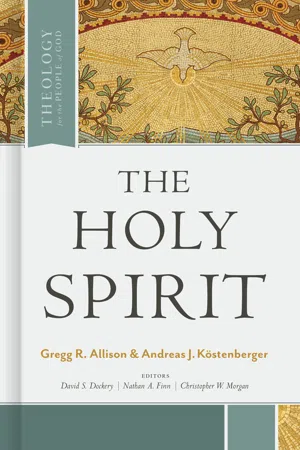
This book studies the Holy Spirit through the lens of both biblical and systematic theology. It provides a comprehensive look at the third person of the Trinity as revealed by Scripture, focusing on eight central themes and assumptions.
eBook - ePub
The Holy Spirit
- 576 pages
- English
- ePUB (mobile friendly)
- Available on iOS & Android
eBook - ePub
About this book
Information
Subtopic
Théologie chrétiennePART I
BIBLICAL THEOLOGY
1
Introduction to Biblical Theology of the Holy Spirit
The study of references to the Holy Spirit in Scripture is a fascinating enterprise. This is true especially if such study is approached via a biblical-theological method, tracking the references to God’s Spirit book by book in both the OT and the NT, with a view toward connecting the dots between these references. In this way, each biblical author’s contribution to a biblical theology of the Holy Spirit is considered and respected while at the same time attention is paid to the gradual unfolding of scriptural revelation regarding the Holy Spirit across the canon of Scripture.
While numerous studies are available on the Holy Spirit in both testaments and in individual biblical authors, and several biblical-theological treatments exist (although most are multi-author collections), it is not often that one finds studies that investigate with a consistent and coherent biblical-theological methodology all biblical references to the Holy Spirit. A case in point is the helpful volume A Biblical Theology of the Holy Spirit, in which contributors use different methodologies and, in some cases, adopt a topical approach.1
By contrast, in the first half of this volume, we take essentially a narrative-oriented tack; that is, we read a given book (such as Acts) in consecutive order as it was written. In so doing, we focus particularly on references to the person and work of the Holy Spirit, both within that book and within the framework of prior canonical references.2 In this way, an organic treatment emerges that can (hopefully) serve as a faithful representation of the Bible’s own teaching on the Holy Spirit (though there are, of course, passages in which judgment calls have to be made as to whether the referent is the Holy Spirit).
In what follows, then, we will first look at references to God’s Spirit in the OT: the Pentateuch, the Historical Books, the Wisdom Books, and key prophetic books, such as Isaiah, Jeremiah, Ezekiel, and certain books from the Twelve (the Minor Prophets), particularly Joel and Zechariah. While it may be interesting to treat OT references in (presumed) chronological order of writing, this would raise many complex questions as to the dating of various books, which is beyond the scope of this study; in any case, the composite picture is not materially affected.
After this, we will turn our attention to the NT, treating, in canonical order, the four Gospels and the book of Acts.3 Paul’s epistles will be discussed in chronological order of writing,4 as there is a general timeline agreed upon by many scholars, and such an approach will nicely surface developments and respective emphases in Pauline pneumatology. The study will conclude with discussions of references to the Spirit in Hebrews, Peter’s and John’s letters, Jude and Revelation.5
The Holy Spirit is often neglected in the church or, alternately, given disproportionate attention in certain circles. Our purpose here is to provide a nuanced and theologically sensitive and balanced presentation of the biblical teaching on the Holy Spirit that can serve as a reliable foundation for the historical-theological and systematic-theological treatment that makes up the second part of this volume. In this collaborative effort involving biblical, historical, and systematic theology, we hope to make a helpful methodological contribution as well.
1 Trevor J. Burke and Keith Warrington, eds., A Biblical Theology of the Holy Spirit (Eugene: Cascade, 2014). See also M. Turner, “Holy Spirit,” in New Dictionary of Biblical Theology, ed. T. Desmond Alexander and Brian S. Rosner (Leicester, UK: Inter-Varsity, 2000), 551–58. For broader studies, see G. K. Beale, A New Testament Biblical Theology: The Unfolding of the Old Testament in the New (Grand Rapids: Baker, 2011), 559–650; E. Kamlah, J. D. G. Dunn, and C. Brown, “Spirit,” in New International Dictionary of New Testament Theology, ed. C. Brown (Grand Rapids: Zondervan, 1978); 3:689–709, and Charles H. H. Scobie, The Ways of Our God: An Approach to Biblical Theology (Grand Rapids: Eerdmans, 2003), 269–97.
2 The question of various orders in the OT canon cannot be addressed here. We will discuss references to the Spirit within the framework of the order used in most English Bibles. On this question, see esp. Greg Goswell, “The Order of the Books in the Hebrew Bible,” JETS 51 (2008): 673–88; Goswell, “The Order of the Books in the Greek Old Testament,” JETS 52 (2009): 449–66. See further my comments in the next paragraph.
3 Again, we will not be unduly deterred by technical questions regarding the NT canon that exceed the scope of this investigation. See Greg Goswell, “The Order of the Books of the New Testament,” JETS 53 (2010): 225–41.
4 Colossians, Philippians, and Philemon do not warrant full, separate treatment due to the paucity of references to the Spirit in these books. The letters to Timothy and Titus will be treated as part of the Pauline corpus.
5 No separate treatment is required for the book of James.
2
The Holy Spirit in the Old Testament and in the Pentateuch
Old Testament
While the term Holy Spirit is exceedingly rare in the OT,1 there are approximately 100 references to the Spirit of God in the OT, out of close to 400 instances of the Hebrew term ruach, which in addition to “S/spirit” can also mean “wind” or “breath.”2 It is challenging at times to distinguish between (God’s) “Spirit” and (human) “spirit” in some texts, especially since there is often a connection between God as Creator and the human spirit. This connection notwithstanding, passages in which the referent is the human spirit rather than God’s Spirit will not be discussed in the text that follows. Also, as noted in the following discussion, OT references to God’s Ruach are usually better rendered “God’s Spirit” rather than “Spirit of God” in order to convey the unity between Yahweh and his Ruach. In addition, interpreters discuss a variety of theological questions related to the Spirit’s presence and work in the lives of OT believers.3
Pentateuch
Overview
The first reference in Scripture to the Spirit is found in Gen 1:2, where the Spirit is shown to be active in creation. At Gen 6:3, God announces before the flood in the days of Noah that the Spirit will not remain or contend with depraved humanity forever. At Gen 41:38, then, surprisingly, it is none other than the Egyptian pharaoh who recognizes that the S/spirit of God dwells in Joseph.
The book of Exodus narrates how those building the tabernacle are endowed with skill and the Spirit of God. In the book of Numbers, God is said to take the S/spirit that is in Moses and put it on the seventy elders (Num 11:17), and when the S/spirit has come to rest on them, they prophesy (Num 11:25). Later in the book, the Spirit of God is said to come on Balaam the prophet (Num 24:2) as well as on Joshua, Moses’s successor (Num 27:18; cf. Deut 34:9).
Discussion
At the outset of creation, the book of Genesis describes the universe as “formless and empty” (tohu wa vohu; Gen 1:2; cf. Jer 4:23). There is darkness, and the Spirit of God (ruach elohim) is hovering over the waters.4 While the meaning of ruach in Gen 1:2 is debated, the term is used in conjunction with Elohim, who is featured as the personal God throughout the creation narrative.5 Thus ruach is shown to subsist in close relation to this personal God and Creator and serve as his agent in creation (cf. Ps ...
Table of contents
- Series Introduction
- Figures
- Abbreviations
- Introduction
- Part I: Biblical Theology
- Part II: Systematic Theology
- Bibliography
- Name Index
- Subject Index
- Scripture Index
Trusted by 375,005 students
Access to over 1.5 million titles for a fair monthly price.
Study more efficiently using our study tools.
Frequently asked questions
Yes, you can cancel anytime from the Subscription tab in your account settings on the Perlego website. Your subscription will stay active until the end of your current billing period. Learn how to cancel your subscription
No, books cannot be downloaded as external files, such as PDFs, for use outside of Perlego. However, you can download books within the Perlego app for offline reading on mobile or tablet. Learn how to download books offline
Perlego offers two plans: Essential and Complete
- Essential is ideal for learners and professionals who enjoy exploring a wide range of subjects. Access the Essential Library with 800,000+ trusted titles and best-sellers across business, personal growth, and the humanities. Includes unlimited reading time and Standard Read Aloud voice.
- Complete: Perfect for advanced learners and researchers needing full, unrestricted access. Unlock 1.5M+ books across hundreds of subjects, including academic and specialized titles. The Complete Plan also includes advanced features like Premium Read Aloud and Research Assistant.
We are an online textbook subscription service, where you can get access to an entire online library for less than the price of a single book per month. With over 1.5 million books across 990+ topics, we’ve got you covered! Learn about our mission
Look out for the read-aloud symbol on your next book to see if you can listen to it. The read-aloud tool reads text aloud for you, highlighting the text as it is being read. You can pause it, speed it up and slow it down. Learn more about Read Aloud
Yes! You can use the Perlego app on both iOS and Android devices to read anytime, anywhere — even offline. Perfect for commutes or when you’re on the go.
Please note we cannot support devices running on iOS 13 and Android 7 or earlier. Learn more about using the app
Please note we cannot support devices running on iOS 13 and Android 7 or earlier. Learn more about using the app
Yes, you can access The Holy Spirit by Gregg Allison,Andreas J. Köstenberger, David S. Dockery,Nathan A. Finn,Christopher W. Morgan, David S. Dockery, Nathan A. Finn, Christopher W. Morgan in PDF and/or ePUB format, as well as other popular books in Théologie et religion & Théologie chrétienne. We have over 1.5 million books available in our catalogue for you to explore.