Behind every disease is a story, a complex narrative woven of multiple threads, from the natural history of the disease, to the tale of its discovery and its place in history. The Atlas of Disease is the first book to tell these stories in a new an innovative way, interweaving new maps with contemporary illustrations to chart some of the world's most deadly pandemics and epidemics.
In The Atlas of Disease, Sandra Hempel reveals how maps have uncovered insightful information about the history of disease, from the seventeenth century plague maps that revealed the radical idea that diseases might be carried and spread by humans, to cholera maps in the 1800s showing the disease was carried by water, right up to the AIDs epidemic in the 1980s, and the recent devastating ebola outbreak.
Crucially, The Atlas of Disease will also explore how cartographic techniques have been used to combat epidemics by revealing previously hidden patterns. These discoveries have changed the course of history, affected human evolution, stimulated advances in medicine and saved countless lives.
Weakness, sore throat, fever, swollen neck glands, thick grey coating in the throat or nose
Incidence and deaths
Around 5,000 cases a year worldwide. Fatal in 5–10 per cent of cases.
Prevalence
Endemic in many countries in Asia, the South Pacific, the Middle East, Eastern Europe and in Haiti and the Dominican Republic. Rare in industrialised countries.
Prevention
Vaccination
Treatment
Antitoxins and antibiotics
Global strategy
Childhood vaccination programmes but the World Health Organization (WHO) describes diphtheria as a ‘forgotten’ disease
El Lazarillo de Tormes, 1808–10 by Francisco de Goya, sometimes also known as El garrotillo (‘Diphtheria’).
In 1859, The Lancet published a report on the sudden appearance of ‘a strange type of disease’. The author, a surgeon at the West London Hospital called Ernest Hart, described the unknown sickness as ‘distressing in its symptoms, rapid in its progress, intractable, and communicable by infection and by contagion’. It also ‘acted with severity in confined areas of population’ and left ‘terrible traces of its passage’, he wrote.
Hart said it was important to find out if this malady was entirely new to the world or had, in fact, re-emerged from foreign lands and previous centuries. One thing, however, was clear: ‘The most experienced surgeons … find themselves called upon to combat an unknown enemy, and one whose mode of attack is new to them.’
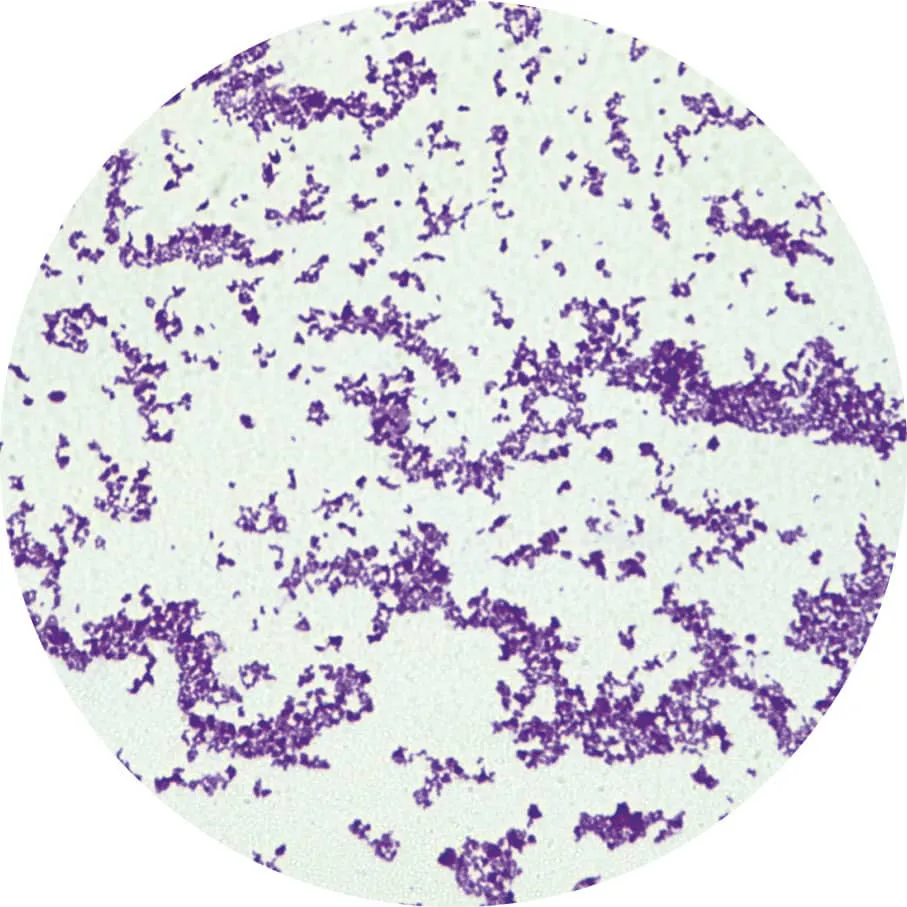
Microscopic image of diphtheria bacteria, Corynebacterium diphtheriae.
The return of an old disease
While diphtheria’s origins and its route into Europe are unknown, it was not new to Britain in the 1850s. Various medical reports in previous centuries describe what appear to be its symptoms, and in 1821 the French physician Pierre Bretonneau had identified diphtheria as a separate disease from other childhood illnesses.
The German scientist Friedrich Loeffler – who identified the bacterium Corynebacterium diphtheriae as being responsible for the disease in 1884 – claimed there were no descriptions of diphtheria in the writings of any of the great classical Greek physicians. But others believe that Hippocrates, the ‘father of Western medicine’, referred to it in the fifth century BC. Regardless, many experts, including Loeffler, accept that the infection was well-known in ancient Egypt, Syria and Palestine.
Some of the more recent accounts in the West of a disease that appears to be diphtheria date from sixth-century France, from Rome in 856 and 1004, and from parts of the Byzantine empire in 1039. Loeffler also refers to what he believed was an outbreak in England in 1389, which he said killed many children. As with scarlet fever – with which it was often confused – diphtheria favours the young.
The Strangler
The first recorded major epidemic seems to have been in France in 1562–98 during the religious wars between the Catholics and the Huguenots. It reached Paris in 1576. It was followed by an infamous epidemic in Spain in 1583–1618, where it was dubbed El garrotillo – ‘The Strangler’ – and the year of 1613 was referred to as Ano de los garrotillos, the ‘Year of the Strangler’.
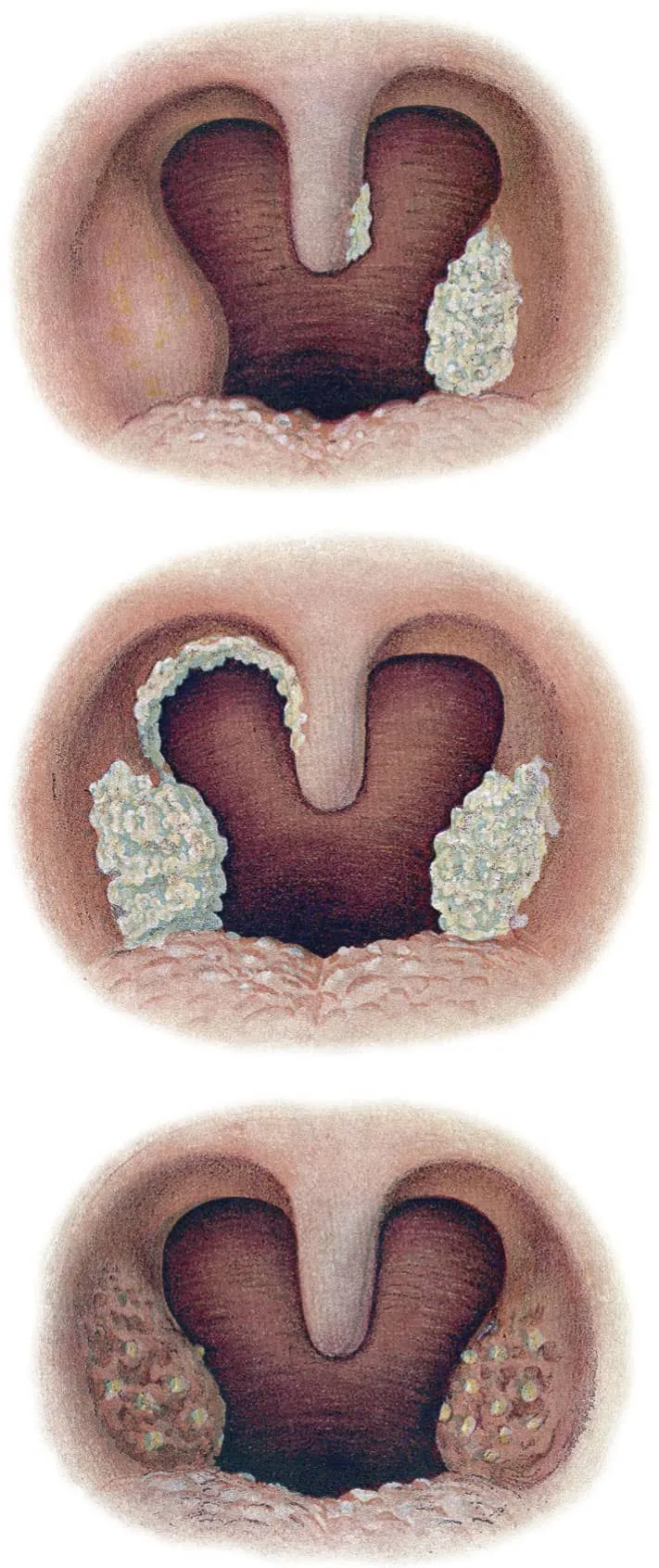
Diphtheria was known as ‘the Strangler’ because of its unpleasant tendency to suffocate its victim. The bacterium destroys the lining of the throat, causing dead tissue and pus to merge together over the site, forming a tough leathery membrane known as a pseudomembrane. Any attempt to remove it rips at the live tissue beneath, causing massive bleeding. If it is left in place, however, the membrane blocks the patient’s airway. Even if the sufferer manages to survive the effects of the membrane, the toxin can invade the body, damaging organs and nerves.
The symptoms of diphtheria, as seen affecting the mouth.
Something in the air?
In the great medical science breakthroughs of the second half of the nineteenth century, doctors were beginning to understand the role germs played in spreading epidemic disease. In the late 1800s and early 1900s, bacteriologists like Loeffler were fast identifying the different pathogens responsible for different diseases and the infections’ various means of transmission. Diphtheria, which is highly infectious, is mainly caught by inhaling droplets released into the air by an infected person’s coughs or sneezes. It can also be passed on through direct contact with bacteria, for example, in mucous or on surfaces and objects.
Back in the 1850s, however, when the mystery epidemic hit Britain, the centuries-old theory of miasmatism still held sway. Foul smells, or miasma, from decaying organic matter – bad food, rotting carcasses and excreta, for example – or emanating from marshlands and stagnant water, were thought to contain the ‘poisons’ that caused disease. Other factors such as the climate determined which particular disease prevailed.
This may explain why in 1859 Ernest Hart looked to the weather and the environment for clues. He could find none and waxed lyrical ...
Table of contents
Cover
Title Page
Contents
Introduction
Section 1 Airborne
Section 2 Waterborne
Section 3 Insects & Animals
Section 4 Human To Human
Index
Credits
Copyright
Frequently asked questions
Yes, you can cancel anytime from the Subscription tab in your account settings on the Perlego website. Your subscription will stay active until the end of your current billing period. Learn how to cancel your subscription
No, books cannot be downloaded as external files, such as PDFs, for use outside of Perlego. However, you can download books within the Perlego app for offline reading on mobile or tablet. Learn how to download books offline
Perlego offers two plans: Essential and Complete
Essential is ideal for learners and professionals who enjoy exploring a wide range of subjects. Access the Essential Library with 800,000+ trusted titles and best-sellers across business, personal growth, and the humanities. Includes unlimited reading time and Standard Read Aloud voice.
Complete: Perfect for advanced learners and researchers needing full, unrestricted access. Unlock 1.4M+ books across hundreds of subjects, including academic and specialized titles. The Complete Plan also includes advanced features like Premium Read Aloud and Research Assistant.
Both plans are available with monthly, semester, or annual billing cycles.
We are an online textbook subscription service, where you can get access to an entire online library for less than the price of a single book per month. With over 1 million books across 990+ topics, we’ve got you covered! Learn about our mission
Look out for the read-aloud symbol on your next book to see if you can listen to it. The read-aloud tool reads text aloud for you, highlighting the text as it is being read. You can pause it, speed it up and slow it down. Learn more about Read Aloud
Yes! You can use the Perlego app on both iOS and Android devices to read anytime, anywhere — even offline. Perfect for commutes or when you’re on the go. Please note we cannot support devices running on iOS 13 and Android 7 or earlier. Learn more about using the app
Yes, you can access Atlas of Disease by Sandra Hempel in PDF and/or ePUB format, as well as other popular books in History & Social History. We have over one million books available in our catalogue for you to explore.