One of the largest southern cities and a hub for the cotton industry, Memphis, Tennessee, was at the forefront of black political empowerment during the Jim Crow era. Compared to other cities in the South, Memphis had an unusually large number of African American voters. Black Memphians sought reform at the ballot box, formed clubs, ran for office, and engaged in voter registration and education activities from the end of the Civil War through the Brown v. Board of Education decision of 1954.
In this groundbreaking book, Elizabeth Gritter examines how and why black Memphians mobilized politically in the period between Reconstruction and the beginning of the civil rights movement. Gritter illuminates, in particular, the efforts and influence of Robert R. Church Jr., an affluent Republican and founder of the Lincoln League, and the notorious Memphis political boss Edward H. Crump. Using these two men as lenses through which to view African American political engagement, this volume explores how black voters and their leaders both worked with and opposed the white political machine at the ballot box.
River of Hope challenges persisting notions of a "Solid South" of white Democratic control by arguing that the small but significant number of black southerners who retained the right to vote had more influence than scholars have heretofore assumed. Gritter's nuanced study presents a fascinating view of the complex nature of political power during the Jim Crow era and provides fresh insight into the efforts of the individuals who laid the foundation for civil rights victories in the 1950s and '60s.
eBook - ePub
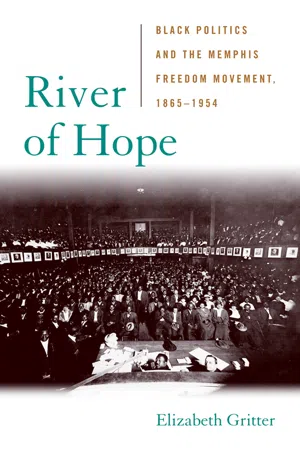
River of Hope
Black Politics and the Memphis Freedom Movement, 1865–1954
- 380 pages
- English
- ePUB (mobile friendly)
- Available on iOS & Android
eBook - ePub
About this book
Information
1 “To Regain the Lost Rights of a Growing Race”
Black Political Mobilization, 1865–1916
W. Herbert Brewster grew up in a community “with very little opportunity” in rural West Tennessee near the small village of New Castle.1 Until a life-changing night in 1916, he had never been in an auditorium before and did not even know what one was. When he and his fellow black students pressed their way into Memphis’s crowded Church’s Auditorium that evening, they looked up and saw a beautiful place. After the singing of “The Battle Hymn of the Republic,” Brewster remembered, “there strode out to . . . the platform a young man of great personal carriage and personality. We had never seen a man who charmed us like he did.” The man was Robert Reed Church Jr. Church introduced Roscoe Conkling Simmons, the nephew of Booker T. Washington and a prominent journalist and civil rights leader in his own right. Simmons gave a rousing address. “When I heard that speech and saw [Church Jr.], [I] resolved that night to be somebody someday,” Brewster said. “That determination . . . was inspired by Bob Church and that crowd of people in that black auditorium. I never knew before that I had a chance.”2 Brewster went on to work with Church in political efforts and, eventually, became a prominent minister in local and national Baptist circles, the head of a ministerial school, and one of the most influential gospel songwriters of the twentieth century.3
Brewster’s meeting with Church Jr. occurred at a rally of the Lincoln League on the night before election day. Church had formed this mass-based Republican organization in order to mobilize African Americans politically, press for civil rights, and support the Grand Old Party. During Reconstruction, the Republican-controlled federal government had granted African Americans citizenship rights and black men voting rights. White Republicans took charge of southern state governments, and black men registered to vote and occupied public office in Memphis and elsewhere in the region. But the alliance between white Republicans and African Americans was tenuous; most white Republicans were not committed to ensuring black equality. Former white Confederates resumed control of southern state governments, and Reconstruction ended in 1877. A surge of white activism, compounded by white extralegal violence, led to the removal of black officeholders, the widespread disenfranchisement of African Americans, and the enactment of legal segregation across the South by the early twentieth century. Although black Tennesseans retained the right to vote more than most other black southerners, the number of black officeholders in the state and in Memphis declined to zero. The number of Republicans in the South also decreased; a sizable proportion of the remaining whites joined “lily-white” factions that largely excluded African Americans. African Americans mainly stayed involved in the Republican Party in “black-and-tan” factions that included a few whites and often competed with the lily whites for control of local party organizations, while white Democrats monopolized southern politics and excluded African Americans from their party organizations.
In 1916, the lily-white faction was the most prominent Republican group in Memphis. Church wanted his black-and-tan faction to displace it as the dominant party organization. For the November election, he organized a Lincoln League ticket of black candidates to run against the white Republican slate for state and national positions. If the black office seekers polled more votes, the black and tans would become the “regular Republicans” and, consequently, exert more political influence, bettering their chances for racial advancement. With the backing of many of the city’s black leaders, the Lincoln League mobilized ordinary black Memphians in support of the candidates. League leaders portrayed the Republican Party as the vehicle that had delivered African Americans from slavery and as their best hope for wielding political influence in the two-party system.4 While historians have emphasized the ideology and programs of individual African Americans during the post-Reconstruction years and the community building that African Americans engaged in to protect themselves from the prevailing environment, the story of Memphis reveals how black southerners mobilized politically.
Elsewhere in the South, a small but significant number of African Americans continued to participate in the political process after the end of Reconstruction, particularly in urban areas. Hundreds voted in some cities, including Atlanta and Richmond, while a few cast ballots despite facing the white primary. Some voted in nonpartisan municipal elections, bond and tax rate referenda, and occasional special elections; in some cases, they secured the passage of measures beneficial to the black community. While cities served as the headquarters of black-and-tan Republican committees, black women petitioned municipal governments for better public services. In addition, the number of African American urban civic organizations and nonpartisan political leagues increased: these groups conducted discussions of public matters affecting African Americans and coached them on how to overcome registration requirements. By challenging disenfranchisement in the courts and raising funds for such litigation, these organizations joined the black southerners engaged in legal battles against disenfranchisement. The NAACP, founded in 1909 in part to secure black voting rights, began a legal battle to overturn disenfranchisement measures and achieved success when in 1915 the Supreme Court ruled the grandfather clause unconstitutional.5
In Memphis, Brewster called Church Jr.’s father, Robert Reed Church Sr., the “forerunner” of the 1916 political developments because his rise to prominence from humble beginnings had left a “legacy of inspiration.”6 Church Sr. was the most influential African American in Memphis from the Civil War until his death in 1912. His life testifies to the frustrations and travails that all black southerners experienced during these years; the wealth that he amassed underscores the opportunities of which only a very small number were able to take advantage. Born in Holly Springs, Mississippi, in 1837, Church Sr. was the grandson of Lucy, a daughter of a royal family of the Malay Islands who was taken prisoner during a time of civil strife. It is unclear who captured her or why, but she arrived in Norfolk, Virginia, between 1805 and 1810 and was sold into slavery. Church Sr. was the son of her daughter Emmeline and Captain Charles Beckwith Church, a white steamship owner. Contradictory evidence exists as to whether Church Sr. was a slave. He claimed that he was, but his daughter and granddaughter later unearthed firsthand accounts saying that he and his mother were not slaves; rather, Emmeline worked as a seamstress for the Lynchburg, Virginia, planter family that purchased her and then later moved to Holly Springs.7
In the 1850s, Church Sr. served as a steward on his father’s steamboats, which ran up and down the Mississippi River from Memphis to New Orleans. During the Battle of Memphis on 6 June 1862, a Federal fleet captured the steamboat Victoria, but Church escaped. The Confederates lost Memphis to the Union in a naval battle that day, resulting in Union troops occupying the city for the rest of the war. Church stayed in Memphis and saved money while working as a helper at a livery stable. After the war, he became one of the city’s first black saloonkeepers when he opened a saloon at the corner of Beale and Gayoso.8
The unsettled social, political, and economic conditions that followed the Civil War led to racial friction, and Church was a target. Whites of all classes confronted growing competition from black workers. For a brief period after the war, whites were forced to accept the authority of black soldiers stationed just south of Memphis. In 1866, these simmering tensions exploded into the first large-scale urban race riot in the South. Following a verbal confrontation between members of the Irish-dominated police force and black troops on a Memphis street corner, white rioters targeted black property and businessmen, but Church refused to close his saloon. Members of a white mob shot Church in the back of the head at his business, leaving him to die. The injury left a hole in his head where one could insert the tip of a little finger; he subsequently suffered from headaches so severe that he sometimes threatened to commit suicide. By the time order was restored, at least seventy-five people had been wounded, some one hundred blacks robbed, at least five black women raped, and forty-six blacks and two whites killed. After the riot, no whites experienced punishment, and no African Americans received compensation despite Church’s testimony before a congressional committee investigating the riot. African Americans rebuilt their churches and schools and increasingly sought solace and protection in their own neighborhoods and through their own institutions.9
More than any other person, Church transformed the Beale Street area into a center of commercial activity and community life for black Memphians. Church invested his business profits in rental properties and came to own more property than any other black Memphian. His first wife, Louisa Ayres, a former slave, ran a successful hair salon, the first one for black women in Memphis, in the downtown area. With her profits, they bought their first carriage and house, which was located in an interracial suburb. Church accrued a fortune mainly through real estate, and he served as an architect and civil engineer for his buildings: he designed them and supervised their construction. Called the “Boss of Beale Street,” he dominated the street’s business affairs by 1883. He operated several saloons in the area and owned a hotel, a restaurant, and other properties on the street, including in the vice district. He also owned valuable business property on South Second Street, more than 350 residences in Memphis, and several hundred acres of land on the city’s edge. His real estate empire eventually encompassed properties in other large municipalities. Recognized across the region and the nation for his success, Church became the first black millionaire in the South and, reputedly, in the United States.10
Reflecting and symbolizing Church’s financial success was his palatial house, which he built in 1884. He and Louisa had divorced around 1867.11 He lived there with his second wife, Anna Wright Church, in a silk-stocking neighborhood that included prominent whites and blacks. The three-story, fourteen-room Queen Anne–style home at 384 S. Lauderdale ranked with the white mansions of the city and included frescoes and elaborate lace curtains on bay windows. As was common during that time, the showplace of the house was the parlor, which was hand-painted by French artists and featured velvet Brussels carpets and two crystal chandeliers. The Commercial Appeal, a local white daily, noted that the family had earned the respect of their white neighbors, but Church’s success stoked jealousies among whites as well.12
Although Church was first and foremost a businessman, he participated in political movements aimed at advancing the collective interests of African Americans. In the late 1860s, the Republicandominated state legislature passed laws providing for the suffrage of black men, removing restrictions on black officeholding, and protecting black voters from economic intimidation. Taking advantage of these new laws, black Memphians formed political clubs, held elected and appointive office, and built coalitions with whites in the 1870s and 1880s. Black fraternal organizations encouraged black political participation and officeholding, while black churches hosted political meetings. Whites of both parties competed for the black vote. Nearly every branch of government included black officials or employees, and African Americans served on the grand jury and as police officers and firefighters. African Americans usually were elected to office from predominately black districts. Like most African Americans of his era, Church was a lifelong Republican. He helped African Americans register to vote and campaigned for James Garfield, who won the 1880 presidential election. In 1882, Church made a bid for a city council seat but lost.13
The political scene in Memphis reflected the revolution in politics and society occurring across the South. During Reconstruction, some two thousand African Americans held elective and appointive office at the local, state, and national levels, with the majority at the local level. Most black officeholders were former slaves, attesting to the radical social transformation by which enslaved African Americans not only became free but also occupied political positions over their former masters. Black churches especially provided the space for political organizing, and African Americans used the political process to press for racial advancement. Although not granted suffrage, black women participated in politics through such means as petitioning local officials to hire black police officers. Black political activists and officeholders were full of hope, but the road was not smooth anywhere. They faced violence, intimidation, and economic repercussions. While whites mainly occupied the most important political positions, African Americans were represented in public office in numbers disproportionate to their population size. Southern white Republicans generally could be counted on to support black political rights, but most did not see racial equality as a priority.14
Church Sr. knew many of the most prominent African American political figures of the day and interacted socially with them. Family friends included Pinckney S. B. Pinchback, Frederick Douglass, Blanche Bruce, and John Lynch. Pinchback was the only black governor during Reconstruction, as governor of Louisiana. Most well known as an abolitionist and orator, Douglass was the first African American to have his name entered into nomination for president at a major party convention, the Republican national convention in 1888. Bruce, of Mississippi, was one of two black US senators during the Reconstruction era, and Lynch served as speaker of the Mississippi House of Representatives, a US congressman, a justice of the peace, and the temporary chair of the Republican national convention in 1884.15
While Church participated in economic and political efforts on behalf of black Memphians, he helped white residents as well. Memphis was severely affected with yellow fever epidemics in 1873, 1878, and 1879; its population fell from more than 40,000 in 1876 to 18,500 in late 1879 because of death and emigration. The city, which had become a business center in the Mid-South, lost its charter and became a taxing district run by the state. Having faith in the city’s recovery and potential, Church stepped up his investments in local real estate and bought the first bond for $1,000 to restore the city’s charter, spurring white capitalists to purchase bonds. Memphis regained its financial standing and status as a city, and its population rose to 64,495 in 1890.16 Recalling Church Sr.’s role in buying the first bond, the Memphis Evening Scimitar in 1891 called him “a firm believer in Memphis,” adding that “war and plagues have never shaken his faith in her.”17
In spite of his contributions to Memphis, Church, along with other assertive and economically successful African Americans, remained the target of white violence and hatred. Fearful of the new freedoms afforded to African Americans, white southerners embraced Jim Crow measures and racist demagoguery in order to elevate their relative status, control black workers, and limit black advancement. Extralegal violence emerged as a crucial weapon in this new campaign to affirm white privilege and dominance. Lynching and mob violence reached a height during the 1890s and threatened black progress into the 1930s. A group of white hoodlums, wanting to gain economic control of Beale Street, threatened to shoot Church, but he was not hurt. Other African Americans were not so fortunate: at least fifteen lynchings occurred in Shelby County between 1892 and 1914.18
While Church emerged safe from lynching, he and his generation could not stop disenfranchisement from occurring across the South from 1888 to 1908. Conservative white Democrats regained control of all southern state legislatures, and federal troops left the region in 1877, effectively ending Reconstruction. Southern state legislatures soon began enacting disenfranchisement measures that dramatically diminished the political power of African Americans and that of some marginalized whites, including...
Table of contents
- Cover
- Half title
- Title
- Copyright
- Contents
- Introduction
- 1. “To Regain the Lost Rights of a Growing Race”: Black Political Mobilization, 1865–1916
- 2. “The Fight … to Make America Safe for Americans”: Memphis as a Political Model for the Region and the Country, 1917–1927
- 3. “Come … and See What a Negro Democrat Looks Like”: The Diversity of Black Political Activity, 1928–1939
- 4. “As Un-American as Any Dictator-Ridden Country in Europe”: Seeking Democracy during the War Years, 1940–1945
- 5. “A New Day Breaking” in the City and the South: The Decline of the Crump Machine and the Rise of New Leadership, 1946–1954
- Conclusion
- Acknowledgments
- Notes
- Bibliography
- Index
Trusted by 375,005 students
Access to over 1.5 million titles for a fair monthly price.
Study more efficiently using our study tools.
Frequently asked questions
Yes, you can cancel anytime from the Subscription tab in your account settings on the Perlego website. Your subscription will stay active until the end of your current billing period. Learn how to cancel your subscription
No, books cannot be downloaded as external files, such as PDFs, for use outside of Perlego. However, you can download books within the Perlego app for offline reading on mobile or tablet. Learn how to download books offline
Perlego offers two plans: Essential and Complete
- Essential is ideal for learners and professionals who enjoy exploring a wide range of subjects. Access the Essential Library with 800,000+ trusted titles and best-sellers across business, personal growth, and the humanities. Includes unlimited reading time and Standard Read Aloud voice.
- Complete: Perfect for advanced learners and researchers needing full, unrestricted access. Unlock 1.5M+ books across hundreds of subjects, including academic and specialized titles. The Complete Plan also includes advanced features like Premium Read Aloud and Research Assistant.
We are an online textbook subscription service, where you can get access to an entire online library for less than the price of a single book per month. With over 1.5 million books across 990+ topics, we’ve got you covered! Learn about our mission
Look out for the read-aloud symbol on your next book to see if you can listen to it. The read-aloud tool reads text aloud for you, highlighting the text as it is being read. You can pause it, speed it up and slow it down. Learn more about Read Aloud
Yes! You can use the Perlego app on both iOS and Android devices to read anytime, anywhere — even offline. Perfect for commutes or when you’re on the go.
Please note we cannot support devices running on iOS 13 and Android 7 or earlier. Learn more about using the app
Please note we cannot support devices running on iOS 13 and Android 7 or earlier. Learn more about using the app
Yes, you can access River of Hope by Elizabeth Gritter in PDF and/or ePUB format, as well as other popular books in Social Sciences & North American History. We have over 1.5 million books available in our catalogue for you to explore.