Managing the Design Process—Implementing Design focuses on design implementation and execution. This is where design ideas become real, tangible goods in the marketplace and beyond. This book examines design management concepts and methods in real-world applications. Unlike other books on design management, this bookis visually stunning, featuring many image-rich case studies to illustrate the fundamentals of design management in a way that speaks to a design audience. The information is not something that is typically taught in design (or business) school—it's learned on the job, making this an invaluable reference for designers.
eBook - ePub
Managing the Design Process-Implementing Design
An Essential Manual for the Working Designer
- 208 pages
- English
- ePUB (mobile friendly)
- Available on iOS & Android
eBook - ePub
Managing the Design Process-Implementing Design
An Essential Manual for the Working Designer
About this book
Information
Topic
DesignSubtopic
Design GeneralDesign Process Overview Chart
Chapter 1
Project Management
What Is Project Management?
A designer can have a great project, for the most amazing client, with a generous budget, and still barely break even. Designers can actually lose money, plus be tearing their hair out in frustration throughout the project because their team is disorganized, or worse, their client is out of control. Their project mismanagement can turn a great opportunity into a nightmare.
Good project management affects
▸ Creativity
▸ Quality
▸ Relationships
▸ Work flow
▸ Timelines
▸ Costs (fees and expenses)
▸ Profitability
In short, project management affects everyone on a design project. Managing a project consistently and well is critical to the project and to the designer’s bottom line. In the short term, it makes projects more pleasurable and profitable. In the long term, good project management means a robust and rewarding design practice. It’s worth the time and effort to understand project management best practices, use tried-and-true tools, and fully implement some sort of project management program. It will pay for itself in financial terms and in client and design team satisfaction.
A Brief History
Project management has its origins in the multitasking, multiperson, highly schedule-driven construction industry. Early project management theory and practice came out of the building and manufacturing industries until the 1950s when corporations such as DuPont and Lockheed lead the way. In 1969, the Project Management Institute (PMI) was formed. By the 1970s, project management tools and techniques were primarily influenced by the nascent software industry. In 1981, PMI published A Guide to the Project Management Body of Knowledge, often referred to as the PMBOK Guide, which is essentially the bible of project management. Many believe we are stepping into a new era, with design and design process influencing professional project management theory.
In moving from bricks and mortar to bits and bytes, project management has landed more squarely in the realm of the designer. But should you run out and buy the PMBOK Guide to better run your design practice? Probably not. PMI espouses lots of procedures and methods that require so much work that the return on time invested would be very little for most designers. Instead, we should look to the project management procedures that graphic and industrial designers already use, sharpen them with some of the professional project management industry’s methods, and develop our own theories and practices for graphic design project management.
The Constraints That Affect Projects
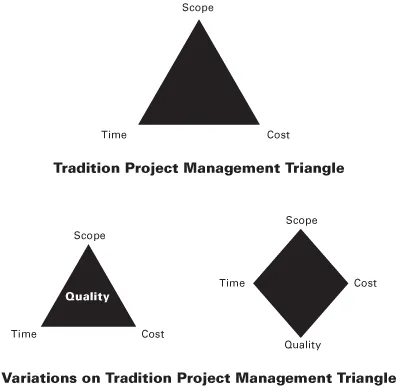
Traditionally, project management deals primarily with managing three constraints: cost, time, and scope. This is often visualized as a triangle, with some people placing quality at the center of the triangle as a unifying theme that informs the three constraints (see charts at upper right). However, because commercial projects must be delivered on time and within an agreed-upon cost and scope of work, as well as meet the client’s and the designer’s quality expectations, some people illustrate the constraint concept as a diamond, with quality as one of the four points (see charts at right). Regardless of the illustration you use, cost, time, scope, and quality are major mitigating factors that influence and impact all work.
RIGHT
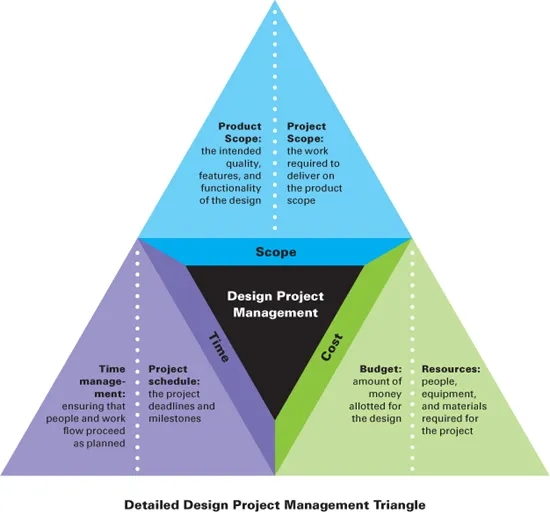
Taking this idea a step further, design project management constraints can be diagrammed as a complex triangle that defines in more detail the terms time, cost, and scope.
Taking this idea a step further, design project management constraints can be diagrammed as a complex triangle that defines in more detail the terms time, cost, and scope.
Constraints
Project Management Constraints
Time management is critical. Good time management means working within specific periods for each task and meeting incremental milestones such as presentations and other deadlines within a project schedule.
Cost management includes the overall budget the client has agreed to for design services and outside costs such as printing. Plus designers must marshal their resources appropriately, ensuring that the right people, equipment, and materials are employed to complete the design.
Scope is a bit more complex conceptually, but designers must be mindful of two aspects: the product scope, or the overall quality of the design they are delivering, which should be summarized in the creative brief (see page 31); and the project scope, or the work, measured in specific tasks per phase, that is required to deliver the expected product scope. Designers must always be aware of these issues to keep the project in balance and moving forward.
Design Means Constraints
Each assignment requires a unique, short-term management structure comprised of the designer, the client, and their respective teams who work together during the project. Although designers can affect constraint parameters, most designers can’t control them, and instead work within the parameters the client has set; time constraints, budgets, and at least some of the people required for the project are frequently dictated by the client. Combine that with communication goals, audience needs, and brand infrastructure, which also all affect design, and that’s a lot to manage.
Overview of Project Management
Estimates are never perfect, and creativity is hard to schedule so that it fits into neat little time units. But in business, time equals money. Designers must deliver their creativity in a timely fashion so that they can move on to the next client opportunity. If they don’t, they may end up working at below minimum wage, or even lose money, in spite of decent client budgets and plenty of projects lined up. Without good management, a designer’s business will fail.
What’s the best way to tackle design project management? This book will break down some best practices in detail. These nitty-gritty details of running a business are boring compared to the exciting intellectual and creative challenges that are at the heart of design work. Unfortunately, creative activities typically comprise less than half the time spent on a design project; usually, most time is spent on technical, communication, management, clerical, and billing issues, all in service to the project. The reality is, these activities can make or break a design project and a design firm.
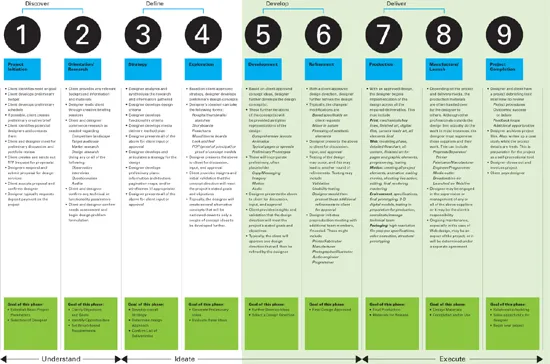
The process work flowchart on pages 10–11 breaks down the phases of work on a typical design project, including the tasks typically completed in the phase. Each task affects the project’s schedule, costs, and scope. Therefore, each task must be defined, resourced, scheduled, and managed.
Design Project Management Cycle
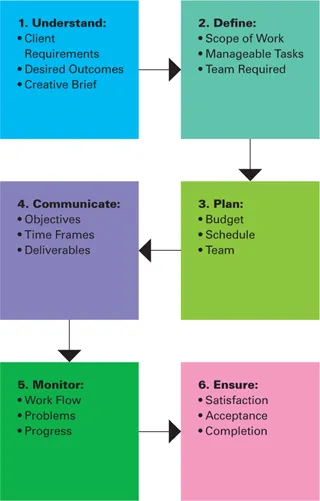
This diagram describes the steps in the design project management process. Whether it is a large or small assignment, someone must manage each aspect from start to finish.
Table of contents
- Cover
- Title Page
- Contents
- Introduction
- Design Process Overview Chart
- Directory of Contributors
- Index
- Bibliography
- Resources
- Acknowledgments
- About the Author
- Copyright Page
Trusted by 375,005 students
Access to over 1.5 million titles for a fair monthly price.
Study more efficiently using our study tools.
Frequently asked questions
Yes, you can cancel anytime from the Subscription tab in your account settings on the Perlego website. Your subscription will stay active until the end of your current billing period. Learn how to cancel your subscription
No, books cannot be downloaded as external files, such as PDFs, for use outside of Perlego. However, you can download books within the Perlego app for offline reading on mobile or tablet. Learn how to download books offline
Perlego offers two plans: Essential and Complete
- Essential is ideal for learners and professionals who enjoy exploring a wide range of subjects. Access the Essential Library with 800,000+ trusted titles and best-sellers across business, personal growth, and the humanities. Includes unlimited reading time and Standard Read Aloud voice.
- Complete: Perfect for advanced learners and researchers needing full, unrestricted access. Unlock 1.5M+ books across hundreds of subjects, including academic and specialized titles. The Complete Plan also includes advanced features like Premium Read Aloud and Research Assistant.
We are an online textbook subscription service, where you can get access to an entire online library for less than the price of a single book per month. With over 1.5 million books across 990+ topics, we’ve got you covered! Learn about our mission
Look out for the read-aloud symbol on your next book to see if you can listen to it. The read-aloud tool reads text aloud for you, highlighting the text as it is being read. You can pause it, speed it up and slow it down. Learn more about Read Aloud
Yes! You can use the Perlego app on both iOS and Android devices to read anytime, anywhere — even offline. Perfect for commutes or when you’re on the go.
Please note we cannot support devices running on iOS 13 and Android 7 or earlier. Learn more about using the app
Please note we cannot support devices running on iOS 13 and Android 7 or earlier. Learn more about using the app
Yes, you can access Managing the Design Process-Implementing Design by Terry Stone in PDF and/or ePUB format, as well as other popular books in Design & Design General. We have over 1.5 million books available in our catalogue for you to explore.