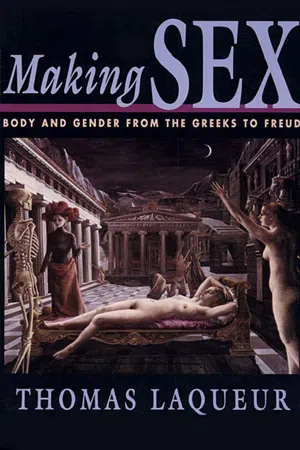
This is a book about the making and unmaking of sex over the centuries. It tells the astonishing story of sex in the West from the ancients to the moderns in a precise account of developments in reproductive anatomy and physiology. We cannot fail to recognize the players in Thomas Laqueur's story—the human sexual organs and pleasures, food, blood, semen, egg, sperm—but we will be amazed at the plots into which they have been woven by scientists, political activists, literary figures, and theorists of every stripe.
Laqueur begins with the question of why, in the late eighteenth century, woman's orgasm came to be regarded as irrelevant to conception, and he then proceeds to retrace the dramatic changes in Western views of sexual characteristics over two millennia. Along the way, two "master plots" emerge. In the one-sex story, woman is an imperfect version of man, and her anatomy and physiology are construed accordingly: the vagina is seen as an interior penis, the womb as a scrotum, the ovaries as testicles. The body is thus a representation, not the foundation, of social gender. The second plot tends to dominate post-Enlightenment thinking while the one-sex model is firmly rooted in classical learning. The two-sex story says that the body determines gender differences, that woman is the opposite of man with incommensurably different organs, functions, and feelings. The two plots overlap; neither ever holds a monopoly. Science may establish many new facts, but even so, Laqueur argues, science was only providing a new way of speaking, a rhetoric and not a key to female liberation or to social progress. Making Sex ends with Freud, who denied the neurological evidence to insist that, as a girl becomes a woman, the locus of her sexual pleasure shifts from the clitoris to the vagina; she becomes what culture demands despite, not because of, the body. Turning Freud's famous dictum around, Laqueur posits that destiny is anatomy. Sex, in other words, is an artifice.
This is a powerful story, written with verve and a keen sense of telling detail (be it technically rigorous or scabrously fanciful). Making Sex will stimulate thought, whether argument or surprised agreement, in a wide range of readers.
- 313 pages
- English
- ePUB (mobile friendly)
- Available on iOS & Android
eBook - ePub
About this book
Information
Publisher
Harvard University PressYear
1992Print ISBN
9780674543553
9780674543492
eBook ISBN
9780674255111
ONE
Of Language and the Flesh
The first thing that strikes the careless observer is that women are unlike men. They are “the opposite sex” (though why “opposite” I do not know; what is the “neighboring sex”?). But the fundamental thing is that women are more like men than anything else in the world.
DOROTHY L. SAYERS “THE HUMAN - NOT - QUITE - HUMAN”
An interpretive chasm separates two interpretations, fifty years apart, of the same story of death and desire told by an eighteenth-century physician obsessed with the problem of distinguishing real from apparent death.1
The story begins when a young aristocrat whose family circumstances forced him into religious orders came one day to a country inn. He found the innkeepers overwhelmed with grief at the death of their only daughter, a girl of great beauty. She was not to be buried until the next day, and the bereaved parents asked the young monk to keep watch over her body through the night. This he did, and more. Reports of her beauty had piqued his curiosity. He pulled back the shroud and, instead of finding the corpse “disfigured by the horrors of death,” found its features still gracefully animated. The young man lost all restraint, forgot his vows, and took “the same liberties with the dead that the sacraments of marriage would have permitted in life.” Ashamed of what he had done, the hapless necrophilic monk departed hastily in the morning without waiting for the scheduled interment.
When time for burial came, indeed just as the coffin bearing the dead girl was being lowered into the ground, someone felt movement coming from the inside. The lid was torn off; the girl began to stir and soon recovered from what proved not to have been real death at all but only a coma. Needless to say, the parents were overjoyed to have their daughter back, although their pleasure was severely diminished by the discovery that she was pregnant and, moreover, could give no satisfactory account of how she had come to be that way. In their embarrassment, the innkeepers consigned the daughter to a convent as soon as her baby was born.
Soon business brought the young aristocrat, oblivious of the consequences of his passion but far richer and no longer in holy orders because he had come into his inheritance, back to the scene of his crime. Once again he found the innkeepers in a state of consternation and quickly understood his part in causing their new misfortune. He hastened to the convent and found the object of his necrophilic desire more beautiful alive than dead. He asked for her hand and with the sacrament of marriage legitimized their child.
The moral that Jacques-Jean Bruhier asks his readers to draw from this story is that only scientific tests can make certain that a person is really dead and that even very intimate contact with a body leaves room for mistakes. But Bruhier’s contemporary, the noted surgeon Antoine Louis, came to a very different conclusion, one more germane to the subject of this book, when he analyzed the case in 1752.2 Based on the evidence that Bruhier himself offered, Louis argues, no one could have doubted that the girl was not dead: she did not, as the young monk testified, look dead and moreover who knows if she did not give some “demonstrative signs” in proof of her liveliness, signs that any eighteenth-century doctor or even layperson would have expected in the circumstances.
Bruhier earlier on in his book had cited numerous instances of seemingly dead young women who were revived and saved from untimely burial by amorous embraces; sexual ecstasy, “dying” in eighteenth-century parlance, turned out for some to be the path to life. Love, that “wonderful satisfactory Death and . . . voluntary Separation of Soul and Body,” as an English physician called it, guarded the gates of the tomb.3 But in this case it would have seemed extremely unlikely to an eighteenth-century observer that the innkeepers’ daughter could have conceived a child without moving and thereby betraying her death.4 Any medical book or one of the scores of popular midwifery, health, or marriage manuals circulating in all the languages of Europe reported it as a commonplace that “when the seed issues in the act of generation [from both men and women] there at the same time arises an extra-ordinary titillation and delight in all members of the body.”5 Without orgasm, another widely circulated text announced, “the fair sex [would] neither desire nuptial embraces, nor have pleasure in them, nor conceive by them.”6
The girl must have shuddered, just a bit. If not her rosy cheeks then the tremors of venereal orgasm would have given her away. Bruhier’s story was thus one of fraud and not of apparent death; the innkeepers’ daughter and the monk simply conspired, Louis concludes, to escape culpability by feigning coma until the last possible moment before burial.
In 1836 the tale was told again, but now with a new twist. This time, the reality of the gir’s deathlike comatose state was not questioned. On the contrary, her becoming pregnant under these conditions was cited by Dr. Michael Ryan as one among many other cases of intercourse with insensible women to prove that orgasm was irrelevant to conception. (In one story, for example, an ostler confesses that he came to an inn and had sex with, and made pregnant, a girl who was so dead asleep before the fire that he was long gone before she awoke.) Not only need a woman not feel pleasure to conceive; she need not even be conscious.7
Near the end of the Enlightenment, in the period between these two rehearsals of the tale of the innkeepers’ daughter, medical science and those who relied on it ceased to regard the female orgasm as relevant to generation. Conception, it was held, could take place secretly, with no telltale shivers or signs of arousal; the ancient wisdom that “apart from pleasure nothing of mortal kind comes into existence” was uprooted.8 Previously a sign of the generative process, deeply embedded in the bodies of men and women, a feeling whose existence was no more open to debate than was the warm, pleasurable glow that usually accompanies a good meal, orgasm was relegated to the realm of mere sensation, to the periphery of human physiology—accidental, expendable, a contingent bonus of the reproductive act.
This reorientation applied in principle to the sexual functioning of both men and women. But no one writing on such matters ever so much as entertained the idea that male passions and pleasures in general did not exist or that orgasm did not accompany ejaculation during coition. Not so for women. The newly “discovered” contingency of delight opened up the possibility of female passivity and “passionlessness.”9 The purported independence of generation from pleasure created the space in which women’s sexual nature could be redefined, debated, denied, or qualified. And so it was of course. Endlessly.
The old valences were overturned. The commonplace of much contemporary psychology—that men want sex while women want relationships—is the precise inversion of pre-Enlightenment notions that, extending back to antiquity, equated friendship with men and fleshliness with women. Women, whose desires knew no bounds in the old scheme of things, and whose reason offered so little resistance to passion, became in some accounts creatures whose whole reproductive life might be spent anesthetized to the pleasures of the flesh. When, in the late eighteenth century, it became a possibility that “the majority of women are not much troubled with sexual feelings,” the presence or absence of orgasm became a biological signpost of sexual difference.
The new conceptualization of female orgasm, however, was but one formulation of a more radical eighteenth-century reinterpretation of the female body in relation to the male. For thousands of years it had been a commonplace that women had the same genitals as men except that, as Nemesius, bishop of Emesa in the fourth century, put it: “theirs are inside the body and not outside it.”10 Galen, who in the second century A.D. developed the most powerful and resilient model of the structural, though not spatial, identity of the male and female reproductive organs, demonstrated at length that women were essentially men in whom a lack of vital heat—of perfection—had resulted in the retention, inside, of structures that in the male are visible without. Indeed, doggerel verse of the early nineteenth century still sings of these hoary homologies long after they had disappeared from learned texts:
though they of different sexes be,
Yet on the whole they are the same as we,
For those that have the strictest searchers been,
Find women are but men turned outside in.11
In this world the vagina is imagined as an interior penis, the labia as foreskin, the uterus as scrotum, and the ovaries as testicles. The learned Galen could cite the dissections of the Alexandrian anatomist Herophilus, in the third century B.C., to support his claim that a woman has testes with accompanying seminal ducts very much like the man’s, one on each side of the uterus, the only difference being that the male’s are contained in the scrotum and the female’s are not.12
Language marks this view of sexual difference. For two millennia the ovary, an organ that by the early nineteenth century had become a synecdoche for woman, had not even a name of its own. Galen refers to it by the same word he uses for the male testes, orcheis, allowing context to make clear which sex he is concerned with. Herophilus had called the ovaries didymoi (twins), another standard Greek word for testicles, and was so caught up in the female-as-male model that he saw the Fallopian tubes—the spermatic ducts that led from each “testicle”—as growing into the neck of the bladder as do the spermatic ducts in men.13 They very clearly do not. Galen points out this error, surprised that so careful an observer could have committed it, and yet the correction had no effect on the status of the model as a whole. Nor is there any technical term in Latin or Greek, or in the European vernaculars until around 1700, for vagina as the tube or sheath into which its opposite, the penis, fits and through which the infant is born.
But then, in or about the late eighteenth, to use Virginia Woolf’s device, human sexual nature changed. On this point, at least, scholars as theoretically distant from one another as Michel Foucault, Ivan Illich, and Lawrence Stone agree.14 By around 1800, writers of all sorts were determined to base what they insisted were fundamental differences between the male and female sexes, and thus between man and woman, on discoverable biological distinctions and to express these in a radically different rhetoric. In 1803, for example, Jacques-Louis Moreau, one of the founders of “moral anthropology,” argued passionately against the nonsense written by Aristotle, Galen, and their modern followers on the subject of women in relation to men. Not only are the sexes different, but they are different in every conceivable aspect of body and soul, in every physical and moral aspect. To the physician or the naturalist, the relation of woman to man is “a series of oppositions and contrasts.”15 In place of what, in certain situations, strikes the modern imagination as an almost perverse insistence on understanding sexual difference as a matter of degree, gradations of one basic male type, there arose a shrill call to articulate sharp corporeal distinctions. Doctors claimed to be able to identify “the essential features that belong to her, that serve to distinguish her, that make her what she is”:
All parts of her body present the same differences: all express woman; the brow, the nose, the eyes, the mouth, the ears, the chin, the cheeks. If we shift our view to the inside, and with the help of the scalpel, lay bare the organs, the tissues, the fibers, we encounter everywhere . . . the same difference.16
Thus the old model, in which men and women were arrayed according to their degree of metaphysical perfection, their vital heat, along an axis whose telos was male, gave way by the late eighteenth century to a new model of radical dimorphism, of biological divergence. An anatomy and physiology of incommensurability replaced a metaphysics of hierarchy in the representation of woman in relation to man.
By the late nineteenth century, so it was argued, the new difference could be demonstrated not just in visible bodies but in its microscopic building blocks. Sexual difference in kind, not degree, seemed solidly grounded in nature. Patrick Geddes, a prominent professor of biology as well as a town planner and writer on a wide range of social issues, used cellular physiology to explain the “fact” that women were “more passive, conservative, sluggish and stable” than men, while men were “more active, energetic, eager, passionate, and variable.” He thought that with rare exceptions—the sea horse, the occasional species of bird—males were constituted of catabolic cells, cells that put out energy. They spent income, in one of Geddes’ favorite metaphors. Female cells, on the other hand, were anabolic; they stored up and conserved energy. And though he admitted that he could not fully elaborate the connection between these biological differences and the “resulting psychological and social differentiations,” he nevertheless justified the respective cultural roles of men and women with breathtaking boldness. Differences may be exaggerated or lessened, but to obliterate them “it would be necessary to have all the evolution over again on a new basis. What was decided among the pre-historic Protozoa cannot be annulled by an act of Parliament.”17 Microscopic organisms wallowing in the primordial ooze determined the irreducible distinctions between the sexes and the place of each in society.
These formulations suggest a third and still more general aspect of the shift in the meaning of sexual difference. The dominant, though by no means universal, view since the eighteenth century has been that there are two stable, incommensurable, opposite sexes and that the political, economic, and cultural lives of men and women, their gender roles, are somehow based on these “facts.” Biology—the stable, ahistorical, sexed body—is understood to be the epistemic foundation for prescriptive claims about the social order. Beginning dramatically in the Enlightenment, there was a seemingly endless stream of books and chapters of books whose very titles belie their commitment to this new vision of nature and culture: Roussel’s Système physique et moral de la femme, Brachet’s chapter “Etudes du physique et du moral de la femme,” Thompson and Geddes’ starkly uncompromising Sex. The physical “real” world in these accounts, and in the hundreds like them, is prior to and logically...
Table of contents
- Cover
- Title
- Copyright
- Preface
- Contents
- 1 Of Language and the Flesh
- 2 Destiny Is Anatomy
- 3 New Science, One Flesh
- 4 Representing Sex
- 5 Discovery of the Sexes
- 6 Sex Socialized
- Notes
- Credits
- Index
Trusted by 375,005 students
Access to over 1.5 million titles for a fair monthly price.
Study more efficiently using our study tools.
Frequently asked questions
Yes, you can cancel anytime from the Subscription tab in your account settings on the Perlego website. Your subscription will stay active until the end of your current billing period. Learn how to cancel your subscription
No, books cannot be downloaded as external files, such as PDFs, for use outside of Perlego. However, you can download books within the Perlego app for offline reading on mobile or tablet. Learn how to download books offline
Perlego offers two plans: Essential and Complete
- Essential is ideal for learners and professionals who enjoy exploring a wide range of subjects. Access the Essential Library with 800,000+ trusted titles and best-sellers across business, personal growth, and the humanities. Includes unlimited reading time and Standard Read Aloud voice.
- Complete: Perfect for advanced learners and researchers needing full, unrestricted access. Unlock 1.5M+ books across hundreds of subjects, including academic and specialized titles. The Complete Plan also includes advanced features like Premium Read Aloud and Research Assistant.
We are an online textbook subscription service, where you can get access to an entire online library for less than the price of a single book per month. With over 1.5 million books across 990+ topics, we’ve got you covered! Learn about our mission
Look out for the read-aloud symbol on your next book to see if you can listen to it. The read-aloud tool reads text aloud for you, highlighting the text as it is being read. You can pause it, speed it up and slow it down. Learn more about Read Aloud
Yes! You can use the Perlego app on both iOS and Android devices to read anytime, anywhere — even offline. Perfect for commutes or when you’re on the go.
Please note we cannot support devices running on iOS 13 and Android 7 or earlier. Learn more about using the app
Please note we cannot support devices running on iOS 13 and Android 7 or earlier. Learn more about using the app
Yes, you can access Making Sex by Thomas Laqueur in PDF and/or ePUB format, as well as other popular books in Psychology & Human Sexuality in Psychology. We have over 1.5 million books available in our catalogue for you to explore.