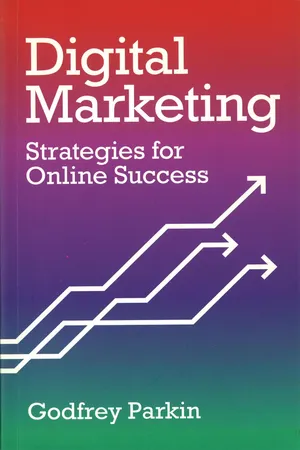
The force of the internet and the power of online consumers have dramatically altered the face of today's business world. Understanding and using this resource to its best advantage is essential to the success of every business. "Digital Marketing: Strategies for Online Success" clarifies the complex subject of ecommerce, presenting a simple 8-step strategy for success in internet marketing. This book is essential for anyone seeking success in a business environment altered by the digital revolution. Godfrey Parkin presents fascinating facts about both the history and potential of the internet, as well as providing clear and practical advice on how to make the most of it. Key strategies are outlined on every aspect of ecommerce including a step-by-step guide to developing a low-risk business strategy; the principles of designing a website that works as a successful business tool; guidelines on maximising effectiveness of search engines, email marketing and online advertising, as well as advice on using web 2.0 and social media in order to expand brand awareness and increase sales. This book is indispensable to anyone who wishes his or her company to remain relevant in today's digital environment.
- 250 pages
- English
- ePUB (mobile friendly)
- Available on iOS & Android
eBook - ePub
About this book
Information
1 Online in
context
By 2008 the internet was fully validated around the world as an indispensable component of any marketing mix. Online advertising expenditure had leapt by 50 per cent on the previous year. The web was the place where creativity blossomed. Online video was ubiquitous. Despite having spawned dozens of me-too competitors, YouTube served more than 200 million videos a day. Marketers scrambled to create their own branded video channels. An online community allowing women to share videos of their shoes (called, of course, Shoetube.tv) was launched, attracted a huge following, and then within a year reinvented itself, adding designer boutiques and e-commerce. It was a breakout year for women and the ‘silver-surfer’ older generations, who started to dominate web usage and ecommerce. Even the Queen of England started her own YouTube channel. The Dalai Lama started to Twitter. The Vatican opted for a more conservative approach, and launched its own daily podcast.
Online experiences provided by global brands such as Coke, Wrigleys, Pampers and dozens of others all received millions of unique visitors. Consumer goods websites, microsites, nanosites and social sites proliferated. Google consolidated its position as the largest advertising agency – and advertising medium – in the world. Along with other bands, Radiohead rubbed salt in the wounds of dying business models by launching their new album online on a pay-what-you-like basis and made more money than they had on all their previous albums combined. Apple dropped ‘computer’ from its name, in anticipation of the mobile phone becoming the new web access device. The car industry moved billions of marketing dollars from conventional media into digital media, not as a trial, but as the result of experience. Television viewership and newspaper readership started falling around the world. Mothers in America spent seven times as long on the web as they did watching television.
Consumers are online, en masse. Digital marketing is no longer a peripheral experiment, but an essential fundamental in the strategy of every serious marketer.
Yet while the avant-garde of marketers are building online customer relationships, the majority are still building websites. A website is not enough, no matter how ‘optimized’ it may be. In fact, websites as you know them may be quite unnecessary if your emarketing is dynamic and focused.
A website is not enough, no matter how ‘optimized’ it may be.
To many businesses, the website has become an end in itself, the new vehicle by which senior marketing people conspicuously wield their power and importance.
And what status symbols they have become! At a recent symposium I shared a lunch table with two rather senior marketers from different companies. One alluded, with some pride, to the fact that he had spent a small fortune on a new website. The other smugly announced that he had spent three times that, and that was before the integration costs. Not only does a new website give you something to boast about, it can give you total control over every micro-move that customers and marketers make. If you were not a bureaucrat before the emarketing revolution, it is hard to resist becoming one now.
It is not too late for marketers to back out of this pretentious, site-centric cul-de-sac and rediscover the creativity, connectivity and infinite potential of the world wide web. Social media, user-generated content, marketing 2.0, web 2.0, web 3.0 and mobile marketing are now on the agenda of every progressive marketing company. These concepts, how they are creatively interpreted and what they evolve into, are some of the building blocks of New Marketing. Customer-centric online marketing is your future, or you’re history.
@ If your current approach to emarketing consists of a website, a few banner advertisements, and a budget for Search Engine Optimization (SEO), you are not really taking the new consumer seriously. It is time to rethink your strategic vision.
In many respects, the future has already happened. You don’t need a crystal ball to see clearly how digital lifestyles and the technologies that connect us all will fundamentally change the way companies run their businesses; you simply need to look beyond your own comfort zone at what is happening in other industries, in other countries, in other cultures, in other generations. Or, if that is asking too much, you can look at the impact of the web a little closer to home, in your consumer bases, in your families, or in your own personal behaviour. People need to accept that these influences are neither isolated, nor trivial or transient; they are all interconnected and interrelated, and collectively they are deeply disruptive.
THE ONLINE LANDSCAPE
I have been running businesses in what analysts like to call the ‘digital space’ since 1991, when commercial use of the internet was first permitted. While I have tried not to be cast as a zealot, I have always been an optimist. Every step of the way, I have encountered people – academics, venture capitalists, business partners, prospective customers, even technologists – who have viewed the web with a mix of scepticism, denial and fear.
The digital revolution shakes things up, and established models do not like being shaken, particularly if they are fragile.
Ask anyone to give you a few examples of what they think of as digital, and they tend to respond with a list that includes computers, cameras, iPhones, printers or cell phones. These are just ‘things’. True, they all use digital technology to function, but they are still merely tools. In themselves, they are not responsible for the digital revolution. Very few people seek to own ‘things’ for their own sake. It is what those things can do for them that drives their desire to own them.
The true digital revolution is not in the appliances, but in the processes that they improve: designing, learning, sharing, communicating, job-searching, dating, researching, purchasing, exploring, and all the other activities that occupy your time. Digital technologies, particularly the web and the mobile phone, have enhanced the processes that you live by. Those processes have become cheaper, faster, more reliable, more convenient or more satisfying. And where digital technologies have facilitated those enhancements, people have adopted them voraciously. It took 125 years for landline telephones to reach one billion subscribers worldwide (that happened only in 2001). In 2002, the number of mobile phone users passed the 1 billion mark. It had taken 21 years. From there, the mobile phone global user base trebled to 3 billion people in a mere 5 years.
The true digital revolution is not in the appliances, but in the processes that they improve.
Sometimes the digitally enhanced process is a simple improvement on what already exists. Sometimes it is a replacement. The former is easy for companies to invest in, since it clearly adds value. The latter usually meets with resistance, since it threatens established investments and business models. It is far easier for a new company to succeed in a new business model, than for an existing company to abandon its existing approach and start again.
A BRIEF HISTORICAL PERSPECTIVE
Because the internet keeps evolving so rapidly, people tend to think of it as a new phenomenon. In fact, the internet has been around for longer than Microsoft Windows. It started out during the Cold War. The 1960s were a time of mutually assured destruction, the Cuban missile crisis, the assassination of John F. Kennedy and the Soviet invasion of Czechoslovakia. Computers were huge mainframes, connected only by dedicated cables. The military feared that a missile strike against one computer would break the chain that connected all of them, so they asked a think-tank of scientists at the Advanced Research Projects Agency (ARPA) to come up with a fail-safe solution.
The result was the first computer network. It used revolutionary concepts that still form the basis of the internet today. At the time, if you wanted to send a file from one computer to another, you sent it as one big file along a dedicated cable. While it was being sent, you could not use the cable for anything else, and if it got corrupted along the way, it was useless at the other end.
The first innovation was to break the individual data files into thousands of smaller ‘packets’ and send them off. Each packet was handled like a postcard, with the address of its destination and its sender. This allowed multiple messages to use the same cable system simultaneously. When they arrived at the other end, the packets were re-assembled into the original file, and even if some packets got lost or corrupted, the result was usable.
The second innovation was to build a mesh of cables like a large fishnet across the country, with a machine at each connection point that would receive the packets and route them to the next node. If a strand or a node in the net was broken, these ‘routers’ would send the packets down the next most efficient path. This ‘packet switching’ system was tested using four academic institutions in 1969, and the resulting network, the ARPANET, was the precursor of the internet.
There is a delightful irony in the fact that a system intended to strengthen the military-industrial complex became the most massively democratising engine of global freedom since the printing press.

The first email to use the ‘@’ sign in its address was sent in 1971.
The ARPANET expanded, and other similar networks were developed. But they all used different standards, so communication between networks was problematic. By 1983 a common communication technology called TCP/IP, for Transmission Control Protocol/Internet Protocol, became the only standard communication protocol for computer networks. Still used today, TCP/IP allowed all the diverse networks around the world to talk to each other, and the internet was born.
An internet is a network of networks, and for many years ‘the Internet’ was spelt with a capital ‘I’ to differentiate it. In the 21st century, the internet has become such a household term that most sources have abandoned capitalization of the term.
The internet remained a closed shop for many years, with only scientists, governments and academic institutions having access. It was controlled by the United States National Science Foundation, and commercial or personal use was banned. All of that changed in 1991, when the ban was lifted and the internet was opened up to anyone who wanted to use it.
A remarkable thing happened. A point-and-cli...
Table of contents
- Cover
- Title
- Copyright
- Contents
- Introduction
- 1 Online in context
- 2 New marketing
- 3 The elements of emarketing
- 4 Your emarketing strategy
- 5 Best and worst practices
- 6 New consumers and web 2.0
- 7 Website design
- 8 Search engine marketing
- 9 Online advertising
- 10 Email marketing
- 11 Buzz marketing
- 12 The future of marketing
- Appendix: Building an effective online business
- Glossary
- Index
Trusted by 375,005 students
Access to over 1.5 million titles for a fair monthly price.
Study more efficiently using our study tools.
Frequently asked questions
Yes, you can cancel anytime from the Subscription tab in your account settings on the Perlego website. Your subscription will stay active until the end of your current billing period. Learn how to cancel your subscription
No, books cannot be downloaded as external files, such as PDFs, for use outside of Perlego. However, you can download books within the Perlego app for offline reading on mobile or tablet. Learn how to download books offline
We are an online textbook subscription service, where you can get access to an entire online library for less than the price of a single book per month. With over 1.5 million books across 990+ topics, we’ve got you covered! Learn about our mission
Look out for the read-aloud symbol on your next book to see if you can listen to it. The read-aloud tool reads text aloud for you, highlighting the text as it is being read. You can pause it, speed it up and slow it down. Learn more about Read Aloud
Yes! You can use the Perlego app on both iOS and Android devices to read anytime, anywhere — even offline. Perfect for commutes or when you’re on the go.
Please note we cannot support devices running on iOS 13 and Android 7 or earlier. Learn more about using the app
Please note we cannot support devices running on iOS 13 and Android 7 or earlier. Learn more about using the app
Yes, you can access Digital Marketing by Godfrey Parkin in PDF and/or ePUB format, as well as other popular books in Business & Marketing. We have over 1.5 million books available in our catalogue for you to explore.