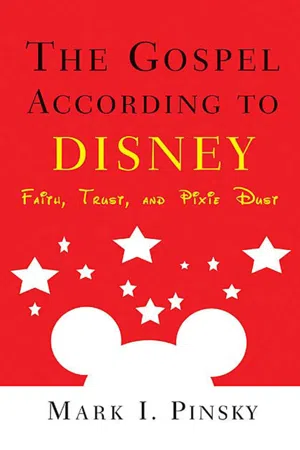
In this follow-up to his bestselling The Gospel According to The Simpsons: The Spiritual Life of the World's Most Animated Family, religion journalist Mark Pinsky explores the role that the animated features of Walt Disney played on the moral and spiritual development of generations of children. Pinsky explores thirty-one of the most popular Disney films, as well as recent developments such as the 1990s boycott of Disney by the Southern Baptist Convention and the role that Michael Eisner and Jeffrey Katzenberg played in the resurgance of the company since the mid-1980s.
- English
- ePUB (mobile friendly)
- Available on iOS & Android
eBook - ePub
About this book
Information
Topic
Theology & ReligionSubtopic
ReligionChapter One
The Disney Gospel: Secular ’Toonism
The old man needed a miracle, supernatural intervention to give life to his little boy, slumped motionless across the room. So the white-haired woodcarver did what might be expected under the circumstances: He knelt on his bed, folded his hands on the windowsill, and turned his eyes to heaven. Then, in his soft Italian accent, he did not pray. Instead, Geppetto wished upon a star. The transformation from puppet to boy that ensued in Walt Disney’s 1940, Oscar-winning animated feature Pinocchio was indeed miraculous, but not traditionally divine. As the man slept, a winged, glowing spirit, the Blue Fairy, advised the marionette to “let your conscience be your guide,” to “choose right from wrong” so he could earn the “gift of life.” And Pinocchio is not an exception. Walt Disney did not want religion in his movies. “He never made a religious film, and churchmen were rarely portrayed in Disney movies,” according to Bob Thomas, author of Walt Disney: An American Original, an authorized biography. In Building a Company: Roy O. Disney and the Creation of an Entertainment Empire, Thomas wrote that, throughout his career, Walt “had eschewed any film material dealing with religion, reasoning that portions of the audience would be displeased by the depiction of a particular sect.” Thus, there is relatively little explicit Judeo-Christian symbolism or substance in seventy years of Disney’s animated features, despite the frequent, almost pervasive use of a theological vocabulary: words such as faith, believe, miracle, blessing, sacrifice, and divine. It seems a contradiction, portraying consistent Judeo-Christian values without sectarian, or even a godly, context—the fruits without the roots.
The Disney empire, by its founder’s designation, is a kingdom of magic, almost totally without reference to any kingdom of heaven. It advertises Disneyland as the happiest place on earth—not the holiest. There are no churches on Main Street at Disneyland or Walt Disney World or chapels on Disney cruise ships. Walt’s daughter Diane Disney Miller told one minister that there are no churches on Main Street because her father did not want to favor any particular denomination. It is an explanation repeated today by company officials—as if the company’s genius for the generic did not extend to creating a one-size-fits-all church. Walt “didn’t want to single out any one religion,” according to Disney archivist David Smith.
“Pictures are for entertainment—messages should be sent by Western Union,” the movie mogul Sam Goldwyn once advised his screenwriters, warning them against trying to telegraph a political position or a moral lesson. As a filmmaker, Walt Disney took a different view. His animated features were always designed to be “message” films in the broadest sense, and especially for children. Yet throughout his life, it was a decision he downplayed, steadfastly denying there was any particular theological perspective in his work. “We like to have a point of view in our stories, not an obvious moral, but a worthwhile theme,” he told one interviewer. “All we are trying to do is give the public good entertainment. That is all they want.” However, in an early draft of a 1962 article for the inspirational monthly magazine Guideposts that is filed in the Disney archives, Walt addressed this point more directly. “Children are people, and they should have to reach to learn about things, to understand things, just as adults have to reach if they want to grow in mental stature,” Walt wrote. “Life is composed of lights and shadows, and we would be untruthful, insincere and saccharine if we tried to pretend there were no shadows. Most things are good, and they are the strongest things; but there are evil things, too, and you are not doing a child a favor by trying to shield him from reality. The important thing is to teach a child that good can always triumph over evil, and that is what our pictures attempt to do.”
Few entertainment productions continue to have as profound an impact on young children as the full-length features that are the signature of the Walt Disney Company. Together, The Lion King, Snow White and the Seven Dwarfs, Aladdin, Beauty and the Beast, and The Little Mermaid have sold hundreds of millions of video-cassettes and DVDs, adding exponentially to viewings at movie theaters and readings of bedtime stories based on the films. These animated classics—which are reflected in all of the Disney theme parks—rely primarily on mythic tales and images, some pre-Christian, that are replete with witches and demons, sorcerers and spells, genies and goblins. Regardless, millions of children around the world know much of what they do about the practical application of right and wrong from Disney. In the Western world in particular, the number of hours children spend receiving moral instruction in houses of worship is dwarfed by the amount of time spent sitting in front of screens large and small, learning values from Disney movies and other programming.
For the past seventy-five years, through its films, toys, books, and theme parks, Disney has created a world of fantasy—based on a set of shared American beliefs—that both entertains and educates children in this country and around the world. What accounts for this enduring impact? For many parents, Disney’s entertaining morality tales, from Pinocchio to the company’s latest releases, have offered one of the few safe havens for children’s viewing in modern popular culture.
But in the more than thirty-five animated features Disney has released since 1937, there is scarcely a mention of God as conceived in the Christian and Jewish faiths shared by most people in the Western world and many beyond. Disney’s decision to exclude or excise traditional religion from animated features was in part a commercial one, designed to keep the product saleable in a worldwide market. In 1935, Walt and Roy were impressed to find that a theater in Paris was showing six Disney cartoons—and no feature, according to Thomas. Three years later, while visiting Paris without Walt to oversee the opening of Snow White, Roy arranged for the feature’s dubbing into Arabic and Hindi, as well as into European languages. When Pinocchio was released in 1940, the studio spent $65,000 to dub it into seven foreign languages. “Walt wanted to communicate with a global audience,” said John Culhane, an animation authority at New York University and author of two books on Fantasia. “He wanted to communicate with a multicultural audience.” Thus, the choice was made to keep the films accessible and relevant to children from both inside and outside the Judeo-Christian tradition in order to pass through a minefield of conflicting sensibilities.
Yet since ancient times, dramatists have seen the need for a sometimes unexpected device to intervene and resolve plot conflicts. The Greeks had an actor portraying a deity descend to the stage in a basket to aid in the narrative, which they called deus ex machina, god from the machine. Magic, Disney apparently decided, would be a far more universal device to do this than any one religion. Clearly, this strategy has worked; Disney characters are arguably far more recognizable around the world than images of Jesus or Buddha. And this approach still works. “Magic never goes out of style,” Kathy Merlock Jackson, president of the American Culture Association, told the Orlando Sentinel’s Jay Boyar in an article published on November 18, 2001. “We’ve never been without it. … Wish fulfillment is a key theme in many Disney movies,” continued Jackson, author of Walt Disney: A Bio-Bibliography. “Magic becomes a way to empower the powerless.”
In the same Sentinel article, discussing the Harry Potter phenomenon, film critic and author Leonard Maltin agreed: “Magic takes you away and shows you a better life. And then it allows you to apply it to your real life.” Magic, wrote Boyar, “is often an agent of transformation, a way of changing an ordinary thing into some marvelous something else. Other films may feature these kinds of changes, but generally not to the extent that the Disney features do.”
But there is also a key theological dimension to Disney’s choice of magic over religion, as the evangelist and social activist Tony Campolo observed in the foreword to The Gospel according to The Simpsons, citing Bronislaw Malinowski’s Magic, Religion, and Science. Magic, Malinowski said, “is an attempt to manipulate spiritual forces so that the supplicant gets what he or she wants, whereas in pure religion the individual surrenders to spiritual forces so that those forces (i.e. God) can do through him or her what those forces desire.”
The case is easily made that, in selecting magic as its agent of supernatural intervention, Disney made a successful choice, both culturally and commercially, a phenomenon Time magazine writers have tracked since at least 1954. In a cover story that year, the magazine wrote, “Measured by his social impact, Walt Disney is one of the most influential men alive. … The hand that rocks the cradle is Walt Disney’s—and who can say what effect it is having on the world?” Richard Schickel, in The Disney Version: The Life, Times, Art, and Commerce of Walt Disney, reached a similar conclusion, that Walt was “one of the most significant shaping forces in American culture in the middle third of the [twentieth] century.”
A debate about Disney and the teaching of values broke out in the mid-1960s. Max Rafferty, the conservative educator then serving as California’s superintendent of public instruction, wrote an opinion piece in the April 19, 1965, Los Angeles Times, calling Walt Disney “the greatest pedagogue of all,” a more outstanding educator than “John Dewey or James Conant or all of the rest put together.” This provoked a sharp response, reprinted in a variety of publications, from a librarian named Frances Clarke Sayers, who accused Disney of not being a good educator, of “making morals overly obvious so as to leave nothing to the child’s imagination,” according to Jackson’s Walt Disney: A Bio-Bibliography. Time’s Richard Corliss broached the subject in 1988: “Walt’s entertainment edifice was a unique institution—a cathedral of popular culture whose saints were mice and ducks, virgin princesses and lurking sprites, little boys made of wood and little girls lost in wonderland. Virtually every child attended this secular church, took fear and comfort from its doctrines, and finally outgrew it. … For most American children of the past half-century, a Disney cartoon feature was the sacred destination of their first trip to the movies.” Walt’s credo, Corliss wrote, must have been the Jesuits’: “Give me a child before he’s seven, and he will be mine for life.”
The animated feature was the financial rock on which Disney built its corporate church. Early hits enabled the company to expand and move to newer and larger studios, and, ultimately, made possible the construction of Disneyland in Anaheim, California. Even those classics that did not perform well in original theatrical release or rerelease have generated significant revenues when resurrected on videocassette as baby boomers began raising families and the cultural climate became more conservative. These features exalted the Calvinist paradigm of hard—sometimes unrelentingly hard—work, which was unfailingly rewarded with upward social mobility. In this sense, the model paralleled Walt’s own rise to prosperity. Today the animated features have been able to advance Disney’s interests around the world, raising synergy to an art form.
There are those who take a harsher view of Disney’s magic versus religion marketing strategy. “There is an anathema against the New Testament in the Disney films,” said the Reverend Lou Sheldon, head of the Washington, D.C.-based Traditional Values Coalition, an organization that later joined the religious boycott of Disney of the 1990s. “They’re not fair to what the Christian message is of life, death, and eternal life.” The Reverend Clark Whitten of Calvary Assembly Church, a megachurch in Orlando, said that “it is obvious that they sidestep and avoid what I would consider Judeo-Christian figures—literally anything that has to do with Christianity. They have a gospel—it’s to make money,” he said, while acknowledging that he has taken his children to see Disney films. Even critic Sheldon, whose organization began in a suite of offices in the shadow of Disneyland, sees the value in Walt Disney’s early animated features. “They have a lot of good points, but they do not go far enough to truly reflect the deeply held Christian faith of tens of millions of Americans,” he said.
In recent decades, such “culture war” debates between conservatives and liberals have unfolded in religious circles. One term in particular, secular humanism, emerged on the right as a pejorative term for the idea that universal values can be defined and communicated without a religious (usually Judeo-Christian) context. The 1954 Time magazine cover story, coinciding with the opening of Disneyland in Anaheim, noted that Walt Disney had been described as “the poet of the new American humanism” and that Mickey Mouse was “the symbol of common humanity in struggle against the forces of evil.” For nearly seven decades, viewers of the company’s animated features have been receiving a message with recognizable, if watered-down, religious values. I call this Disney gospel “secular ’toonism.” Some religious conservatives have complained that the animated features under Michael Eisner’s regime represent a betrayal of Walt’s “family values” legacy. But in addition to the founder’s humanism, as we shall see, the early films strongly supported environmentalism, the theory of evolution, and, arguably, a tolerant, even gay-friendly attitude that would doubtless make today’s conservatives uncomfortable, to say the least.
Many in the cultural debate insist that Walt Disney officials made a wise and reasonable decision to finesse the touchy subject of religion and theology. Robert Schuller, a nationally known evangelist and author, defended Disney’s approach, saying he saw a strong and consistent religious message reflected in the Disney animated films. Disney’s gospel is that “the bad news will never be the last news,” said Schuller, whose Hour of Power television program is broadcast from the Crystal Cathedral in Garden Grove, California. “Gospel means good news. In the culture that comes from Judeo-Christian values, that is the theme: Ultimately, God will reward the right and will never reward the unrepentant wrong.”
Some see the movies in a more sectarian light. Disney films “very much reflect Christian values in particular,” said Robert Knight, director of the Culture and Family Institute, an affiliate of Concerned Women for America, a Washington, D.C.-based, conservative think tank. “The values in Disney films generally reflect Judeo-Christian principles,” said Knight, although “it is a little troubling that Disney uses magic as a stand-in, essentially, for the power of the Holy Spirit as a transforming agent of good. On the other hand, with the moral ambiguity that Hollywood has been dishing up, Disney’s clear delineation between good and evil is always welcome.”
In the 1950s, Jewish moral philosopher Will Herberg wrote in Protestant—Catholic—Jew: An Essay in American Religious Sociology that we Americans, as a people, have a group of broadly shared beliefs that constitute a “civic religion”—that is, a nondenominational, nonsectarian faith, with an undergirding of unconquerable optimism, which I will argue is reflected in the Disney gospel. Boiled down, American religion is “faith in faith,” Herberg wrote. It is nontheological and nonliturgical, “secularized Puritanism. … It is not faith in anything that is so powerful, just faith, the ‘magic of believing.’” Although he might just as easily have quoted Walt Disney to support this view, Herberg instead quoted President Eisenhower, who said in the early 1950s, “Our government makes no sense unless it is founded in a deeply felt religious faith—and I don’t care what it is.” (The former chief executive was a Disney admirer, describing Walt as “a genius creator of folklore [who] helped our children develop a clean and cheerful view of humanity,” according to Kevin Maney, writing in USA Today, March 3, 2004.)
Tony Campolo echoes Herberg—and Eisenhower. “All of us have to believe in something transcendent,” he says. “There is a sense in Disney that you have to believe in a transcendent power. Americans have faith, and if you have faith, things will work out well. Many in this country believe that people who don’t have faith in something are really non-American. We’re not really going to tell you what you have to have faith in, but you have to have faith in something beyond yourself. It’s not what you believe in that makes the difference, it’s the believing that makes the difference. Believing people are to be trusted; non-believing people are not to be trusted. So we don’t care what you believe in, but if you don’t have a faith, you’re nothing in American society.”
Of course, magic is okay, but for believers it always works best if their kind of God is in the mix somewhere, even implied or off-screen. “Americans believe, 58 percent to 40 percent, that it is necessary to believe in God to be moral,” New York Times columnist Nicholas D. Kristof wrote on August 15, 2003, citing a 1998 Harris poll of more than 1,000 respondents. “Americans not only have faith in God,” according to Campolo. “They have faith in themselves. Because with God on our side all things will work together for good”—what Campolo calls “the American value system spiritualized.” Still, it only works if you do your part, just like Walt did in his own life. “In the Disney value system, success should always be competitively achieved. For somebody to inherit wealth is almost evil. … The answer communicated by the animated movies is that good people always triumph, get rich and succeed, and the poor people don’t. Disney is a perfect embodiment of the Protestant work ethic, divorced of religious moorings.”
Clearly the animated features have benefited from this approach—just as religion has, Campolo says. “The church does best when it picks up on the themes from the media and preaches on them. Jesus used parables. Are not the Disney movies parables? Are they not lessons? I’m not so sure that Disney creates the values as much as it reinforces values that are already operative in American society.”
Take the one character that most epitomizes the Walt Disney Company—Mickey Mouse, “the most persistent and pervasive figment of American popular culture” in the twentieth century, according to novelist John Updike. “Mickey is a purely innocent creature,” said Campolo. “There is no guile in him. He is the unfallen creature. And he’s never done anything sinful in his life. He’s Adam before the fall. There’s a naiveté about him. And all of us are attracted to him. And we all cheer for him because he is ‘so good.’ And he calls people to goodness. And when you see him in the theme park parade, it’s goodness wedded with joyfulness. Look at the fifth chapter of Galatians, where Paul talks about the fruits of the Holy Spirit. They are these: love and joy and peace and patience. All of these godly virtues are wrapped up in Mickey and his followers. Mickey is a wonderful, wonderful creature. He is innocence. And in a real sense, we all believe in Mickey.”
More recently, others have questioned the way the studio has sanded away the sharp edges of traditional myths and has invented new ones. Martin Marty, emeritus professor of church history at the University of Chicago, said, “There’s no question that Disney has been the most successful creator of a complete set of mythologies, that is, ways of telling stories that impart certain kinds of truths that people wouldn’t listen to if they didn’t come in that form.” But while Disney’s idealized values as presented in the animated features may work for moral instruction of young children, they may also be misleading in what they say about the real world. “Righteousness and right don’t always prevail,” continued Marty, “and I think that you have to learn that on your own after you’ve seen a Disney film. At the same time, Disney’s prime—...
Table of contents
- Cover
- Title Page
- Copyright Page
- Dedication Page
- Contents
- Introduction
- Methodology
- Chapter 1: The Disney Gospel: Secular ’Toonism
- Part One: The Disney Years: 1937–1984
- Part Two: The Eisner Years: 1984–2004
- Part Three: Disney and American Culture
- Acknowledgments
- Bibliography
- Index
Trusted by 375,005 students
Access to over 1.5 million titles for a fair monthly price.
Study more efficiently using our study tools.
Frequently asked questions
Yes, you can cancel anytime from the Subscription tab in your account settings on the Perlego website. Your subscription will stay active until the end of your current billing period. Learn how to cancel your subscription
No, books cannot be downloaded as external files, such as PDFs, for use outside of Perlego. However, you can download books within the Perlego app for offline reading on mobile or tablet. Learn how to download books offline
Perlego offers two plans: Essential and Complete
- Essential is ideal for learners and professionals who enjoy exploring a wide range of subjects. Access the Essential Library with 800,000+ trusted titles and best-sellers across business, personal growth, and the humanities. Includes unlimited reading time and Standard Read Aloud voice.
- Complete: Perfect for advanced learners and researchers needing full, unrestricted access. Unlock 1.5M+ books across hundreds of subjects, including academic and specialized titles. The Complete Plan also includes advanced features like Premium Read Aloud and Research Assistant.
We are an online textbook subscription service, where you can get access to an entire online library for less than the price of a single book per month. With over 1.5 million books across 990+ topics, we’ve got you covered! Learn about our mission
Look out for the read-aloud symbol on your next book to see if you can listen to it. The read-aloud tool reads text aloud for you, highlighting the text as it is being read. You can pause it, speed it up and slow it down. Learn more about Read Aloud
Yes! You can use the Perlego app on both iOS and Android devices to read anytime, anywhere — even offline. Perfect for commutes or when you’re on the go.
Please note we cannot support devices running on iOS 13 and Android 7 or earlier. Learn more about using the app
Please note we cannot support devices running on iOS 13 and Android 7 or earlier. Learn more about using the app
Yes, you can access The Gospel according to Disney by Mark I. Pinsky in PDF and/or ePUB format, as well as other popular books in Theology & Religion & Religion. We have over 1.5 million books available in our catalogue for you to explore.