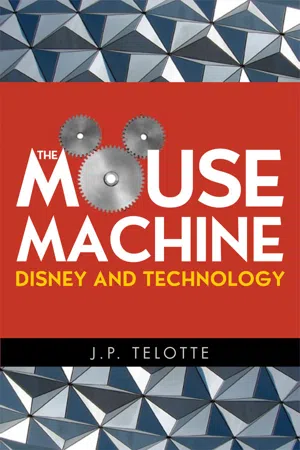
Throughout Disney's phenomenally successful run in the entertainment industry, the company has negotiated the use of cutting-edge film and media technologies that, J. P. Telotte argues, have proven fundamental to the company's identity. Disney's technological developments include the use of stereophonic surround sound for Fantasia, experimentation with wide-screen technology, inaugural adoption of three-strip Technicolor film, and early efforts at fostering depth in the animated image. Telotte also chronicles Disney's partnership with television, development of the theme park, and depiction of technology in science fiction narratives. An in-depth discussion of Disney's shift into digital filmmaking with its Pixar partnership and an emphasis on digital special effects in live-action films, such as the Pirates of the Caribbean series, also highlight the studio's historical investment in technology. By exploring the technological context for Disney creations throughout its history, The Mouse Machine illuminates Disney's extraordinary growth into one of the largest and most influential media and entertainment companies in the world. Hardback is unjacketed.
- English
- ePUB (mobile friendly)
- Available on iOS & Android
eBook - ePub
About this book
Information
Publisher
University of Illinois PressYear
2010Print ISBN
9780252075407
9780252033278
eBook ISBN
9780252092633
Subtopic
Film & Video1 Sound Fantasy
The great satisfaction in the first animated cartoons was that they used sound properly—the sound was as unreal as the action; the eye and the ear were not at war with each other, one observing a fantasy, the other an actuality.
—Gilbert Seldes (in Leonard Maltin, Of Mice and Magic)
In his commentary on early sound film, the noted critic Gilbert Seldes lavishes an ostensible praise on those pioneers like Walt and Roy Disney who embraced the potential of the new technology. It is, of course, something of a backhanded compliment, alluding, on the one hand, to some of the misbegotten efforts at sound narrative readily found among the live-action feature films during the rush to sound in the 1927–28 period, while also implying that the first sound cartoons, such as those produced by the Disney Company starting in 1928, were quite limited in scope, and that Disney especially had elected to use sound, as Alexander Walker also concludes, “non-realistically” (189). Certainly, in many of the early sound films—a situation lampooned in a movie like Singin’ in the Rain (1952)—image and sound often seem at odds with each other, particularly as the imperative to talk combined with the era’s bulky and sensitive sound equipment to stultify action in many live-action films. That account, however, along with the critical assessment that has often followed it, hardly does justice to early Disney efforts. For it seems to suggest that we see them all simply as part of a natural aesthetic trajectory that would culminate in a feature film like Fantasia (1940), a work that does in many ways seem designed to see just how closely fantasy images might be matched with fantastic sounds.
Certainly, the first Disney sound cartoons do demonstrate a level of fantastic aural imagery that at times hints that, in its early usage, sound existed largely for the purpose of furnishing additional gags, that is, simply for comic effect. As an example, we need only consider the scene in Disney’s first sound cartoon, Steamboat Willie (1928), in which screen newcomer Mickey Mouse finds that a goat has swallowed Minnie’s sheet music. After twisting its tail into the shape of a hand crank, Mickey and Minnie quickly turn the goat into a phonograph to reproduce that music, playing “Turkey in the Straw.” Even in the midst of various other such transformative turns, though, we can also see Disney trying to work out more naturalistic applications of the new sound technology, as if already mindful of what would come to be known as the “illusion-of-life” aesthetic that would increasingly become an informing principle for the studio’s productions. In fact, we might describe the use of sound technology in early Disney cartoons as less focused on producing fantastic sounds, as Seldes suggests, than on creating a kind of sound fantasy, an aural environment in which real and expressive sound imagery easily merge, where they are constantly in narrative negotiation, constructing a kind of in-between world that is, I would offer, one of their key attractions.
As is so often the case in early film history, the sort of complementary activity I am suggesting follows from a variety of influences, one of them the pointedly economic decision to invest fully, as a studio, in the nascent sound technology. Douglas Gomery has convincingly argued that Disney’s embrace of the new technology resulted from a fundamentally sound business sense, the recognition that this very small studio, often on the verge of bankruptcy, needed “to find an appropriate business niche” in an increasingly competitive animation market (72). Fortunately, it was an understanding that worked to keep Disney from going under at a crucial moment in its history. Having just lost control of his modestly successful cartoon character Oswald the Lucky Rabbit, Walt Disney, together with his top animator Ub Iwerks, had managed to fashion a new potential “star,” Mickey Mouse, around whom they hoped to build another cartoon series. The mouse, however, originally differed little from the rabbit: the body looked similar, but with circles for ears; backgrounds were again simplistic; the action and gags were much the same, and in some cases were simply copied from the Oswald shorts.1 In fact, Richard Schickel suggests that, at this stage, the overall style of the mouse was hardly distinctive, but was rather “very much a product of the then-current conventions of animation” (95). Given this general similarity, the first vehicle for Disney’s new star, the silent cartoon Plane Crazy (1928), predictably met with a lukewarm reception from potential exhibitors, one that initially seemed to destine Mickey, as Schickel adds, for “a life no longer than many of his competitors” (95). Yet as would so often become the story for the Disney Company, innovation, and with it the needed level of product differentiation, would come not simply from the character but from the technology behind it, in this instance, from a technology that would give both voice and character to Mickey, and sound to his animated world.
Getting access to that technology, however, involved a variety of additional business negotiations and compromises—between the Disneys and the various vendors of the new technology, and even between the Disney brothers themselves, as they weighed the consequences of fully staking their personal futures and that of their company on sound technology. Having tested out the possibility by projecting a cartoon while ad-libbing sound effects and comments, Walt announced that the result “was terrible, but it was wonderful!” (107), and both Disneys agreed that sound could prove a valuable addition to their films. They then worked out a method for adding it, by timing the action to be animated to a metronome that was set to the measure of the music and sound effects they wanted to use.2 Having established a crude but workable procedure for simply adding a sound increment to their films, Walt then set off for New York, where he hoped to arrange for sound accompaniment for their latest effort, Steamboat Willie. Along the way, he stopped in Kansas City to contract with old friend Carl Stalling to compose a simple score for the film. The next step was to decide which of the competing sound technologies to employ—a decision that largely depended on which of the new technologies the small company could afford.
An added difficulty in making this decision came from the fact that there was, as yet, no industry-wide consensus on the best technology, and many of the various sound devices relied on shared or similar patents. As Bob Thomas recounts, Walt rejected the sound-on-disc approach of the Warners-Vitaphone system for some of the same reasons others in the industry hesitated to embrace it: because of its fragility and the ease with which sound and image could lose synchronization. While he found the Fox-Movietone sound-on film system more attractive, largely because of its reliable synchronization and lower follow-up costs (e.g., no need to constantly replace worn-out or broken discs), Fox “was too busy … to bother with a small cartoon maker from the Coast” (Walt 91). And the other leading sound-on-film vendor, RCA, essentially priced its system beyond the Disneys’ modest capacities. Pat Powers, often described in film histories as a “con man” and a “wheeler-dealer,” offered an alternative.3 He was at the time marketing the Powers Cinephone System, a sound-on-film technology created by R. R. Halpenny and William Garity, based on—and, some have suggested, pirated from—the RCA Phonofilm system (Geduld 228). As Schickel offers, Powers saw “in the Mouse exactly the sort of gimmick he needed” to help promote the questionably legitimate Cinephone (101), and so he was quite eager to strike a deal with the Disneys.
Initially, though, finances still stood in the way of this marriage of mutual convenience. A ten-year contract with Powers would cost the Disneys $26,000 per year plus the cost of the Cinephone equipment—a rather substantial investment when they had only been receiving $2,250 from the distributor for each of their Oswald cartoons, which they had been producing at a rate of slightly more than one per month (Merritt and Kaufman 99). As recompense, Powers agreed to distribute the new sound cartoons nationally and pay production costs (underestimated at approximately $2,500 per cartoon), while taking only 10 percent of the gross receipts (Watts 30). Roy’s reluctance to proceed with this contract and to begin production on another Mickey cartoon met with pleadings from his brother; in a letter Walt implored, “Why should we let a few dollars jeopardize our chances? I think this is Old Man Opportunity rapping at our door. Let’s don’t let the jingle of a few pennies drown out his knock” (Thomas, Walt 94). To seal this familial side of the negotiations, though, Walt himself had to compromise, agreeing to sell his prized Moon roadster: “I had them send the pink slip to me. I signed it, I sent it back. They sold my car to meet payrolls before I ever got out of New York” (Thomas, Building 62).
However, the product that resulted more than repaid these various negotiations, as the Mickey Mouse cartoons quickly caught on and would, in short order, prompt Disney to consider creating another series of cartoons, the Silly Symphonies, designed expressly to capitalize on sound’s possibilities as something more than simply an aural complement. In order to assess that accomplishment, and particularly to determine how it is that the Disneys managed to strike the public fancy with their use of this new technology, we need to look in some detail at a few of these early sound cartoons, particularly the groundbreaking Steamboat Willie and the first of the Silly Symphony efforts, The Skeleton Dance (1929). And as a gauge of the Disney Company’s rapid development of what might be described as a characteristic sound aesthetic, I also want to consider a later effort, Mickey’s Trailer (1938). Coming a decade after Steamboat Willie, this cartoon suggests the subordination of that early “sound fantasy,” as I have termed it, to the imperatives of the “illusion-of-life” aesthetic that was gradually developed during the 1930s and that had become a dominant influence on the Disney films by the time of Mickey’s Trailer.
While Steamboat Willie was not, as we have noted, the first Mickey Mouse cartoon—or even the first cartoon to employ sound—it is clearly the initial effort at designing a Mickey narrative with a consciousness of the various possibilities sound afforded. Certainly, Walt and Ub Iwerks already had a sense of their new character Mickey, after creating Plane Crazy and Gallopin’ Gaucho (1928). He was, as the very first scene of Plane Crazy makes explicit, an embodiment of the Machine Age and its spirit, for we see Mickey admiring a magazine picture of the ultimate Machine Age hero, Charles Lindbergh, and arranging his “hair” and smile to match the figure in the photograph. Mickey’s energetic nature is drawn from another key figure of the era, Douglas Fairbanks Sr., whose films obviously inspired the second cartoon Gallopin’ Gaucho. And Steamboat Willie, the third Mickey film, echoed yet another iconic figure of the era, Buster Keaton, by recalling his recently released Steamboat Bill, Jr. (1928), and evoking not only his athletic persona, but also what Miles Orvell has described as “the essential Keaton fantasy,” an inherent capacity for “transformation” (29). What makes this first true sound cartoon especially interesting, though, is the extent to which that power of transformation is bound up in the film’s aural dimension, as Mickey emerges not simply as an embodiment of change, but, almost literally and far more importantly, as a conductor of change, as would become most obvious in a later work like The Band Concert (1935), wherein he conducts a local orchestra in a successful concert despite a variety of interruptions, including a tornado that destroys practically everything around him.
What makes Steamboat Willie particularly striking is the extent to which Disney was able to build that capacity to orchestrate change into the film’s soundtrack, even as the company was obviously still struggling to determine how best to use this new technology. One of those uses, of course, is simply to emphasize the reality of the images by selectively giving them voice—or as Paul Virilio has put it, by overcoming the moviegoer’s seeming “deafness” (85) in the face of early film. Here, sound provides an aural context for the typical cartoon action, as chickens cluck, a duck quacks, a cow moos, and a boat winch makes a realistically mechanical winding sound. When Mickey’s steamboat approaches the landing, we hear the chug of its engine, if not the sound of the water splashed by its paddlewheel, and when Minnie Mouse runs to catch the boat, her shoes provide a pronounced clopping noise. More significantly, other sound effects serve to build a sense of spatial reality by suturing off-screen space to on-screen. Thus when Mickey moves from the steamboat’s deck on which the goat/phonograph is playing “Turkey in the Straw” to the ship’s interior, we continue to hear the tune, as if through a window, and when at the end Mickey throws a potato at a mocking parrot and knocks it out of a porthole, a splash is clearly audible, indicating that the parrot has fallen into the river. Moreover, that same sound motivates Mickey’s impish smile of satisfaction on which the film concludes. These and similar sounds essentially function to help construct the traditional reality illusion in a variety of ways: denoting an action, announcing a presence, suggesting contiguous space, and motivating character response.
Yet at the same time, they also underscore their function as part of a larger aesthetic construction, for the animals make their specific identifying sounds only on cue, with silence following each cluck, quack, or moo, so that we never get the sort of barnyard cacophony reality might actually demand. While the winch contributes its mechanical noise, the boom of which it is part silently swings into action. And as the steamboat approaches the landing and Minnie chases after the boat, the sounds of the boat engine and of Minnie’s feet remain constant in volume; there is no hint of sound perspective to suggest changing distance, only indexical sounds to denote presence or action. In fact, it quickly becomes apparent that the sounds we do hear are all carefully selected, and that others we might well expect to hear—such as the splash of the ship’s paddlewheel—remain absences just as in a silent film. The result is clear evidence of the soundtrack’s general divorce from the image track, or of the extent to which Disney was already adopting what Rick Altman has described as “Hollywood’s habit of constructing reality (as opposed to observing it)” at the level of sound, just as at the more obvious level of the image (47).
What we see in this first Mickey Mouse cartoon is not just the development of a new character, then, but also an effort to sort out some of the narrative possibilities afforded by the new sound technology and ultimately to link those possibilities to character. Sound’s potential obviously offered some support for that “illusion-of-life” aesthetic, insofar as it helped to build a realistic mise-en-scène and motivate character actions and reactions. Yet it also opened onto a transformative potential, as we not only have a goat becoming a phonograph, but each animal on board the steamboat, in turn, proving an effective musical instrument in Mickey’s hands. It is as if the goat’s eating of the music—literally internalizing the potential for sound—inspires Mickey to then externalize it, to recognize and then release the potential for music everywhere he sees it. Thus, to join in with the music he pulls a cat’s tail to provide a high note and then swings the animal by its tail to produce a continuous siren-like sound. A goose becomes a bagpipe, a pig proves another sort of wind instrument as he plays on its teats, and a cow’s mouth becomes an effective xylophone. In fact, the various animals Mickey uses—and clearly abuses in the common fashion of early cartoons—easily mesh with the other “found” instruments he plays—a washboard, pots, pans, a wooden tub—to suggest a world of unexpected potential, marked by its fantastic sounds, that Mickey doesn’t simply produce but discovers and discloses to the delight of both Minnie and the audience. And with this demonstration, we also see sound helping to produce—and disclose to the audience—Mickey’s basic character.
It is in this same context that we might read the effect that is most commonly cited, rather slightingly, in descriptions of the early Disney talkies—“mickey mousing.” Supposedly coined by David O. Selznick, the term describes “the close synchronization of music to action” (Handzo 409), such that the action is continuously punctuated by a specific musical tempo or motif. Sometimes seen as an unfortunate influence of the exaggerations found in the early Mickey cartoons, the term is typically used pejoratively, to suggest overscoring and a pointedly manipulative or intrusive use of the soundtrack that violates the reality illusion. However, that effect most commonly works in conjunction with realistic sound effects—and, in fact, it largely gained that negative implication because of this conjunction and the rather difficult narrative negotiation it imposes on the audience. It is, consequently, also in some ways the essence, perhaps even the glory of the early Mickey Mouse and Silly Symphony cartoons, because of the way it suggests the very spirit that moves in them. For “mickey mousing” shows us how the world of these films adapts itself to sound, moves to the beat of the new sound environment, finds its full aural/musical potential, thanks to the energetic intervention of the mouse or some other figure or force.
It is also important here that we recognize that Mickey holds no monopoly on the transformative or conductive potential that is played out in the early Disney talkies. Designed expressly to foreground music and supposedly inspired by Carl Stalling’s suggestion of “finding music that was evocative of some mood and building a cartoon around the theme,”4 the Silly Symphony shorts were inaugurated in 1929 with an eye to, as Steven Watts suggests, being “more experimental in their techniques and structure … and full of free-flowing fantasy” (31), without the conventional reliance upon recurring characters to anchor their stories and denote their series status. Robert Haas hits upon one of the main reasons for the success of this new series, as he relates it to the then-popular musical genre and notes how, “unhampered by the restrictions of early sound-filming procedures …, Disney combined sound and image in an expressive manner impossible for live-action narrative cinema” (75). That “expressive manner” largely follows from the foregrounding of the soundtrack in these films—a foregrounding that would shortly produce the first hit song for the Disney studio with 1933’s “Who’s Afraid of the Big, Bad Wolf” from The Three Little Pigs—and would eventuate in the studio’s ambitious experiment in illustrating classical music, Fantasia. That expressiveness, though, is also vested in the narratives themselves, carefully chosen to allow for the sort of sound fantasy we have previously described.
The first of these efforts, The Skeleton Dance, neatly demonstrates a major form that this expressiveness would take. Scored in part to Edvard Grieg’s classical composition “March of the Dwarfs” and set in a graveyard one night, the film describes a transformation in the natural world, as dusk surrenders to deep night and morning eventually dispels the darkness. Marking that shift is a change in the very “music of the night,” as a medley of natural sounds gives way to those produced by a host of skeletons, which are, in turn, replaced by the natural sounds associated with dawn’s breaking. As the film opens, we hear a variety of natural sounds, all set in time to a musical accompaniment: an owl hoots, the wind whistles, a church bell sounds, wind-blown reeds beat on logs, bats flap their wings, dogs howl, and cats screech. It is a kind of natural cacophony—or symphony—and one that underscores its naturalness by having sounds bridge from one shot to another and by effectively using sound perspective: the bell seen in the deep background sounds as if from a distance, while the bats that emerge from the church steeple make louder noises as they fly into the foreground. While these effects demonstrate how much (and how quickly) Disney had developed in the melding of sound and animation since Steamboat Willie, particularly in creating what we might describe as a normal sound environment, they also pointedly serve to build the eerie atmosphere of the scene, in fact, to turn it into something of a mood piece. That eerie mood prepares for the film’s key transformation, as a skeleton appears from behind a gravestone, hears the owl’s hooting off-screen, and throws his skull at the bird, effectively dispell...
Table of contents
- Cover
- Title Page
- Copyright
- Contents
- Acknowledgments
- Introduction: Main Street, Machines, and the Mouse
- 1. Sound Fantasy
- 2. Minor Hazards: Disney and the Color Adventure
- 3. Three-Dimensional Animation and the Illusion of Life
- 4. A Monstrous Vision: Disney, Science Fiction, and CinemaScope
- 5. Disney in Television Land
- 6. The “Inhabitable Text” of the Parks
- 7. Course Correction: Of Black Holes and Computer Games
- 8. “Better Than Real”: Digital Disney, Pixar, and Beyond
- Conclusion
- Notes
- Works Cited
- Index
Trusted by 375,005 students
Access to over 1.5 million titles for a fair monthly price.
Study more efficiently using our study tools.
Frequently asked questions
Yes, you can cancel anytime from the Subscription tab in your account settings on the Perlego website. Your subscription will stay active until the end of your current billing period. Learn how to cancel your subscription
No, books cannot be downloaded as external files, such as PDFs, for use outside of Perlego. However, you can download books within the Perlego app for offline reading on mobile or tablet. Learn how to download books offline
Perlego offers two plans: Essential and Complete
- Essential is ideal for learners and professionals who enjoy exploring a wide range of subjects. Access the Essential Library with 800,000+ trusted titles and best-sellers across business, personal growth, and the humanities. Includes unlimited reading time and Standard Read Aloud voice.
- Complete: Perfect for advanced learners and researchers needing full, unrestricted access. Unlock 1.5M+ books across hundreds of subjects, including academic and specialized titles. The Complete Plan also includes advanced features like Premium Read Aloud and Research Assistant.
We are an online textbook subscription service, where you can get access to an entire online library for less than the price of a single book per month. With over 1.5 million books across 990+ topics, we’ve got you covered! Learn about our mission
Look out for the read-aloud symbol on your next book to see if you can listen to it. The read-aloud tool reads text aloud for you, highlighting the text as it is being read. You can pause it, speed it up and slow it down. Learn more about Read Aloud
Yes! You can use the Perlego app on both iOS and Android devices to read anytime, anywhere — even offline. Perfect for commutes or when you’re on the go.
Please note we cannot support devices running on iOS 13 and Android 7 or earlier. Learn more about using the app
Please note we cannot support devices running on iOS 13 and Android 7 or earlier. Learn more about using the app
Yes, you can access The Mouse Machine by J P. Telotte in PDF and/or ePUB format, as well as other popular books in Media & Performing Arts & Film & Video. We have over 1.5 million books available in our catalogue for you to explore.