What happens when manhood suffrage, a radically egalitarian institution, gets introduced into a deeply hierarchical society? In her sweeping history of Imperial Germany's electoral culture, Anderson shows how the sudden opportunity to "practice" democracy in 1867 opened up a free space in the land of Kaisers, generals, and Junkers. Originally designed to make voters susceptible to manipulation by the authorities, the suffrage's unintended consequence was to enmesh its participants in ever more democratic procedures and practices. The result was the growth of an increasingly democratic culture in the decades before 1914.
Explicit comparisons with Britain, France, and America give us a vivid picture of the coercive pressures--from employers, clergy, and communities--that German voters faced, but also of the legalistic culture that shielded them from the fraud, bribery, and violence so characteristic of other early "franchise regimes." We emerge with a new sense that Germans were in no way less modern in the practice of democratic politics. Anderson, in fact, argues convincingly against the widely accepted notion that it was pre-war Germany's lack of democratic values and experience that ultimately led to Weimar's failure and the Third Reich.
Practicing Democracy is a surprising reinterpretation of nineteenth- and early twentieth-century Germany and will engage historians concerned with the question of Germany's "special path" to modernity; sociologists interested in obedience, popular mobilization, and civil society; political scientists debating the relative role of institutions versus culture in the transition to democracy. By showing how political activity shaped and was shaped by the experiences of ordinary men and women, it conveys the excitement of democratic politics.
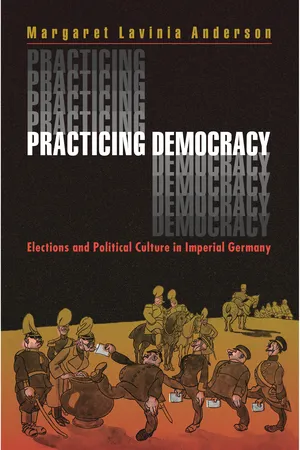
eBook - PDF
Practicing Democracy
Elections and Political Culture in Imperial Germany
- 508 pages
- English
- PDF
- Available on iOS & Android
eBook - PDF
About this book
Information
Publisher
Princeton University PressYear
2021Print ISBN
9780691048543
9780691048536
eBook ISBN
9780691229539
Table of contents
- Cover Page
- Half-title Page
- Title Page
- Copyright Page
- Dedication Page
- Contents
- List of Figures
- Acknowledgments
- A Note on Usage
- Abbreviations
- Part I. The Framework
- Part II. Fields of Force
- Part III. Degrees of Freedom
- Bibliography
- Index
Trusted by 375,005 students
Access to over 1.5 million titles for a fair monthly price.
Study more efficiently using our study tools.
Frequently asked questions
Yes, you can cancel anytime from the Subscription tab in your account settings on the Perlego website. Your subscription will stay active until the end of your current billing period. Learn how to cancel your subscription
No, books cannot be downloaded as external files, such as PDFs, for use outside of Perlego. However, you can download books within the Perlego app for offline reading on mobile or tablet. Learn how to download books offline
Perlego offers two plans: Essential and Complete
- Essential is ideal for learners and professionals who enjoy exploring a wide range of subjects. Access the Essential Library with 800,000+ trusted titles and best-sellers across business, personal growth, and the humanities. Includes unlimited reading time and Standard Read Aloud voice.
- Complete: Perfect for advanced learners and researchers needing full, unrestricted access. Unlock 1.5M+ books across hundreds of subjects, including academic and specialized titles. The Complete Plan also includes advanced features like Premium Read Aloud and Research Assistant.
We are an online textbook subscription service, where you can get access to an entire online library for less than the price of a single book per month. With over 1.5 million books across 990+ topics, we’ve got you covered! Learn about our mission
Look out for the read-aloud symbol on your next book to see if you can listen to it. The read-aloud tool reads text aloud for you, highlighting the text as it is being read. You can pause it, speed it up and slow it down. Learn more about Read Aloud
Yes! You can use the Perlego app on both iOS and Android devices to read anytime, anywhere — even offline. Perfect for commutes or when you’re on the go.
Please note we cannot support devices running on iOS 13 and Android 7 or earlier. Learn more about using the app
Please note we cannot support devices running on iOS 13 and Android 7 or earlier. Learn more about using the app
Yes, you can access Practicing Democracy by Margaret Lavinia Anderson in PDF and/or ePUB format, as well as other popular books in History & German History. We have over 1.5 million books available in our catalogue for you to explore.