A groundbreaking work of scholarship that sheds critical new light on the urban renewal of Paris under Napoleon III
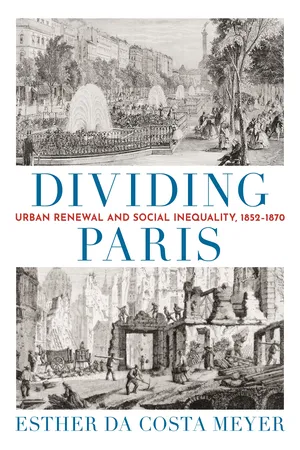
In the mid-nineteenth century, Napoleon III and his prefect, Georges-Eugène Haussmann, adapted Paris to the requirements of industrial capitalism, endowing the old city with elegant boulevards, an enhanced water supply, modern sewers, and public greenery. Esther da Costa Meyer provides a major reassessment of this ambitious project, which resulted in widespread destruction in the historic center, displacing thousands of poor residents and polarizing the urban fabric.
Drawing on newspapers, memoirs, and other archival materials, da Costa Meyer explores how people from different social strata—both women and men—experienced the urban reforms implemented by the Second Empire. As hundreds of tenements were destroyed to make way for upscale apartment buildings, thousands of impoverished residents were forced to the periphery, which lacked the services enjoyed by wealthier parts of the city. Challenging the idea of Paris as the capital of modernity, da Costa Meyer shows how the city was the hub of a sprawling colonial empire extending from the Caribbean to Asia, and exposes the underlying violence that enriched it at the expense of overseas territories.
This marvelously illustrated book brings to light the contributions of those who actually built and maintained the impressive infrastructure of Paris, and reveals the consequences of colonial practices for the city's cultural, economic, and political life.
- 400 pages
- English
- ePUB (mobile friendly)
- Available on iOS & Android
eBook - ePub
About this book
Information
Topic
ArchitectureSubtopic
History of ArchitectureIndex
- Note: Page numbers in italic type indicate illustrations.
- About, Edmond, 320, 341n124
- Académie des Beaux-Arts, 69
- Achard, Amédée, 115, 308
- aqueducts, 140, 159f, 167–69, 178, 186, 259; Arcueil/Lutèce, 159, 169; Belleville, 159, 169; Marie de Médicis, 159f, 169; Pré-Saint-Gervais, 159, 169; Sens (Burgundy), 169; Vanne, 168, 169, 170, 171
- affluent classes. See upper classes
- Africa, 7, 8, 63, 227, 285, 311, 316
- Agassiz, Louis and Elizabeth Cabot Cary, 227; A Journey in Brazil, 227
- Agoult, Marie, comtesse d’, 6, 225, 234
- Agrippa, 186
- Ahasuerus, 135
- Aimard, Gustave, 55; Les Peaux-Rouges de Paris, 55
- Albert, Prince, 295
- Alexander II (Tsar), 193
- Algeria, 17, 63, 70, 242, 315, 315, 316
- Alphand, Jean-Charles-Adolphe, 13, 61, 71, 114, 121f, 127, 166f, 171, 172, 185, 190, 196, 214, 226, 228, 231–39, 232, 235, 236, 240, 241, 241, 242, 242, 245, 246, 247, 248, 250, 252, 253, 257f, 261, 263–66, 267, 268, 271, 274, 275f, 277, 278f, 324, 337n165, 350n198, 360n193, 364n44, 365n55, 366n94, 369n211, 370n260, 371n285; Les promenades de Paris, 13, 171, 185, 231, 232, 232, 233, 236, ...
Table of contents
- Cover Page
- Title Page
- Copyright Page
- Dedication
- Contents
- Acknowledgments
- Abbreviations
- Introduction
- One: The President, the Emperor, and the Prefect
- Two: Requiem
- Three: Streets and Boulevards
- Four: Water
- Five: De Profundis
- Six: Disenchanted Nature
- Seven: The Periphery
- Conclusion
- Notes
- Index
- Photography and Copyright Credits
Trusted by 375,005 students
Access to over 1.5 million titles for a fair monthly price.
Study more efficiently using our study tools.
Frequently asked questions
Yes, you can cancel anytime from the Subscription tab in your account settings on the Perlego website. Your subscription will stay active until the end of your current billing period. Learn how to cancel your subscription
No, books cannot be downloaded as external files, such as PDFs, for use outside of Perlego. However, you can download books within the Perlego app for offline reading on mobile or tablet. Learn how to download books offline
Perlego offers two plans: Essential and Complete
- Essential is ideal for learners and professionals who enjoy exploring a wide range of subjects. Access the Essential Library with 800,000+ trusted titles and best-sellers across business, personal growth, and the humanities. Includes unlimited reading time and Standard Read Aloud voice.
- Complete: Perfect for advanced learners and researchers needing full, unrestricted access. Unlock 1.5M+ books across hundreds of subjects, including academic and specialized titles. The Complete Plan also includes advanced features like Premium Read Aloud and Research Assistant.
We are an online textbook subscription service, where you can get access to an entire online library for less than the price of a single book per month. With over 1.5 million books across 990+ topics, we’ve got you covered! Learn about our mission
Look out for the read-aloud symbol on your next book to see if you can listen to it. The read-aloud tool reads text aloud for you, highlighting the text as it is being read. You can pause it, speed it up and slow it down. Learn more about Read Aloud
Yes! You can use the Perlego app on both iOS and Android devices to read anytime, anywhere — even offline. Perfect for commutes or when you’re on the go.
Please note we cannot support devices running on iOS 13 and Android 7 or earlier. Learn more about using the app
Please note we cannot support devices running on iOS 13 and Android 7 or earlier. Learn more about using the app
Yes, you can access Dividing Paris by Esther da Costa Meyer in PDF and/or ePUB format, as well as other popular books in Architecture & History of Architecture. We have over 1.5 million books available in our catalogue for you to explore.