"I have a right to appear here. Otherwise, who will listen to me? Where should I talk about myself, if not here?"
Ultimo has a degree in piracy from Mogadishu University of Applied Sciences. Tofdau won't rest until his story's told. Sergeant Pellner and Officer Dorsch are sailing up the Hindu Kush in search of Lieutenant Colonel Deutinger in the rainforest of Afghanistan. And at his parents' home in Bad Rippoldsau, Wolfram Lotz is experiencing writer's block.
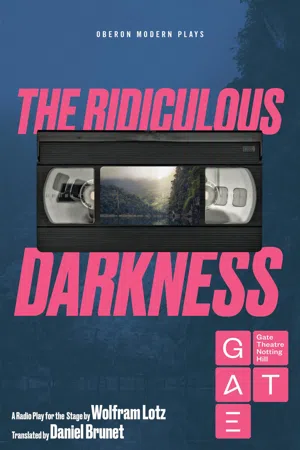
Critically acclaimed dark comedy The Ridiculous Darkness, by award-winning German playwright Wolfram Lotz, is a surreal, hilarious and powerful response to Heart of Darkness and Apocalypse Now that invites us to rethink colonial narratives, confront our ideas of each other and question what we imagine is in the darkness.
Four black femmes. Three revered White Male Writers. Two classic works. A radical deconstruction.
- 80 pages
- English
- ePUB (mobile friendly)
- Available on iOS & Android
eBook - ePub
The Ridiculous Darkness
About this book
Information
II. The Journey on the River
1.
My name is Oliver Pellner, I am a Sergeant First Class in the Bundeswehr. My mission was to find Lieutenant Colonel Karl Deutinger so that he could be liquidated. Deutinger was part of a three-person special unit that was underway on a secret mission oneand-a-half years ago in the woods in the eastern part of the country. The enterprise, however, did not come to fruition, because Deutinger, as far as I could tell from the documents I was issued, killed his two comrades, Ingo Petrov and Matthias Wenske, in a fit of madness. My task was now to find Deutinger in the target area and pass on his exact location to the command center for an airstrike.
For this purpose, I was now to cruise up the Hindu Kush with a patrol boat into the target area. Now people say: “The Hindu Kush isn’t a river, it’s a mountain range.” They see something on television and then just believe it and say that they know that the Hindu Kush is a mountain range. But I was there, I cruised up the Hindu Kush. It is a dark, slowly flowing river. I cruised up it searching for Lieutenant Colonel Deutinger, into the rain forests of Afghanistan, accompanied only by Non-Commissioned Officer Stefan Dorsch, who piloted our patrol boat. It’s best to let Stefan Dorsch himself say something briefly about his person.
STEFAN DORSCH: What should I say Mr. Sergeant First Class?
PELLNER: Well, for example, that you’re from East Germany.
STEFAN DORSCH: Okay. Well, I come from East Germany, from Bernburg in Saxony-Anhalt.
PELLNER: And something about your professional qualifications?
STEFAN DORSCH: I studied social work.
PELLNER: You have to add that you didn’t finish your studies.
STEFAN DORSCH: Yes, without finishing my studies.
PELLNER: And say a little bit about how you came to be in the Bundeswehr.
STEFAN DORSCH: What exactly do you mean?
PELLNER: The thing about the bad situation where you come from.
STEFAN DORSCH: Yes, ok, well, I joined the Bundeswehr because I didn’t find a job after my studies. I enlisted. It was already clear that I would have to go to the war zone, but I thought that’s still better than being unemployed.
PELLNER: Exactly. But you didn’t just simply enlist. You had doubts due to your personal situation.
STEFAN DORSCH: Yes, good, that’s true.
PELLNER: You should say a little bit about that too!
STEFAN DORSCH: Yes?
PELLNER: Of course, only if you want to!
STEFAN DORSCH: Well good, okay.
I had my first girlfriend at the time, and we had only been together for a month and a half. That’s also four years ago now. In the meantime I’m 31, and of course it was also a thing where I thought: if I enlist and have to be deployed abroad, it’s going to make it nearly impossible to find someone. And that’s the most important thing, that you have someone. Also sexuality of course, sure.
I miss that.
Pause.
Should I say anything else about myself?
PELLNER: No, thank you, that’s enough for now.
STEFAN DORSCH: But I still have a question, Mr. Sergeant First Class.
PELLNER: Yes?
STEFAN DORSCH: I’m taking you up the river, I know that much, but what exactly is our mission?
Oh, these questions! I wasn’t allowed to tell him, since our mission was top secret. (Pause.) I just acted as if I hadn’t heard him at all.
2.
A few days after we set off, we reached the last proper station before the beginning of complete wilderness, as planned. The camp was operated by Italian UN Blue Helmet soldiers. They must have seen us coming from a long way off since the commander, a certain Lodetti, had come down to the dock to welcome us.
Lodetti took us up to the camp. Several dozen natives were hanging about on the hillside, some were lying under a tree and sleeping, others were sitting around a fire, over which they roasting a snake, still others were sitting before a cliff and playing some kind of game with dice in the afternoon heat. They seemed not to take any special notice of us.
“What are these people doing here?” I asked. Lodetti answered approximately the following:
LODETTI: They’re harvesters. They’re spending their lunch break here. They’re safe from the attacks of the Taliban here.
PELLNER: Why are they spending their lunch break on this steep hillside?
LODETTI: Oh, stop it! They were always in the camp at first, but that just didn’t work.
STEFAN DORSCH: What was the problem?
LODETTI: These natives… how should I say it… these people are completely uncivilized. The problem was the use of the toilets. We tried for a long time to teach them to sit down to pee, but there was always someone amongst them who just didn’t do that. There were always little splashes on the toilet seat. Twice there were even streaks in the bowl, because they clearly didn’t use the toilet brush. It simply didn’t work. But it also was not a solution to let them just go behind the camp instead, in this hot climate, it starts to smell immediately. At some point, I had the idea that they could just spend their lunch break on the hillside along the river. It isn’t optimal, but they’re still protected by our camp and, most importantly, they can just go in the river, which has ultimately proved to be the best solution. And it is really just a matter of the lunch break, at night they go back to their villages.
PELLNER: What kind of work are these people doing here?
LODETTI: They harvest coltan in the woods, one is quite far from conducting sensible farming in this country. Coltan is used to manufacture cellular phones, European companies pay good money for it, and if we didn’t keep an eye on the harvest, the Taliban would hog the profits.
STEFAN DORSCH: That means the station was built here for this?
LODETTI: Yes, why else would you have the idea of building a station here in the wilderness? We’re sitting here completely cut off from everything. We’ve been trying to get Internet here for months, but it simply isn’t possible, you can completely forget about television. Can you imagine that? We’re sitting here in the middle of the war zone, but we don’t even realize it because we don’t have TV or Internet here. Now and then grenades are shot at us from the woods and there are always attacks from individual units, but we don’t see any more of the war than that,...
Table of contents
- Front Cover
- Half-Title Page
- Title Page
- Copyright Page
- Contents
- I. Prologue of the Somali Pirate
- II. The Journey on the River
Trusted by 375,005 students
Access to over 1.5 million titles for a fair monthly price.
Study more efficiently using our study tools.
Frequently asked questions
Yes, you can cancel anytime from the Subscription tab in your account settings on the Perlego website. Your subscription will stay active until the end of your current billing period. Learn how to cancel your subscription
No, books cannot be downloaded as external files, such as PDFs, for use outside of Perlego. However, you can download books within the Perlego app for offline reading on mobile or tablet. Learn how to download books offline
Perlego offers two plans: Essential and Complete
- Essential is ideal for learners and professionals who enjoy exploring a wide range of subjects. Access the Essential Library with 800,000+ trusted titles and best-sellers across business, personal growth, and the humanities. Includes unlimited reading time and Standard Read Aloud voice.
- Complete: Perfect for advanced learners and researchers needing full, unrestricted access. Unlock 1.5M+ books across hundreds of subjects, including academic and specialized titles. The Complete Plan also includes advanced features like Premium Read Aloud and Research Assistant.
We are an online textbook subscription service, where you can get access to an entire online library for less than the price of a single book per month. With over 1.5 million books across 990+ topics, we’ve got you covered! Learn about our mission
Look out for the read-aloud symbol on your next book to see if you can listen to it. The read-aloud tool reads text aloud for you, highlighting the text as it is being read. You can pause it, speed it up and slow it down. Learn more about Read Aloud
Yes! You can use the Perlego app on both iOS and Android devices to read anytime, anywhere — even offline. Perfect for commutes or when you’re on the go.
Please note we cannot support devices running on iOS 13 and Android 7 or earlier. Learn more about using the app
Please note we cannot support devices running on iOS 13 and Android 7 or earlier. Learn more about using the app
Yes, you can access The Ridiculous Darkness by Wolfram Lotz, Daniel Brunet in PDF and/or ePUB format, as well as other popular books in Media & Performing Arts & European Drama. We have over 1.5 million books available in our catalogue for you to explore.