What is the future of food in light of growing threats from the climate emergency and natural resource depletion, as well as economic and social inequality? This textbook engages with this question, and considers the complex relationships between food, place, and space, providing students with an introduction to the contemporary and future geographies of food and the powerful role that food plays in our everyday lives. Geographies of Food explores contemporary food issues and crises in all their dimensions, as well as the many solutions currently being proposed. Drawing on global case studies from the Majority and Minority Worlds, it analyses the complex relationships operating between people and processes at a range of geographical scales, from the shopping decisions of consumers in a British or US supermarket, to food insecurity in Sub-Saharan Africa, to the high-level political negotiations at the World Trade Organization and the strategies of giant American and European agri-businesses whose activities span several continents. With over 60 color images and a range of lively pedagogical features, Geographies of Food is essential reading for undergraduates studying food and geography.
eBook - ePub
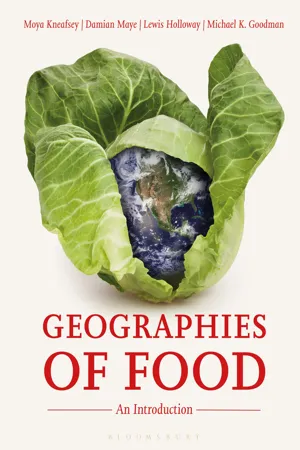
Geographies of Food
An Introduction
- 368 pages
- English
- ePUB (mobile friendly)
- Available on iOS & Android
eBook - ePub
About this book
Trusted by 375,005 students
Access to over 1.5 million titles for a fair monthly price.
Study more efficiently using our study tools.
Information
1 Introducing Geographies of Food
1.1 Introduction
There is nothing more geographical than food. Eating connects us to the land, to animals, to technologies and virtual space, to ecological processes, and to other people both near and far, in multiple places and spaces and across multiple scales. It connects us into relationships of power, politics, and identity, questions of agency and structure, relations of inequality and (in)justice, and feelings of despair and hope. Biting into an apple, a cassava, or a hamburger might connect you to your own backyard or garden, to a local, outdoor market, a complex refrigerated supply chain, or a landscape thousands of miles away. That same bite might tie you into networks of global food policy, international trade, urban activists working to create “food justice,” farmer-led movements to assert “food sovereignty,” or even to “happy cows” that ate grass and lived on pastures, rather than inside a confined animal feeding operation (CAFO) or “factory farm.” These food networks can be simple or complex, fair or unequal, “good” or “bad,” local or global—and sometimes many of these things at once. You may know nothing at all about what you are eating except that the food on your plate tastes good. Or, you may have acquired foods sold and packaged with “stories”—and geographical stories at that—telling you about their origins, about their ethics and who might have touched them along the way. Any way you square it, food and its geographies are intimately and inseparably connected.
To understand how food stitches together such a wonderful mosaic of materialities, people, places, spaces, and scales—and at the same time how foods themselves are produced by these geographies—it takes what David Harvey (1990) and others have called a “geographical imagination.” This geographical imagination is vital in helping us to understand and interpret the vast array of information and data now available concerning food and all its many dimensions. For example, we can uncover information about who eats what through maps showing, for instance, how much corn is produced in the US or how much meat is consumed in parts of Africa. Yet, without a geographical imagination that works to understand the food stories of these places, we are unable to understand those data or to interpret why those maps look the way they do. Knowing data and seeing maps are important, but how we see them, how they are contextualized and the connections embedded in their representations can only be understood through a sensitivity to geography. A geographical imagination provides a powerful window, not just on who eats what, but also on how the world’s food systems are put together and why food production and consumption work—or don’t—for different people and places.
The main aim of this book is to encourage and support you to use your geographical imagination to critically analyze the shifting places and spaces of food and the multiple, complex, and often uneven relationships of power that connect them. In order to start out on this endeavor, this first chapter introduces some of the key conceptual ingredients which you will need in order to bring your geographical imaginations of food to life. We start by outlining what we mean by the concept of “food geographies.” This involves unpacking the multiple meanings of food and then considering how these meanings relate to core geographical concepts of place, space, scale, and mobility. We then focus on the idea of “geographical imaginations,” and introduce some of the main ways in which Geography, as an academic discipline, with a particular history, concepts, and methodologies, has contributed to the patterns and processes of food production and consumption that we see today.
1.2 What are food geographies?
In general terms, we use the concept of “food geographies” to describe the spatial distribution, patterns, and arrangements of food production, distribution, and consumption around the world. This distribution is far from accidental, and has been shaped by the complex interplay of many relationships between and amongst people, animals, plants, and the environment. These relationships have often been uneven, and infused with power and control. Before delving more into the spatialities of food though, we first of all need to pause and consider what food actually is.
1.2.1 Multiple food meanings
Food is an essential ingredient for human life, along with water and air. We need food to live, and what we eat helps to shape our physical identity: our body shape is partly related to eating behaviours and these in turn are often established during childhood (in fact, even before birth our future health is influenced by what our mother ate). Our diet is a major influence on our health and indeed the health of the planet, and also impacts upon how we perceive ourselves at different stages in life. Did we have an abundance or scarcity of food when growing up? Do we now think of ourselves as too fat, too thin, or just right? Can we change this if we want to? Are we a “healthy” or “ethical” eater, and what does it mean to eat “healthily” or “ethically”? What did we learn about food when we were growing up and how does this influence our choices today?
However, we should think about food beyond its role in fulfilling a fundamental human need, because in reality food has multiple meanings. There are a number of different dimensions to this multiplicity. For example, the same plate of food can taste very different to different people or even at different times in your life. While we all have to eat, our experience of food is refracted through the many varied and intersecting layers of our identity, including but not limited to our place of birth and childhood, our age, family situation, class, race, gender, body shape, and health conditions. The same food can be acceptable or desirable to some, while being disgusting or taboo to others. We can understand this multiplicity of food as being material-semiotic. This means that food simultaneously has material, physical characteristics and is embedded with multiple layers of meaning and cultural significance. So, food is material in terms of the actual, physical plants and animals that grow or are reared, that move around, and that you cook and eat. It is also semiotic—that is, involved in the making and communication of meaning—so that it can be represented and representational in things like advertisements, on social media and food labels. Food can be as much, if not more, in your mind and imagination as on the end of the fork in front of you. Within these multiple layers of meaning, food can take on sacred importance through religious festivals and it can represent national or local identities, cultures, and landscapes. It can be seen as simply fuelling one’s body for everyday life, or as highly tuned fuel driving sporting performance. Foods—and even exactly the same foods depending on quantities—can be healthy and nutritionally sufficient, and they can be unhealthy and nutritionally insufficient. Food can be used as a political weapon by withholding it and causing famines or it can be imbued with “commensality,” joy, and collectivity through family meals, community festivals, and political activism. It can be a source of celebration or shame, or it can be a source of wealth to be traded on futures markets and through financial instruments. Food can move us, in sometimes unexpected ways. It can change your mood, and your moods can change it and how you think about it: inspired by a celebrity chef you might just think, “I’ll cook that differently today!” Food prepared by a loved one comes laden with emotional baggage. The smells and tastes, even just the memory, of certain foods can remind us of other places and times, perhaps of our childhoods. We can get nostalgic with food. In these ways, food is strongly associated with our individual and cultural identities and experiences. It “identifies who we are, where we came from, and what we want to be” (Belasco 2008: 1). It also has affect, meaning more than (just) an association with meaning and identity, and implying an inexpressible and sometimes profoundly moving set of feelings and sensations, potentially both joyous and melancholic.
José Luis Vivero Pol (2017b) identifies six different—and sometimes competing—“dimensions” of food (Fig. 1.1). We’ve already discussed what is perhaps the most obvious dimension, which is that food is essential for human life. Additionally, as Vivero Pol shows, food can be thought of as a natural, renewable resource, being based on domesticated and wild plants and animals—although of course its renewability entirely depends on how it is managed. Another dimension is that food is what Vivero Pol calls a “cultural determinant.” In many symbolic and practical ways, food forms an integral part of our cultural identities. Eating is of fundamental importance to the experience of being human. In most cultures, for example, eating together in family or kinship groups is when social identities, relationships, and hierarchies are performed, such as who does the food preparation and washing up, who is allowed to speak, or who sits at the “head” of the table. Our encounters with food are so powerful that even the smell of particular foods can evoke memories (either happy or sad) of childhood many years later. This is one reason why migrants often seek out particular foods which remind them of home.
As well as forming the memories, practical knowledge, and sense of self which contribute to our individual identity, the production, preparation, consumption, and disposal of food shapes the way our surroundings look, sound, and smell (for further discussion of this, see Chapter 2). Think of how agricultural landscapes are shaped by the work of the farmers to produce the foods that have become integral to our perceptions of different countries around the world: terraced paddy fields producing rice in China, the great plains of North America growing grain for the meat and wheat-based diets that are now becoming global, the stone-walled fields of England’s northern uplands enclosing lambs for the British “Sunday roast.” These are typical, “iconic” landscapes, which become enrolled into popular representations or images of the different nations in which they are located. Food doesn’t just shape rural landscapes though. Think about the urban fabric of towns and cities: who could imagine a French village without its bakery and the delicious smell of freshly baked bread and pastries wafting out of the door? Or a bustling New York street without its busy eateries and the jostling of tastes and aromas from a hundred cuisines from a hundred different places? Or a town square without its busy weekly market selling local specialties and filled with the noise, hustle, and bustle of people looking for their favorite foods? The work that goes into the production, processing, retailing, distribution, and consumption of food shapes the geographies, landscapes, infrastructures, and public and domestic spaces of everyday life—often in entirely mundane ways which are barely even noticed in daily routines.

Fig. 1.1 Six dimensions of food. Source: Vivero Pol 2017b: 6.
Food is moved around because it is a tradeable good, the fourth of Vivero Pol’s dimensions. Food has been traded since the origin of settled agricultural societies. In contemporary food trade, food is often regarded as a commodity (Vivero Pol 2017b). Agricultural commodities include grains (e.g. rice or wheat) and sugar. The price of commodities is usually determined by international markets. The idea of food as a commodity is very different to the ways in which food is understood in many Indigenous cultures, for example where food is often regarded as a common good or a “gift” which is acquired through cultivating relationships of care and respect for soils, plants, animals, water, and kin (Daigle 2017). As Jennifer Clapp writes (2012: 17):
[W]e have moved increasingly away from food being viewed primarily as a source of nourishment and a cultural feature of society, and toward food as any other product that firms produce, sell and trade. The people who eat those food products in turn have been reduced to “consumers,” rather than being considered simply as “eaters.” Distance between the production and the eating of food, is increased by the commodification of food within the global economy.
The distancing or “disconnection” of people from food has very real impacts on people’s lives. As Clapp (2012) explains, it means that access to food becomes a market transaction and so people’s ability to acquire food is largely determined by their ability to pay for it. The ability to pay is unevenly distributed throughout society, with the effect that some people are excluded from accessing enough nutritious food. The commodification of food is also associated with “de-skilling,” which refers to the loss of knowledge and skills about how to grow, prepare, store, and preserve food (Howard 2016). This in turn creates greater dependency on food companies that provide “convenient” foods and ready-to-eat meals which require little skill or time to prepare—and encourages the purchase of required technologies such as large fridge-freezers, microwaves, and dishwashers.
For many critics of the way our current food system works, the commodification of food is the root cause of hunger and environmental destruction. As Agyeman and McEntee (2014: 217) put it, “contemporary food injustices are the direct result of a commodity-driven system where hunger is a by-product of profit.” This is because, as Vivero Pol (2017b) explains, the commodification of food presents a direct contradiction and challenge to the concept of food as a universal human right (for more on this, see Chapter 8).
An alternative construction of food, and Vivero Pol’s sixth dimension, is to see it as a public good. Unlike private goods, which are allocated by market forces, these are goods which are provided to all members of a society, usually by public institutions. Consumption by one person doesn’t reduce the availability of the good to another person, or exclude anyone from access. In theory, anyone can benefit from public goods, even if they have not paid for them. Public goods are usually produced by governments because the market does not. Typical examples include public infrastructure such as sewage systems and pavements, or services such as education and defense, although in many countries previously public goods are increasingly commodified (e.g. university education, health care). Another, related way to think of this is to conceive of food as a “commons.” Commons are resources that can be accessed and used by the community that governs their management, whether this be on a local, national, or global scale. In simple terms (following Quilligan 2013), whereas public goods are those requiring management by the state (on a local, regional, or national scale), common goods, or commons, are those which result from the expression of mutual and collaborative effort by social groups. According to Vivero Pol, “[T]he consideration of food as commons rests upon revalorizing the different food dimensions that are relevant to human beings, thereby reducing the importance of the tradeable dimension that has rendered it a mere commodity” (2017b: 8). Food regarded as a commons would be governed in a polycentric1 manner by “food citizens” (rather than food “consumers”) who develop “food democracies” which adequately value the different dimensions of food. To paraphrase from Vivero Pol, every eater should have a say in how ...
Table of contents
- Cover
- Dedication
- Series Page
- Title Page
- Contents
- List of Figures
- List of Tables
- List of Boxes
- List of Activities
- Insights
- Acknowledgments
- Preface
- Part 1 The Place of Food
- 1 Introducing Geographies of Food
- 2 Food and Place Identity
- Part 2 Geographies of Food Production, Transformation, and Consumption
- 3 Geographies and Politics of Agricultural Production
- 4 What Happens to Food? Geographies of Mobility and Transformation
- 5 Eating Geographies: The Spaces and Cultures of Food Consumption
- Part 3 Geographies of Food Crisis and Response
- 6 Food Systems in Crisis? The New Food Insecurity
- 7 The Fight against Hunger and Malnutrition in the Majority World
- 8 Food Insecurity amidst Wealth
- 9 Reconnecting Consumers, Producers, and Food
- Part 4 Geographies of Possible Food Futures
- 10 Future Scenarios for Sustainable Food and Farming
- 11 Conclusions
- Bibliography
- Index
- Copyright
Frequently asked questions
Yes, you can cancel anytime from the Subscription tab in your account settings on the Perlego website. Your subscription will stay active until the end of your current billing period. Learn how to cancel your subscription
No, books cannot be downloaded as external files, such as PDFs, for use outside of Perlego. However, you can download books within the Perlego app for offline reading on mobile or tablet. Learn how to download books offline
Perlego offers two plans: Essential and Complete
- Essential is ideal for learners and professionals who enjoy exploring a wide range of subjects. Access the Essential Library with 800,000+ trusted titles and best-sellers across business, personal growth, and the humanities. Includes unlimited reading time and Standard Read Aloud voice.
- Complete: Perfect for advanced learners and researchers needing full, unrestricted access. Unlock 1.5M+ books across hundreds of subjects, including academic and specialized titles. The Complete Plan also includes advanced features like Premium Read Aloud and Research Assistant.
We are an online textbook subscription service, where you can get access to an entire online library for less than the price of a single book per month. With over 1.5 million books across 990+ topics, we’ve got you covered! Learn about our mission
Look out for the read-aloud symbol on your next book to see if you can listen to it. The read-aloud tool reads text aloud for you, highlighting the text as it is being read. You can pause it, speed it up and slow it down. Learn more about Read Aloud
Yes! You can use the Perlego app on both iOS and Android devices to read anytime, anywhere — even offline. Perfect for commutes or when you’re on the go.
Please note we cannot support devices running on iOS 13 and Android 7 or earlier. Learn more about using the app
Please note we cannot support devices running on iOS 13 and Android 7 or earlier. Learn more about using the app
Yes, you can access Geographies of Food by Moya Kneafsey,Damian Maye,Lewis Holloway,Michael K. Goodman in PDF and/or ePUB format, as well as other popular books in Politics & International Relations & Agricultural Public Policy. We have over 1.5 million books available in our catalogue for you to explore.