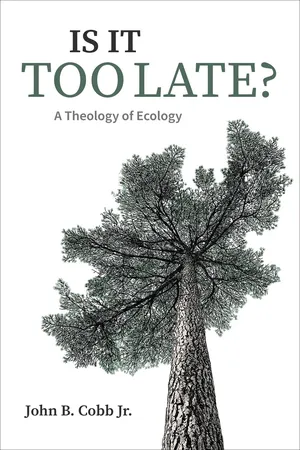
In the fifty years since its initial publication, Is It Too Late? has proven its prescience in ways both significant and dire. As the first book-length philosophical and theological analysis of the environmental crisis, this work introduced a generation to the key elements of crisis while suggesting ways that religion can be a force for hope rather than an instrument of despair. Covering an ambitious range of issues--from deforestation to abortion, from religious views of the natural world to the need for technological innovation to avoid nature's destruction--John Cobb moves deftly from philosophical to theological to scientific learning and integrates these interdisciplinary insights into a compelling vision for what he calls "a new Christianity." Comprehensive in scope, non-technical in expression, and concise in length, Is It Too Late? provides the scholar and the student alike with a readable and compelling orientation to the philosophical and theological stakes of ecology. This Fortress edition includes a new preface in which Cobb reflects on the current situation, the specific promises and perils we now face, and how his own thinking on matters theological and ecological has evolved in the last half century.
- 157 pages
- English
- ePUB (mobile friendly)
- Available on iOS & Android
eBook - ePub
About this book
Information
Topic
Theology & ReligionSubtopic
EcologyWhat’s the Problem?
The great question of the seventies is: shall we . . . begin to make reparations for the damage we have done to our air, to our land, and to our water?—Richard M. Nixon1
Simple arithmetic yields astounding results. It shows that beginning with a hundred dollars, you only have to double your money ten times in order to have a hundred thousand dollars. If you double it ten more times, you would have a hundred million dollars. Since most of us could raise a hundred dollars, this is very encouraging. It seems to make wealth more accessible than we ordinarily think.
But the same rate of growth applies in other areas where the results are frightening. For example, if the world population continues to double about three times a century, by 2300 it will have increased a thousandfold, and by 2633 it will have increased a millionfold. In 2300 there will be three and a half trillion people, and in 2633 there will be 3,500,000,000,000,000. The latter figure is too much for our imagination. The former is bad enough. In fact, one thing of which we can be certain is that there really won’t be three and a half trillion people in 2300. Can you imagine Japan with one hundred billion people—that is, thirty times the present population of the whole planet? Or can you imagine China with eight hundred billion, or even this country with two hundred billion? No, that is all quite impossible. Something will happen to prevent it.
When driving across vast barren stretches of the American West, one might recall that once great herds of buffalo found tall grass growing there. We know that we slaughtered the buffalo, but we ask what has happened to the grass. Sometimes the answer is that sheep were brought in, and in a few years brambles took over. Sometimes we learn that wells were drilled and the water table lowered. But there were other, more favored lands to which people could move.
For some years those of us who live in Southern California have been complaining about the smog. It stings the eyes, aggravates the sinuses, reduces the grape harvest, and hides the beauty of the mountains from our view. We have been told that it is the result of local problems of atmospheric inversion and that stricter controls will take care of it.
From time to time an old swimming hole or a once fashionable beach is closed. The sanitation department tells us it is no longer suitable for swimming. But we can build fine new swimming pools and fill them with chemically purified water. Streams and pools in which we once fished are now dead, but with our superior transportation we can go higher into the mountains to catch fish supplied to those lakes and streams by our public hatcheries.
In 1966 the East Coast suffered a spectacular blackout because of an electrical power failure. Less publicized failures are not infrequent occurrences. But more generating plants can be built, and the electrical grid of the nation can be interconnected.
The last dodo died in 1689, and a hundred more species of birds have since vanished forever. But there are plenty of other birds. The California grizzly is extinct, but there are plenty of other bears. The giant Galápagos turtle will soon be gone from its native home, but the San Diego Zoo will preserve the species.
Both the United States and the Soviet Union have enough atomic weapons to destroy all humanity several times over. Their arsenals of chemical and bacteriological warfare are no less potent. But they exercise restraint.
One out of every four persons born today will carry through life the irreversible physical or psychological effects of malnutrition. Thousands starve every day. Protein deficiency stunts the normal development of intelligence. We are assured that agricultural technology will solve these problems.
Insect pests develop new strains capable of surviving chemical insecticides, while their natural enemies, the birds, are killed. We undertake to control the use of such insecticides while raising the official level of allowable contamination in milk and poultry.
For some time we have been more or less aware of one or more of these matters. We have felt some sadness, even a little anger, but we have accepted them as the price of progress. If the situation ever became really serious, we assure ourselves, our leaders would correct it.
It is only quite recently that we have begun to realize that all these problems are interconnected and cumulative. The attempt to solve one problem all too often worsens others. Furthermore, they are neither local nor temporary. The transformation of forests and grasslands into brambles and dustbowls has been going on for thousands of years. Ancient civilizations collapsed when they destroyed their agricultural base, but these were local problems. Now civilization is worldwide, and if our worldwide resources in soil are further depleted, there will be nowhere left to turn.
Smog may be an especially severe problem in the Los Angeles basin because of atmospheric inversion, but it is now a national and worldwide problem as well. The smog of Tokyo is breathed in California. It is not the air here and there, but the total planetary atmosphere that is being poisoned.
It is no longer just an occasional stream that has been turned into a sewer. Most of our major waterways are seriously polluted. Lake Erie is dead, and Lake Michigan is fast dying. Even Lake Tahoe is affected! When Paul Ehrlich wrote a science fiction scenario entitled The Year the Oceans Died projecting present trends, his date was not 2300 but 1979!
The problem of an adequate supply of electrical power is proving to be nationwide. Good sites for more dams are becoming scarce. The public is alerted to the risks of atomic power. The use of coal and oil pollutes the air and hastens the depletion of these resources.
Whereas species of birds and animals have become extinct throughout history, the rate is increasing rapidly. From A.D. 1 to 1800 one species of mammal was exterminated each fifty-five years. In this century the rate of extinction is one per year. Today the threat to their survival is wholesale. In some instances they are decimated by more efficient and ruthless methods of hunting. In others their ancient habitats are taken over. In still others their environment or their food is poisoned. Rachel Carson foresees a “silent spring” when birds will sing no more.
The United States and the Soviet Union may continue to exercise restraint in the employment of their ultimate weapons, but more and more countries are gaining possession of them. Even if these resist the temptation to use them, danger remains. The problem of storage and disposal of radioactive wastes has not been solved, and we dump outdated bacteriological weapons into the ocean on the untested assumption that the water will sufficiently dilute their virulence to prevent major damage.
Although we are making a little progress in controlling the use of DDT, we must remember that great quantities are already lying around in our soil and water, finding their way up the food chain to us and being carried through the rivers to the continental shelves. We must watch helplessly as they do their work of damage both in our own bodies and in the minute marine life that is the basis for the food chain in the ocean. Virtually all of California’s oceanic birdlife is already doomed. Meanwhile, our chemical industry continues to produce new products whose effects upon our environment are unknown. And while we are beginning to be more careful with our insecticides and weed poisons, the pressure of population on the food supply of the underdeveloped world greatly increases the demand for dangerous chemicals there.
At the moment, newly developed high-yield grains are bringing about a “green revolution.” Perhaps India will be able to feed its present population after all. This is cause for great rejoicing. But the risks, too, are great. The new strains of grain may prove subject to as yet unknown pests and diseases to which the native strains were resistant. The tragedy of the Irish in the last century points up the danger. There the whole national agriculture shifted to potatoes because of the quantity that could be grown. The population of the island multiplied. Then came the potato blight. Millions starved and other millions emigrated to save their lives. If the “green revolution” encourages the upward spiraling of India’s already vast population, the result of a blight could be disastrous indeed! The present corn blight in this country reminds us that even our scientific and technological skills are sometimes impotent.
We are being made to realize that the problem of overpopulation is not one of the distant future; we cannot put it out of our minds with the assurance that something will happen before it becomes serious. It is a problem now. It is not a simple problem. Not all lands are crowded. In some cases the problem is more the rate of growth than the absolute population.
The problem of overpopulation is quite different in industrially advanced and in underdeveloped countries. In the latter, rapid increase of agricultural and industrial production is very difficult. Without outside aid a growth rate of 2 or 3 percent per year is difficult to sustain over long periods of time That rate of growth would be encouraging if it meant that living standards rose 20 to 30 percent per decade. But in most such countries the rate of growth of population equals that of production. Immense efforts are needed just to prevent further worsening of the already miserable quality of life. In countries where the population growth rate is very high, the battle is already being lost.
The industrial nations have a quite different problem. If their population growth rates were as large as those of many underdeveloped lands, they, too, would experience difficulties. If the population of the United States doubled in the next twenty years, we would not only have to replace all obsolete facilities but also double the quantity of homes, factories, highways, schools, hospitals, post offices, food production, and so forth just to keep up our present standards. This would involve as much production and construction in the next twenty years as we have managed in our total past history; and that would be no mean task even for us! But the population grows much more slowly in this and other industrialized lands. Raising the already comfortable standard of living is not difficult for us.
But it is just in these industrialized lands, and especially in the United States, that the other major problem of overpopulation arises—the problem of overconsumption. It has been estimated that the average American consumes from thirty to fifty times as much of the world’s resources as the average Indian. Thus while the increasing population of India creates serious problems for the Indian people, their total impact on the resources of the planet is moderate. We, on the other hand, experience only minor and local ill effects from crowding. But it is our population, and not that of India, that threatens to pollute the skies and oceans and to make the whole world a far poorer place for our descendants.
Those who ridicule the idea that the United States should control its population when there is still much unpeopled land can argue that this country could support ten times its present population. They are right. Ten times our present population could live in this country on the standard of living now endured by the Indian peasant. But if we ask instead whether the world can afford a long continuance of even our present national level of consumption, the answer must be negative. If we wish to continue and pass on to our children anything approaching our present style of life, we are already overpopulated.
Furthermore, the underdeveloped world will not be content to wallow indefinitely in its misery while the industrial nations use up the remainder of the world’s irreplaceable resources. A stable world order will require that the industrial nations cooperate with the others in their industrialization also so that they may have hope of escaping their present treadmill. But it is simply not possible for even the existing world population to consume at the present American rate. There isn’t that much to be consumed, and the total resources are declining, not increasing. If we are to set the norm for per capita consumption for the planet, we must learn to consume less as a nation.
I have been speaking of the exhaustible resources of our planet. It is widely recognized that fossil fuels are in limited supply, and it is obvious that if the average per capita consumption of petroleum in the world equaled that in the United States, the world supply would be used up in a few years. The same is true of many metals and minerals.
The story is similar with respect to timber and soil. Even now the forests of the world are being annually reduced. If the rate of consumption of timber products by all people averaged that in the United States, deforestation would be extremely rapid. And if we can conceive of increasing agricultural production around the world to the extent that all people ate as well as we Americans, the already disturbing rate of exhaustion of our topsoils would be accelerated.
Water and electricity are other significant elements in our consumption. Ours is a favored land, but already national rather than merely regional shortages threaten. Water can be reused several times over, but not indefinitely. In most parts of the world, even with the most careful management, the present population could not consume water as we do. There simply is not enough. Similarly, we have nearly exhausted the possibilities of hydroelectric power, and we generate much of our electricity from irreplaceable fossil fuels. There is no possibility of the present population of the world consuming electricity at our rate unless it is generated in other ways.
In making these statements I have largely ignored these other ways, and in them lies some hope. New sources of energy—atomic, for example—will be extensively employed to replace fossil fuels and waterpower. Chemistry will develop plastics to replace metals and minerals, substitutes for wood products will be found, and grains will be grown chemically without use of topsoil.
However, these technological solutions of the problems caused by the inevitable shortages are themselves extremely dangerous. We have already noted that radioactive wastes continue to pose a danger. In addition, the use of atomic energy generates immense quantities of heat that may seriously alter the temperature of the ocean. The proliferation of chemicals of unknown potency already endangers the living environment, and the rapid increase of dependence on the chemical industry is not compatible with the caution and restraint that are needed.
Furthermore, the replacement of our present dependence on fossil fuels, metals, and topsoil by sophisticated developments in physics and chemistry is an immense undertaking. The required scientific and technological competence is remote from the experience and potentiality of the majority of the world’s peoples. The kinds of transformations of cultures that will be required for such changes cannot occur overnight. The world must have time to adjust. It has immense unfinished business dealing with the problems of the pollution it has already created and simply feeding its present population. We dare not accelerate the rate at which technological change will be required for physical survival.
We come finally to the specific warning of the ecologists. It is their province to show us how interrelated are all living things, both plants and animals, that jointly constitute what we call the Earth’s “biosphere.” The destruction of one species of life, however minor it may appear to us, can drastically alter the conditions of life for many other species. Similarly, the introduction of a new species into an area can upset the existing balance. We know too little about the consequences of these kinds of actions to plunge heedlessly on. Yet the rapid rate of change required to meet human demands leaves no time for the careful investigation that we need.
Fifty miles from Los Angeles and a mile above sea level the pines in the San Bernardino Mountains are dying from smog. An attempt is being made to replace them with smog-resistant trees. This is a minor incident in the larger picture. But the death of these forests reminds us of the risk of thoughtless tampering with our environment. The survival of life itself may be at stake.
1 Richard M. Nixon, “State of the Union Message,” 1970.
Is Ecology the Issue?
The ravages committed by man subvert the relation and destroy the balance which nature has established; . . . and she avenges herself upon the intruder by letting loose upon her defaced provinces her destructive energies. . . . When the forest is gone, the great reservoir of moisture stored up in its vegetable mold is evaporated. . . . The well-wooded and humid hills are turned to ridges of dry rock . . . and . . . the whole earth, unless rescued by human art from the physical degradation to which it tends, becomes an assemblage of bald mountains, of barren, turfless hills, and of swampy and malarious plains. There are parts of Asia Minor, of Northern Africa, of Greece, and even of Alpine Europe, where the operation of causes set in action by man has brought the face of the earth to a desolation almost as complete as that of the moon. . . . The earth is fast becoming an unfit home for its noblest inhabitant, and another era of equal human crime and human improvidence . . . would reduce it to such a condition of impoverished productiveness, of shattered surface, of climatic excess, as to threaten the depravation, barbarism, and perhaps even extinction...
Table of contents
- Cover
- Title Page
- Copyright Page
- Contents
- Preface to the Fortress Edition
- Preface to the Revised Edition
- Preface to the Original Edition
- 1. What’s the Problem?
- 2. Is Ecology the Issue?
- 3. Let the Engineers Handle It!
- 4. The Christian Responsibility
- 5. Non-Western Views of Nature
- 6. A New Christianity
- 7. A Style of Life for the Survival of Life
- 8. Too Many People—the Ethical Problem
- 9. Nature as Historic
- 10. Humanity as Part of Nature
- 11. Is the Nonhuman World Real?
- 12. The Philosophical Problem
- 13. Whitehead: An Ecological Philosophy
- 14. The Commitment We Need
- 15. Is Commitment Possible?
- 16. Is It Too Late?
- Afterword to the Revised Edition
- Bibliography of Christian Theology and Ecology
Trusted by 375,005 students
Access to over 1.5 million titles for a fair monthly price.
Study more efficiently using our study tools.
Frequently asked questions
Yes, you can cancel anytime from the Subscription tab in your account settings on the Perlego website. Your subscription will stay active until the end of your current billing period. Learn how to cancel your subscription
No, books cannot be downloaded as external files, such as PDFs, for use outside of Perlego. However, you can download books within the Perlego app for offline reading on mobile or tablet. Learn how to download books offline
Perlego offers two plans: Essential and Complete
- Essential is ideal for learners and professionals who enjoy exploring a wide range of subjects. Access the Essential Library with 800,000+ trusted titles and best-sellers across business, personal growth, and the humanities. Includes unlimited reading time and Standard Read Aloud voice.
- Complete: Perfect for advanced learners and researchers needing full, unrestricted access. Unlock 1.5M+ books across hundreds of subjects, including academic and specialized titles. The Complete Plan also includes advanced features like Premium Read Aloud and Research Assistant.
We are an online textbook subscription service, where you can get access to an entire online library for less than the price of a single book per month. With over 1.5 million books across 990+ topics, we’ve got you covered! Learn about our mission
Look out for the read-aloud symbol on your next book to see if you can listen to it. The read-aloud tool reads text aloud for you, highlighting the text as it is being read. You can pause it, speed it up and slow it down. Learn more about Read Aloud
Yes! You can use the Perlego app on both iOS and Android devices to read anytime, anywhere — even offline. Perfect for commutes or when you’re on the go.
Please note we cannot support devices running on iOS 13 and Android 7 or earlier. Learn more about using the app
Please note we cannot support devices running on iOS 13 and Android 7 or earlier. Learn more about using the app
Yes, you can access Is It Too Late? by John B. Cobb, Jr,John B. Cobb Jr.,John B. Cobb in PDF and/or ePUB format, as well as other popular books in Theology & Religion & Ecology. We have over 1.5 million books available in our catalogue for you to explore.