On September 30, 1919, local law enforcement in rural Phillips County, Arkansas, attacked black sharecroppers at a meeting of the Progressive Farmers and Household Union of America. The next day, hundreds of white men from the Delta, along with US Army troops, converged on the area "with blood in their eyes." What happened next was one of the deadliest incidents of racial violence in the history of the United States, leaving a legacy of trauma and silence that has persisted for more than a century. In the wake of the massacre, the NAACP and Little Rock lawyer Scipio Jones spearheaded legal action that revolutionized due process in America.
The first edition of Grif Stockley's Blood in Their Eyes, published in 2001, brought renewed attention to the Elaine Massacre and sparked valuable new studies on racial violence and exploitation in Arkansas and beyond. With contributions from fellow historians Brian K. Mitchell and Guy Lancaster, this revised edition draws from recently uncovered source material and explores in greater detail the actions of the mob, the lives of those who survived the massacre, and the regime of fear and terror that prevailed under Jim Crow.
eBook - ePub
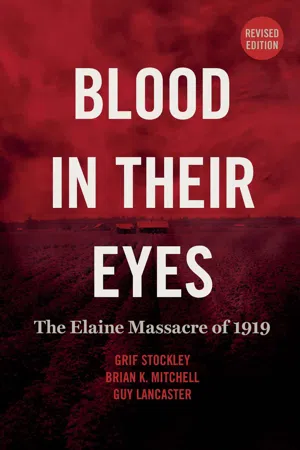
Blood in Their Eyes
The Elaine Massacre of 1919
- English
- ePUB (mobile friendly)
- Available on iOS & Android
eBook - ePub
About this book
Information
CHAPTER 1
Charles Hillman Brough’s Midnight Train Ride
He does not look upon the “Jim Crow” car as a humiliation—in fact, he infinitely prefers the freedom of his own car to one where the presence of the white race would be felt as a restraint.
—CHARLES HILLMAN BROUGH
October 1, 1919, Little Rock
When Democratic governor Charles Hillman Brough received the initial October 1, 1919, telegram from Sid Stokes, the mayor of Elaine and one of his earliest political allies in the Delta, requesting troops to quell “race riots in Elaine,” he was at the end of a special session of the Arkansas legislature. Part of it had not gone well, and he was angry. He had asked the legislature to pass an antiprofiteering bill, but businessmen from all over the state had come to Little Rock and killed it.1
Brough was taking this defeat hard. He had spent a good part of his time and energy in his second two-year term as governor helping President Woodrow Wilson win the “war to end all wars.” He had made hundreds of speeches in Arkansas and all over the country in the effort to sell Liberty Loan Bonds and raise money for the Red Cross and other war-related causes. During the war, he had been proud of the state’s effort: everyone, for the most part—business and labor, men and women, white and black—had come together in the name of patriotism.2 Brough would have remembered how astonished US secretary of the treasury William Gibbs McAdoo had been when the black Little Rock lawyer Scipio Africanus Jones, on the stage of the Kempner Theater, had presented him with a check for Liberty Loan Bonds for $50,000 from the Mosaic Templars of America, an African American fraternal organization.3 Jones, a black leader Brough had always been able to count on, had proudly told McAdoo that if that wasn’t enough, he could raise another $50,000 if the country needed it. Then Jones had gone out and done just that. People like Scipio Jones were always helping to make the community better. When there had been trouble between black and white soldiers based outside of Little Rock at Camp Pike, Scipio Jones and others had arranged for some of the “colored” clubs to be moved to lessen the chance for conflict.
Now the war might be over, but the world still wasn’t safe for democracy—not overseas and not in this country. Bolsheviks seemed to be everywhere, in labor unions like the radical Industrial Workers of the World (IWW) and even in the halls of Congress. During the war, Brough had told an audience in St. Louis that there existed “no twilight zone in American patriotism. In this war we are either for the president and for the flag, or we are against the president and against the flag.”4 Not one to shy away from controversy when the security of the country was at stake, Brough, in a speech at Milwaukee, had called the Wisconsin antiwar senator Bob LaFollete a Bolshevik leader. He wouldn’t be surprised now if the Bolsheviks were somehow behind the trouble in Elaine. There had been so many race riots in the country recently that surely they couldn’t all be coincidental. A horrible race riot had just occurred the previous week in Omaha, Nebraska. The mayor, trying unsuccessfully to protect a black prisoner, had nearly been lynched himself. A rope had been placed around his neck, and he had been wounded as well. The Omaha courthouse had been burned. Thirteen hundred troops had been rushed to the scene. There had been other riots and race violence in the past few months in places like Washington, DC, Chicago, Knoxville, and Indianapolis. In today’s edition of the Arkansas Gazette, there was a front-page story out of Oklahoma City headlined, “Mob Seeks Negro.” More than three hundred people had gathered at a police station after an African American had shot and killed a streetcar conductor. Right below that story was another about a posse in New Jersey that had finally caught a black man who had reportedly attacked a white woman.5 There had been no warning out of Phillips County, and now a second telegram arrived, this one more alarming and specific than the first: “Circuit and county judges, sheriff, mayor and leading private citizens urgently request immediate dispatch of 500 troops with machine guns to Elaine. One hundred seventy-five negro prisoners are expected to arrive at any moment among white men. Two dead and from 5 to 25 wounded.”6
If the president had not been so sick, Brough might well have called the White House. A fellow Southerner, Wilson had been scheduled to come to Little Rock on Saturday as part of a national tour to drum up support for America’s entry into the League of Nations. The president had collapsed while on a podium in Colorado and now perhaps was dying. So instead, after the first telegram, Brough called the secretary of the War Department, Newton D. Baker, who granted permission to use troops from Camp Pike, but this was going to take a bit longer than anyone wanted. With the war over and with a reduction in troop strength, Commanding General S. D. Sturgis had to cobble together a force from different units.
Then a third telegram came from the mayor of Helena, J. C. Knight, with news that would have been chilling: “Posse numbering at least 500 will be in Elaine neighborhood before 6 P.M. Considering situation it is absolutely necessary troops be in Elaine at earliest possible moment.”7
With this telegram, Brough would have known that a bloodbath was occurring in Phillips County. In 1902, he had published an article for the Mississippi Historical Quarterly about a race riot that had occurred in his hometown of Clinton, Mississippi. Three whites had been killed by African Americans after a political rally in 1875, at the tail end of Reconstruction. White volunteers, Brough had written, had come from Vicksburg on a special train, “asking no questions and submitting to no commands.” This group of former veterans “soon put the country-side in fear.”8 And not just fear. Brough wrote: “An arrangement was made with the citizen soldiery, now fully 200 strong, that if they would end the killing of the negroes, the United States officers would not assume command but leave matters in charge of the civil authorities.”9
No one would ever know how many black lives had been taken. “No accurate estimate has been made, or can be made, of the number of negroes killed after the arrival of the troops,” Brough wrote.10 He reported that the number was variously estimated at between ten and fifty but that the Hinds County grand jury, which took testimony from over one hundred witnesses afterward, had reported that the number could not be determined.
After the killing had ended, Republican governor Adelbert Ames, who presided “as the Carpet-bag Charlatan of a mongrel governmental mixture,” had urged President Ulysses S. Grant to intervene, but the “laconic President advised the hot-headed Governor that the general public were tired of these annual autumnal outbreaks in the South, and announced a policy of non-intervention on the part of the Federal Government.”11
In summing up, Brough wrote: “The return of the terrorized negroes to their homes after the riot was gradual, and their return to municipal, county and State politics was like that of the ship homeward bound, but which never reached its long looked for destination. This lesson of Anglo-Saxon supremacy, written in letters of blood, will ever remain the most important of the many lessons taught in the modest college town of Clinton to the rising young manhood of a proud and untrammeled Commonwealth.”12
Not only did Brough know the history of his own state, but since moving to Arkansas in 1903, he would also have become conversant with his adopted state’s record of violence against African Americans if he had done nothing but read the newspapers. Upon Brough’s arrival in Arkansas, Jeff Davis was governor, and the state had reached its nadir in gubernatorial leadership—at least in the area of racial equity. Davis, who served as governor from 1901 to 1907 before moving on to the United States Senate, promised in one of his most-chilling campaign speeches that “we may have a lot of dead niggers in Arkansas, but we shall never have negro equality, and I want to say that I would rather tear, screaming from her mother’s arms, my little daughter and bury her alive than to see her arm in arm with the best nigger on earth.”13 Campaigning in 1904, Davis told his audience “that ‘nigger’ dominion will never prevail in this beautiful Southland of ours, as long as shotguns and rifles lie around loose, and we are able to pull the trigger.”14
Brough, who by then had a PhD from Johns Hopkins University in “economics, history, and jurisprudence,” would have known that this unusually savage disposition toward African Americans from an Arkansas governor had been building in the state (and the South) since the early 1890s, when attitudes had begun to harden, resulting in increased violence, disfranchisement, and segregation. In 1892, a black Arkansas preacher reported, “some [African Americans were] being strung up to telephone poles, others burnt at the stake and still others being shot like dogs. In the last 30 days there have been not less than eight colored persons lynched in the state.”15
As a new arrival in the state, Brough could not have had any illusions about the actual regime of racism in the Arkansas Delta, but if he did, they would have been quickly dispelled. On March 27, 1904, the statewide Arkansas Gazette printed on its front page a story reporting that the town of Saint Charles was now “quiet” after the last four days of violence. Only twenty miles west of Elaine, black residents of the Saint Charles area were reported to have been “organizing to defy law and order.”16 The lynchings had come about because of a fight between a white man and two black men named Henry and Walker Griffin, who were then reported to have successfully resisted arrest by a white deputy sheriff. From that point on, it was open season on black people in Saint Charles who seemed in any way hostile. A vigilante group shot three African Americans for “defy[ing] the posse.”17 A mob took five more out of a jail and “shot them to death.”18 By the time the dust had settled, thirteen had been murdered, including the Griffin brothers. No whites were charged.
Whites continued to lynch African Americans (even occasionally women), and other forms of violence and intimidation remained commonplace throughout Arkansas, not just in the Delta. Between 1900 and 1910 the black population of Harrison, a town of 1,500 residents just miles from the Missouri border, decreased from 115 to one through two instances of racial cleansing in 1905 and 1909, in which white mobs forced black persons out of their homes, giving them twenty-four hours to leave. As a professor in Fayetteville and then later a candidate campaigning for votes throughout the state, Brough would have noticed that “after 1910 few African Americans resided in extreme northwest Arkansas.”19 Like every other resident of Arkansas, he would have known that African Americans were not supposed “to let the sun go down on their heads” in this part of the state. Harrison, however, was not the only such “sundown town” in the state. Whites in other communities, such as Cotter (located in the Ozark Mountains of north-central Arkansas), Mena (in the Ouachita Mountains near the Oklahoma border), and Paragould (along Crowley’s Ridge in northeastern Arkansas) also perpetrated expulsive violence against African Americans.20
By 1919, confident as he was in dealing with whatever problems African Americans in the Delta might have been presenting him, Brough would have felt any governor’s frustration in dealing with the federal government. General Sturgis was refusing to allow the actual deployment of the troops until he obtained a formal order from the War Department. All hell was breaking loose in the Arkansas Delta, and the army was sitting on its confused bureaucratic behind. Brough got in touch with Arkansas senator William Fosgate Kirby, who complained in a telegram to the army chief of staff that Sturgis was refusing to move without an order.21
Brough was confident that he could handle the crisis if he could just get the troops down to Elaine. After all, nobody in the history of the state had been better prepared to be governor. After coming back to his Clinton alma mater, Mississippi College, to teach, Brough had picked up a master of arts degree in psychology and ethics. Then he quit his teaching job and acquired a law degree from the University of Mississippi, completing a two-year course in twelve months and graduating with distinction.22
Brough would have stayed in Mississippi had he been hired as head of the new state department of archives and history. Losing that job by a five-to-four vote, in 1903 he applied for and received a new teaching job at the University of Arkansas in Fayetteville.23 A popular professor on campus and widely known for his speechmaking, he first made an aborted run at the governor’s office in 1913. He announced as a candidate to fill the unexpired term of Joe T. Robinson, who was appointed to fill a seat in the United States Senate. Brough withdrew when it became clear he didn’t have the necessary support and bided his time.
By 1915, Brough felt that his adopted state would accept a professor as governor. Finally, the people were ready to be taught that Arkansas could only make progress if it were willing to invest in education. It had made a start under former governor George Washington Donaghey. It could do more under Brough. But he had to be elected first.
In July 1915, at the age of thirty-nine, Brough submitted his resignation to the university and began to campaign in earnest, though the primary wasn’t until the following year. His phenomenal memory for faces and names helped make him a natural politician. Even though he didn’t act like an egghead professor, he did look a bit like one. At five feet ten inches, he was quite bald on top and had a prominent Roman nose. Yet, despite his braininess, he wasn’t stuffy. He liked people and with his friendly down-to-earth manner put them at their ease. In 1908, he had acquired a wife, Anne Roark, from Kentucky, who seemed born to occupy a governor’s mansion. Talented, gracious, intelligent, and with strong likes and dislikes, Anne Roark was not particularly domestic. Her interests lay in helping her husband go as far in the world as he wanted to. In fact, she had served as his campaign manager and driver in his first full race.24
The 1916 Democratic primary (which was tantamount to election) came down to three candidates. Brough was only truly worried about one. Earle Hodges was associated with the immediate past governor, George Hays, who had run strong in the Delta. Though Brough was able to tag Hodges as the machine candidate, he had his own soft spots: for one thing, he could be made to seem weak on the “Negro question”—in fact, the Hodges campaign charged him with being “a Negrophile.”
How to combat this? Those closest to Brough knew he was a Southerner from head to toe. He liked to say that he was “to the manner born.”25 Yet he had a problem. As a professor at the University of Arkansas, Brough had chaired the Southern Sociological Congress’s University Race Commission, and his views had become a matter of public record. He had studied the “Negro problem” and was confident that he knew the solution. It was relatively simple. During slavery, black people had benefited from the experience of having been around whites. They had imitated their masters and had begun the process of becoming civilized. The Civil War had abruptly ended this teacher-student relationship, and neither race was better off as a result. Brough had written: “This close social contact of the races has now almost disappeared. Separate schools, separate churches, separate telephones, the ‘Jim Crow’ car, restrictions of the ballot, not to mention violent anti-negro political agitation in at least two of the states, have produced an alienation of the two races without parallel.”26
Of course, a desperate opponent would deliberately misinterpret his meaning. In his speeches and writings during this period, Brough had also said that economic improvement did not equate with social equality and that African Americans should not vote. Naturally, Hodge would not call attention to Brough’s views on miscegenation—to which, he said, the South was “unalterably opposed,” viewing its increase with alarm. Brough had also said that mulattoes were difficult, an “incarnated protest against the color line,” while pure-blooded Negroes “were naturally unambitious, tractable, and easily satisfied.”27 The pure-blooded Negro was uninterested in the ballot and generally satisfied with the status quo: “He does not look upon the ‘Jim Crow’ car as a humiliation—in fact, he infinitely prefers the freedom of his own car to one where the presence of the white race would be felt as a restraint.” Thus separate coach laws were “wise,” according to Brough.28
The “best Negroes,” Brough believed, had applauded the work of his race commission. They understood that he was saying nothing about industrial education that their leader Booker T. Washington had not already said. Ever a supporter from his earliest days, Scipio Jones had written a letter in support of Brough’s work as head of the commission.29
But now there must be no misunderstanding of Brough’s position. He immediately took out advertisements in the papers that set forth his views: “I am not in favor of social equality. . . . I am not in favor of negroes serving on juries, I...
Table of contents
- Cover Page
- Title Page
- Copyright Page
- Contents
- Acknowledgments
- Introduction to the Revised Edition
- Introduction to the First Edition
- Chronology of Events
- Chapter 1. Charles Hillman Brough’s Midnight Train Ride
- Chapter 2. The Law of the Delta
- Chapter 3. The Boys from Camp Pike
- Chapter 4. A Committee of Seven
- Chapter 5. More Than One Version
- Chapter 6. Little Rock and New York
- Chapter 7. The Trials Begin
- Chapter 8. Colonel Murphy for the Defense
- Chapter 9. The Retrials of the Ware Defendants
- Chapter 10. The Changing of the Guard
- Chapter 11. Affidavits from Unlikely Sources
- Chapter 12. Moore v. Dempsey
- Chapter 13. Scipio Jones Takes Charge
- Conclusion. On the Larger Meaning of Elaine
- Appendix I
- Appendix II
- Notes
- A Note on Sources
- Index
Trusted by 375,005 students
Access to over 1.5 million titles for a fair monthly price.
Study more efficiently using our study tools.
Frequently asked questions
Yes, you can cancel anytime from the Subscription tab in your account settings on the Perlego website. Your subscription will stay active until the end of your current billing period. Learn how to cancel your subscription
No, books cannot be downloaded as external files, such as PDFs, for use outside of Perlego. However, you can download books within the Perlego app for offline reading on mobile or tablet. Learn how to download books offline
Perlego offers two plans: Essential and Complete
- Essential is ideal for learners and professionals who enjoy exploring a wide range of subjects. Access the Essential Library with 800,000+ trusted titles and best-sellers across business, personal growth, and the humanities. Includes unlimited reading time and Standard Read Aloud voice.
- Complete: Perfect for advanced learners and researchers needing full, unrestricted access. Unlock 1.5M+ books across hundreds of subjects, including academic and specialized titles. The Complete Plan also includes advanced features like Premium Read Aloud and Research Assistant.
We are an online textbook subscription service, where you can get access to an entire online library for less than the price of a single book per month. With over 1.5 million books across 990+ topics, we’ve got you covered! Learn about our mission
Look out for the read-aloud symbol on your next book to see if you can listen to it. The read-aloud tool reads text aloud for you, highlighting the text as it is being read. You can pause it, speed it up and slow it down. Learn more about Read Aloud
Yes! You can use the Perlego app on both iOS and Android devices to read anytime, anywhere — even offline. Perfect for commutes or when you’re on the go.
Please note we cannot support devices running on iOS 13 and Android 7 or earlier. Learn more about using the app
Please note we cannot support devices running on iOS 13 and Android 7 or earlier. Learn more about using the app
Yes, you can access Blood in Their Eyes by Grif Stockley,Brian K. Mitchell,Guy Lancaster in PDF and/or ePUB format, as well as other popular books in Social Sciences & North American History. We have over 1.5 million books available in our catalogue for you to explore.