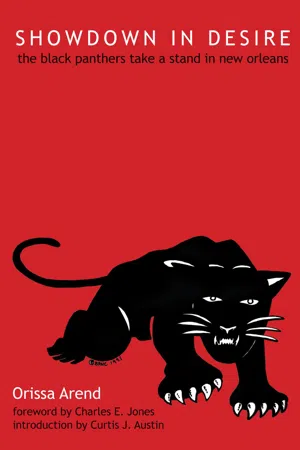
Showdown in Desire portrays the Black Panther Party in New Orleans in 1970, a year that included a shootout with the police on Piety Street, the creation of survival programs, and the daylong standoff between the Panthers and the police in the Desire housing development. Through interviews with Malik Rahim, the Panther; Robert H. King, Panther and member of the Angola 3; Larry Preston Williams, the black policeman; Moon Landrieu, the mayor; Henry Faggen, the Desire resident; Robert Glass, the white lawyer; Jerome LeDoux, the black priest; William Barnwell, the white priest; and many others, Orissa Arend tells a nuanced story that unfolds amid guns, tear gas, desperate poverty, oppression, and inflammatory rhetoric to capture the palpable spirit of rebellion, resistance, and revolution of an incendiary summer in New Orleans.
eBook - ePub
Showdown in Desire
The Black Panthers Take a Stand in New Orleans
- English
- ePUB (mobile friendly)
- Available on iOS & Android
eBook - ePub
Showdown in Desire
The Black Panthers Take a Stand in New Orleans
About this book
Information
Publisher
University of Arkansas PressYear
2009Print ISBN
9781557289339
9781557288967
eBook ISBN
9781610753807
PART I
Bullets and Breakfast on Piety Street
1
Desire and the Panthers
When Donald Guyton crawled on his belly through the Piety Street house beneath the tear gas and bullet holes, he didn’t foresee the mild September evening thirty-three years hence when he would again come face to face with the people responsible for those bullets and that tear gas. Guyton, who was in charge of security for the fledgling Black Panther chapter in New Orleans in 1970, was trying to assess the carnage. The shooting had stopped, and his fellow Panther Charles Scott had instructed Guyton to go room to room and shout back who was injured and who was dead. Guyton dreaded what he might find in the next room. But he had come back from Vietnam skilled as a warrior. He was totally focused on his assignment.
The shootout on Piety Street between the Black Panthers and the New Orleans police was actually a thirty-minute war. It occurred on September 15, 1970, the seventh anniversary of the bombing of the Sixteenth Street Church in Birmingham that killed four little black girls. There was a growing feeling among young black men and women that the dominant strain of pacifism in the civil rights movement was not an effective strategy against the terrorism of white supremacy. The Panthers offered Guyton, and many like him, a real alternative.
Years later, Guyton would become a Muslim and change his name to Malik Rahim. From his perspective in 2003, he would be able to connect Birmingham, Piety, Vietnam, and many other events and ponder an overarching explanation for them all. But on that September day in 1970, all he could do was defend, count, and report. His mind didn’t wander from the immediate task, And yet, even on his belly, as he wiped the sweat from his brow with a gritty forearm, he sensed the presence of four little guardian angels, the children murdered that day seven years ago in Birmingham.
The tensions leading to the shootout on Piety Street had been building for months. During the summer before it happened, Donald and his wife Barbara went to their friend Puchimo’s house every day for Panther meetings. Those were the early days of the party in New Orleans, and Puchimo’s house was one of the gathering places. Donald, the oldest of the prospective Panthers, was only twenty-two. Even though he had been halfway around the world, his encounter with the Panthers in his hometown awakened him to new ideas and new possibilities. Thirty-three years later he would reflect, “It was the first time I ever talked to a brother who had no fear,”1
That brother was nineteen-year-old Steve Green, the founder of the Louisiana chapter of the Black Panther Party, who had come to New Orleans in May from Compton, California. When Donald and Barbara wanted to join the party, Steve had tried to discourage them. They had two children, and Panthers had to be ready on a daily basis to put their lives on the line for their principles. “Too dangerous,” Steve had told them.
But Donald and Barbara prevailed, and by the fall of 1970 they were members of the National Committee to Combat Fascism (NCCF), an organizing bureau for the Black Panther Party. Headquartered on Piety Street, the Panthers were just outside of the largest, poorest housing development in New Orleans.
The twenty-three-million-dollar project had opened to tenants on May 21, 1956, with 388 four-bedroom apartments and 968 three-bedroom apartments. It was built for large, poor black families. The project, located on the outskirts of New Orleans in a cypress swamp and dumping ground, was named Desire. The Times-Picayune, one of New Orleans’ daily newspapers, would later call it a “disaster from its inception . . . a mind-numbing series of careless decisions that amounted to a blueprint for disaster.”2 It wasn’t designed for people to live in; it was designed, rather, to warehouse the city’s poorest residents, according to Ed Arceneaux, a former Desire manager and housing management specialist with the federal Department of Housing and Urban Development.
Developers had been under orders to build the project to minimum standards at minimum cost. Twice the size of its neighboring project, Florida, which was built for white tenants, Desire was made up of a series of two-story, bricked-over-barracks-type buildings clustered around courtyards. It was the only project built without cement beneath its floors and steps. As the buildings sat on soggy soil, the ground beneath the first 262 buildings began subsiding immediately, causing foundations, then pipes, to break and crumble. Porches fell away from their buildings. Sidewalks cracked. Gas, water, and sewer lines twisted and ruptured—all before the first tenant settled in.
Residents, desperate as they were for housing, were not naïve about what was being built for them. A tenants’ association report made public on April 9, 1956, six weeks before Desire opened, stated, “It is our conclusion that this project is a waste of public money, that it is undesirable for many reasons and finally that it is unsafe for human habitation.” The report concluded, “A proper investigation, we feel, will reveal the Desire project as a real scandal and a blight on public housing in New Orleans.”3
When residents finally did move in, they lacked privacy, because they were forced to share poorly maintained hallways, porches, and courtyards. A further adjustment for the tenants that arrived to fill Desire’s first 508 units in the summer of 1956 was that they found themselves removed from the city they had grown up in—its employment opportunities, stores, churches, and bus routes. Even emergency vehicles couldn’t readily come and go. There were not enough schools, so children had to go in shifts. There were no playgrounds. In 1989, Larry Jones, the executive director of the Housing Authority of New Orleans (HANO) blamed racism for the problems. He told the Times-Picayune that the aim in building the Desire project had been quantity, not quality, and so housing officials had constructed an unwieldy giant: “This was for poor black people. I just think that the commitment was not there . . . They just felt like poor people don’t deserve a whole lot.”4
In the late 1950s, when previously all-white projects opened their doors to black people, the residents of Desire began moving out, deciding that any move would be a move up. In 1965 Hurricane Betsy put Desire under six feet of water, making grim conditions worse. And yet poverty forced other families to move in and stay there. By 1970, 10,594 residents, 8,312 (75 percent) of them under the age of twenty-one, were crowded into an area twelve blocks long and three blocks wide.5
On a typical summer day, women sat on their porches fanning the tepid air and exchanging news and banter while barefoot children jumped rope and played ball in the dirt. Broken glass, old shoes, and the remains of drug deals and hastily eaten meals littered the trampled weeds between the apartments, but the porches and courtyards offered a welcome alternative to the dank living quarters reeking of sewage. Holes in the walls and broken pipes accommodated a sizeable population of audacious rats.
However, the city administration did not become concerned about the plight of the people in Desire until the Black Panthers, demanding attention and advocating revolutionary action, established a headquarters on Piety Street half a block from the project. At the same time, the Panthers were setting up services to provide some relief and to point out that simple and humane remedies to the problems facing the residents could be provided, if not by the city, then by young revolutionaries who felt they were under siege.
When the city finally did take notice, Robert H. (Bob) Tucker Jr. was a young, idealistic black special assistant to Mayor Moon Landrieu. In August of 1970 the mayor sent Tucker to Desire to investigate and write a report. Tucker spent seventy-two hours “living” in the home of Desire resident Henry Faggen. Describing Desire as “one of the most explosive areas of the city,” Tucker wrote, “Life in any multi-family structure for the low income family is a very difficult proposition, to say the least. The Desire housing project is a classic study of the worst.”6
He reported that children swam in clogged sewers for lack of recreation facilities; families were afraid to leave their homes at night because of high rates of assault, robbery, muggings, and rape; piles of garbage went uncollected for days, even weeks. Desire was isolated, Tucker found, culturally and geographically from the rest of the city. Located in the Ninth Ward, downriver from the city, it was bordered by railroad tracks, the Mississippi River, the Industrial Canal, and a corridor of industrial plants.7 But it had nonetheless spawned community leaders, entrepreneurs, and social activists.
Desire Community Center leaders told the States-Item:
We are fighting against the top . . . to acquire operational funds, against ignorant powers . . . against public leaders who are all too often ignorant of the misery and frustration that cause addicts to revert to drug-dependence behavior . . . We are fighting against the bottom—the crummy building we live in, reeking with the smell of urine, the dirty floors and broken windows, the backyard that’s littered with garbage; the millions of cockroaches crawling over us when we are asleep, sharing our coffee when we are awake; the huge flies and tiny mosquitoes that come through our window, left open in summer heat so that we can breathe “fresh pollution.”8
Tucker reported that 61 percent of the families in Desire lived on less than three thousand dollars a year. Food-stamp recipients were held up in broad daylight by junkies and vagrants. He told the Times-Picayune that a major source of irritation in the community was a local food store that failed to meet health standards and that inflated prices on days when welfare checks arrived in residents’ mailboxes. This store, owned by a black man named Clarence Broussard, would soon become an even larger source of irritation.
As reported in the Times-Picayune just days before the shootout that put Guyton on his belly in the Piety Street house, Tucker had proposed an eleven-point program to Mayor Landrieu to help alleviate some of the conditions. Included in the program were suggestions that the New Orleans Public Service return regular bus service to the area after midnight; that the Board of Health rigidly inspect the grocery store in question; that the Housing Authority of New Orleans and the City Sanitation Department provide more jobs for neighborhood residents, particularly ex-addicts; and that clogged sewers be cleaned.9
Tucker was not the only person making public statements about the conditions in Desire. Walter Rogers, a white activist who lived in the Lower Ninth Ward, circulated a flier fifteen days after the shootout. He was a member of Local 406 Operating Engineers and the AFL-CIO, and he was a construction worker. He was seventy and his wife Elizabeth was seventy-eight when the Panthers moved into the neighborhood. Rogers, who had been one of the construction workers who laid the sewer pipes in Desire, had some insight about the problems with the project’s sewers:
I saw those faults, which I don’t think can ever be mended, without tearing down the unhappy brick houses. It’s in the sewers. These were laid about 12 feet deep. The rule is, to fill with shell above the sewer pipe, to cushion the pressure from buildings and pavement above. Pittman [the contractor] ignored this rule; apparently the inspectors did too. He crammed in huge stumps and cement lumps (less costly than shell), then ran bulldozers over it. When the cracked pipes began to show leaks, the scandal broke. A walk through Desire today shows sewers still leaking, and after [Hurricane] Betsy, 1965, we saw sewage flowing up through the pavement on Louisa [Street], where it stood for days before the city acted.10
Broken pipes weren’t the worst damage Desire sustained as a result of Hurricane Betsy. Rogers, whose house had flooded during the hurricane, claimed: “Most workers believe, and there is evidence, that U.S. Engineers actually blew up Industrial Canal levees to make [the Lower Ninth Ward] a spillway, thus saving wealth and industry upstream.”11
Citing the broken promises of urban renewal between 1965 and 1970, Rogers went on to say, “At last into this hellhole of poverty came the Panthers like a fresh wind, to start doing what Government should have done hundreds of years ago. Free breakfasts, free clothing, donations from merchants (like the churches get); self-respect, self-discipline, community responsibility and authority, the asserting of self-defense against attacks by cops, goons, dogs, and spies.”12
Rogers had his own theory about what really threatened the established authorities: “What scares the cops and their kennel-owners is not just the bottles, rocks and fire-bombs of angry poor folk. Nor the free breakfasts, clinics, [and distribution of] clothes the Panthers have begun and the people carry on. What the Powers fear is THE TRUTH. The Panthers have seen the truth; millions more see it clearer daily: That NONE OF THE ILLS CREATED BY CAPITALISM WILL EVER BE CURED BY CAPITALISM.”13
The conditions in Desire, the arrival of the Panthers, and the subsequent shootout captured the imagination of the national press. In an article called “Death in Desire,” Time Magazine stated, “The streetcar no longer runs on Desire Street, but New Orleans does have a housing project there named Desire. It is torn by frustrations and passions—as brutal as anything in Tennessee Williams’ play. It is also as dirty, crime-ridden and crowded as any black ghetto in the North . . . Alarmed by the report of one of his black appointees [Bob Tucker], who described the area as ‘potentially explosive,’ Mayor Moon Landrieu was scheduled to make a tour of it last week. The slum erupted before he got there.”14
The reality of the housing development stood in stark contrast to its evocative street names. Piety intersects Pleasure, Humanity, and Desire, streets named by an eighteenth-century Creole who first developed that part of town. In this Catholic city, the names of the landowners’ daughters, Piete and Desiree, morphed into a primary human emotion and its superego counterpart, desire and piety.
According to Webster’s Dictionary, the term piety means “fidelity to natural obligations, faithfulness to that which one is bound by a pledge, a duty, or by a sense of what is right or appropriate.” In many ways, Piety was the right street for the Panthers. That duty, pledge, sense of what is right, was the Panthers’ commitment to self-determination for black people. And Piety intersected Desire. Desire was a fitting name also, because in this housing development, there was a pervasive feeling, angrier than hopelessness, born of a longing that could never be fulfilled.
But the Panthers hadn’t begun their operations in New Orleans on Piety Street. In May of 1970 a caller identifying himself as “Steve” had informed Bill Rouselle, deputy director of the city’s Human Relations Committee, that he had just arrived from the West Coast to set up a Black Panther headquarters. Rouselle said “Steve” asked him for help in opening a free breakfast program for black children. Help never came.15
The Panthers’ first, brief home was adjacent to the St. Thomas Housing Development. St. Thomas was like Desire in that it also had a large concentration of poor African Americans. Located between downtown and the posh Garden District, it was, however, much more a part of the city. Until the 1960s the residents of St. Thomas had been all white. The building that housed the Panther headquarters at 2353 St. Thomas Street was owned by Criminal District Court judge Bernard J. Bagert. The Panthers’ public education classes held in the house attracted crowds of young people from all over town, up to 150 according to police intelligence.
Police chief Joseph I. “Joe” Giarrusso was worried. He was at the end of his tenure, and he was “old school,” as one of his officers would describe him. Some would say that he was brutal in his intolerance of threats to police authority. And according to information from the FBI director J. Edgar Hoover, those threats loomed large. Ho...
Table of contents
- Cover Page
- Title Page
- Copyright Page
- Dedication
- Contents
- Foreword
- Introduction
- Preface
- Part I: Bullets and Breakfast on Piety Street
- Part II: Desire Heats Up
- Part III: Prisoners and Those who Love Them
- Part IV: Making Sense of it
- Epilogue
- Acknowledgments
- Appendix A: Cast of Characters
- Appendix B: October 1966 Black Panther Party Platform and Program
- Appendix C: Eight Points of Attention
- Appendix D: Three Main Rules of Discipline
- Chronology
- Abbreviations
- Notes
- Suggested Reading and Viewing
- Bibliography
- Index
- About the Authors
Trusted by 375,005 students
Access to over 1.5 million titles for a fair monthly price.
Study more efficiently using our study tools.
Frequently asked questions
Yes, you can cancel anytime from the Subscription tab in your account settings on the Perlego website. Your subscription will stay active until the end of your current billing period. Learn how to cancel your subscription
No, books cannot be downloaded as external files, such as PDFs, for use outside of Perlego. However, you can download books within the Perlego app for offline reading on mobile or tablet. Learn how to download books offline
Perlego offers two plans: Essential and Complete
- Essential is ideal for learners and professionals who enjoy exploring a wide range of subjects. Access the Essential Library with 800,000+ trusted titles and best-sellers across business, personal growth, and the humanities. Includes unlimited reading time and Standard Read Aloud voice.
- Complete: Perfect for advanced learners and researchers needing full, unrestricted access. Unlock 1.5M+ books across hundreds of subjects, including academic and specialized titles. The Complete Plan also includes advanced features like Premium Read Aloud and Research Assistant.
We are an online textbook subscription service, where you can get access to an entire online library for less than the price of a single book per month. With over 1.5 million books across 990+ topics, we’ve got you covered! Learn about our mission
Look out for the read-aloud symbol on your next book to see if you can listen to it. The read-aloud tool reads text aloud for you, highlighting the text as it is being read. You can pause it, speed it up and slow it down. Learn more about Read Aloud
Yes! You can use the Perlego app on both iOS and Android devices to read anytime, anywhere — even offline. Perfect for commutes or when you’re on the go.
Please note we cannot support devices running on iOS 13 and Android 7 or earlier. Learn more about using the app
Please note we cannot support devices running on iOS 13 and Android 7 or earlier. Learn more about using the app
Yes, you can access Showdown in Desire by Orissa Arend,Charles E. Jones,Curtis J. Austin in PDF and/or ePUB format, as well as other popular books in Social Sciences & North American History. We have over 1.5 million books available in our catalogue for you to explore.