- English
- ePUB (mobile friendly)
- Available on iOS & Android
eBook - ePub
The Photograph as Contemporary Art
About this book
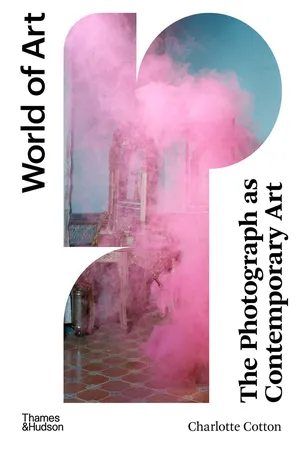
In the 21st century photography has come of age as a contemporary art form. Almost two centuries after photographic technology was first invented, the art world has fully embraced it as a legitimate medium, equal in status to painting and sculpture. This book provides an introduction to the extraordinary range of contemporary art photography, from portraits of intimate life to highly staged, directorial spectacle. The vast span of photographers whose work is reproduced includes established artists such as Isa Genzken, Jeff Wall, Sophie Calle, Thomas Demand, Nan Goldin and Sherry Levine, as well as emerging talents such as Sara VanDerBeek, Rashid Johnson, Viviane Sassen and Amalia Ulman. This new edition revitalizes previous discussion of works from the 2000s through dialogue with more recent practice. Adding to the wide selection featured of work, Cotton celebrates a new generation of artists, who are shaping photography as a culturally significant medium for our current socio-political climate.
Information
Topic
ArtSubtopic
History of Contemporary ArtChapter 1
If This is Art
The photographers in this chapter collectively make one of the most confident declarations about how central photography has become within contemporary art practice, and how far removed it has become from traditional notions of the way a photographer creates their work. All of the photographs here evolve from a strategy, performance or happening orchestrated by the photographers for the purpose of creating an image. Although making an observation and framing a moment from an unfolding sequence of events remains part of the process for many here, the central artistic gesture is one in which an event is directed especially for the camera. Artistic creation begins long before the camera is actually held in position and an image fixed, starting instead with the planning of the idea. Many of the works here share the corporeal nature of performance and body art, but the viewer experiences the physical actions indirectly. We comprehend these works’ meanings not just through an image but as photographic acts.

12 Tatsumi Orimoto, Bread Man Son and Alzheimer Mama, Tokyo, 1996
The roots of this approach lie in the conceptual art of the mid-1960s and 1970s, when photography became central to the wider dissemination and communication of artists’ performances and other temporary works of art. The motivations and style of such photography within conceptual art practice was markedly different from the established modes used in fine art photography of the time. Rather than offering an appreciation of virtuosic photographic practice or distinguishing key individuals as ‘masters’ of photography, conceptual art played down the importance of craft and authorship. It made an asset of photography’s unshakable and everyday capacity to depict things; it took on a distinctly ‘non-art’ and ‘unauthored’ look and emphasized that it was the act depicted in the photograph that was of artistic importance. Conceptual art used photography as a means of conveying ephemeral artistic ideas or actions, standing in for the art object in the gallery or on the pages of artists’ books and magazines. This versatility – photography’s status as both document and evidence of art – retained an intellectual vitality and ambiguity that has been well used in contemporary art photography, especially in practices that shift artistic actions into the context of the ordinary and everyday, and engage with the fallible and political corporality of the human body.
To cite this historical moment in art practice is not to say that the same dynamic between avant-garde art and photography is still at play today. Rather, it is to suggest that the ambiguity with which photography has positioned itself within art, as both a document of an artistic gesture and a work of art, is a heritage that is used imaginatively by many contemporary practitioners. French artist Sophie Calle’s (b. 1953) blending of artistic strategy with daily life is one of the most compelling realizations of conceptually led photography.[3] In The Hotel (1981), Calle took a job as a chambermaid in a hotel in Venice. During her daily cleaning of the bedrooms, she photographed the personal items of their temporary inhabitants, discovering and imagining who they might be. She opened suitcases, read diaries and paperwork, inspected laundry and rubbish bins, systematically photographing each intrusion and making notes that were then published and exhibited. Calle’s artworks conflate fact and fiction, exhibitionism and voyeurism, performance and spectatorship. She creates scenarios that consume her, border on running out of control, fail, remain unfinished or take unexpected turns. The importance of a script for her art was highlighted in her collaboration with the writer Paul Auster (b. 1947), who, in his novel Leviathan (1992), created a character based on Calle, called Maria. Calle intertwined the novel’s character with her artistic persona by correcting passages in the book that referred to Maria. She also invited Auster to invent activities for her, while undertaking the activities he had invented for Maria in the novel. These included a week-long chromatic diet that consisted of eating food of a single colour. On the final day, Calle added a further twist by inviting dinner guests to choose one of the meals from the diet.
Performance played a major role in Chinese art in the 1980s and 1990s. In a political climate in which avant-garde artistic practice was outlawed, the temporary theatricality of performance-based art that could be staged from under the institutional radar provided an opportunity and outlet for dissident expression. The corporeal nature of performance also intrinsically challenged the cultural subordination of the self in China, and hence became a critical dramatization of Chinese politics. One of the best-known artists’ groups was the short-lived and politically persecuted Beijing East Village, which began in 1993. Most of its members had trained as painters, and used performances that blurred life and theatre to present disturbing manifestations that questioned, countered and responded to the violent shifts in Chinese culture. These were staged to small audiences in houses or out-of-the-way places. In the extreme performances of Zhang Huan (b. 1965), Ma Liuming (b. 1969) and Rong Rong (Lii Zhirong, b. 1968), the human body was tested to its limits, the artists enduring physical pain and psychological discomfort.[13, 14] Photography was always part of the performance, whether through its interpretation by art photographers or as a final work of art born out of the performance.

13 Zhang Huan, To Raise the Water in a Fishpond, 1997. This group performance was staged to be photographed, the still image being the final outcome of the artistic gesture. Along with Ma Liuming and Rong Rong, Zhang Huan was a member of the Beijing East Village community. The group always used photography as an integral part of their performance pieces.

14 Rong Rong, Number 46: Fen-Ma Liuming’s Lunch, East Village Beijing, 1994
In a parallel practice, the Ukrainian artist Oleg Kulik (b. 1961) stages performances with a direct, politically confrontational element.[16] These have included acting like a savage dog, attacking the police and representatives of institutionalized power. His concept of the ‘artist–animal’ is not just a persona he adopts for the length of his performances, but is also presented as a way of life: he has even formed his own Animal Party, to give his ideas a political platform. The influence of earlier conceptually minded artists is especially apparent in Kulik’s work. One New York performance, in which he lived as a dog for two weeks, was entitled I Bite America and America Bites Me in homage to the heritage of performance as a politicized photo opportunity. It references German artist Joseph Beuys’s (1921–1986) protest against the Vietnam War, I Like America and America Likes Me, in which Beuys lived locked up with a coyote in a New York gallery and their strange cohabitation was photographed.[15] Kulik’s Family of the Future is made up of photographs and drawings that ruminate on what the relationship between man and animals could be if the behaviour and attitudes of both were combined in one lifestyle.

15 Joseph Beuys, I Like America and America Likes Me, 1974

16 Oleg Kulik, Family of the Future, 1992–7
The inscribing of cultural and political meaning onto the human body is a dynamic component of contemporary art photography. Chinese artist Ni Haifeng (b. 1964) paints his own torso with motifs from eighteenth-century Chinese porcelain, designed by Dutch traders catering to the Western market for ‘china’.[17] The words on his body are written in the style of a museum label or a catalogue entry, suggestive of the language of the collector. Haifeng succinctly and materially delineates the social trauma of global trade and colonialism, and the commodification and exploitation of human beings.

17 Ni Haifeng, Self-Portrait as a Part of Porcelain Export History (no. 1), 1999–2001
The equal prominence given to text and image in Kenneth Lum’s (b. 1956) work investigates the role of the caption in enabling a photograph to elaborate its ideas or subtext fully.[18] The image alone, even carefully staged by the artist, is shown to be proble...
Table of contents
- Cover
- Title Page
- About the author
- Contents
- Introduction
- Chapter 1: If This is Art
- Chapter 2: Once Upon a Time
- Chapter 3: Deadpan
- Chapter 4: Something and Nothing
- Chapter 5: Intimate Life
- Chapter 6: Moments in History
- Chapter 7: Revived and Remade
- Chapter 8: Physical and Material
- Chapter 9: Photographicness
- Further Reading
- List of Illustrations
- Index
- Copyright
Trusted by 375,005 students
Access to over 1.5 million titles for a fair monthly price.
Study more efficiently using our study tools.
Frequently asked questions
Yes, you can cancel anytime from the Subscription tab in your account settings on the Perlego website. Your subscription will stay active until the end of your current billing period. Learn how to cancel your subscription
No, books cannot be downloaded as external files, such as PDFs, for use outside of Perlego. However, you can download books within the Perlego app for offline reading on mobile or tablet. Learn how to download books offline
Perlego offers two plans: Essential and Complete
- Essential is ideal for learners and professionals who enjoy exploring a wide range of subjects. Access the Essential Library with 800,000+ trusted titles and best-sellers across business, personal growth, and the humanities. Includes unlimited reading time and Standard Read Aloud voice.
- Complete: Perfect for advanced learners and researchers needing full, unrestricted access. Unlock 1.5M+ books across hundreds of subjects, including academic and specialized titles. The Complete Plan also includes advanced features like Premium Read Aloud and Research Assistant.
We are an online textbook subscription service, where you can get access to an entire online library for less than the price of a single book per month. With over 1.5 million books across 990+ topics, we’ve got you covered! Learn about our mission
Look out for the read-aloud symbol on your next book to see if you can listen to it. The read-aloud tool reads text aloud for you, highlighting the text as it is being read. You can pause it, speed it up and slow it down. Learn more about Read Aloud
Yes! You can use the Perlego app on both iOS and Android devices to read anytime, anywhere — even offline. Perfect for commutes or when you’re on the go.
Please note we cannot support devices running on iOS 13 and Android 7 or earlier. Learn more about using the app
Please note we cannot support devices running on iOS 13 and Android 7 or earlier. Learn more about using the app
Yes, you can access The Photograph as Contemporary Art by Charlotte Cotton in PDF and/or ePUB format, as well as other popular books in Art & History of Contemporary Art. We have over 1.5 million books available in our catalogue for you to explore.