This book situates the production of The Boy Friend and the Players' Theatre in the context of a post-war London and reads The Boy Friend, and Wilson's later work, as exercises in contemporary camp. It argues for Wilson as a significant and transitional figure both for musical theatre and for modes of homosexuality in the context of the pre-Wolfenden 1950s.
Sandy Wilson's The Boy Friend is one of the most successful British musicals ever written. First produced at the Players' Theatre Club in London in 1953 it transferred to the West End and Broadway, making a star out of Julie Andrews and gave Twiggy a leading role in Ken Russell's 1971 film adaptation.
Despite this success, little is known about Wilson, a gay writer working in Britain in the 1950s at a time when homosexuality was illegal.
Drawing on original research assembled from the Wilson archives at the Harry Ransom Center, this is the first critical study of Wilson as a key figure of 1950s British theatre. Beginning with the often overlooked context of the Players' Theatre Club through to Wilson's relationship to industry figures such as Binkie Beaumont, Noël Coward and Ivor Novello, this study explores the work in the broader history of Soho gay culture. As well as a critical perspective on The Boy Friend, later works such as Divorce Me, Darling!, The Buccaneer and Valmouth are examined as well as uncompleted musical versions of Pygmalion and Goodbye to Berlin to give a comprehensive and original perspective on one of British theatre's most celebrated yet overlooked talents.
eBook - ePub
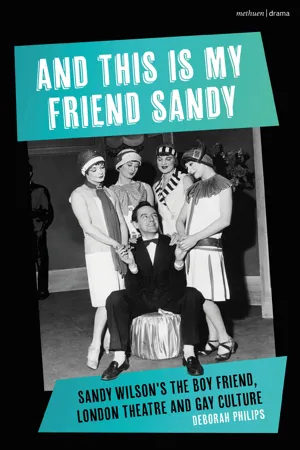
And This Is My Friend Sandy
Sandy Wilson's The Boy Friend, London Theatre and Gay Culture
- 256 pages
- English
- ePUB (mobile friendly)
- Available on iOS & Android
eBook - ePub
And This Is My Friend Sandy
Sandy Wilson's The Boy Friend, London Theatre and Gay Culture
About this book
Information
1
And this is my friend Sandy . . .
Bona to vada your dolly old eek
Round the Horne
From 1965 to 1968, BBC radio broadcast the programme Round the Horne which weekly featured a sketch with Kenneth Williams and Hugh Paddick,1 each episode was introduced with Williams saying ‘I’m Julian, and this is my friend Sandy.’ Julian and Sandy were unabashedly camp, and brought Polari, the coded language of a gay subculture,2 to a mainstream audience. ‘Julian’ was a reference to Julian Slade, the writer and composer of Salad Days, and ‘Sandy’ to Sandy Wilson, the writer and composer of The Boy Friend.3
The Boy Friend and Salad Days were the hit musicals of 1953 and 1954, Salad Days eventually outstripping The Boy Friend as the longest running musical in the West End. According to Mander and Mitchenson’s survey of musical comedy:
The two phenomena of 1954 were Salad Days, written as an end-of-season romp, by Dorothy Reynolds and Julian Slade for the Bristol Old Vic Company, which unexpectedly became a record runner at the Vaudeville, and The Boy Friend, a brilliant nostalgic pastiche of the 1920s which, after two tentative starts at the Players’ Theatre, settled in . . . at the Wyndham’s Theatre. (Mander and Mitchenson, 1969, p. 35)
Both musicals had originated in small-scale productions, originally intended as Christmas entertainments for independent theatres from outside the West End, Salad Days at the Bristol Old Vic and The Boy Friend at the Players’ Theatre Club, known for its staging of nostalgic Victorian music hall. Salad Days and The Boy Friend both pastiched the music and styles of the 1920s, and both writers had come from a background in university drama clubs, Slade with the Cambridge Footlights4 and Wilson with the Oxford Experimental Theatre Club, each had gone on to write for revues. And both musicals were written by gay men in the context of a post-war Britain in which sexual acts between men were both illegal and demonized.
Sandy Wilson (or rather, his most famous work, The Boy Friend) is regularly cited as a footnote in surveys of 1950s theatre.5 Wilson, however, merits more than a footnote in the history of musical theatre; he wrote what was to become one of the most loved and performed musicals and has a back catalogue that is widely remembered and revived. He is also a figure who provides a focus for a culture and a sensibility at a significant period in British gay history. Wilson’s trajectory represents a transitional moment in the history of the British musical, in British theatre and in modes of homosexuality. As a composer he begins by being in thrall to the glamorous and romantic works of Noël Coward and Ivor Novello and ends with musical adaptations of fiction, largely written by gay men, for the stage. As a young man he came into his professional own at a time when sexual relations between men were illegal; he modelled himself on the covert homosexuality of Coward and Novello and their generation. Wilson ended his life, if somewhat uncertain of the strategies of the Gay Liberation Front, certainly supportive of the cause. An undated lyric in Sandy Wilson’s file of ‘Songs and Sketches’ is titled ‘Why did it have to be gay?’ and expresses an understanding of the need for change, but also rueful regret for the discreet camp of closeted homosexuality:
‘Why did it Have to Be Gay?’
I remember the days, not long ago,
When one sometimes used to hear
A person say ‘He’s Bent’ or ‘so’
Or ‘one of those’ or ‘Queer’
They were none of them nice expressions
And I’m rather glad they went . . .
In my old-fashioned way,
I’m all for hi-de-ho and also hi-de-hey.
But something has gone for ever,
And though you may think I’m absurd
I could smack the head of whoever said,
‘Gay’s the Word!’
(undated lyric, Sandy Wilson archive)
It was Ivor Novello who coined the phrase ‘Gay’s the Word’6 as the title of his last musical in 1951, as Wilson knew full well as an admirer and biographer of Novello. Wilson’s lyric articulates a resentment at the derogatory terms used for gay men, but also a wistfulness for a time at which ‘gay’ was a coded word, which must have resonated with the generation of men who attended the revues for which this lyric was written.7
Wilson’s life appears to follow a conventional narrative of the successful songwriter; public school, Oxford, a move to London and a hit musical in 1954, but his life was less straightforward than his autobiography or that life history would suggest. There is little in Sandy Wilson’s archive about his childhood or schooldays, the only item from that period is a scrapbook with pasted images of New York, Paris and Hollywood stars (suggesting his youthful aspirations). There are very few letters from his immediate family; Wilson’s archiving begins from the collection of programmes from productions he was involved in, starting with the revues he scored at Oxford. The only information available about his childhood is from his 1975 autobiography, which ends with the production of The Boy Friend, and gives an unapologetically show-business and resolutely optimistic account of his life. The narrative is focussed on his theatrical career; it neatly glosses over any personal details, eschews anything painful and alludes only very tangentially to his relationships with men.
Wilson seems to have had a relatively untroubled time at public school, at university and in the army, as he blithely recounts in the autobiography. His progress, through public school at Harrow to Oriel College, Oxford, would appear to be one of privilege, but it is clear that his access to education was a struggle for him and for his family; his early childhood was troubled by family tensions and constant house moves brought on by the Depression. Like his heroes, Coward and Novello, Wilson was not born into wealth, but had to make his own way; he may have possessed family connections and cultural capital, but there was not enough financial capital to support his family’s ambitions.
The only son in a family of three sisters (to whom he remained close throughout his life) Wilson was born Alexander Galbraith Wilson in 1924, to a genteelly impoverished family, with the aspiration, but not the wealth, to send him to public school. Wilson’s father came from a Scots family who had made money in woollen mills, and had himself been to Harrow, ‘where he distinguished himself in games and was made captain of the school football team’ (Wilson, 1975a, p. 11). George Wilson was sent, as befitted the youngest son of a gentleman of the period, to India, where he worked for a shipping company and where he met Wilson’s mother, Elsie Humphrey. The family fortune dwindled during the Depression, as did that of the shipping company, and the family finances, and Wilson’s parents’ marriage, were clearly strained. The family returned to Britain to an aunt’s house in Stirling, then moved to Manchester, to Sale in Cheshire (where Wilson was born), and eventually to London.
Wilson’s childhood reminiscences are dominated by his visits to the pantomime and to films. On moving to London, the young Wilson mapped the city through its theatres and cinemas:
Down St Martin’s Lane . . . was the Duke of York’s, and, opposite it the Coliseum. Round the corner and . . . there was the Garrick. Across the road to Leicester Square . . . and beyond lay Piccadilly Circus and Shaftesbury Avenue with another whole row of theatres to be explored. By the time I was ten I knew my way all round the West End and could reel off exactly what was on at each theatre and cinema and who was in it. (Wilson, 1975a, p. 32)
Although clearly happy in London, Wilson was sent, under the auspices of a family friend, to Elstree preparatory school to be ‘groomed’ for the Harrow scholarship, the only way in which he could follow his father to public school: ‘There was a place waiting for me at the Headmaster’s House, Harrow. But it was rapidly becoming obvious that I could only take it up if I . . . won a scholarship and a substantial one at that’ (Wilson, 1975a, p. 33). At Elstree there is a faint suggestion of homoerotic feelings as he recounts his daydream of rescuing ‘my current hero . . . a fair-haired boy in an upper form’ (Wilson, 1975a, p. 35), but his most significant friendship is with another boy, Charles (who remained a friend for the rest of their lives, and who is interviewed for Wilson’s autobiography). Charles shares Wilson’s passion for cinema, together they spend their holidays at the cinema and theatre, read film magazines and set up a Drama Society at the school. In a passage which rather over neatly maps on to the history of The Boy Friend, Wilson fantasizes about becoming a writer of musicals: ‘my favourite fantasy was set in the future. . . . I wrote and composed a musical show which was a hit in the West End and then went to Broadway’ (Wilson, 1975a, p. 36).
The graft and ambition that it must have taken to take the entrance examination, and his eventual success at winning a Harrow scholarship are underplayed in the autobiography; he briskly notes only: ‘I was a scholarship boy, I had worked extremely hard to get there, and it was what my family wanted for me, so that was that’ (Wilson, 1975a, p. 54). Instead, Wilson lists all the plays and films that he and Charles went to together, some among them rather improbably adult for boys of prep school age. This period in Wilson’s life is written with an eye to his later status as a man of the theatre; he is keen to demonstrate his immersion in popular theatre, music and film. Wilson’s childhood, by his own account, is largely framed by the glamour of theatre and cinema, which overshadows everything, including his father’s serious illness and his mother’s fragile health. Wilson senior’s death and funeral takes up a paragraph, rather less than the space he devotes to his reading of the coverage of West End Theatre in Vogue and Life magazines.
Once at Harrow, Wilson joins the Film Society, avoids football (he does not follow his father as captain of the football team) and learns to play the piano. He reads Noël Coward’s autobiography, and clearly sees him as a role model for his future career: ‘I was amazed and envious to read how early he had started his career and how soon he had been successful . . . . He acted, wrote plays, composed songs – all the things I wanted to do. If I was to follow in his footsteps, there was no time to be lost!’ (Wilson, 1975a, p. 56). His theatre-going during the school holidays extended to attending revues, among them one with Joan Sterndale Bennett and Vida Hope,8 who were both stalwart performers at the Players’ Theatre Club; he also sees Hermione Gingold,9 for whom he would later write his first revue songs. He attends the Late Joys at the Players’ Theatre (which would become the producing venue for his greatest success, The Boy Friend), where he feels ‘peerlessly adult’ in his first dinner jacket (Wilson, 1975a, p. 59).
In 1938, among the lists of plays and films, there is some recognition that global politics would encroach on Wilson’s enclosed world: ‘back in 1938, the current decade was having its troubles’ (Wilson, 1975a, p. 56), as Wilson grudgingly acknowledges the impending war that would shape his entire generation. The ‘phony war’, months before the outbreak of fighting in the Second World War between September 1939 and May 1940, sounds the first alarm: ‘we were all of us thoroughly scared’ (Wilson, 1975a, p. 57). This does not, however, impinge on Wilson’s playgoing or interest in the theatre; he begins to write his own plays, and produces his own version of Frankenstein at Harrow. With the award of another scholarship he takes up piano lessons and begins to write his own songs. The beginning of the air-raids is marked, for Wilson, by the closure of his beloved theatres and cinemas, and he does take note when his charity production is interrupted by the sound of fighter planes and distant gunfire (Wilson, 1975a, p. 67).
Wilson’s progress throughout the war is erratic, unmarked by heroism, and his experience is dealt with briskly and briefly in the autobiography: ‘I spent three years in uniform and, while there were periods of discomfort and depression, on the whole I disliked it much less than I expected’ (Wilson, 1975a, p. 77). His first response to the war effort is to take up the War Office’s appeal to the public schools for students to learn Chinese and Japanese for the Far East campaign. Based at the School of Oriental and African Studies in central London, he takes advantage of its proximity to the West End and spends much of the time going to the theatre and cinema. Focussing on producing a revue rather than his studies, he fails to learn any Japanese, and is permitted to leave. On being called up to the army he is sent for military training, and requests to be a front line cook, but his Harrow education means that he is assigned to the Royal Army Ordnance Corps as a clerk, a post which consists largely of filing.
Having never before travelled beyond Paris, Wilson is sent to Egypt and then to Iraq, where his filing duties continue. He meets men from outside his own public school-educated milieu, which convinces him to become, for the first time and from then on, a Labour voter. While in the army he composes music, plays the piano in the mess, edits a newspaper for the base, which includes his own caricatures of ‘Camp Characters’ (‘camp’ ostensibly referring to the army base) (Wilson 1975a, p. 94). The army was, for many of Wilson’s generation, a time which afforded men the experience of performing, and, with the absence of women in most army units, often performing in drag. Spike Milligan, Frankie Howerd and Kenneth Williams were among the many British comedians whose first experience of performance was in the Armed Services. According to Matt Cook, drag was an integral part of wartime entertainment for all male troops; he describes drag as ‘a staple of troop entertainment . . . . In these shows, performers were often obviously male, but there were also sometimes more genuine attempts to pass as female . . . . Drag in the forces did not need to compromise the manliness and presumed “normality” of those involved’ (Cook, 2007, p. 148). Wilson’s theatrical Aunt Virginia does open up an opportunity for him to be transferred to ENSA (Entertainments National Service Association), but Wilson’s clerical duties are deemed to be so important to the war effort that he is not permitted to take this up.
Wilson’s description...
Table of contents
- Cover
- Half-Title
- Series
- Title
- Dedication
- Contents
- List of figures
- Acknowledgements
- 1 And this is my friend Sandy . . .
- 2 Mapping theatreland: Soho, the West End and homosexual law reform
- 3 The Ivy League: Binkie Beaumont, Noël Coward, Ivor Novello and Terence Rattigan
- 4 ‘Oh! The Fairies’: The Players’ Theatre Club
- 5 ‘That certain thing called The Boy Friend’: The 1953 production of The Boy Friend
- 6 ‘What next?’: After The Boy Friend
- 7 Queer utopianism: Valmouth
- 8 ‘A walpurgisnacht of self-indulgence’: The Ken Russell film of The Boy Friend, His Monkey Wife, The Clapham Wonder and Aladdin
- Conclusion
- Afterword
- Notes
- Bibliography
- Index
- Copyright
Trusted by 375,005 students
Access to over 1.5 million titles for a fair monthly price.
Study more efficiently using our study tools.
Frequently asked questions
Yes, you can cancel anytime from the Subscription tab in your account settings on the Perlego website. Your subscription will stay active until the end of your current billing period. Learn how to cancel your subscription
No, books cannot be downloaded as external files, such as PDFs, for use outside of Perlego. However, you can download books within the Perlego app for offline reading on mobile or tablet. Learn how to download books offline
Perlego offers two plans: Essential and Complete
- Essential is ideal for learners and professionals who enjoy exploring a wide range of subjects. Access the Essential Library with 800,000+ trusted titles and best-sellers across business, personal growth, and the humanities. Includes unlimited reading time and Standard Read Aloud voice.
- Complete: Perfect for advanced learners and researchers needing full, unrestricted access. Unlock 1.5M+ books across hundreds of subjects, including academic and specialized titles. The Complete Plan also includes advanced features like Premium Read Aloud and Research Assistant.
We are an online textbook subscription service, where you can get access to an entire online library for less than the price of a single book per month. With over 1.5 million books across 990+ topics, we’ve got you covered! Learn about our mission
Look out for the read-aloud symbol on your next book to see if you can listen to it. The read-aloud tool reads text aloud for you, highlighting the text as it is being read. You can pause it, speed it up and slow it down. Learn more about Read Aloud
Yes! You can use the Perlego app on both iOS and Android devices to read anytime, anywhere — even offline. Perfect for commutes or when you’re on the go.
Please note we cannot support devices running on iOS 13 and Android 7 or earlier. Learn more about using the app
Please note we cannot support devices running on iOS 13 and Android 7 or earlier. Learn more about using the app
Yes, you can access And This Is My Friend Sandy by Deborah Philips in PDF and/or ePUB format, as well as other popular books in Media & Performing Arts & Theatre. We have over 1.5 million books available in our catalogue for you to explore.