- 352 pages
- English
- ePUB (mobile friendly)
- Available on iOS & Android
eBook - ePub
About this book
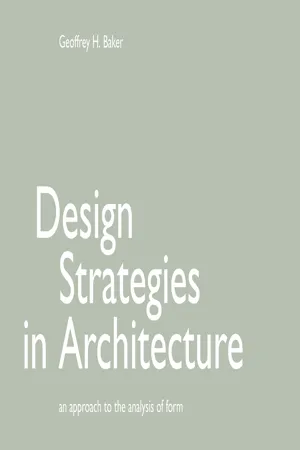
Modern architecture has become extremely complex and its study has been made more difficult by changes in fashion and a proliferation of design modes. In this book, Geoffrey Baker develops a methodology for design analysis that reveals the underlying organisation of buildings.
Part One explains the nature and role of architecture in a wide-ranging discussion extending from geometry to symbolism. Part Two demonstrates the analytical methodology by reference to cities and works by modern masters such as Aalto, Meier and Stirling.
In this second revised edition, Dr Baker has added a chapter outlining the relationship between some current perceptions of science, art and philosophy, and how these impinge on architecture. The discussion compares Futurism, Constructivism, Suprematism, High Tech, Deconstruction and the attitude of the avant-garde, with the phenomenology of Bachelard and Heiddeger.
Information
PART ONE
PRINCIPLES OF ANALYSIS
1
THE ROLE OF ARCHITECTURE
FORCES

In his study of place, Genius Loci, Towards a Phenomenology of Architecture, Christian Norberg-Schulz explains the basic act of architecture as being ‘to understand the vocation of the place.’1 He describes the need ‘to concretise the genius loci … by means of buildings which gather the properties of the place and bring them close to man.’2 Throughout the book Norberg-Schulz draws out those features of topography and landscape which give a special character to places and shows how architecture can respond by creating a meaningful environment.
In his discussion Norberg-Schulz constantly refers to man-made and natural forces as when he describes the siting of Prague as comprising ‘all the main natural forces, undulating plain, rocky hills and water,’3 explaining how the architecture in the city manages to embody this.
In the study, Norberg-Schulz first identifies the characteristics of the region, showing how the city became a nodal point where a road from Ucrania and Poland which crossed the Vitava into Germany met the road from Austria in the south to Saxony and Prussia. He describes how Prague is situated on an extended hill which rises at the curve of the river, the hill and the river being ‘opposed but complimentary forces.’4
GENIUS LOCI
Rome is seen as being at ‘the centre of a landscape which contains everything,’5 with the Piazza Navona demonstrating that the ideal equilibrium between nature and the culture has been achieved:
At Piazza Navona we are really ‘inside,’ close to the earth, close to the palpable things of everyday existence, at the same time as we feel part of a comprehensive cultural totality. No wonder it has become the popular place of Rome par excellence. The synthesis of nature is condensed and visualized in Bernini’s great fountain, where natural elements such as water and rocks are combined with human figures and religious symbols, as well as the axis mundi of the obelisk. In front of the church of S. Agnese, finally, we find another characteristic Roman element, a broad flight of stairs. In Rome, stairs are not used to create a distance between different existential realms; rather they represent the articulation of the ground itself. The great Roman stairs bring us close to the earth and increase our sense of belonging to the place.

Rome: Piazza Navona
NATURE
In an essay discussing the relationship between art and nature, art and the world, John Berger argues that ‘Nature is energy and struggle. It is what exists without any promise … as an arena, a setting, it has to be thought of as one which lends itself as much to evil as to good. Its energy is fearsomely indifferent.’1 He goes on to argue that we sense beauty because it is such a contrast to our struggle against nature.
It is within this bleak natural context that beauty is encountered, and the encounter is by its nature sudden and unpredictable. The gale blows itself out… Under the fallen boulder of an avalanche a flower grows … beauty is always an exception, always despite of. This is why it moves us.
Berger asserts that the kind of aesthetic emotion we feel before a man-made object derives from the emotion we feel before nature:
All the languages of art have been developed as an attempt to transform the instantaneous into the permanent. Art supposes that beauty is not an exception — is not despite of — but is the basis for an order.
Art is an organized response to what nature allows us to glimpse occasionally. Art sets out to transform the potential recognition into an increasing one.2
ART
In his discussion Berger relates his argument to a white wooden bird, hung by peasants in their kitchens in certain regions of Czechoslovakia, Russia and the Baltic countries. These birds somehow manage to act as ‘mediators’ between man and nature.
As Berger explains, their figurative form, that of a dove, makes a direct reference to the world of nature. Being located indoors (where birds are not usually found) renders the object symbolic. Then there is respect for the way the material, wood, has been fashioned. There is also unity and economy in the object, a richness resulting from its design. Finally there is wonder as to how the object is made. This sense of mystery, the fine craftsmanship, provoke an aesthetic ‘emotion.’ Thus does man ‘transform’ nature into a work of art.
In a discussion of the cave paintings in Spain and southern France, Dr. Jacob Bronowski suggests that these works by early man ‘act as a kind of telescope tube of the imagination; they direct the mind from what has been seen to what can be inferred or conjectured.’1
He explains how art and science are both human actions deriving from the ability to visualize the future, playing a vital part in cultural evolution, which he describes as ‘a constant growing and widening of the human imagination.’2
ART AS SYMBOL
The link between art and man’s emotions has been pursued by Susanne K. Langer, who has given her own definition of art: ‘Art is the creation of forms symbolic of human feeling.’1 She explains the importance of the term creation’ because it is the creative act that produces the work of art. Merely to produce something is not enough; to erect a house is a mechanical act which is not the same as creating a work of architecture.
Discussing the content of forms Langer argues that what matters is their import so that they become ‘logically expressive or significant forms. They are symbols for the articulation of feeling and convey the elusive and yet familiar pattern of sentience.’2 The symbolic element is of the greatest importance because Langer asserts that art is always a symbol. ‘In an articulate symbol, the symbolic import permeates the whole structure, because every articulation of that structure is an articulation of the idea it conveys.’3
Langer insists that in order to create significant form with an appropriate symbolic content an intellectual dimension is necessary. ‘Works of art are made of sensuous elements, but not all sensuous elements will do.’4 They must be capable of assemblage in the right kind of combinations; as symbols, works of art must communicate directly and immediately. ‘An articulate form must be clearly given and understood before it can convey any import,’ and ‘the congruence of the ...
Table of contents
- Cover Page
- Half Title page
- Title Page
- Dedication
- Copyright Page
- Contents
- Acknowledgements
- Preface to the Second Edition
- Foreword
- Prologue
- Part One Principles of Analysis
- Part two Analytical Studies
Trusted by 375,005 students
Access to over 1.5 million titles for a fair monthly price.
Study more efficiently using our study tools.
Frequently asked questions
Yes, you can cancel anytime from the Subscription tab in your account settings on the Perlego website. Your subscription will stay active until the end of your current billing period. Learn how to cancel your subscription
No, books cannot be downloaded as external files, such as PDFs, for use outside of Perlego. However, you can download books within the Perlego app for offline reading on mobile or tablet. Learn how to download books offline
Perlego offers two plans: Essential and Complete
- Essential is ideal for learners and professionals who enjoy exploring a wide range of subjects. Access the Essential Library with 800,000+ trusted titles and best-sellers across business, personal growth, and the humanities. Includes unlimited reading time and Standard Read Aloud voice.
- Complete: Perfect for advanced learners and researchers needing full, unrestricted access. Unlock 1.5M+ books across hundreds of subjects, including academic and specialized titles. The Complete Plan also includes advanced features like Premium Read Aloud and Research Assistant.
We are an online textbook subscription service, where you can get access to an entire online library for less than the price of a single book per month. With over 1.5 million books across 990+ topics, we’ve got you covered! Learn about our mission
Look out for the read-aloud symbol on your next book to see if you can listen to it. The read-aloud tool reads text aloud for you, highlighting the text as it is being read. You can pause it, speed it up and slow it down. Learn more about Read Aloud
Yes! You can use the Perlego app on both iOS and Android devices to read anytime, anywhere — even offline. Perfect for commutes or when you’re on the go.
Please note we cannot support devices running on iOS 13 and Android 7 or earlier. Learn more about using the app
Please note we cannot support devices running on iOS 13 and Android 7 or earlier. Learn more about using the app
Yes, you can access Design Strategies in Architecture by Geoffrey H. Baker in PDF and/or ePUB format, as well as other popular books in Architecture & Architecture General. We have over 1.5 million books available in our catalogue for you to explore.