David Nunan's dynamic learner-centered teaching style has informed and inspired countless TESOL educators around the world. In this fresh, straightforward introduction to teaching English to speakers of other languages he presents teaching techniques and procedures along with the underlying theory and principles.
Complex theories and research studies are explained in a clear and comprehensible, yet non-trivial, manner without trivializing them. Practical examples of how to develop teaching materials and tasks from sound principles provide rich illustrations of theoretical constructs. The content is presented through a lively variety of different textual genres including classroom vignettes showing language teaching in action, question and answer sessions, and opportunities to 'eavesdrop' on small group discussions among teachers and teachers in preparation. Readers get involved through engaging, interactive pedagogical features and opportunities for reflection and personal application. Each chapter follows the same format so that readers know what to expect as they work through the text. Key terms are defined in a Glossary at the end of the book. David Nunan's own reflections and commentaries throughout enrich the direct, up-close style of the text.
Trusted by 375,005 students
Access to over 1.5 million titles for a fair monthly price.
define the following key terms – curriculum, syllabus, methodology, evaluation, audiolingualism, communicative language teaching, task-based language teaching, grammar-translation, structural linguistics
describe the ‘eclectic’ method in which a teacher combines elements of two or more teaching methods or approaches
set out the essential issues underpinning the methods debate
articulate three key principles that guide your own approach to language teaching methodology
say how communicative language teaching and task-based language teaching are related
describe the three-part instructional cycle of pre-task, task, and follow-up
Introduction
The main topic of this chapter is language teaching methodology, which has to do with methods, techniques, and procedures for teaching and learning in the classroom. This will provide a framework for chapters to come on teaching listening, speaking, reading, writing, pronunciation, vocabulary, and grammar.
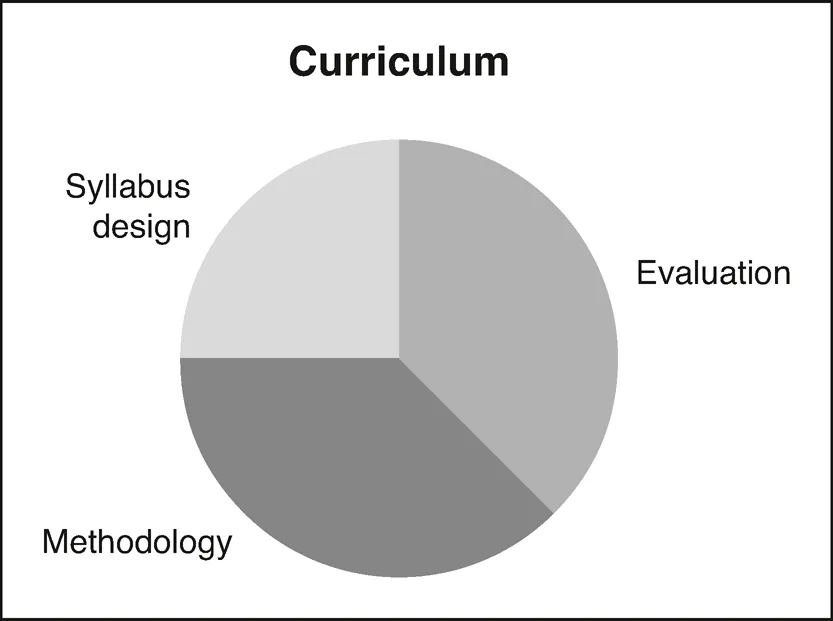
Methodology fits into the larger picture of curriculum development. There are three subcomponents to curriculum development: syllabus design, methodology, and evaluation. All of these components should be in harmony with one another: methodology should be tailored to the syllabus, and evaluation/assessment should be focused on what has been taught. (In too many educational systems, what is taught is determined by what is to be assessed.)
Figure1.1 The three components of the curriculum ‘pie'
Syllabus design focuses on content, which deals not only with what we should teach, but also the order in which the content is taught and the reasons for teaching this content to our learners.
According to Richards et al. (1987), methodology is “The study of the practices and procedures used in teaching, and the principles and beliefs that underlie them.” Unlike syllabus design, which focuses on content, methodology focuses on classroom techniques and procedures and principles for sequencing these.
Assessment is concerned with how well our learners have done, while evaluation is much broader and is concerned with how well our program or course has served the learners. The relationship between evaluation and assessment is discussed, in some detail, in chapter 12.
Vignette
As you read the following vignette, try to picture the classroom in your imagination.
The teacher stands in front of the class. She is a young Canadian woman who has been in Tokyo for almost a year. Although she is relatively inexperienced, she has an air of confidence. There are twelve students in the class. They are all young adults who are taking an evening EFL (English as a Foreign Language) class. This is the third class of the semester, and the students and the teacher are beginning to get used to each other. Her students have a pretty good idea of what to expect as the teacher signals that the class is about to begin.
“All right, class, time to get started” she says. “Last class we learned the questions and answers for talking about things we own. ‘Is this your pen? Yes, it is. No it isn’t. Are these your books? Yes, they are. No, they aren’t.’ OK? So, let’s see if you remember how to do this. Is this your pen? Repeat.”
The class intones, “Is this your pen?”
“Pencil,” says the teacher.
“Is this your pencil?”
“Books.”
Most students say, “Are these your books?” However, the teacher hears several of them say, “Is this your books?”
She claps her hands and says loudly “Are these your books? Are these your books? Are these your books? Again! … books.”
“Are these your books?” the students say in unison.
“Good! Great! … those.”
“Are those your books?” say the students.
“Excellent! … her.”
“Are those her book?”
“Book?” queries the teacher.
“Books, books,” say several of the students emphasizing the ‘s’ on the end of the verb.
“Your”
“Are those your books?”
The teacher beams. “Perfect!” she says. The students smile shyly.
“Now,” says the teacher, “Now we’ll see how well you can really use this language.” She passes around a brown velvet bag and instructs the students to put a small, personal object into the bag – a pen, a ring, a pair of earrings. Then, she instructs the students to stand up. She passes the bag around a second time, and tells the students to remove an object. “Make sure it isn’t the one that you put in!” she says, and laughs.
When each student has an object or objects that is not his or her own, she makes them stand up and find the owner of the object by asking “Is this your …?” or “Are these your …?” She repeats the procedure several times, circulating with the students, correcting pronunciation and grammar, until she is satisfied that they are fluent and confident in using the structure.
REFLECT
What 3 things did you notice in the vignette? Write them down in note form.
Write down 3–5 questions you would like to ask the teacher about the lesson.
My Observations on the Vignette
The teacher begins the lesson with a classic audiolingual drill. This is the way that I was trained to teach languages back in the early 1970s. Despite her relative inexperience, the young teacher has confidence because the rigid set of procedures laid out in the audiolingual methodology gives her control of the classroom.
The teacher is active. She encourages the students with positive feedback, but also gives gentle correction when they make mistakes. She praises the students without being patronizing. This appears to create a positive classroom environment.
In the second phase of the lesson, the teacher uses a technique from communicative language teaching (CLT)/task-based language teaching (TBLT). In my 2004 book on task-based language teaching I called this kind of classroom procedure a “communicative activity” (Nunan, 2004). It is partly a traditional grammar exercise (the students are practicing the grammar structure for the lesson “Is this your/Are these your …?), but it has an aspect of genuine communication. The student asking the question doesn’t know the answer prior to hearing the response from the person who is answering it.
Issue in Focus: The ‘Methods' Debate
For much of its history, the language teaching profession has been obsessed with the search for the one ‘best’ method of teaching a second or foreign language. This search was based on the belief that, ultimately, there must be a method that would work better than any other for learners everywhere regardless of biographical characteristics such as age, the language they are learning, whether they are learning English as a second language or as a foreign language, and so on. If such a method could be found, it was argued, the language teaching ‘problem’ would be solved once and for all.
Grammar-Translation
At different historical periods, the profession has favored one particular method over competing methods. The method that held greatest sway is grammar-translation. In fact, this method is still popular in many parts of the world. Focusing on written rather than spoken language, the method, as the name suggests, focuses on the explicit teaching of grammar rules. Learners also spend much time translating from the first to the second language and vice versa. For obvious reasons, the method could only be used in classrooms where the learners shared a common language.
Grammar-translation came in for severe criticism during World War II. The criticism then intensified during the Cold War. The crux of the criticism was that students who had been taught a language through the grammar-translation method knew a great deal about the target language, but couldn’t actually use it to communicate. This was particularly true of the spoken language, which is not surprising as learners often had virtually no exposure to the spoken language. This was profoundly unsatisfactory to government bodies that needed soldiers, diplomats, and others who could learn to speak the target language, and who could develop their skills rapidly rather than over the course of years. (I studied Latin in junior high school, and can recall spending hours in the classroom and at home, doing translation exercises with a grammar book and a bilingual dictionary at my elbow.)
Audiolingualism
In his introductory book on language curriculum development, Richards describes audiolingualism as the most popular of all the language teaching methods. In the following quote, he points out that methods such as audiolingualism are underpinned by a theory of language (in this case structural linguistics) and a theory of learning (behaviorism).
In the United States, in the 1960s, language teaching was under the sway of a powerful method – the Audiolingual Method. Stern (1974: 63) describes the period from 1958 to 1966 as the “Golden Age of Audiolingualism.” This drew on the work of American Structural Linguistics, which provided the basis for a grammatical syllabus and a teaching approach that drew heavily on the theory of behaviorism. Language learning was thought to depend on habits that could be established by repetition. The linguist Bloomfield (1942: 12) had earlier stated a principle that became a core tenet of audiolingualism_ “Language learning is overlearning: anything less is of no use.” Teaching techniques made use of repetition of dialogues and pattern practice as a basis for automatization followed by exercises that involved transferring learned patterns to new situations.
(Richards, 2001: 25–26)
In this extract, Richards describes the origins of audiolingualism and summarizes its key principles. Although behaviorism, the psychological theory on which it is based, was largely discredited many years ago, some of the techniques spawned by the method such as various forms of drilling remain popular today. At the beginning stages of learning another language, and also when teaching beginners, I often use some form of drilling, although I always give the drill a communicative cast.
In the 1970s, audiolingualism came in for some severe criticism. Behaviorist psychology was under attack, as was structural linguistics because they did not adequately account for key aspects of language and language learning. This period also coincided with the emergence of ‘designer’ methods and the rise of communicative language teaching. I used the term ‘designer’ methods in my 1991 book on language teaching methodology (Nunan, 1991) to capture the essence of a range of methods, such as Suggestopedia and the Silent Way, that appeared in the 1970s and 1980s. These methods provided a clear set of procedures for what teachers should do in the classroom and, like audiolingualism, were based on beliefs about the nature of language and the language learning process.
Communicative Language Teaching
Communicative language teaching was less a method than a broad philosophical approach to language, viewing it not so much as a system of rules but as a tool for communication. The methodological ‘realization’ of CLT is task-based language teaching (Nunan, 2004, 2014). You will hear a great deal more about CLT in this book, as it remains a key perspective on language teaching. Patsy Duff provides the following introduction to the approach:
Communicative language teaching (CLT) is an approach to language teaching that emphasizes learning a language first and foremost for the purpose of communicating with others. Communication includes finding out about what people did on the weekend … or on their last vacation and learning about classmates’ interests, activities, preferences and opinions and conveying one’s own. It may also involve explaining daily routines t...
Table of contents
Cover Page
Half-Title Page
Title Page
Copyright Page
Table of Contents
Introduction
1 Language Teaching Methodology
2 Learner-Centered Language Teaching
3 Listening
4 Speaking
5 Reading
6 Writing
7 Pronunciation
8 Vocabulary
9 Grammar
10 Discourse
11 Learning Styles and Strategies
12 Assessment
Glossary
Index
Frequently asked questions
Yes, you can cancel anytime from the Subscription tab in your account settings on the Perlego website. Your subscription will stay active until the end of your current billing period. Learn how to cancel your subscription
No, books cannot be downloaded as external files, such as PDFs, for use outside of Perlego. However, you can download books within the Perlego app for offline reading on mobile or tablet. Learn how to download books offline
Perlego offers two plans: Essential and Complete
Essential is ideal for learners and professionals who enjoy exploring a wide range of subjects. Access the Essential Library with 800,000+ trusted titles and best-sellers across business, personal growth, and the humanities. Includes unlimited reading time and Standard Read Aloud voice.
Complete: Perfect for advanced learners and researchers needing full, unrestricted access. Unlock 1.5M+ books across hundreds of subjects, including academic and specialized titles. The Complete Plan also includes advanced features like Premium Read Aloud and Research Assistant.
Both plans are available with monthly, semester, or annual billing cycles.
We are an online textbook subscription service, where you can get access to an entire online library for less than the price of a single book per month. With over 1.5 million books across 990+ topics, we’ve got you covered! Learn about our mission
Look out for the read-aloud symbol on your next book to see if you can listen to it. The read-aloud tool reads text aloud for you, highlighting the text as it is being read. You can pause it, speed it up and slow it down. Learn more about Read Aloud
Yes! You can use the Perlego app on both iOS and Android devices to read anytime, anywhere — even offline. Perfect for commutes or when you’re on the go. Please note we cannot support devices running on iOS 13 and Android 7 or earlier. Learn more about using the app
Yes, you can access Teaching English to Speakers of Other Languages by David Nunan in PDF and/or ePUB format, as well as other popular books in Languages & Linguistics & Education General. We have over 1.5 million books available in our catalogue for you to explore.